The main difference between the .277 Fury and the 6.8 Western is their primary design purpose and case architecture; the .277 Fury is a military derived cartridge that utilizes a revolutionary three piece hybrid bi metal case to withstand 80,000 psi of pressure and drive standard weight bullets at extreme velocities from short tactical barrels, whereas the 6.8 Western is a dedicated long range hunting cartridge utilizing a standard brass case and a fast twist barrel to stabilize ultra heavy, highly aerodynamic bullets for ethical harvests at extended distances.
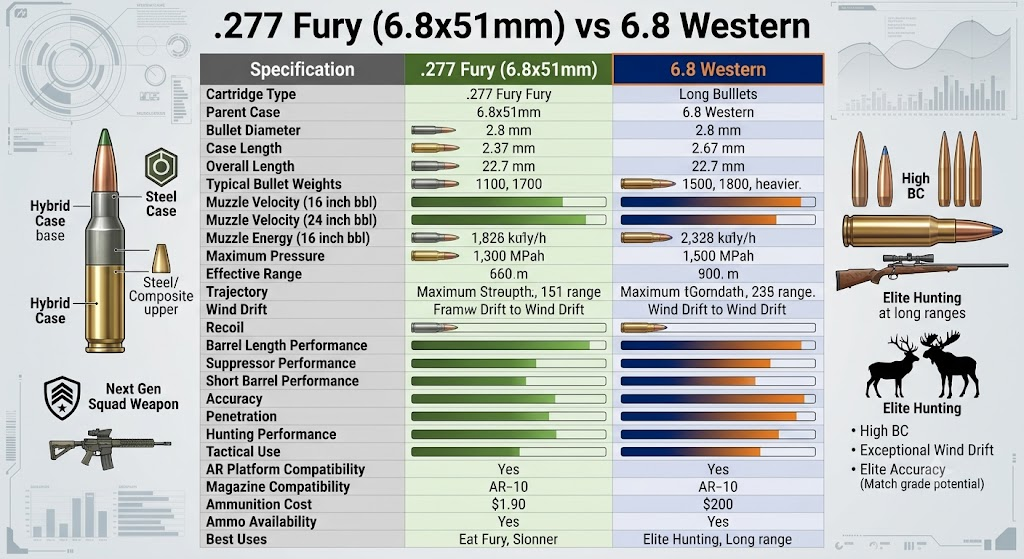
.277 Fury vs 6.8 Western Comparison Table
To accurately compare these two modern .277 caliber cartridges, we must examine their physical dimensions, pressure limits, and baseline ballistic performance. The data below represents premium factory loads, comparing the SIG Sauer 135 grain Elite Hybrid hunting load for the .277 Fury against the Winchester 165 grain AccuBond Long Range load for the 6.8 Western.
| Specification | .277 Fury (6.8x51mm) | 6.8 Western |
| Cartridge Type | Short Action Rifle | Short Action Rifle |
| Parent Case | .308 Winchester | .270 WSM |
| Bullet Diameter | .277 inches (7.0 mm) | .277 inches (7.0 mm) |
| Case Length | 2.015 inches | 2.020 inches |
| Overall Length | 2.750 inches | 2.955 inches |
| Typical Bullet Weights | 135 grains to 150 grains | 165 grains to 175 grains |
| Muzzle Velocity (16 inch bbl) | 3,000 fps (135gr Hybrid Case) | 2,700 fps (165gr) |
| Muzzle Velocity (24 inch bbl) | 3,150+ fps (135gr Hybrid Case) | 2,970 fps (165gr) |
| Muzzle Energy (16 inch bbl) | 2,698 foot pounds | 2,670 foot pounds |
| Maximum Pressure | 80,000 psi (Hybrid Case) | 65,000 psi (SAAMI) |
| Effective Range | 1,000+ yards | 1,000+ yards |
| Trajectory | Extremely Flat | Extremely Flat |
| Wind Drift | Low | Exceptionally Low (High BC) |
| Recoil | Moderate to Heavy | Heavy |
| Barrel Length Performance | Excels in 16 inch barrels | Excels in 22 to 24 inch barrels |
| Suppressor Performance | Good | Good |
| Short Barrel Performance | Outstanding | Poor (Significant velocity loss) |
| Accuracy | High | Elite (Match grade potential) |
| Penetration | Deep | Extreme (High sectional density) |
| Hunting Performance | Excellent (Deer, Elk at medium ranges) | Elite (Elk, Moose at extended ranges) |
| Tactical Use | Next Generation Squad Weapon (US Army) | None |
| AR Platform Compatibility | Yes (AR10 and SR25 Pattern) | No (Case is too fat for standard magazines) |
| Magazine Compatibility | Standard .308 Win Box Magazines | Short Action Magnum Box Magazines |
| Ammunition Cost | Very High (Hybrid cases) | High |
| Ammo Availability | Specialty or Online | Moderate |
| Best Uses | Short barrel tactical rifles, military applications | Open country big game hunting |
Understanding the Engineering
The technical differences between these cartridges represent two entirely different solutions to achieving long range performance.
The .277 Fury (adopted by the United States Army as the 6.8x51mm) was developed by SIG Sauer to defeat modern body armor at extended ranges without increasing the size of the infantryman’s rifle. To achieve this, SIG Sauer designed a revolutionary three piece cartridge case featuring a stainless steel base locked to a brass body via an aluminum washer. This hybrid design safely contains a staggering 80,000 psi of chamber pressure, allowing the .277 Fury to achieve magnum velocities out of a highly maneuverable 16 inch combat barrel. (Note: SIG Sauer also produces standard solid brass .277 Fury ammunition for practice, which operates at standard pressures and yields much lower velocities).
The 6.8 Western was introduced by Browning and Winchester specifically for the hunting and precision shooting markets. Rather than increasing chamber pressure to dangerous levels, they utilized a standard brass case based on a shortened .270 Winchester Short Magnum. They moved the shoulder back to accommodate incredibly long, aerodynamic, heavy bullets (up to 175 grains) while still fitting inside a standard short action magazine. To stabilize these massive bullets, 6.8 Western rifles require a very fast 1:7.5 rifling twist rate.
Velocity Comparison
Velocity dictates the trajectory flatness and the kinetic energy delivered to the target.
The .277 Fury achieves its blistering speed through sheer pressure. When loaded in its signature hybrid case, it pushes a 135 grain bullet to 3,000 feet per second from a short 16 inch barrel. If fired from a full length 24 inch barrel, it easily exceeds 3,150 feet per second.
The 6.8 Western takes a traditional approach. Operating at a standard magnum pressure of 65,000 psi, it relies on a large powder column and a 24 inch barrel to push massive 165 grain bullets just shy of 3,000 feet per second.
Muzzle Energy Comparison
Muzzle energy measures the absolute kinetic force transferred to a target upon impact.
Because the .277 Fury drives its lighter bullet at extreme velocities, it generates roughly 2,698 foot pounds of energy from a 16 inch barrel. The 6.8 Western, relying on heavy mass, generates approximately 3,226 foot pounds of energy from a 24 inch barrel.
While the .277 Fury is highly impressive for a short barreled tactical rifle, the 6.8 Western is a true magnum class hunting cartridge that delivers significantly more raw kinetic force for taking down heavy boned animals like elk and moose.
Trajectory Comparison
A flat trajectory minimizes the margin of error when estimating range for a hunter in the field.
Because the .277 Fury launches its bullet at an incredibly high initial velocity, it shoots exceptionally flat inside the first 400 yards. However, the 6.8 Western utilizes much heavier bullets with significantly higher Ballistic Coefficients (BC). As the distance stretches past 500 yards, the superior aerodynamics of the 6.8 Western allow it to retain its velocity much more efficiently, resulting in less bullet drop at extreme ranges.
Wind Drift Comparison
Wind deflection is mitigated by a bullet’s velocity and its aerodynamic profile.
This is the exact category the 6.8 Western was engineered to dominate. A 165 grain 6.8 Western bullet features a phenomenally high ballistic coefficient. Once the bullets pass the 500 yard mark, the heavier 6.8 Western projectile resists crosswinds vastly better than the lighter 135 grain or 150 grain bullets fired from the .277 Fury. For long range hunters facing unpredictable mountain winds, the 6.8 Western is drastically more forgiving.
Recoil Comparison
Recoil dictates a shooter’s ability to spot their own impacts through a rifle scope and fire rapid follow up shots.
The .277 Fury operates at 80,000 psi and generates a very sharp, snappy recoil impulse. When fired from a lightweight AR10 style combat rifle, it is noticeably more violent than a standard .308 Winchester.
The 6.8 Western generates heavy recoil simply because it pushes a massive 165 grain to 175 grain bullet. In a standard weight bolt action hunting rifle, it produces a stout, heavy push that is comparable to a .300 Winchester Magnum. Most shooters highly recommend a muzzle brake or suppressor for the 6.8 Western to mitigate shooter fatigue.
Penetration Comparison
Deep penetration is required to punch through the heavy shoulder bones of massive game animals.
Sectional Density measures a bullet’s weight relative to its diameter. A higher sectional density allows the bullet to penetrate deeper. The exceptionally long 165 grain and 175 grain bullets used in the 6.8 Western possess massive sectional densities. They will reliably punch through both shoulders of an elk and exit the other side. The lighter standard weight bullets of the .277 Fury will penetrate beautifully on deer sized game, but they cannot match the deep plowing force of the heavier 6.8 Western bullets.
Short Barrel Performance Comparison
Modern tactical and hunting applications frequently require highly maneuverable short barreled rifles.
The .277 Fury is the absolute champion of this category. It was designed from its inception to maximize velocity in a 16 inch combat barrel for the US Army. It achieves complete powder combustion quickly and delivers magnum level performance in a highly compact package.
The 6.8 Western requires a minimum of 22 to 24 inches to burn its large column of slow burning magnum rifle powder efficiently. If you chop a 6.8 Western barrel down to 16 inches, a massive amount of unburnt powder blasts out of the muzzle, resulting in severe velocity loss, a blinding fireball, and a deafening concussive blast.
Action Length and Rifle Compatibility
This is a massive logistical difference for civilian shooters.
The .277 Fury shares the exact same case head dimensions and overall length as the .308 Winchester. This means it fits perfectly into standard AR10 magazines and utilizes standard short action bolt faces. You can easily build a semi automatic .277 Fury rifle on existing SR25 pattern platforms.
The 6.8 Western is based on the Winchester Short Magnum family. It features a very fat case diameter that requires a specialized magnum bolt face and specialized short action magnum box magazines. It is almost exclusively chambered in bolt action hunting rifles.
Ammo Cost and Availability
Both cartridges are considered modern specialty rounds, and ammunition is priced accordingly.
The .277 Fury is uniquely expensive. The standard solid brass practice ammunition is moderately priced, but the three piece hybrid case ammunition (which is required to achieve the advertised 80,000 psi velocity) is incredibly complex to manufacture and often costs several dollars per round.
The 6.8 Western is supported heavily by Browning and Winchester. While it is expensive premium hunting ammunition, it is generally easier to find on the shelves of large sporting goods retailers than the highly specialized .277 Fury hybrid loads.
Pros and Cons
.277 Fury
Pros
- Hybrid case safely contains an unprecedented 80,000 psi of pressure.
- Delivers magnum velocity from short 16 inch tactical barrels.
- Fits perfectly into standard AR10 and .308 Winchester magazines.
- Extremely flat trajectory inside 400 yards.
- Officially adopted by the US Military, ensuring long term support.
Cons
- Hybrid ammunition is exceptionally expensive and difficult to source.
- Generates very sharp, snappy recoil in lightweight semi automatic rifles.
- Lacks the twist rate to stabilize ultra heavy, high BC bullets.
6.8 Western
Pros
- Fast twist barrels perfectly stabilize heavy 165gr and 175gr bullets.
- Phenomenally high ballistic coefficients defeat wind drift at extreme ranges.
- Elite stopping power and deep penetration on large game animals.
- Fits perfectly into short action bolt rifles to save weight.
- Ammunition is widely supported by Browning and Winchester.
Cons
- Requires a specialized magnum bolt face and magnum magazines.
- Performs terribly in barrels shorter than 22 inches.
- Generates heavy recoil comparable to traditional long action magnums.
Final Verdict
Choosing between the .277 Fury and the 6.8 Western comes down to deciding between military tactical efficiency and dedicated hunting precision.
- For the Tactical Enthusiast: Choose the .277 Fury. The ability to achieve magnum velocities from a 16 inch AR10 platform utilizing the exact same ammunition technology adopted by the US Army makes it an incredibly appealing and capable combat rifle platform.
- For the Elk and Moose Hunter: Choose the 6.8 Western. The heavy 165 grain and 175 grain bullets provide the deep penetration and kinetic energy required to ethically harvest massive animals, which the lighter .277 Fury bullets struggle to guarantee.
- For Extreme Long Range Precision: Choose the 6.8 Western. The superior ballistic coefficients of the long, heavy bullets resist wind deflection far better at 1,000 yards, ensuring a higher hit probability in unpredictable environments.
- For Suppressed Short Barreled Rifles: Choose the .277 Fury. It burns its powder efficiently in short barrels without producing the massive concussive blast and velocity loss associated with cutting down traditional magnum hunting cartridges.