The main difference in the 14.5x114mm Vs 50 Bmg comparison is that the American round is a heavy military anti-materiel cartridge, whereas the Soviet round is a drastically larger anti-aircraft and anti-armor behemoth that delivers nearly double the kinetic energy. While the American round is widely available in man-portable sniper platforms, the Soviet round is so massively powerful that it is primarily restricted to crew-served heavy machine guns and massive hydraulic-dampened anti-tank rifles.
14.5x114mm Vs 50 Bmg Comparison
| Feature | 14.5x114mm | 50 BMG (12.7x99mm NATO) |
| Bullet Diameter | 0.587 inches (14.88 mm) | 0.510 inches (12.95 mm) |
| Typical Bullet Weight | 900 gr to 1,000 gr (typically 994 gr) | 650 gr to 800 gr (typically 660 or 750 gr) |
| Muzzle Velocity | 3,200 to 3,350 fps | 2,750 to 3,000 fps |
| Muzzle Energy | ~23,000 to 24,500+ ft-lbs | ~12,000 to 15,000+ ft-lbs |
| Momentum | ~450 to ~470 lb-fps | ~260 to ~290 lb-fps |
| Case Length | 4.49 inches (114 mm) | 3.91 inches (99 mm) |
| Case Capacity | ~655 grains of water | ~290 grains of water |
| Ballistic Coefficient | Very High | High to Very High |
| Penetration | Extreme (Defeats light tanks / APCs) | Deep (Defeats light armored vehicles) |
| Expansion | N/A (Armor-Piercing Incendiary) | N/A (Armor-Piercing / Solid) |
| Trajectory | Ultra-flat out to 2,000+ yards | Flat out to 1,500+ yards |
| Recoil | Unmanageable without hydraulic dampening | Brutal (~55 to 70+ ft-lbs in a heavy rifle) |
| Effective Range | 2,000 to 3,000+ yards | 1,500 to 2,500+ yards |
| Ammo Availability | Extremely Low (Strictly military/surplus) | Moderate to High (Global commercial/military) |
| Ammo Cost | Extremely Expensive / Unavailable | Expensive ($3.00 to $7.00+/rd) |
| Best Use | Anti-aircraft, anti-armor, heavy machine guns | Anti-materiel sniper, heavy machine guns |
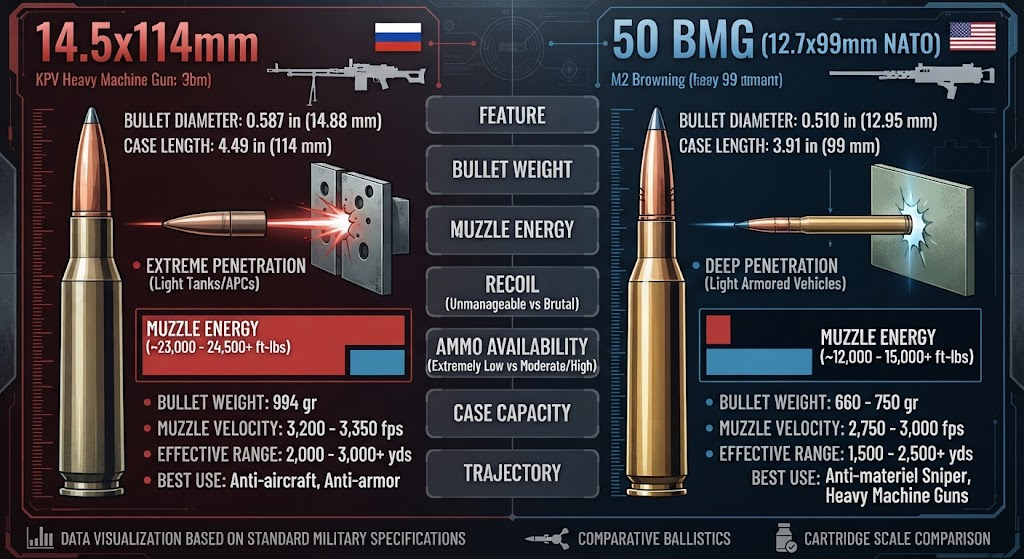
The table above illustrates the sheer disparity in scale. While the .50 BMG is considered the absolute limit of shoulder-fired power in the Western world, the 14.5x114mm dwarfs it completely. Developed by the Soviet Union in 1939 for the PTRD and PTRS anti-tank rifles, the 14.5mm case holds more than double the powder capacity of the .50 BMG (655 grains of water volume vs 290). This massive engine room allows it to push a projectile that is significantly wider and heavier than the .50 BMG at velocities exceeding 3,200 feet per second.
14.5x114mm Vs 50 Bmg Ballistics
To objectively evaluate the ballistic capabilities, we must examine standard military loads, as neither cartridge is commonly used for standard civilian hunting.
- Load A (14.5x114mm Soviet Military): B32 Armor-Piercing Incendiary (API). Bullet weight is 994 grains. Muzzle velocity is 3,280 feet per second. Muzzle energy is 23,755 foot-pounds.
- Load B (14.5x114mm High Velocity): BS-41 Armor-Piercing Tungsten Core. Bullet weight is 980 grains. Muzzle velocity is 3,350 feet per second. Muzzle energy is 24,420 foot-pounds.
- Load C (50 BMG Military Standard): M33 Ball 660-grain FMJ. Muzzle velocity is 2,910 feet per second. Muzzle energy is 12,427 foot-pounds.
- Load D (50 BMG Match Grade): Hornady 750-grain A-MAX Match. Muzzle velocity is 2,820 feet per second. Muzzle energy is 13,248 foot-pounds.
14.5x114mm Vs 50 Bmg Velocity
Despite firing a projectile that is roughly 300 grains heavier than a standard .50 BMG bullet, the 14.5x114mm is substantially faster.
The Soviet 14.5mm routinely achieves muzzle velocities of 3,200 to 3,350 feet per second out of heavy machine gun or anti-tank rifle barrels. The massive 114mm-long brass case simply holds so much powder that it can effortlessly accelerate nearly 1,000 grains of steel and lead to hyper-velocities. The .50 BMG is fast for its size, generally hovering around 2,800 to 2,900 fps, but it cannot match the sheer speed of the larger Soviet cartridge.
14.5x114mm Vs 50 Bmg Muzzle Energy
Muzzle energy represents the raw kinetic work capacity of a projectile, and the 14.5x114mm operates in a completely different classification of warfare.
The .50 BMG generates an awe-inspiring 12,000 to 15,000 foot-pounds of muzzle energy, enough to obliterate engine blocks and concrete bunkers.
The 14.5x114mm generates roughly 23,000 to 24,500+ foot-pounds of muzzle energy. It delivers nearly double the destructive kinetic payload of the .50 BMG. This extreme energy allows the 14.5mm to punch through thick armor plating that would successfully stop a .50 BMG dead in its tracks.
14.5x114mm Vs 50 Bmg Momentum
Momentum calculates mass in motion, dictating a projectile’s ability to drive through heavy structural barriers, sloped armor, and thick vehicle plating.
Because momentum relies equally on bullet mass and speed, the 14.5x114mm crushes the .50 BMG. A heavy 750-grain .50 BMG bullet traveling at 2,820 fps yields approximately 302 pound-feet per second of linear momentum.
A 994-grain 14.5mm bullet traveling at 3,280 fps yields an astonishing 465 pound-feet per second of linear momentum. The sheer driving mass of the Soviet round ensures it will not deflect off light armor.
14.5x114mm Vs 50 Bmg Trajectory
Both cartridges shoot with incredibly flat trajectories out to 1,500 yards. However, because the 14.5x114mm was primarily designed for the ZPU series of anti-aircraft guns to shoot down fast-moving fighter planes and helicopters, its extreme velocity ensures it covers distance faster and drops significantly less at 2,000 yards than standard military .50 BMG ball ammunition.
14.5x114mm Vs 50 Bmg Recoil
Recoil management defines the practical limitations of these weapon systems.
The .50 BMG produces brutal recoil (roughly 55 to 70 ft-lbs), but a trained shooter can manage it comfortably from a 30- to 35-pound shoulder-fired sniper rifle equipped with a massive muzzle brake (like the Barrett M82).
The 14.5x114mm produces recoil so violent that it cannot be fired from standard solid-stock rifles. World War II anti-tank rifles (like the PTRD) were notorious for injuring shooters’ shoulders. Modern sniper rifles chambered in 14.5mm (such as the South African Denel NTW-14.5) weigh nearly 65 pounds and must utilize complex hydraulic buffering systems that physically allow the barrel to slide backward into the chassis to absorb the catastrophic recoil impulse.
14.5x114mm Vs 50 Bmg Penetration
When evaluating anti-materiel performance, the 14.5x114mm is superior.
At 500 meters, a standard .50 BMG armor-piercing round will penetrate roughly 19mm (0.75 inches) of hardened steel armor.
At the same 500-meter distance, the 14.5x114mm BS-41 tungsten-core armor-piercing round will penetrate up to 32mm (1.25 inches) of sloped steel armor. This allows the 14.5mm to reliably defeat modern armored personnel carriers (APCs) and infantry fighting vehicles (IFVs) that are specifically designed to withstand .50 BMG fire.
14.5x114mm Vs 50 Bmg Self Defense
Neither cartridge is remotely suitable for civilian self-defense, home defense, or concealed carry. Both are extreme military calibers capable of flying for miles and punching straight through residential structures, commercial buildings, and armored vehicles.
Which Has More Stopping Power: 14.5x114mm Vs 50 Bmg?
Against vehicles, aircraft, and hardened bunkers, the 14.5x114mm possesses vastly superior anti-materiel stopping power. It delivers double the energy and penetrates significantly thicker armor than the .50 BMG.
Which Is More Powerful: 14.5x114mm Vs 50 Bmg?
Based on raw kinetic energy, mass, and velocity, the 14.5x114mm is drastically more powerful, generating nearly 24,000 foot-pounds of muzzle energy compared to the .50 BMG’s 12,000 to 15,000 foot-pounds.
14.5x114mm Pros And Cons
Pros
- Monstrous anti-materiel power; generates over 23,000 ft-lbs of kinetic energy
- Penetrates armor plating that successfully defeats .50-caliber weapons
- Hyper-velocities (3,300+ fps) provide incredibly flat trajectories at anti-aircraft distances
- Massive payload capacity allows for highly destructive incendiary and explosive projectiles
Cons
- Recoil is physically unmanageable in standard shoulder-fired rifle platforms
- Weapon systems are extraordinarily heavy, crew-served, and difficult to transport
- Ammunition is strictly military-grade and virtually impossible for civilians to source
50 Bmg Pros And Cons
Pros
- The undisputed Western standard for anti-materiel and extreme long-range sniper use
- Can be fired safely from man-portable, shoulder-fired sniper rifles (30 to 35 lbs)
- Widespread military surplus and commercial match ammunition availability
- Legendary combat track record spanning over a century of global conflicts
Cons
- Defeated by modern up-armored APCs and IFVs that are rated to withstand 12.7mm fire
- Lacks the raw kinetic payload and penetration depth of 14.5mm and 20mm cannons
Final Comparison
| Category | Winner | Reason |
| Velocity | 14.5x114mm | Massive powder capacity drives heavier bullets 300+ fps faster |
| Muzzle Energy | 14.5x114mm | Generates nearly double the kinetic energy (24,000 vs 13,000 ft-lbs) |
| Momentum | 14.5x114mm | 1,000-grain bullets traveling at hyper-velocities carry massive driving mass |
| Penetration | 14.5x114mm | Tungsten cores defeat 32mm of steel armor, thoroughly outclassing the .50 BMG |
| Expansion | Tie | Neither is designed to expand; both rely on incendiary or armor-piercing payloads |
| Trajectory | 14.5x114mm | Higher initial velocity yields a flatter curve at extreme distances |
| Recoil Control | 50 BMG | Can actually be shoulder-fired by a lone sniper; 14.5mm requires hydraulic dampening |
| Effective Range | 14.5x114mm | Heavier mass and extreme speed carry lethal energy thousands of yards further |
| Self Defense | Neither | Both are extreme military calibers |
| Ammo Cost | 50 BMG | Civilian commercial production makes the .50 BMG accessible to buy |
| Ammo Availability | 50 BMG | Ubiquitous global commercial and surplus availability |
| Overall Performance | Depends on Role | 50 BMG for man-portable sniper use; 14.5x114mm for ultimate anti-armor destruction |
14.5x114mm Vs 50 Bmg: Which Should You Choose?
Selecting between these two titans is not a practical choice for civilians, but rather a study in military doctrine.
Choose the 50 BMG if you are an extreme long-range shooter or a military sniper requiring a man-portable weapon system. It is the absolute limit of what a single human being can carry, deploy, and fire from the shoulder without sustaining injury. It remains the global gold standard for anti-materiel sniper operations.
Choose the 14.5x114mm if the objective is destroying armored vehicles or low-flying aircraft. It is a crew-served, heavy machine gun cartridge that bridges the gap between small arms and autocannons, delivering double the power of the .50 BMG to defeat armor that the American round simply cannot breach.
FAQs
Is 14.5x114mm more powerful than 50 BMG?
Yes, it is significantly more powerful. The 14.5x114mm generates nearly 24,000 foot-pounds of kinetic energy, whereas the 50 BMG generates roughly 12,000 to 15,000 foot-pounds.
Can a person shoulder-fire a 14.5x114mm rifle?
It is extremely difficult and punishing. While World War II anti-tank rifles like the PTRD were shoulder-fired, they caused severe shooter fatigue and bruising. Modern man-portable 14.5mm rifles (like the Denel NTW) weigh over 60 pounds and use complex hydraulic shock absorbers to make firing survivable.
Which has more penetration?
The 14.5x114mm penetrates significantly deeper. Armed with a tungsten-core bullet, it can pierce up to 32mm of sloped steel armor at 500 meters, effectively defeating light tanks and modern armored personnel carriers.
Why does the 14.5x114mm exist?
The Soviet Union developed it prior to WWII specifically to destroy German light tanks. After tank armor grew too thick for rifles, the cartridge was repurposed into heavy anti-aircraft machine guns (ZPU series) and vehicle-mounted weapons (KPV) where its massive power continues to excel today.
Can you buy a 14.5x114mm rifle as a civilian?
In the United States, any firearm with a bore diameter over 0.50 inches is generally classified as a Destructive Device by the ATF. While legally obtainable with rigorous federal paperwork, tax stamps, and approvals, rifles and ammunition in this caliber are practically non-existent on the civilian commercial market.
Which should you choose?
For civilian extreme long-range shooting, the 50 BMG is the only practical choice due to rifle availability, manageable recoil, and commercial ammunition supplies.