The main difference between 50 cal and 9mm is their physical scale and intended purpose; the 50 cal (specifically .50 BMG) is a massive rifle and heavy machine gun cartridge designed to destroy light armor and vehicles at extreme distances, while the 9mm (9mm Luger) is a compact handgun cartridge built for personal defense and close-quarters engagements. The 50 cal delivers over 10,000 foot-pounds of muzzle energy, making it completely incompatible and incomparable in function to the small, low-recoiling 9mm round.
50 cal vs 9mm: Main Difference
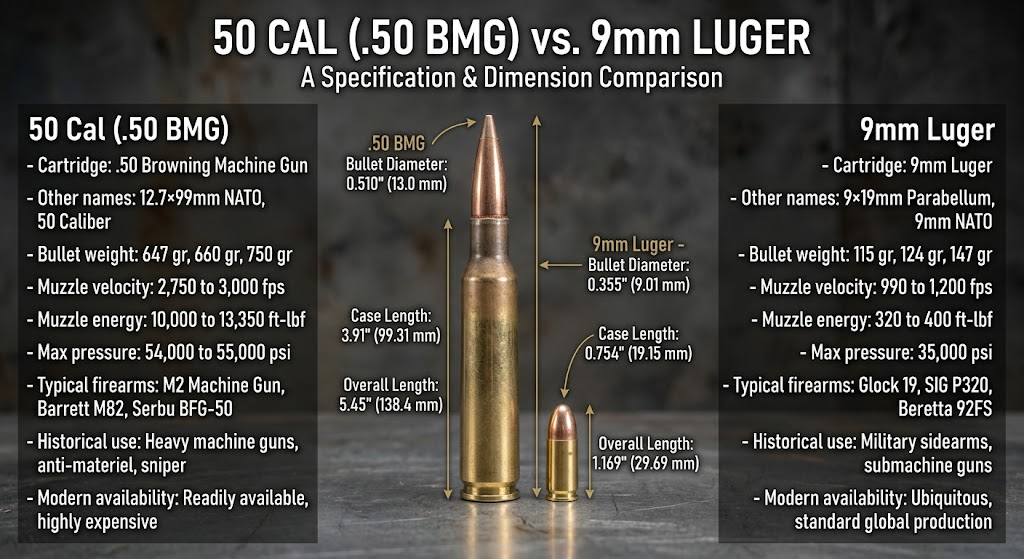
| Feature | 50 Cal (.50 BMG) | 9mm (9mm Luger) |
| Cartridge name | .50 Browning Machine Gun (.50 BMG) | 9mm Luger |
| Other names | 12.7×99mm NATO, 50 Caliber | 9×19mm Parabellum, 9mm NATO |
| Bullet diameter | 0.510 in (13.0 mm) | 0.355 in (9.01 mm) |
| Case length | 3.91 in (99.31 mm) | 0.754 in (19.15 mm) |
| Overall cartridge length | 5.45 in (138.4 mm) | 1.169 in (29.69 mm) |
| Typical bullet weights | 647 gr, 660 gr, 750 gr | 115 gr, 124 gr, 147 gr |
| Typical muzzle velocity | 2,750 to 3,000 fps | 990 to 1,200 fps |
| Typical muzzle energy | 10,000 to 13,350 ft-lbf | 320 to 400 ft-lbf |
| Maximum pressure | 54,000 to 55,000 psi (SAAMI/CIP) | 35,000 psi (SAAMI standard) |
| Typical firearms | M2 Machine Gun, Barrett M82, Serbu BFG-50 | Glock 19, SIG P320, Beretta 92FS |
| Historical use | Heavy machine guns, anti-materiel, military sniper | Military sidearms, submachine guns |
| Modern availability | Readily available but highly expensive | Ubiquitous, standard global production |
Winner: 9mm — While the 50 cal offers devastating anti-materiel power, the 9mm is the ultimate practical choice for personal defense, everyday carry, and affordable high-volume training.
What Is 50 Cal?
The term “50 cal” most commonly refers to the .50 BMG (Browning Machine Gun), a heavy centerfire cartridge developed by John Browning in the late 1910s. It is also known globally by its metric designation, 12.7×99mm NATO. It was originally engineered for anti-aircraft and anti-vehicle use during World War I and World War II.
The .50 BMG is an enormous cartridge, featuring a 99mm case designed to hold massive amounts of slow-burning powder. Typical applications include heavy mounted machine guns and specialized anti-materiel sniper rifles used to disable light armored vehicles, radar dishes, and unexploded ordnance from distances exceeding a mile. It is less common for casual civilian use today due to the sheer cost of the ammunition, the extreme recoil, and the heavy, expensive firearms required to safely shoot it.
(Note: “50 cal” can also refer to the .50 Action Express (.50 AE) used in the Desert Eagle handgun, but .50 BMG is the standard military cartridge associated with the moniker).
What Is 9mm?
The 9mm, specifically the 9mm Luger, is a rimless, centerfire handgun cartridge designed by Georg Luger in 1901. It is universally recognized by its alternative names: 9×19mm Parabellum and 9mm NATO. It was first adopted by the German military and eventually became the standard sidearm cartridge for NATO forces worldwide.
Today, the 9mm Luger is the most widely adopted and manufactured handgun caliber on the planet. Its efficient 19.15mm case dimensions allow modern firearms to hold anywhere from 10 to 20 rounds in standard flush-fitting magazines while keeping the grip size manageable. Typical modern applications include military duty, law enforcement service, concealed carry, and recreational target shooting.
50 cal vs 9mm Ballistics
When evaluating 50 cal vs 9mm ballistics, the comparison highlights two completely different realms of physics. Keep in mind that actual velocity and energy depend on the specific ammunition, bullet weight, barrel length, firearm, and load.
- Bullet weight: The 50 cal uses monolithic and jacketed bullets commonly weighing between 647 grains and 750 grains. The 9mm utilizes lightweight pistol projectiles typically ranging from 115 grains to 147 grains.
- Muzzle velocity: A standard military 50 cal load pushes a 660-grain bullet at roughly 2,750 to 2,900 feet per second (fps) out of a long rifle barrel. A standard 9mm Luger load pushes a 115-grain bullet at roughly 1,150 to 1,200 fps out of a standard pistol barrel.
- Muzzle energy: The 9mm produces between 320 and 400 foot-pounds of force (ft-lbf). The 50 cal utterly dwarfs this, generating upwards of 10,000 to 13,000+ ft-lbf of energy at the muzzle.
- Pressure: The maximum pressure for standard 9mm Luger is set at 35,000 psi by SAAMI. The 50 cal operates at much higher rifle pressures, peaking around 54,000 to 55,000 psi.
- Performance differences: The 9mm is engineered to expand inside soft tissue at close range for personal defense without over-penetrating. The 50 cal is designed to punch straight through engine blocks, brick walls, and steel plating at distances exceeding 1,500 yards.
50 cal vs 9mm Dimensions
| Dimension | 50 Cal (.50 BMG) | 9mm (9mm Luger) |
| Bullet diameter | 0.510 in (13.0 mm) | 0.355 in (9.01 mm) |
| Case length | 3.910 in (99.31 mm) | 0.754 in (19.15 mm) |
| Overall cartridge length | 5.450 in (138.4 mm) | 1.169 in (29.69 mm) |
| Rim diameter | 0.804 in (20.4 mm) | 0.392 in (9.96 mm) |
| Base diameter | 0.804 in (20.4 mm) | 0.391 in (9.93 mm) |
50 cal vs 9mm Compatibility
The 50 cal and 9mm are completely different cartridges in every conceivable way and cannot be used interchangeably. A 50 cal cartridge is nearly five times longer and over ten times heavier than a single 9mm round.
It is always critical to match ammunition to the exact cartridge designation specified by the firearm manufacturer. Do not confuse the .50 BMG with handgun calibers like .50 Action Express, nor should 9mm Luger be confused with shorter variants like .380 ACP (9mm Browning Short). There is no mechanism by which a 50 cal and a 9mm can share a firearm platform.
50 cal vs 9mm Uses
- Military use: The 50 cal is the standard NATO heavy machine gun round for vehicle mounts, helicopters, and anti-materiel sniper teams. The 9mm is the standard NATO sidearm round carried on the belts of almost all ground forces.
- Police use: The 50 cal is rarely used in domestic law enforcement, aside from highly specialized explosive ordnance disposal (EOD) or barricade-busting SWAT applications. The 9mm is the standard-issue duty handgun cartridge for the vast majority of police departments worldwide.
- Pistols: The 50 cal is generally too powerful for a handheld pistol, though some single-shot novelty handguns exist. 9mm ammunition is chambered in practically every semi-automatic handgun currently manufactured.
- Carbines or other platforms: The 50 cal requires massive, heavy bolt-action or semi-automatic rifles. The 9mm is incredibly popular in lightweight, shoulder-fired Pistol Caliber Carbines (PCCs) and submachine guns.
- Modern civilian availability: Civilians buy 50 cal for extreme long-range target shooting and structural destruction events. Civilians buy 9mm for home defense, concealed carry, and weekend range practice.
50 cal vs 9mm Availability
The modern ammunition availability between these two is stark. 9mm Luger ammunition is manufactured in the billions of rounds annually, making it the cheapest and easiest centerfire cartridge to find in any sporting goods store.
50 cal ammunition is readily available from major manufacturers (like Lake City, PMC, and Hornady), but it is a highly specialized product. Because it requires immense amounts of brass, copper, and powder, 50 cal ammunition is extremely expensive—often costing between $3.00 and $8.00 per single round, whereas 9mm can easily be found for under $0.30 per round.
Which Is More Powerful: 50 cal or 9mm?
The 50 cal is exponentially more powerful than the 9mm. Based on reliable published ballistic data, a standard .50 BMG round generates over 12,000 foot-pounds of muzzle energy, while a 9mm Luger generates roughly 350 foot-pounds. This makes the 50 cal approximately 34 times more powerful than the 9mm. While ammunition load, bullet weight, barrel length, and manufacturer affect the specific numbers, there is no scenario or loading in which a 9mm can rival the power of a 50 cal rifle cartridge.
Pros and Cons of 50 Cal
Pros
- Devastating kinetic energy capable of penetrating light armor and concrete.
- Effective maximum range pushing beyond 2,000 yards.
- Unmatched ballistic coefficient and resistance to wind drift.
Cons
- Extremely high cost per round.
- Produces punishing recoil and concussive muzzle blast.
- Requires extremely heavy, long, and expensive firearms.
Pros and Cons of 9mm
Pros
- Highly affordable and globally available in massive quantities.
- Low recoil allows for fast, accurate follow-up shots.
- Allows for high magazine capacities in very small, easily concealed handguns.
Cons
- Limited effective range (typically under 50 yards for practical defense).
- Lacks the kinetic energy to penetrate engine blocks or heavy barricades.
- Requires modern expanding hollow points to maximize terminal effectiveness.
Frequently Asked Questions
What is the main difference between 50 cal and 9mm?
The main difference is scale and purpose. The 50 cal (.50 BMG) is a massive anti-materiel rifle cartridge, while the 9mm (9mm Luger) is a small, low-recoil cartridge designed for personal defense handguns.
Is 50 cal the same as 9mm?
No, they are fundamentally different in size, pressure, energy, and intended firearm platforms.
Which is more powerful, 50 cal or 9mm?
The 50 cal is vastly more powerful, generating over 12,000 foot-pounds of energy compared to the 9mm’s average of 350 foot-pounds.
Is 50 cal longer than 9mm?
Yes. A 50 cal cartridge measures 5.45 inches in total length, making it over four and a half times longer than the 1.169-inch 9mm Luger.
Can 50 cal and 9mm be used interchangeably?
No. They cannot be chambered in the same firearms and share no dimensional similarities.
What guns use 50 cal?
The 50 cal (.50 BMG) is used in heavy machine guns like the M2 Browning and large anti-materiel rifles like the Barrett M82. (Handguns like the Desert Eagle use a completely different cartridge called .50 Action Express).
Why is 9mm more common?
The 9mm is more common because it is affordable, easy to shoot, and fits into everyday carry handguns used by civilians and police alike, whereas the 50 cal is a highly specialized, expensive military round.
Is 50 cal still available?
Yes, 50 cal (.50 BMG) ammunition is actively produced for military and civilian long-range shooting, though it remains quite expensive per round.