When comparing 25 ACP vs 22 LR, shooters are evaluating two small calibers often chambered in compact pocket pistols. While the 22 LR is a rimfire cartridge primarily designed for rifles and widely used for recreation, the 25 ACP is a centerfire pistol cartridge developed specifically for reliable feeding in small semi-automatic handguns. This comparison will cover their dimensional differences, ballistic performance, reliability factors, and practical applications to help you understand how they perform in the real world.
Table of Contents [Click to minimize]
25 ACP vs 22 LR: Quick Comparison
| Feature | .25 ACP | .22 Long Rifle |
| Cartridge type | Centerfire handgun cartridge | Rimfire rifle and handgun cartridge |
| Bullet diameter | .2512 inches (6.38 mm) | .2255 inches (5.73 mm) |
| Typical bullet weight | 35 to 50 grains | 30 to 40 grains |
| Case length | .615 inches (15.6 mm) | .613 inches (15.6 mm) |
| Overall cartridge length | .910 inches (23.1 mm) | 1.000 inches (25.4 mm) |
| Rim diameter | .302 inches (7.7 mm) | .278 inches (7.1 mm) |
| Case type | Semi-rimmed, straight-walled | Rimmed, straight-walled |
| Primer type | Small pistol centerfire | Rimfire |
| Typical muzzle velocity | 760 to 900 fps (2-inch barrel) | 1,080 to 1,328 fps (18-inch barrel) |
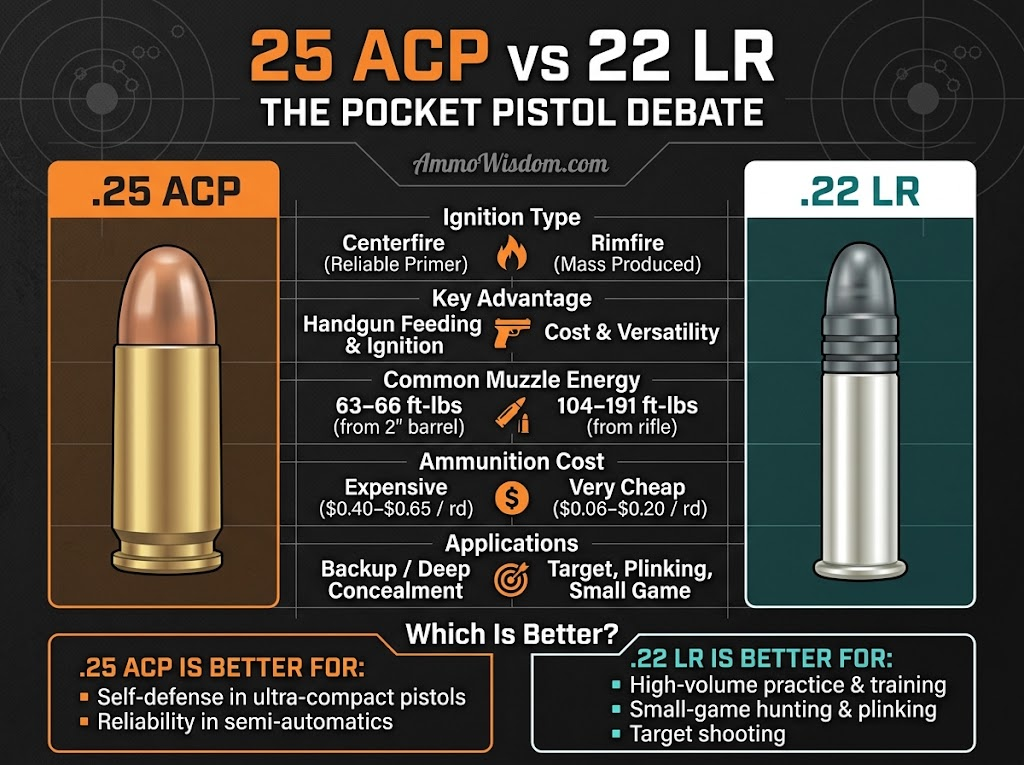
| Typical muzzle energy | 63 to 66 ft-lbs (2-inch barrel) | 104 to 191 ft-lbs (18-inch barrel) |
| Maximum average pressure | 25,000 PSI | 24,000 PSI (SAAMI specification) |
| Recoil characteristics | Extremely light | Extremely light |
| Ammunition cost | $0.40 to $0.65 per round | $0.06 to $0.20 per round |
| Common firearm types | Pocket pistols | Rifles, target pistols, revolvers |
| Typical applications | Deep concealment | Target shooting, plinking, hunting |
What Is the Main Difference Between 25 ACP and 22 LR?
The main difference lies in their ignition systems and original design intent. The .25 Automatic Colt Pistol is a centerfire cartridge created by John Browning in 1905 specifically to improve the reliability of small pocket pistols. Its semi-rimmed case and centerfire primer ensure consistent feeding, extraction, and ignition in micro-sized handguns. In contrast, the .22 Long Rifle is an older rimfire design that features a pronounced rim and a heel-based bullet. While the .22 LR is incredibly versatile and heavily used in rifles, its rimfire primer and rimmed case can sometimes cause feeding or ignition issues in extremely small semi-automatic pistols.
25 ACP vs 22 LR Dimensions
| Dimension | .25 ACP | .22 LR |
| Bullet diameter | .2512 inches (6.38 mm) | .2255 inches (5.73 mm) |
| Case length | .615 inches (15.6 mm) | .613 inches (15.6 mm) |
| Overall length | .910 inches (23.1 mm) | 1.000 inches (25.4 mm) |
| Rim diameter | .302 inches (7.7 mm) | .278 inches (7.1 mm) |
| Base diameter | .278 inches (7.1 mm) | .226 inches (5.7 mm) |
| Primer pocket | Small pistol | None (rimfire) |
Looking at the 25 ACP vs 22 LR dimensions, the .25 ACP is slightly shorter in overall length but wider in diameter. The .25 ACP utilizes a semi-rimmed design measuring .302 inches across the rim, which allows it to headspace on the rim while still feeding smoothly from a box magazine. The .22 LR has a pronounced rim measuring .278 inches, which requires careful magazine design to prevent rim-lock when stacked vertically. These cartridges have completely different dimensions and operating pressures. They are strictly not interchangeable, and you must only use the specific ammunition marked on your firearm barrel.
25 ACP vs 22 LR Ballistics
| Cartridge Load | Bullet Weight | Muzzle Velocity | Muzzle Energy | Barrel Length |
| Hornady .25 ACP XTP | 35 grains | 900 fps | 63 ft-lbs | 2-inch pistol |
| Prvi Partizan .25 ACP FMJ | 50 grains | 770 fps | 65 ft-lbs | 2-inch pistol |
| CCI .22 LR Mini-Mag | 40 grains | 1235 fps | 135 ft-lbs | Rifle test barrel |
| Federal .22 LR Standard | 40 grains | 1080 fps | 104 ft-lbs | Rifle test barrel |
When analyzing 25 ACP vs 22 LR ballistics, you must consider the barrel length used for testing. Manufacturer specifications for .25 ACP are typically generated using a 2-inch pistol barrel, which reflects its real-world use. However, most factory .22 LR ballistics are measured using 18-inch or larger rifle barrels. A rifle barrel allows the .22 LR powder to burn completely, producing significantly higher velocity and energy figures on paper. When fired from a 2-inch pocket pistol, the .22 LR loses a massive portion of its advertised performance, bringing its actual numbers much closer to the .25 ACP.
25 ACP vs 22 LR Velocity
Comparing 25 ACP vs 22 LR velocity requires evaluating identical barrel lengths. In a rifle, a standard high-velocity .22 LR pushes a 40-grain bullet past 1,200 feet per second. However, when fired from a 2-inch pocket pistol, that same .22 LR cartridge usually drops to around 800 or 900 feet per second. At this short barrel length, the .25 ACP matches the .22 LR. A 50-grain .25 ACP bullet typically travels at 760 fps, while a lighter 35-grain hollow point can reach 900 fps. Both cartridges remain subsonic when fired from extremely short barrels.
25 ACP vs 22 LR Muzzle Energy
| Firearm and Load | Bullet Weight | Muzzle Velocity | Muzzle Energy |
| Pocket Pistol: .25 ACP 50-grain FMJ | 50 grains | 760 fps | 65 ft-lbs |
| Pocket Pistol: .25 ACP 35-grain JHP | 35 grains | 900 fps | 63 ft-lbs |
| Rifle: .22 LR 40-grain High Velocity | 40 grains | 1235 fps | 135 ft-lbs |
| Rifle: .22 LR 32-grain Hyper-Velocity | 32 grains | 1640 fps | 191 ft-lbs |
When assessing 25 ACP vs 22 LR energy, the 25 ACP produces around 65 foot-pounds from a standard pocket pistol. In a rifle, the .22 LR easily exceeds 130 foot-pounds. However, in a comparable short-barreled handgun, the .22 LR energy drops down to roughly 65 to 75 foot-pounds. Neither cartridge produces enough energy to reliably expand hollow points or guarantee rapid incapacitation, making shot placement the most critical factor for defensive use.
25 ACP vs 22 LR Accuracy and Effective Range
The .22 LR is universally recognized for outstanding mechanical accuracy, particularly when fired from target rifles or full-sized target pistols. High-quality .22 LR ammunition can print tight groups at 50 to 100 yards. The .25 ACP is rarely chambered in target firearms, and its tiny pocket pistols usually feature rudimentary sights and short sight radiuses. While the .25 ACP cartridge is mechanically capable of decent accuracy, its effective range is practically limited to close-quarters distances of 7 to 10 yards due to the firearms that chamber it.
25 ACP vs 22 LR Recoil
Both cartridges produce negligible felt recoil. The 25 ACP vs 22 LR recoil comparison is essentially a tie. Even in incredibly small, lightweight pocket pistols, shooters can fire both cartridges rapidly without flinching or experiencing discomfort. The lack of recoil makes both calibers excellent for shooters who are sensitive to the blast and kick of larger defensive cartridges. However, because .25 ACP pistols are often smaller than .22 LR pistols, the grip shape and frame weight will ultimately dictate how the recoil feels in the hand.
25 ACP vs 22 LR Reliability
Reliability is the primary reason the .25 ACP exists. John Browning designed the centerfire .25 ACP because rimfire priming compounds of the early 20th century were prone to failure. Centerfire primers are struck directly in the center, offering more consistent ignition than rimfire cases that must be crushed on the edge. Furthermore, the semi-rimmed, thick-walled brass of the .25 ACP feeds much more reliably from a box magazine than the thin, heavily rimmed .22 LR. While modern .22 LR ammunition is vastly improved, the .25 ACP remains inherently more reliable in micro-sized semi-automatic pistols.
25 ACP vs 22 LR Ammunition Cost
| Ammunition Type | Typical Retail Price per Box (50 rounds) | Estimated Cost Per Round | Date Verified |
| Prvi Partizan .25 ACP 50-grain FMJ | $20.00 to $23.00 | $0.40 to $0.46 | October 2026 |
| Hornady .25 ACP 35-grain XTP | $31.99 | $0.64 | October 2026 |
| Range/Practice .22 LR | $4.42 to $6.09 | $0.08 to $0.12 | October 2026 |
| Premium/Defensive .22 LR | $6.00 to $10.00 | $0.12 to $0.20 | October 2026 |
The .22 LR dominates the pricing category. Due to massive global production, standard .22 LR ammunition is highly affordable, with median observed prices around $0.12 per round as of October 2026. This makes the .22 LR unbeatable for high-volume training. The .25 ACP is a niche cartridge produced in smaller batches, resulting in significantly higher prices. A standard 50-round box of .25 ACP typically costs between $20.00 and $25.00, making regular practice much more expensive.
25 ACP vs 22 LR for Different Uses
- Target shooting: The .22 LR is the undisputed champion of target shooting. It offers thousands of firearm options, match-grade ammunition varieties, and incredibly low costs. The .25 ACP is not a target cartridge.
- Training and recreational shooting: The affordability of the .22 LR makes it the best choice for plinking and learning marksmanship fundamentals. Practicing extensively with .25 ACP will quickly drain your budget.
- Small-game hunting, where lawful: The .22 LR is an established small-game cartridge capable of taking rabbits and squirrels at intermediate distances. The .25 ACP is unsuitable for hunting due to the lack of accurate rifles and appropriate hunting projectiles.
- Compact pocket pistols: For deep concealment in extremely small firearms, the .25 ACP offers superior feeding and ignition reliability. While .22 LR pocket pistols exist, the rimmed cartridge design increases the risk of rim-lock or feeding malfunctions.
- Firearm availability: The market is flooded with .22 LR rifles, revolvers, and pistols from virtually every manufacturer. Firearms chambered in .25 ACP are primarily limited to legacy pocket pistols, with very few modern models currently in production.
- General ownership considerations: A .22 LR firearm is a staple in almost every collection due to its versatility. A .25 ACP firearm is a specialized tool reserved strictly for backup or deep concealment purposes.
Advantages and Disadvantages of 25 ACP
| Advantages | Disadvantages |
| Centerfire ignition provides highly reliable primer detonation. | Ammunition is significantly more expensive. |
| Semi-rimmed case feeds reliably from small box magazines. | Limited to very short effective ranges. |
| Extremely low recoil for rapid follow-up shots. | Poor terminal ballistics and low energy. |
| Allows for the design of incredibly small pocket pistols. | Very few new firearms are manufactured in this caliber. |
Advantages and Disadvantages of 22 LR
| Advantages | Disadvantages |
| Highly affordable ammunition allows for extensive practice. | Rimfire primers have a slightly higher dud rate. |
| Massive variety of available firearms and ammunition types. | Rimmed cases can cause feeding issues in small magazines. |
| Capable of excellent accuracy at 50 to 100 yards. | Drastic velocity loss when fired from short pistol barrels. |
| Suitable for target shooting, plinking, and hunting. | Dirty ammunition can quickly foul small firearm actions. |
Which Is Better: 25 ACP or 22 LR?
If you are looking for a versatile cartridge for target shooting, training, or small-game hunting, the .22 LR is undeniably better. Its accuracy, low cost, and massive firearm selection make it a mandatory addition to any shooter’s inventory. However, if your strict goal is carrying the absolute smallest semi-automatic pocket pistol for backup defensive use, the .25 ACP holds a practical advantage. Its centerfire primer and semi-rimmed case geometry offer superior feeding and ignition reliability in micro-sized platforms, which is the most critical factor for a defensive tool.
Frequently Asked Questions
Is 25 ACP more powerful than 22 LR? No, the .25 ACP is generally not more powerful than the .22 LR. When the .22 LR is fired from a rifle, it generates significantly more velocity and energy than the .25 ACP. However, when both are fired from identical 2-inch pistol barrels, their power levels are very similar, with both producing around 65 foot-pounds of energy.
Is 25 ACP faster than 22 LR? The .22 LR is faster in almost every scenario. Factory .22 LR ammunition often exceeds 1,200 feet per second in a rifle. Even in a short pistol barrel, high-velocity .22 LR loads can match or slightly exceed the 760 to 900 feet per second velocities typical of standard .25 ACP pistol ammunition.
Which has more muzzle energy?The .22 LR has more muzzle energy when fired from a rifle, often exceeding 130 foot-pounds. The .25 ACP, which is exclusively fired from short handguns, produces roughly 65 foot-pounds. When both are evaluated in short pocket pistols, their muzzle energy is nearly identical.
Is 25 ACP more reliable than 22 LR? Yes, in micro-sized semi-automatic pistols, the .25 ACP is more reliable. John Browning designed the .25 ACP as a centerfire cartridge with a semi-rimmed case specifically to solve the ignition and magazine-feeding issues associated with rimfire .22 LR ammunition in small handguns.
Which cartridge has less recoil? Both cartridges generate virtually no felt recoil, making them incredibly easy to shoot. The perceived recoil will depend more on the weight and grip design of the specific firearm being used rather than the slight differences in the cartridges themselves.
Is 25 ACP more expensive than 22 LR? Yes, .25 ACP ammunition is significantly more expensive. As of late 2026, .22 LR ammunition costs roughly $0.08 to $0.12 per round, while .25 ACP often ranges from $0.40 to $0.65 per round due to its lower production volume.
Can you use 22 LR in a 25 ACP pistol? No, you cannot use .22 LR in a .25 ACP pistol. The cartridge dimensions, case diameters, overall lengths, and operating pressures are entirely different. Furthermore, the .25 ACP requires a centerfire firing pin, while the .22 LR requires a rimfire firing pin.
Is 25 ACP suitable for small-game hunting? The .25 ACP is not suitable for small-game hunting. There are virtually no hunting rifles chambered for it, the available pocket pistols lack the sights and accuracy required for ethical hunting, and the available ammunition is not optimized for harvesting game.
Which cartridge is better for a pocket pistol?For maximum feeding and ignition reliability in a micro-sized semi-automatic pocket pistol, the .25 ACP is historically the better design. However, the lower cost and broader availability of .22 LR ammunition lead many modern shooters to accept the slight reliability trade-off by choosing .22 LR pocket pistols instead.
What is the main difference between 25 ACP and 22 LR? The primary difference is their ignition design. The .25 ACP is a centerfire cartridge created for reliable function in small semi-automatic handguns, while the .22 LR is an older rimfire cartridge designed for rifles that offers immense versatility but can suffer from feeding issues in tiny pistols.