The main difference between the cartridges is that the .338 Lapua Magnum is a precision anti-personnel cartridge designed to be carried by an individual sniper for extreme long-range engagements, whereas the .50 BMG is a massive heavy machine gun and anti-materiel cartridge designed to destroy unarmored vehicles, military equipment, and fortified structures at distances exceeding one mile.
338 Lapua vs 50 BMG Comparison
| Feature | .338 Lapua | .50 BMG |
| Bullet Diameter | 0.338 inches (8.58 mm) | 0.510 inches (12.95 mm) |
| Typical Bullet Weight | 250 gr to 300 gr (typically 250 gr or 300 gr) | 660 gr to 750 gr (typically 660 gr or 750 gr) |
| Muzzle Velocity | 2,700 to 3,000 fps (24 to 27-inch barrel) | 2,700 to 2,900 fps (29 to 30-inch barrel) |
| Muzzle Energy | 4,800 to 5,200 ft-lbs | 12,000 to 14,000+ ft-lbs |
| Momentum | ~100 to ~115 lb-fps (depending on load) | ~250 to ~290 lb-fps (depending on load) |
| Maximum Pressure | 60,916 psi (CIP) | 54,000 to 60,000 psi (SAAMI / Military) |
| Ballistic Coefficient | Very High (~0.600 to 0.820) | Extreme (~0.650 to 1.050) |
| Penetration | Extreme on biological targets | Destroys engine blocks, brick walls, light armor |
| Expansion | 0.60 to 0.70 inches (Hunting loads) | Irrelevant (Solid mass destruction) |
| Trajectory | Supersonic out to 1,500+ yards | Supersonic out to 2,000+ yards |
| Recoil | Heavy (~30 to 40 ft-lbs in a heavy rifle) | Extreme (~100 to 120+ ft-lbs without a brake) |
| Effective Range | 1,500 to 1,800 yards | 2,000 to 2,500+ yards |
| Ammo Availability | Moderate (Specialty long-range match/hunting) | Moderate (Military surplus, specialty match) |
| Ammo Cost | Very Expensive ($4.00 to $8.00 per round) | Extremely Expensive ($4.00 to $10.00+ per round) |
| Best Use | Extreme long-range precision, sniper duty, ELR competition | Anti-materiel duty, ELR competition, heavy destruction |
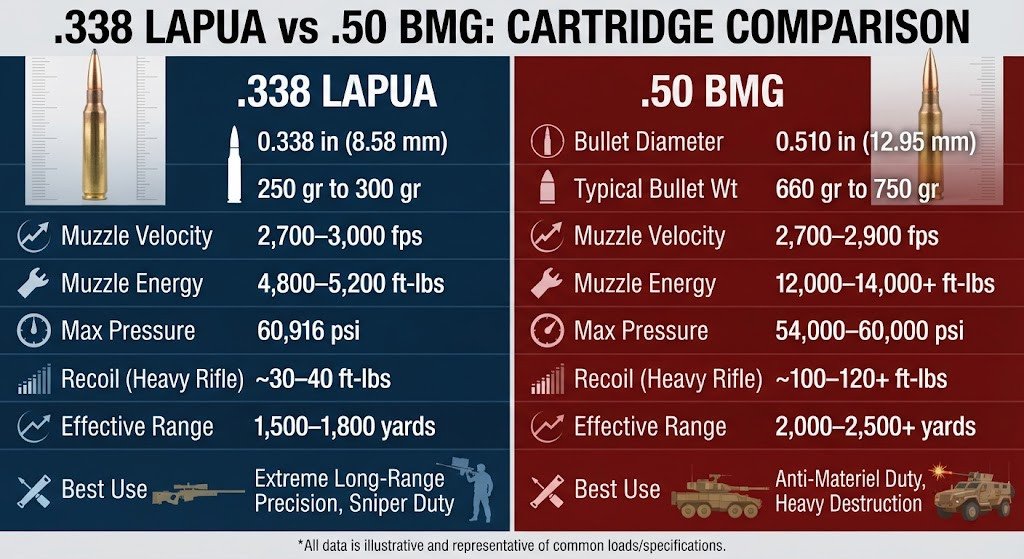
The table above illustrates the massive scale difference between a dedicated extreme long-range sniper cartridge and a heavy machine gun cartridge. The .338 Lapua Magnum was developed in the 1980s by Research Armament Industries and Lapua to fill the massive ballistic gap between the 7.62x51mm NATO and the .50 BMG. The military needed a cartridge that could accurately neutralize enemy personnel wearing body armor at 1,000 to 1,500 yards without requiring the sniper team to carry a massive, 30-pound anti-materiel rifle. The result was a highly efficient, rimless bottlenecked cartridge that operates at a CIP maximum pressure of roughly 61,000 psi.
The .50 Browning Machine Gun (.50 BMG), officially known as the 12.7x99mm NATO, was designed by John Browning in the late 1910s. It was originally engineered to serve in water-cooled heavy machine guns to combat early armored tanks and military aircraft. Due to its sheer powder volume and massive projectile weight, it operates at a slightly lower pressure curve (around 54,000 psi) but generates kinetic energy levels that simply dwarf traditional small arms. Today, it is chambered in heavy shoulder-fired rifles like the Barrett M82, primarily utilized by Explosive Ordnance Disposal teams and military snipers to destroy enemy equipment from safe distances.
338 Lapua vs 50 BMG Ballistics
To objectively evaluate the ballistic capabilities of the .338 Lapua against the .50 BMG, we must examine real-world factory ammunition. Because these cartridges are utilized for extreme distances, standard hunting loads are rarely the focal point. Instead, we look at heavy match-grade ammunition designed to defeat wind deflection and maintain supersonic flight at extreme ranges.
Barrel lengths play a major role in this comparison. A typical .338 Lapua rifle features a 24-inch to 27-inch barrel, while a .50 BMG rifle requires a massive 29-inch to 36-inch barrel to properly burn its enormous powder charge.
- Load A (.338 Lapua Match): Hornady 285-grain ELD Match. Tested from a 24-inch barrel. Muzzle velocity is 2,860 feet per second. Muzzle energy is 5,176 foot-pounds. Ballistic Coefficient is 0.829.
- Load B (.338 Lapua Long Range): Lapua 300-grain Scenar Open Tip Match. Tested from a 26-inch barrel. Muzzle velocity is 2,750 feet per second. Muzzle energy is 5,037 foot-pounds. Ballistic Coefficient is 0.736.
- Load C (.50 BMG Match): Hornady 750-grain A-MAX Match. Tested from a 29-inch barrel. Muzzle velocity is 2,820 feet per second. Muzzle energy is 13,242 foot-pounds. Ballistic Coefficient is 1.050.
- Load D (.50 BMG Military Ball): Federal American Eagle 660-grain Full Metal Jacket (M33 Ball Spec). Tested from a 29-inch barrel. Muzzle velocity is 2,910 feet per second. Muzzle energy is 12,413 foot-pounds. Ballistic Coefficient is 0.650.
Manufacturer data is captured using controlled test barrels. Real-world velocities will vary depending on the exact rifle model and atmospheric conditions.
338 Lapua vs 50 BMG Velocity
Velocity dictates the trajectory curve and influences how well a projectile can resist wind drift. Despite the massive size difference between the two cartridges, their muzzle velocities are surprisingly similar.
The .338 Lapua Magnum utilizes highly efficient modern powders to drive aerodynamic bullets at tremendous speeds. A standard 250-grain bullet easily reaches 2,950 feet per second, while the heavier 300-grain extreme long-range bullets exit the muzzle at roughly 2,750 feet per second. Because these bullets feature incredibly high ballistic coefficients, they shed their velocity very slowly, staying supersonic out to 1,500 yards or more depending on elevation.
The .50 BMG achieves its velocity through brute force. A standard .50 BMG cartridge holds roughly 220 to 240 grains of slow-burning powder, which is nearly three times the powder capacity of the .338 Lapua. This massive powder column pushes incredibly heavy 660-grain to 750-grain bullets at roughly 2,700 to 2,900 feet per second. When loaded with specialized match bullets like the Hornady 750-grain A-MAX, the .50 BMG features a Ballistic Coefficient exceeding 1.000, allowing it to maintain supersonic flight past 2,000 yards.
338 Lapua vs 50 BMG Muzzle Energy
Muzzle energy represents the kinetic work capacity of a projectile. The kinetic energy difference between these two cartridges is the primary reason they serve entirely different combat roles.
A standard .338 Lapua Magnum generates approximately 5,000 foot-pounds of muzzle energy. To put this in perspective, it produces roughly double the kinetic energy of a .308 Winchester. This is an immense amount of power, fully capable of taking any large game animal on the planet, including elephants and cape buffalo, though it is primarily optimized for anti-personnel sniper use.
The .50 BMG operates on an entirely different scale. A standard 750-grain .50 BMG match load generates an earth-shattering 13,242 foot-pounds of kinetic energy. It produces nearly three times the muzzle energy of the .338 Lapua. This level of power is not meant for biological targets; it is specifically engineered to destroy engine blocks on light armored vehicles, shatter concrete barriers, and detonate unexploded ordnance from a safe distance.
338 Lapua vs 50 BMG Momentum
Momentum is a linear measurement calculating mass in motion. In terminal ballistics, high momentum correlates closely with the ability of a bullet to crush through dense bone, brick walls, steel plating, and intermediate barriers without stopping.
The .338 Lapua produces excellent momentum for a shoulder-fired rifle. A 300-grain bullet traveling at 2,750 feet per second yields roughly 117 pound-feet per second of linear momentum. This allows it to effortlessly punch through Level III body armor and heavy structural glass.
The .50 BMG generates a level of momentum that is difficult to comprehend in small arms terms. A 750-grain bullet traveling at 2,820 feet per second yields an unbelievable 302 pound-feet per second of linear momentum. The sheer mass and forward driving force of the .50 BMG bullet allow it to penetrate inches of solid steel, making it the ultimate anti-materiel tool for the modern battlefield.
338 Lapua vs 50 BMG Trajectory
Understanding external ballistics and bullet drop is critical for extreme long-range shooting. The calculations below assume a standard high-profile optic height of 2.0 inches above the bore and a clearly stated zero distance of 200 yards. We will compare the heavy 300-grain .338 Lapua match load against the 750-grain .50 BMG match load out to 1,000 yards to demonstrate their ELR capabilities.
| Distance | .338 Lapua (300 gr Scenar at 2,750 fps) Drop | .50 BMG (750 gr A-MAX at 2,820 fps) Drop |
| Muzzle | -2.0 inches | -2.0 inches |
| 200 Yards | 0.0 inches (Zero) | 0.0 inches (Zero) |
| 400 Yards | -20.2 inches | -18.5 inches |
| 600 Yards | -61.5 inches | -55.8 inches |
| 800 Yards | -128.4 inches | -115.5 inches |
| 1000 Yards | -226.5 inches | -201.2 inches |
Both cartridges shoot exceptionally flat for the massive distances they cover. At 1,000 yards, the .50 BMG drops slightly less than the .338 Lapua due to its higher initial velocity and superior ballistic coefficient. More importantly, the 750-grain .50 BMG bullet is significantly less affected by wind drift. At 1,000 yards in a 10 mph crosswind, the .50 BMG will drift roughly 45 inches, while the .338 Lapua will drift roughly 55 inches. In extreme long-range shooting, cheating the wind is often more important than compensating for gravity.
338 Lapua vs 50 BMG Recoil
Recoil management is a major factor for precision shooters. The physical recoil generated by a firearm is heavily influenced by the weight of the rifle, the mass of the powder charge, and the weight of the bullet.
The .338 Lapua generates substantial recoil. If fired from a standard 9-pound hunting rifle without a muzzle brake, it produces over 45 foot-pounds of free recoil energy, which is punishing to the shoulder. However, most precision rifles chambered in .338 Lapua weigh 15 to 18 pounds and feature highly efficient muzzle brakes, reducing the felt recoil to a level comparable to a standard .30-06 hunting rifle.
The .50 BMG generates a catastrophic amount of raw recoil energy. If fired from a standard-weight sporting rifle without mitigation, the recoil would easily exceed 120 foot-pounds, which can dislocate a shoulder or cause a detached retina. To make the cartridge shootable, .50 BMG rifles like the Barrett M82 or McMillan TAC-50 are massively overbuilt, weighing between 25 and 35 pounds. They also utilize massive, multi-baffle muzzle brakes that redirect the high-pressure gases backward, pulling the rifle forward to cancel out the recoil. Even with these mitigations, firing a .50 BMG creates a concussive shockwave that rattles the teeth of the shooter and anyone standing nearby.
338 Lapua vs 50 BMG Penetration
Terminal penetration is the primary reason militaries deploy these weapons.
The .338 Lapua provides extreme penetration on biological targets. When loaded with solid copper or brass monolithic projectiles, it will penetrate end-to-end on heavy game. Against tactical targets, the .338 Lapua will defeat light barriers, thick automotive glass, and standard military body armor at extreme distances, fulfilling its role as a premier anti-personnel round.
The .50 BMG redefines small arms penetration. Standard M33 ball ammunition will pass straight through concrete block walls, thick timber structures, and light unarmored vehicles. When loaded with military Armor Piercing Incendiary (API) ammunition, the .50 BMG will punch through an inch of hardened steel armor at hundreds of yards, completely disabling enemy radar installations, grounded aircraft, and troop transports.
338 Lapua vs 50 BMG Expansion
Bullet expansion dictates the diameter of the permanent wound channel inside a biological target.
For the .338 Lapua, expansion is highly relevant for civilian hunters. When utilizing premium hunting bullets like the Barnes LRX or Hornady ELD-X, the bullet mushrooms beautifully to roughly 0.60 or 0.70 inches, creating a massive wound channel that ethical drops large game. Military snipers using the cartridge generally rely on non-expanding Open Tip Match bullets, which tumble and fragment upon impact due to their extreme length and velocity.
For the .50 BMG, expansion is entirely irrelevant. The projectile is already a half-inch wide before it strikes the target. A 750-grain solid bullet traveling at Mach 2 does not need to expand to cause catastrophic destruction; the sheer kinetic energy transfer and massive permanent cavity created by the unexpanded bullet are instantly lethal to any biological target.
338 Lapua vs 50 BMG Effective Range
The effective range of these cartridges pushes the absolute limits of human marksmanship.
The .338 Lapua is considered a highly effective anti-personnel cartridge out to 1,500 yards. In the hands of elite military snipers, confirmed engagements have been recorded well past 1,800 yards under ideal atmospheric conditions. The cartridge generally drops to subsonic speeds around 1,500 to 1,600 yards depending on elevation, at which point accuracy degrades rapidly.
The .50 BMG is an undisputed ultra-long-range king. Because the massive match bullets feature ballistic coefficients exceeding 1.000, they remain supersonic well past 2,000 yards. Confirmed military sniper engagements with the .50 BMG have exceeded 3,500 yards. For anti-materiel purposes, the cartridge retains enough energy to destroy vehicle engine blocks at distances exceeding one mile.
338 Lapua vs 50 BMG Self Defense
When discussing self defense with these extreme cartridges, the conversation leaves the realm of practicality.
The .338 Lapua is vastly overpowered for urban or suburban home defense. A 300-grain bullet traveling at 2,750 feet per second will effortlessly pass through an intruder, multiple interior walls, exterior brick walls, and continue into neighboring properties, presenting a severe and unacceptable risk to innocent bystanders. Furthermore, the rifles are extremely long, heavy, and impossible to maneuver in a confined space.
The .50 BMG is even more impractical. Firing a .50 BMG inside a residential hallway would instantly deafen the defender and cause severe concussive overpressure damage to the immediate environment. The bullet would easily penetrate through several suburban houses before coming to a stop. These weapons are strictly reserved for wide-open rural property defense, military applications, or extreme long-range target shooting.
338 Lapua vs 50 BMG Concealed Carry
Concealed carry with either the .338 Lapua or the .50 BMG is physically impossible. The .338 Lapua is chambered in precision rifles that are often four feet long and weigh 15 pounds. The .50 BMG is chambered in massive heavy weapon systems that are often five feet long and weigh up to 35 pounds. There are no handguns manufactured that can chamber these rounds for concealed carry. Their appropriate transport method involves dedicated heavy-duty Pelican hard cases or vehicle mounts.
Which Has More Stopping Power: 338 Lapua or 50 BMG?
Stopping power generally refers to the ability of a cartridge to quickly incapacitate a target.
The .50 BMG has infinitely more stopping power than the .338 Lapua. Striking a target with over 13,000 foot-pounds of energy and 300 pound-feet per second of momentum creates a level of physical destruction that guarantees immediate incapacitation. While the .338 Lapua provides absolutely devastating stopping power on any biological target, it simply cannot compare to the apocalyptic kinetic force of the .50 BMG.
Which Is More Powerful: 338 Lapua or 50 BMG?
Based on the raw data, the .50 BMG is vastly more powerful.
The .338 Lapua Magnum generates roughly 5,000 foot-pounds of muzzle energy. The .50 BMG generates roughly 13,000 to 14,000 foot-pounds of muzzle energy. The heavy machine gun cartridge delivers nearly three times the kinetic energy to the target.
338 Lapua Pros and Cons
Pros
- Man-portable rifle systems allow a single shooter to easily carry and deploy the weapon
- Exceptional precision and ballistic coefficients keep the bullet supersonic past 1,500 yards
- Generates roughly double the kinetic energy of standard full-power cartridges like the .308 Winchester
- Relatively manageable recoil when fired from a heavy chassis rifle with a proper muzzle brake
Cons
- Ammunition is prohibitively expensive for most civilian shooters
- Extreme over-penetration risks make it entirely unsuitable for defensive use in populated areas
- Requires specialized long-range ranges (exceeding 1,000 yards) to truly utilize the capability of the cartridge
50 BMG Pros and Cons
Pros
- The ultimate expression of small arms power, delivering over 13,000 foot-pounds of energy
- Capable of destroying light armor, vehicles, and fortifications at distances exceeding a mile
- Extreme ballistic coefficients allow match bullets to stay supersonic past 2,000 yards
- Military surplus ammunition is often available in bulk for recreational shooting
Cons
- Rifles are massively heavy, often requiring two people or a vehicle to transport comfortably
- Creates a concussive muzzle blast that is highly disruptive and deafening to anyone nearby
- Ammunition costs are staggering, often exceeding ten dollars for a single match-grade round
- Heavily restricted or completely banned in certain jurisdictions and commercial shooting ranges
Final Comparison
| Category | Winner | Reason |
| Velocity | Tie | Both launch projectiles roughly between 2,700 and 2,900 fps |
| Muzzle Energy | .50 BMG | Massive powder column generates nearly 3x the kinetic energy |
| Momentum | .50 BMG | 750-grain bullets carry immense linear driving mass and momentum |
| Penetration | .50 BMG | Punches through structural steel, engine blocks, and concrete |
| Expansion | .338 Lapua | Capable of expanding beautifully with premium hunting bullets |
| Trajectory | .50 BMG | Extreme ballistic coefficients reduce wind drift and bullet drop at 1,000+ yards |
| Recoil Control | .338 Lapua | Significantly less free recoil energy, easily mitigated by a standard brake |
| Effective Range | .50 BMG | Remains supersonic and lethal at distances exceeding 2,000 yards |
| Self Defense | Neither | Both present extreme over-penetration hazards in any residential setting |
| Concealed Carry | Neither | Both are massive long-range rifle cartridges entirely unsuitable for concealment |
| Ammo Cost | .338 Lapua | While expensive, it is generally cheaper than premium .50 BMG match loads |
| Ammo Availability | Tie | Both require specialty orders or visits to dedicated long-range gun shops |
| Overall Performance | Depends on Target | .338 Lapua for precision biological targets; .50 BMG for anti-materiel destruction |
338 Lapua vs 50 BMG: Which Should You Choose?
Selecting between the .338 Lapua and the .50 BMG requires an honest assessment of your physical strength, your budget, and your access to extreme long-range shooting facilities.
Choose the .338 Lapua if you are an avid precision shooter or long-range hunter looking to engage targets at 1,000 to 1,500 yards. It offers military-grade extreme long-range performance in a rifle package that a single person can actually carry through the mountains or maneuver on a firing line. It hits with massive authority while remaining somewhat practical for the dedicated civilian marksman.
Choose the .50 BMG if you desire the absolute pinnacle of shoulder-fired kinetic energy and have access to private land or specialized ranges that stretch to a mile or more. Owning a .50 BMG is an exercise in extreme ballistics, offering the unique ability to defeat structural barriers and engage targets well past 2,000 yards. You must be prepared to handle the immense weight of the rifle and the staggering cost of the ammunition required to feed it.
FAQs
Is 338 Lapua more powerful than 50 BMG?
No, the .50 BMG is massively more powerful. The .50 BMG generates nearly three times the muzzle energy of the .338 Lapua.
Which has more muzzle energy?
The .50 BMG generates roughly 13,000 to 14,000 foot-pounds of muzzle energy, while the .338 Lapua generates roughly 5,000 foot-pounds.
Which has more stopping power?
The .50 BMG has unparalleled stopping power, capable of instantly disabling biological targets and destroying mechanical equipment.
Which has more recoil?
The .50 BMG generates substantially more free recoil energy. Even with massive multi-baffle muzzle brakes and 30-pound rifle chassis systems, the concussive force and recoil of the .50 BMG are significantly heavier than the .338 Lapua.
Which has better penetration?
The .50 BMG offers extreme anti-materiel penetration capabilities, easily punching through concrete walls, engine blocks, and steel armor plating.
Which expands more?
The .338 Lapua expands more when loaded with modern hollow-point hunting bullets. The .50 BMG is generally fired as a solid non-expanding projectile, relying entirely on its massive half-inch diameter to create a permanent wound channel.
Which has a flatter trajectory?
The .50 BMG has a slightly flatter trajectory and significantly less wind deflection at extreme ranges (past 1,000 yards) due to the incredibly high ballistic coefficients of its heavy 750-grain match bullets.
Which is better for self defense?
Neither cartridge is suitable for self-defense in a civilian environment due to extreme over-penetration risks, blinding muzzle flash, and deafening indoor concussive blast.
Which is better for concealed carry?
Neither. Both are chambered in extremely large, heavy long-range rifles that cannot be concealed.
Is 338 Lapua faster than 50 BMG?
Their velocities are very similar. Both cartridges launch their respective projectiles at roughly 2,700 to 2,900 feet per second depending on the specific load and barrel length.
Is 50 BMG stronger than 338 Lapua?
Yes, in terms of sheer kinetic energy, momentum, and destructive capability, the .50 BMG is drastically stronger than the .338 Lapua.
Which is cheaper to shoot?
The .338 Lapua is generally cheaper to shoot, though both are very expensive compared to standard rifle cartridges. Premium match-grade .50 BMG ammunition can easily exceed ten dollars per shot.
Can a 338 Lapua shoot 50 BMG?
No. They are completely different calibers. The .50 BMG is massive and physically will not fit inside a .338 Lapua chamber.
Which is easier to shoot?
The .338 Lapua is much easier to shoot. It utilizes a lighter rifle that is easier to position, and it generates significantly less recoil and concussive muzzle blast than the .50 BMG.
Which should you choose?
Choose the .338 Lapua for a portable, highly accurate extreme long-range precision rifle. Choose the .50 BMG for the ultimate expression of small arms power, anti-materiel capabilities, and shooting past a mile.