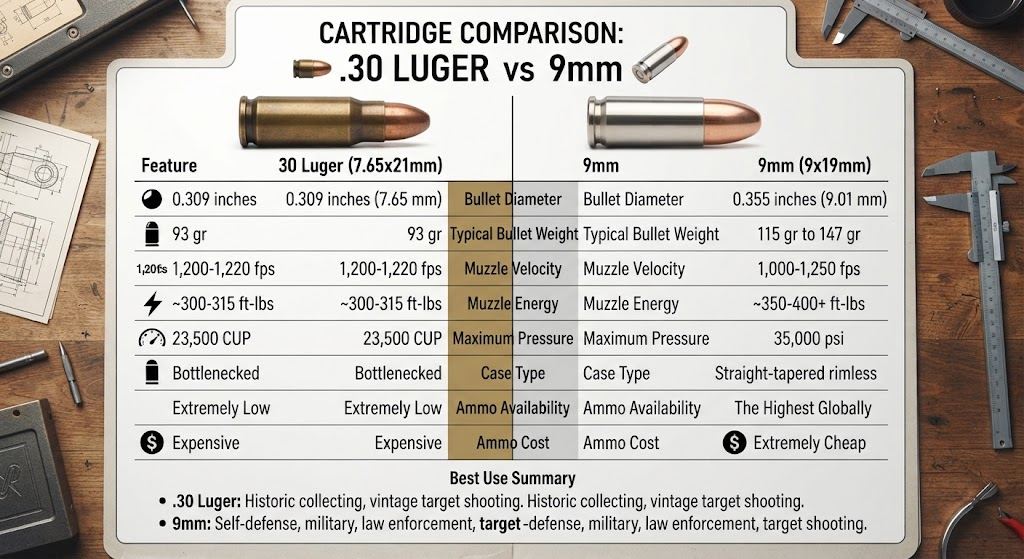
The main difference in the 30 Luger Vs 9mm comparison is that the 30 Luger is a historic, bottlenecked cartridge firing a lightweight projectile at high speeds, whereas the 9mm is its direct descendant, created by straightening the case to hold a wider, heavier bullet. While the 30 Luger is beloved by collectors for its exceptionally mild recoil and vintage charm, the 9mm completely dominates modern ballistics with vastly superior kinetic energy, reliable terminal expansion, and ubiquitous global availability.
30 Luger Vs 9mm Comparison
| Feature | 30 Luger (7.65x21mm Parabellum) | 9mm (9x19mm Parabellum) |
| Bullet Diameter | 0.309 inches (7.65 mm) | 0.355 inches (9.01 mm) |
| Typical Bullet Weight | 93 gr | 115 gr to 147 gr (typically 115 or 124 gr) |
| Muzzle Velocity | 1,200 to 1,220 fps | 1,000 to 1,250 fps |
| Muzzle Energy | ~300 to 315 ft-lbs | ~350 to 400+ ft-lbs |
| Momentum | ~16.2 lb-fps | ~18 to 21 lb-fps |
| Maximum Pressure | 23,500 CUP (~28,000 psi equivalent) | 35,000 psi (SAAMI) |
| Case Type | Bottlenecked | Straight-tapered rimless |
| Penetration | Moderate (mostly full metal jacket) | Deep (highly engineered hollow points) |
| Expansion | Very Limited | Massive (0.50 to 0.65+ inches) |
| Recoil | Extremely Low (~3.0 ft-lbs) | Mild (~4.0 to 5.0 ft-lbs) |
| Effective Range | 50 yards | 50 yards |
| Ammo Availability | Extremely Low (Vintage and specialty runs) | The Highest Globally |
| Ammo Cost | Expensive ($0.80 to $1.50+ per round) | Extremely Cheap ($0.25 to $0.40 per round) |
| Best Use | Historic collecting, vintage target shooting | Self-defense, military, law enforcement, target |
The table above illustrates a direct father-and-son ballistic evolution. In 1898, Georg Luger developed the 7.65x21mm Parabellum (the 30 Luger) for his famous toggle-lock pistol. It was incredibly fast and accurate, but the German military requested a larger caliber with more stopping power. In 1901, Luger simply took the 30 Luger brass case, removed the bottleneck to make it straight-walled, and inserted a 9mm bullet. The resulting 9x19mm Parabellum (the 9mm) went on to become the most successful military and civilian handgun cartridge in human history.
30 Luger Vs 9mm Ballistics
To objectively evaluate the ballistic capabilities, we must look at standard factory loads. Because the 30 Luger is largely a vintage cartridge today, its options are primarily limited to standard Full Metal Jacket (FMJ) target loads, whereas the 9mm boasts decades of advanced hollow-point engineering.
- Load A (30 Luger Standard Target): Fiocchi 93-grain FMJ. Muzzle velocity is 1,214 feet per second. Muzzle energy is 305 foot-pounds.
- Load B (9mm Standard Target): Winchester 115-grain FMJ. Muzzle velocity is 1,190 feet per second. Muzzle energy is 362 foot-pounds.
- Load C (9mm Defensive Hollow Point): Federal Premium 124-grain HST. Muzzle velocity is 1,150 feet per second. Muzzle energy is 364 foot-pounds.
30 Luger Vs 9mm Velocity
Velocity is the one area where the vintage 30 Luger holds its ground. Because it utilizes a bottlenecked case to funnel pressure behind a very lightweight 93-grain bullet, it easily achieves velocities exceeding 1,200 feet per second.
The 9mm is slightly slower when pushing standard 115-grain or 124-grain bullets (typically 1,100 to 1,190 fps). However, modern 9mm +P (overpressure) ammunition can easily push lightweight expanding bullets past 1,250 fps, matching and exceeding the 30 Luger’s historic speed limit.
30 Luger Vs 9mm Muzzle Energy
Muzzle energy represents the raw kinetic work capacity of a projectile, and the 9mm provides a distinct tactical advantage.
A standard 30 Luger load generates roughly 300 foot-pounds of energy at the muzzle. While this is certainly lethal and exceeds modern pocket calibers like the .32 ACP or .380 ACP, it falls short of standard duty requirements.
The 9mm consistently generates between 350 and 400+ foot-pounds of energy. This 15% to 25% increase in raw kinetic energy gives the 9mm significantly more destructive capability upon impacting soft tissue or intermediate barriers.
30 Luger Vs 9mm Momentum
Momentum calculates mass in motion, which dictates a bullet’s ability to crush through dense bone and heavy clothing without being deflected.
Because the 9mm fires a substantially heavier projectile (115 to 147 grains vs 93 grains), it thoroughly dominates this category. A 93-grain 30 Luger bullet traveling at 1,214 fps yields approximately 16.1 pound-feet per second of linear momentum. A standard 124-grain 9mm bullet traveling at 1,150 fps yields approximately 20.3 pound-feet per second. The 9mm carries far more driving mass into the target.
30 Luger Vs 9mm Recoil
Both cartridges are considered very pleasant to shoot, but the 30 Luger is noticeably softer.
Fired from identical steel-framed vintage pistols, the 9mm produces a mild recoil impulse of roughly 4 to 5 foot-pounds. The 30 Luger, utilizing less powder and a much lighter bullet, produces a mere 3 foot-pounds of free recoil energy. It feels more like a snappy .22 LR than a centerfire combat caliber, allowing for blisteringly fast and accurate follow-up shots.
30 Luger Vs 9mm Expansion & Penetration
Modern terminal performance is entirely dictated by bullet design, which places the 30 Luger at a massive disadvantage.
Because the 30 Luger has virtually zero modern commercial demand, ammunition manufacturers do not produce modern, high-tech hollow points for it. Shooters are generally restricted to non-expanding FMJ bullets that punch small, clean 0.30-caliber holes straight through targets.
The 9mm benefits from billions of dollars in modern ballistic research. A premium 9mm defensive hollow point (like the Federal HST or Speer Gold Dot) is engineered to penetrate an optimal 12 to 18 inches in ballistic gelatin while expanding to over 0.60 inches in diameter, creating massive internal wound channels that stop threats instantly.
30 Luger Vs 9mm Self Defense
The 9mm is the undisputed king of modern self-defense. It offers high magazine capacities, proven stopping power, manageable recoil, and ubiquitous defensive ammunition that is guaranteed to perform reliably.
The 30 Luger should not be used for modern self-defense unless it is the only firearm available. Its lack of expanding ammunition presents severe over-penetration hazards, and relying on vintage 100-year-old pistols (or rare specialty modern ones) for life-or-death defense is a mechanical liability.
Which Has More Stopping Power: 30 Luger Vs 9mm?
The 9mm possesses vastly superior stopping power. It delivers more kinetic energy, carries heavier linear momentum, and utilizes wide-expanding projectiles that destroy significantly more tissue upon impact.
Which Is More Powerful: 30 Luger Vs 9mm?
Based on raw kinetic energy and momentum, the 9mm is significantly more powerful, delivering roughly 50 to 100 more foot-pounds of muzzle energy than the 30 Luger.
30 Luger Pros And Cons
Pros
- Incredibly mild recoil makes for a delightful, flinch-free shooting experience
- Very fast, flat-shooting trajectory for a vintage handgun round
- Inherent mechanical accuracy and deep historical significance
- Functions flawlessly in beautifully machined antique Luger pistols
Cons
- Ammunition is highly scarce, expensive, and difficult to find on retail shelves
- Virtually zero availability of modern expanding hollow-point ammunition
- Obsolete for modern self-defense and law enforcement applications
9mm Pros And Cons
Pros
- The ultimate global standard; ammunition is universally available and dirt cheap
- Massive selection of highly engineered defensive hollow points
- Perfect balance of high magazine capacity, stopping power, and manageable recoil
- Chambered in almost every modern semi-automatic pistol on the planet
Cons
- Generates slightly more recoil than the exceptionally soft 30 Luger
- Lacks the vintage bottlenecked aesthetic and collector appeal of the original Luger round
Final Comparison
| Category | Winner | Reason |
| Velocity | 30 Luger | Lightweight 93-grain bullets effortlessly break 1,200 fps |
| Muzzle Energy | 9mm | Superior powder capacity and heavier bullet mass yield more kinetic energy |
| Momentum | 9mm | 115-to-147-grain bullets carry significantly more driving mass |
| Penetration | 9mm | Modern bullet design ensures deep, reliable tissue tracking |
| Expansion | 9mm | Advanced hollow points offer massive expansion (30 Luger lacks JHP options) |
| Trajectory | Tie | Both shoot flat enough for standard 0-to-25-yard handgun distances |
| Recoil Control | 30 Luger | Lighter bullet mass produces exceptionally soft, negligible recoil |
| Effective Range | Tie | Both are standard handgun cartridges topping out around 50 yards |
| Self Defense | 9mm | Unmatched terminal performance, reliability, and modern weapon support |
| Concealed Carry | 9mm | Chambered in micro-compact pistols ideal for daily carry |
| Ammo Cost | 9mm | Global mass production makes 9mm the cheapest centerfire pistol round |
| Ammo Availability | 9mm | Found in endless abundance worldwide |
| Overall Performance | 9mm | The direct evolutionary upgrade that completely rendered the 30 Luger obsolete |
30 Luger Vs 9mm: Which Should You Choose?
Selecting the winner in the 30 Luger Vs 9mm matchup is simply a matter of choosing between historical preservation and modern utility.
Choose the 30 Luger if you are a firearms collector, a military historian, or someone who inherited a beautiful antique toggle-lock pistol and wants to enjoy an incredibly smooth, low-recoil day at the range. It is a brilliant piece of ballistic history.
Choose the 9mm for absolutely every other practical application. It is the most refined, heavily researched, and widely supported handgun cartridge in the world. It provides the perfect blend of capacity, stopping power, and economy for target shooting, concealed carry, and home defense.
FAQs
Is 30 Luger more powerful than 9mm?
No, the 9mm is significantly more powerful. While the 30 Luger is fast, the 9mm fires a much heavier bullet that generates greater kinetic energy and momentum.
Can a 9mm shoot 30 Luger ammunition?
No. They are entirely different case shapes. The 30 Luger has a bottlenecked case and fires a .30-caliber bullet, while the 9mm has a straight-tapered case and fires a .355-caliber bullet. Attempting to chamber one in the other is physically impossible and dangerous.
Why did the 9mm replace the 30 Luger?
The German military evaluated the 30 Luger at the turn of the 20th century and determined that its small 0.30-caliber bullet lacked sufficient stopping power for combat. They requested a larger bullet, leading Georg Luger to straighten the case to hold a 9mm projectile.
Which has more recoil?
The 9mm generates slightly more recoil because it pushes a heavier projectile. However, both cartridges are considered very mild and easy to control.
Is 30 Luger good for self defense?
By modern standards, it is completely obsolete for self-defense. It lacks modern expanding hollow-point ammunition, presenting a risk of over-penetration with standard FMJ rounds, and modern reliable firearms are rarely chambered in it.
Which is cheaper to shoot?
The 9mm is vastly cheaper to shoot. Because it is the global standard for military and civilian use, 9mm practice ammunition is produced in massive bulk, keeping prices exceptionally low. The 30 Luger requires expensive, specialized manufacturing runs.