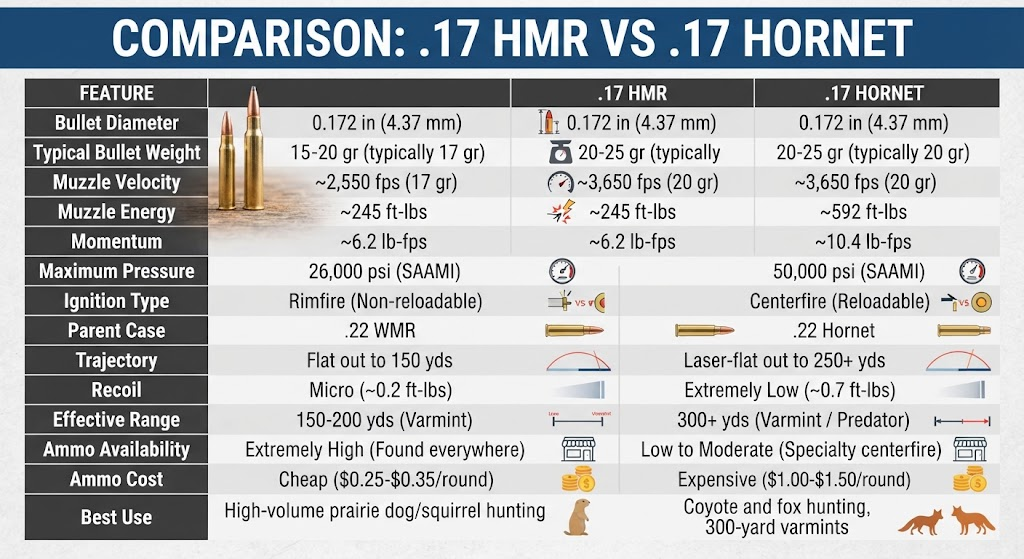
The main difference in the 17 Hmr Vs 17 Hornet comparison is that the 17 HMR is a convenient, rimfire cartridge limited to intermediate ranges, whereas the 17 Hornet is a reloadable centerfire cartridge that delivers significantly higher velocities and double the kinetic energy. While the rimfire option provides cheap and ubiquitous high-volume pest control, the centerfire Hornet transforms the lightweight projectile into a devastating 300-yard predator hunting tool.
Table of Contents [Click to open]
17 Hmr Vs 17 Hornet Comparison
| Feature | 17 HMR | 17 Hornet |
| Bullet Diameter | 0.172 inches (4.37 mm) | 0.172 inches (4.37 mm) |
| Typical Bullet Weight | 15 gr to 20 gr (typically 17 gr) | 20 gr to 25 gr (typically 20 gr) |
| Muzzle Velocity | ~2,550 fps (17 gr from 20-inch barrel) | ~3,650 fps (20 gr from 24-inch barrel) |
| Muzzle Energy | ~245 ft-lbs | ~592 ft-lbs |
| Momentum | ~6.2 lb-fps | ~10.4 lb-fps |
| Maximum Pressure | 26,000 psi (SAAMI) | 50,000 psi (SAAMI) |
| Ignition Type | Rimfire (Non-reloadable) | Centerfire (Reloadable) |
| Parent Case | 22 WMR (Winchester Magnum Rimfire) | 22 Hornet |
| Trajectory | Flat out to 150 yards | Laser-flat out to 250+ yards |
| Recoil | Micro (~0.2 ft-lbs) | Extremely Low (~0.7 ft-lbs) |
| Effective Range | 150 to 200 yards (Varmint) | 300+ yards (Varmint / Predator) |
| Ammo Availability | Extremely High (Found everywhere) | Low to Moderate (Specialty centerfire) |
| Ammo Cost | Cheap ($0.25 to $0.35 per round) | Expensive ($1.00 to $1.50 per round) |
| Best Use | High-volume prairie dog/squirrel hunting | Coyote and fox hunting, 300-yard varmints |
The table above illustrates the mechanical leap from rimfire to centerfire. Hornady engineered the 17 HMR (Hornady Magnum Rimfire) in 2002 by necking down a 22 WMR case, creating what is arguably the most successful modern rimfire cartridge in existence.
Exactly ten years later, in 2012, Hornady struck again by standardizing the 17 Hornet. By necking down the classic centerfire 22 Hornet case, changing the shoulder angle to 25 degrees, and utilizing modern propellants, they created a centerfire cartridge that operates at nearly double the pressure (50,000 psi) of the rimfire HMR. This massive pressure increase translates to drastically higher velocities while maintaining the same 0.172-inch bore diameter.
17 Hmr Vs 17 Hornet Ballistics
To objectively evaluate the ballistic capabilities, we must examine real-world factory ammunition across standard rifle barrel lengths.
- Load A (17 HMR High Velocity): Hornady 17-grain V-MAX. Tested from a 20-inch barrel. Muzzle velocity is 2,550 feet per second. Muzzle energy is 245 foot-pounds. Ballistic Coefficient (G1) is 0.125.
- Load B (17 HMR Heavy Game): Hornady 20-grain XTP. Tested from a 20-inch barrel. Muzzle velocity is 2,375 feet per second. Muzzle energy is 250 foot-pounds. Ballistic Coefficient (G1) is 0.125.
- Load C (17 Hornet High Velocity): Hornady 20-grain V-MAX. Tested from a 24-inch barrel. Muzzle velocity is 3,650 feet per second. Muzzle energy is 592 foot-pounds. Ballistic Coefficient (G1) is 0.185.
- Load D (17 Hornet Heavy Predator): Hornady 25-grain HP Custom. Tested from a 24-inch barrel. Muzzle velocity is 3,320 feet per second. Muzzle energy is 612 foot-pounds. Ballistic Coefficient (G1) is 0.187.
17 Hmr Vs 17 Hornet Velocity
Velocity is the entire reason the centerfire 17 Hornet was created.
The 17 HMR is exceptionally fast for a rimfire cartridge, launching a 17-grain bullet at 2,550 feet per second. This was a revolutionary speed for rimfire shooters in 2002, easily outclassing the 22 Magnum in flat-shooting trajectory.
However, the 17 Hornet operates in an entirely different league. Pushing a heavier 20-grain bullet, the 17 Hornet achieves a blistering 3,650 feet per second at the muzzle. This means the 17 Hornet leaves the barrel 1,100 feet per second faster than the 17 HMR. This extreme hyper-velocity completely changes how the bullet reacts upon impact and how it fights wind deflection.
17 Hmr Vs 17 Hornet Muzzle Energy
Muzzle energy represents the raw kinetic work capacity of a projectile.
The 17 HMR generates roughly 245 to 250 foot-pounds of energy at the muzzle. This is perfect for squirrels, rabbits, and prairie dogs, but many hunters consider it too weak for ethical, consistent kills on larger predators like coyotes past 50 yards.
The 17 Hornet generates nearly 600 foot-pounds of energy at the muzzle—more than double the kinetic energy of the 17 HMR. This massive jump in power bridges the gap between small varmint control and serious predator hunting, delivering the hydrostatic shock necessary to anchor a coyote at 200 yards instantly.
17 Hmr Vs 17 Hornet Momentum
Momentum calculates mass in motion, which dictates a bullet’s ability to drive through tissue rather than splashing superficially on the surface.
Because the 17 Hornet fires slightly heavier bullets (20 to 25 grains) at drastically higher speeds, it carries significantly more linear momentum. A 20-grain 17 Hornet traveling at 3,650 fps yields approximately 10.4 pound-feet per second of momentum. A 17-grain 17 HMR traveling at 2,550 fps yields only 6.2 pound-feet per second.
17 Hmr Vs 17 Hornet Trajectory
Understanding external ballistics highlights the strict range limitations of rimfire cartridges compared to centerfire options. The calculations below assume a standard rifle optic height of 1.5 inches above the bore and a 100-yard zero.
| Distance | 17 HMR (17 gr at 2,550 fps) Drop | 17 Hornet (20 gr at 3,650 fps) Drop |
| Muzzle | -1.5 inches | -1.5 inches |
| 100 Yards | 0.0 inches (Zero) | 0.0 inches (Zero) |
| 200 Yards | -8.5 inches | -2.4 inches |
| 300 Yards | -32.2 inches | -10.8 inches |
| 400 Yards | -80.5 inches | -28.5 inches |
The trajectory data confirms that the 17 Hornet is a laser beam. At 200 yards, the 17 HMR drops 8.5 inches, requiring a hunter to hold over the target’s head. At the same distance, the 17 Hornet drops a mere 2.4 inches, allowing for a dead-center hold on a coyote’s vitals.
Furthermore, the 17 Hornet uses highly aerodynamic bullets. In a 10 mph crosswind at 200 yards, the 17 HMR will drift over 16 inches. The 17 Hornet will drift only 7 inches, making it vastly superior in the open plains.
17 Hmr Vs 17 Hornet Recoil
Recoil is virtually non-existent for both cartridges, making them absolute joys to shoot.
The 17 HMR generates roughly 0.2 foot-pounds of free recoil energy, which is essentially zero. The 17 Hornet generates roughly 0.7 foot-pounds. Both cartridges allow the shooter to keep the reticle perfectly still during the shot, enabling instant visual confirmation of bullet impact through the scope.
17 Hmr Vs 17 Hornet Penetration & Expansion
Both cartridges rely on lightweight, highly frangible bullets (like the V-MAX) to deliver terminal performance.
When a 17 HMR strikes a small target, the polymer tip drives backward into the lead core, causing rapid fragmentation. It is devastating on prairie dogs.
When a 17 Hornet strikes a target at 3,600+ fps, the extreme hydraulic pressure causes the bullet to vaporize violently upon impact. This creates a massive, shallow wound channel that causes instant incapacitation in predators like coyotes and foxes without exiting the opposite side, which preserves the pelt for fur hunters.
17 Hmr Vs 17 Hornet Self Defense
Neither cartridge is suitable for self-defense or home defense. Both utilize tiny, lightweight projectiles engineered to fragment inside small rodents. They lack the penetration depth and mass required to reliably stop human-sized threats.
Which Has More Stopping Power: 17 Hmr Vs 17 Hornet?
On predators and varmints, the 17 Hornet possesses vastly superior stopping power. It hits targets with more than double the kinetic energy, creates drastically larger temporary wound cavities, and reliably anchors medium-sized predators at distances where the 17 HMR would merely wound them.
Which Is More Powerful: 17 Hmr Vs 17 Hornet?
Based on raw kinetic energy and velocity, the 17 Hornet is significantly more powerful, producing nearly 600 foot-pounds of energy compared to the 17 HMR’s 245 foot-pounds.
17 HMR Pros And Cons
Pros
- Extremely cheap to shoot, allowing for high-volume pest eradication
- Ammunition is available in every sporting goods store and hardware store
- No reloading required; simple, reliable rimfire convenience
- Highly accurate out to 150 yards with zero recoil
Cons
- Lacks the kinetic energy to ethically hunt coyotes past 50 yards
- Extremely susceptible to wind drift past 100 yards
- Cannot be reloaded, meaning you are limited to factory load options
17 Hornet Pros And Cons
Pros
- Blistering centerfire velocity (3,650 fps) delivers laser-flat trajectories
- Produces double the kinetic energy, making it an ethical 300-yard coyote cartridge
- Centerfire brass is fully reloadable, allowing shooters to tune accuracy perfectly
- Violent fragmentation preserves predator pelts by preventing exit wounds
Cons
- Ammunition is significantly more expensive (often $1.00+ per round)
- Factory ammunition can be difficult to find locally, often requiring online orders
- Barrels heat up faster and require more cleaning maintenance than rimfire barrels
Final Comparison
| Category | Winner | Reason |
| Velocity | 17 Hornet | Operates at double the pressure to push bullets 1,100 fps faster |
| Muzzle Energy | 17 Hornet | Generates nearly 600 ft-lbs, more than double the rimfire option |
| Momentum | 17 Hornet | Heavier 20-25 grain bullets at extreme speeds yield higher mass-in-motion |
| Penetration | Tie | Both use highly frangible bullets designed to fragment, not penetrate deeply |
| Expansion | 17 Hornet | Hyper-velocity impact creates a much more explosive, violent tissue cavity |
| Trajectory | 17 Hornet | 1,100 fps advantage cuts bullet drop and wind drift by more than half |
| Recoil Control | Tie | Both generate less than 1 ft-lb of recoil, providing flinch-free shooting |
| Effective Range | 17 Hornet | Ethical on varmints and coyotes out to 300+ yards |
| Self Defense | Neither | Both are specialized varmint hunting calibers |
| Concealed Carry | Neither | Both are rifle cartridges |
| Ammo Cost | 17 HMR | Standard rimfire mass-production makes it incredibly cheap |
| Ammo Availability | 17 HMR | Ubiquitous global availability on every store shelf |
| Overall Performance | 17 Hornet | Vastly superior ballistics, though it sacrifices rimfire economy |
17 Hmr Vs 17 Hornet: Which Should You Choose?
Selecting the winner in the 17 Hmr Vs 17 Hornet matchup depends entirely on whether you are looking for high-volume, budget-friendly pest control or a dedicated, long-range predator rifle.
Choose the 17 HMR if your primary goal is shooting prairie dogs, ground squirrels, or rabbits inside 150 yards. It is the ultimate convenience cartridge. You can buy hundreds of rounds for a fraction of the cost of centerfire ammunition, shoot all day without fatigue, and you never have to worry about picking up your brass to reload.
Choose the 17 Hornet if you are a predator hunter targeting coyotes, bobcats, or foxes out to 300 yards. The 17 Hornet delivers the hyper-velocity flat trajectory and kinetic energy required to anchor these larger animals ethically. Furthermore, because the bullets explode on impact without exiting, it is considered one of the finest fur-friendly centerfire cartridges in existence for hunters who save and sell pelts.
FAQs
Is 17 Hornet more powerful than 17 HMR?
Yes, the 17 Hornet is vastly more powerful. Because it is a high-pressure centerfire cartridge, it holds significantly more powder, delivering more than double the kinetic energy (592 ft-lbs) compared to the rimfire 17 HMR (245 ft-lbs).
Can a 17 HMR shoot 17 Hornet ammo?
No. They are completely different cartridge designs. The 17 HMR is a rimfire cartridge, meaning the firing pin strikes the rim of the base. The 17 Hornet is a centerfire cartridge with a replaceable primer in the center of the base. They cannot be chambered in the same firearm.
Which shoots further?
The 17 Hornet shoots significantly further. Its 1,100 fps velocity advantage allows it to shoot flat and resist wind drift out to 300 yards, whereas the 17 HMR drops rapidly and is pushed heavily by the wind past 150 yards.
Is 17 HMR good for coyotes?
While it can kill a coyote with perfect shot placement at close range (under 50 yards), the 17 HMR is widely considered too weak for ethical, consistent coyote hunting. The 17 Hornet is a much better choice for coyotes.
Which is cheaper to shoot?
The 17 HMR is significantly cheaper to shoot. You can often purchase a 50-round box of 17 HMR for $15 to $20, whereas a 25-round box of 17 Hornet typically costs $25 to $35.
Can you reload 17 HMR?
No. Rimfire cartridges cannot be practically reloaded by consumers because the priming compound is spun into the rim at the factory. The 17 Hornet uses a standard Boxer primer and can be reloaded for extreme precision.