The main difference between these cartridges is that the .40 S&W is a shortened version of the 10mm Auto designed to fit into standard-sized pistol frames with manageable recoil, whereas the 10mm Auto utilizes a longer case to pack more powder, driving identical .400-caliber bullets at significantly higher velocities. While the .40 S&W excels in law enforcement and urban concealed carry, the 10mm Auto reigns supreme as a high-capacity wilderness defense tool capable of delivering magnum-level kinetic energy.
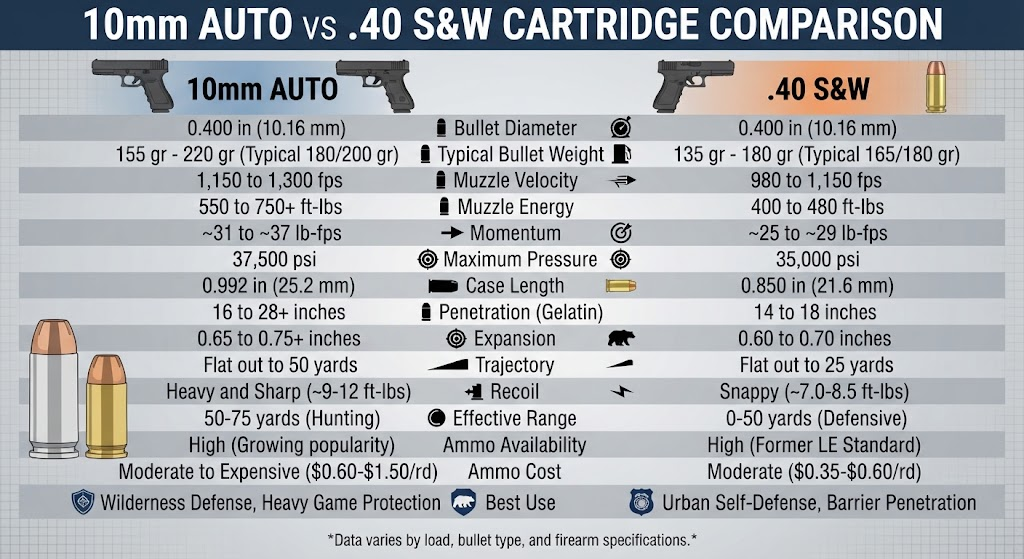
10mm vs 40 S&W Comparison
| Feature | 10mm Auto | .40 S&W |
| Bullet Diameter | 0.400 inches (10.16 mm) | 0.400 inches (10.16 mm) |
| Typical Bullet Weight | 155 gr to 220 gr (typically 180 gr or 200 gr) | 135 gr to 180 gr (typically 165 gr or 180 gr) |
| Muzzle Velocity | 1,150 to 1,300 fps (4 to 5-inch barrel) | 980 to 1,150 fps (4-inch barrel) |
| Muzzle Energy | 550 to 750+ ft-lbs | 400 to 480 ft-lbs |
| Momentum | ~31 to ~37 lb-fps | ~25 to ~29 lb-fps |
| Maximum Pressure | 37,500 psi (SAAMI) | 35,000 psi (SAAMI) |
| Case Length | 0.992 inches (25.2 mm) | 0.850 inches (21.6 mm) |
| Penetration | 16 to 28+ inches (Gelatin depending on bullet) | 14 to 18 inches (Gelatin) |
| Expansion | 0.65 to 0.75+ inches | 0.60 to 0.70 inches |
| Trajectory | Flat out to 50 yards | Flat out to 25 yards |
| Recoil | Heavy and sharp (~9 to 12 ft-lbs) | Snappy (~7.0 to 8.5 ft-lbs) |
| Effective Range | 50 to 75 yards (Handgun Hunting) | 0 to 50 yards (Defensive) |
| Ammo Availability | High (Growing popularity) | High (Former law enforcement standard) |
| Ammo Cost | Moderate to Expensive ($0.60 to $1.50/rd) | Moderate ($0.35 to $0.60/rd) |
| Best Use | Wilderness defense, heavy game protection | Urban self-defense, barrier penetration |
The table highlights the direct lineage between these two rounds. In 1986, following a tragic shootout in Miami, the FBI adopted the 10mm Auto to provide agents with superior penetration and stopping power. However, the massive recoil of full-power 10mm ammunition proved too difficult for many agents to control, and the large-framed pistols required to chamber the long cartridge were difficult for agents with smaller hands to grip.
To solve this, the FBI requested “reduced recoil” 10mm loads. Smith & Wesson and Winchester quickly realized that if the 10mm was being downloaded anyway, they could simply shorten the brass case from 25.2mm down to 21.6mm while replicating the exact same reduced-velocity ballistics. This new cartridge, dubbed the .40 S&W, could fit perfectly into medium-framed pistols designed for the 9mm Luger (like the Glock 23 or M&P40). The .40 S&W offers a highly efficient compromise, while the 10mm Auto retains the absolute maximum physical potential of the 0.400-inch bore.
10mm vs 40 S&W Ballistics
To objectively evaluate the ballistic capabilities, we must examine premium hollow-point ammunition. Because the two cartridges share the exact same bullet diameter, many manufacturers use the exact same projectiles in both cartridges, simply driving them at different speeds.
- Load A (10mm Auto Full Power): Underwood 180-grain XTP Jacketed Hollow Point. Muzzle velocity is 1,300 feet per second. Muzzle energy is 675 foot-pounds.
- Load B (10mm Auto Standard Defense): Federal Premium 180-grain HST. Muzzle velocity is 1,150 feet per second. Muzzle energy is 528 foot-pounds.
- Load C (.40 S&W Standard Defense): Federal Premium 180-grain HST. Muzzle velocity is 1,010 feet per second. Muzzle energy is 408 foot-pounds.
- Load D (.40 S&W High Velocity): Speer 165-grain Gold Dot. Muzzle velocity is 1,150 feet per second. Muzzle energy is 484 foot-pounds.
10mm vs 40 S&W Velocity
Velocity is the primary separator here. Because the 10mm Auto case is over 3.5 millimeters longer, it holds a significantly larger powder charge. Additionally, the 10mm Auto operates at a higher SAAMI maximum pressure limit (37,500 psi) compared to the .40 S&W (35,000 psi).
When firing identical 180-grain bullets, a full-power 10mm Auto exits the barrel at roughly 1,250 to 1,300 feet per second. The .40 S&W pushes that exact same 180-grain bullet at roughly 1,000 feet per second. The 10mm Auto provides a massive 250 to 300 fps velocity advantage.
To achieve 1,150 fps in a .40 S&W, a shooter must drop down to a lighter 165-grain bullet. The 10mm Auto can achieve 1,150 fps while pushing heavy 200-grain bullets. The 10mm simply runs in a completely different speed class.
10mm vs 40 S&W Muzzle Energy
Muzzle energy represents the raw kinetic work capacity of a projectile. Because the 10mm Auto drives identical bullet weights much faster, it completely dominates the muzzle energy category.
A standard .40 S&W defensive load generally produces between 400 and 480 foot-pounds of energy at the muzzle. This is excellent for urban self-defense, offering roughly 20% more energy than a standard 9mm.
A full-power 10mm Auto produces between 600 and 750 foot-pounds of energy at the muzzle. This massive 200+ foot-pound advantage elevates the 10mm Auto out of the urban self-defense tier and directly into the magnum handgun hunting tier, matching the kinetic energy of a .357 Magnum while offering double the ammunition capacity.
10mm vs 40 S&W Momentum
Momentum is a linear measurement calculating mass in motion. In terminal ballistics, high momentum correlates closely with a bullet’s ability to crush through dense bone, heavy winter hides, and intermediate barriers without being deflected.
A 180-grain .40 S&W bullet traveling at 1,010 feet per second yields approximately 26.0 pound-feet per second of linear momentum.
An identical 180-grain 10mm Auto bullet traveling at 1,300 feet per second yields approximately 33.4 pound-feet per second of linear momentum.
When a hiker needs to punch through the thick shoulder cartilage of an aggressive black bear, the extra velocity behind the 10mm bullet provides the driving momentum necessary to reach vital organs, whereas the slower .40 S&W is more likely to halt prematurely.
10mm vs 40 S&W Trajectory
The trajectory of a handgun bullet is effectively a non-issue at typical defensive distances (0 to 15 yards). However, because the 10mm Auto is frequently used by handgun hunters, its longer-range capabilities are relevant.
The 10mm Auto shoots noticeably flatter at 50 yards and beyond due to its higher initial velocity. A hunter aiming at a feral hog at 50 yards with a 10mm Auto can hold their sights directly on the vitals, whereas the slower, arcing .40 S&W bullet will drop an extra inch or two at that distance.
10mm vs 40 S&W Recoil
Recoil management is the exact reason the .40 S&W was invented.
The 10mm Auto produces heavy, sharp recoil. Fired from a full-size pistol (like the Glock 20), a full-power load generates roughly 10 to 12 foot-pounds of free recoil energy. The muzzle flip is substantial, and the concussive blast is loud. For inexperienced shooters, the 10mm Auto can quickly induce flinching and significantly slow down split times between shots.
The .40 S&W produces a “snappy” recoil impulse, generating roughly 7.5 to 8.5 foot-pounds of free recoil energy. While it is certainly harsher than a 9mm, it is vastly more controllable than a full-power 10mm. This reduced recoil allows shooters to place multiple accurate shots on a target much faster during a dynamic defensive encounter.
10mm vs 40 S&W Penetration
The .40 S&W was engineered to perfectly pass the FBI penetration protocol (12 to 18 inches in 10% ballistic gelatin). It accomplishes this flawlessly. A high-quality .40 S&W hollow point will consistently penetrate 14 to 16 inches in soft tissue while expanding reliably, making it an optimal cartridge for stopping two-legged threats.
The 10mm Auto frequently over-penetrates by urban standards. Because it strikes with so much velocity and momentum, premium 10mm hollow points often blow past 18 inches of penetration. When loaded with 200-grain or 220-grain hard-cast lead flat-nose bullets designed for bears, the 10mm Auto will easily crush through 30+ inches of dense muscle and bone, ensuring a complete pass-through on heavy game.
10mm vs 40 S&W Expansion
Because both cartridges fire the exact same 0.400-inch diameter projectiles, their expansion potential is massive.
The .40 S&W expands beautifully at roughly 1,000 fps, frequently mushrooming to 0.60 to 0.70 inches in diameter.
The 10mm Auto strikes targets at significantly higher velocities, which forces fluid into the hollow-point cavity with immense hydraulic pressure. This causes the 10mm bullet to expand more violently and to a wider final diameter, often reaching 0.70 to 0.75+ inches. This wider expansion, combined with higher kinetic energy, translates to a physically larger and more devastating permanent wound channel.
10mm vs 40 S&W Self Defense & Concealed Carry
The .40 S&W is the objectively superior choice for urban concealed carry and daily self-defense. Because the cartridge is shorter, it fits into compact and sub-compact pistol frames (like the Glock 27 or Smith & Wesson M&P40 Shield) that are easy to conceal under a t-shirt. The recoil is manageable enough for rapid defensive fire, and the bullets are designed to stop inside the target, drastically reducing the risk to innocent bystanders.
The 10mm Auto is a wilderness defense tool. To safely contain the extreme pressures and mitigate the massive recoil, 10mm pistols must be built with thicker slides, heavier recoil springs, and larger grips (to hold the longer cartridge). A Glock 20 is a massive, heavy block of steel and polymer that is incredibly difficult to conceal comfortably. Furthermore, the extreme over-penetration risk makes the 10mm a liability in crowded residential environments.
Which Has More Stopping Power: 10mm or 40 S&W?
The 10mm Auto possesses significantly more raw stopping power. It delivers over 200 additional foot-pounds of kinetic energy, pushes bullets much deeper into heavy targets, and creates a wider, more violent wound channel. If you need to stop a massive apex predator, the 10mm Auto is the clear winner.
Which Is More Powerful: 10mm or 40 S&W?
Based on kinetic energy and linear momentum calculations, the 10mm Auto is vastly more powerful. The .40 S&W was literally designed to be a less powerful, downloaded version of the 10mm.
10mm Auto Pros and Cons
Pros
- Generates magnum-level kinetic energy (600+ ft-lbs) in a high-capacity semi-automatic platform
- Heavy 200+ grain hard-cast bullets provide incredibly deep, bone-crushing penetration on dangerous game
- Extremely flat trajectory for a semi-automatic handgun, allowing for ethical 50-yard hunting shots
- The absolute premier choice for wilderness guides and hikers in bear country
Cons
- Heavy, punishing recoil drastically slows down follow-up shots for average shooters
- Requires large, thick-framed handguns that are highly impractical for daily concealed carry
- Extreme over-penetration hazards make it a massive liability for home defense in suburban areas
.40 S&W Pros and Cons
Pros
- Fits perfectly into standard, medium-framed 9mm-sized pistols, making it highly concealable
- Delivers 20% more kinetic energy and wider expansion than standard 9mm ammunition
- Heavy bullets provide excellent barrier-blind penetration through auto glass and heavy winter clothing
- Ammunition is highly affordable and abundant due to decades of massive law enforcement use
Cons
- Produces snappy, harsh recoil that is significantly less pleasant to shoot than a 9mm
- Reduces magazine capacity by 2 to 3 rounds compared to an identical pistol chambered in 9mm
- Lacks the raw momentum and kinetic energy required to ethically stop massive dangerous game like grizzly bears
Final Comparison
| Category | Winner | Reason |
| Velocity | 10mm Auto | Larger powder capacity effortlessly drives identical bullets 250+ fps faster |
| Muzzle Energy | 10mm Auto | Higher velocity translates to roughly 200 more ft-lbs of kinetic energy |
| Momentum | 10mm Auto | Faster speed applied to identical bullet mass yields superior linear momentum |
| Penetration | 10mm Auto | High momentum pushes heavy hard-cast projectiles deep through heavy bone |
| Expansion | 10mm Auto | Higher impact velocities create more violent hydraulic pressure upon impact |
| Trajectory | 10mm Auto | Higher velocity produces a significantly flatter curve out to 50+ yards |
| Recoil Control | .40 S&W | Lower powder charge produces a much milder, more manageable recoil impulse |
| Effective Range | 10mm Auto | Retains lethal kinetic energy and a flat trajectory at longer handgun hunting distances |
| Self Defense | .40 S&W | Fits concealable frames, manageable recoil, and reduces over-penetration risks |
| Concealed Carry | .40 S&W | Chambered in compact, thin pistols that are easy to hide on the body |
| Ammo Cost | .40 S&W | Massive law enforcement legacy guarantees significantly cheaper retail price tags |
| Ammo Availability | Tie | Both are highly popular and found in massive quantities nationwide |
| Overall Performance | Depends on Target | 10mm Auto for wilderness defense; .40 S&W for urban concealed carry |
10mm vs 40 S&W: Which Should You Choose?
Selecting between the 10mm Auto and the .40 S&W is entirely dependent on whether you are defending yourself against apex predators in the woods or human threats in the city.
Choose the 10mm Auto if your primary goal is wilderness defense, backcountry hiking, or handgun hunting. The 10mm Auto provides the massive kinetic energy and deep momentum-driven penetration required to crush through the skull or shoulders of an aggressive bear or feral hog. Having 15 rounds of magnum-level power in a semi-automatic platform provides unmatched security in the wild.
Choose the .40 S&W for urban self-defense, home defense, and daily concealed carry. The .40 S&W provides excellent barrier penetration and wide wound channels, but it fits perfectly into small, easily concealable handguns. The recoil is much faster to manage under panic, and the bullets are specifically designed to stop inside human-sized targets, ensuring you do not endanger your family or neighbors during a home invasion.
FAQs
Is 10mm more powerful than 40 S&W?
Yes, the 10mm Auto is significantly more powerful. It generates roughly 200 to 250 more foot-pounds of muzzle energy and carries substantially higher linear momentum than the .40 S&W because it utilizes a longer case with more powder.
Which has more muzzle energy?
The 10mm Auto generally produces roughly 600 to 750 foot-pounds of muzzle energy, whereas the .40 S&W produces roughly 400 to 480 foot-pounds of energy.
Which has more stopping power?
On large dangerous game (bears, hogs), the 10mm Auto possesses vastly superior stopping power due to its ability to crush heavy bone and deliver deeper penetration. On human-sized targets, both offer excellent stopping power, but the .40 S&W allows for faster, more accurate follow-up shots.
Which has more recoil?
The 10mm Auto generates significantly more recoil. Fired from a full-size pistol, it produces a heavy, sharp impulse with loud muzzle blast. The .40 S&W produces a “snappy” but much more manageable recoil impulse.
Which has better penetration?
The 10mm Auto penetrates much deeper. Its higher velocity allows it to push heavy hard-cast lead bullets through thick shoulder muscle and bone without deflecting or halting prematurely.
Which expands more?
While both fire 0.400-inch diameter bullets, a premium 10mm Auto hollow point will create a wider and more violent permanent wound channel due to its higher impact velocity generating more hydraulic pressure.
Which is better for self defense?
The .40 S&W is widely considered the superior choice for urban self-defense and home defense. It fits into smaller, more concealable handguns, allows for faster follow-up shots, and significantly reduces the risk of bullets over-penetrating through walls and striking bystanders.
Which is better for concealed carry?
The .40 S&W is vastly better for concealed carry. 10mm pistols require large, thick grips to accommodate the longer cartridge and heavy slides to manage the recoil, making them bulky and difficult to hide.
Is 10mm faster than 40 S&W?
Yes, the 10mm Auto is substantially faster. A standard 180-grain 10mm bullet easily reaches 1,250 to 1,300 fps, while the identical 180-grain .40 S&W bullet typically launches at roughly 1,000 fps.
Can a 10mm shoot 40 S&W?
Physically, a .40 S&W cartridge will fit into a 10mm chamber and can often be fired because the extractor hook holds the case against the breech face. However, this is highly dangerous and strongly discouraged by firearm manufacturers. Because the .40 S&W case is shorter, it does not properly headspace on the chamber mouth. Firing it in a 10mm pistol places severe stress on the extractor, can cause light primer strikes, and may lead to catastrophic case failures or immediate weapon malfunctions.
Which is cheaper to shoot?
The .40 S&W is significantly cheaper to shoot due to its decades-long history as the standard law enforcement cartridge in the United States, which resulted in massive bulk production of affordable practice ammunition.
Which should you choose?
Choose the 10mm Auto for wilderness defense against dangerous game and high-capacity handgun hunting. Choose the .40 S&W for urban concealed carry, manageable recoil, and barrier-blind self-defense.