A 50 Caliber Muzzleloader Ballistics Chart is an incredibly detailed and highly comprehensive reference table that tracks the velocity, kinetic energy, and trajectory curve of modern inline muzzleloader projectiles over various distances. By carefully reviewing this specific chart, you can visualize exactly how your sabot or conical bullet will behave from the precise moment the black powder substitute ignites until it strikes a target downrange. This critical data allows you to accurately predict bullet drop, compensate for wind drift, and verify that your heavy projectile retains enough energy for an ethical harvest on big game animals across open fields or dense timber.
Hunters, traditionalists, and modern black powder enthusiasts use a 50 Cal Muzzleloader Ballistics Chart to unlock the absolute true potential of the inline muzzleloading platform. Unlike fixed centerfire cartridges, a muzzleloader allows the shooter to completely customize their load by altering the powder charge and bullet weight to suit specific hunting environments. By studying the numbers today, a dedicated late-season hunter can confidently take a challenging shot on a whitetail deer knowing exactly how their polymer-tipped sabot will perform. A big game hunter uses the trajectory data to understand exactly how much to adjust their optic for hitting a bull elk at two hundred yards. In this comprehensive guide, you will learn how to analyze ballistics data, choose the absolute best projectile weight for your specific needs, understand the variable of powder charges, and see exactly how the modern 50 caliber muzzleloader dominates special hunting seasons today.
50 Caliber Muzzleloader Ballistics Chart
Below is a detailed ballistics table featuring the most popular and proven projectiles available today. Because muzzleloader ballistics are entirely dependent on how much powder the shooter loads, this chart specifies the volumetric powder equivalent (e.g., 100 grains or 150 grains of a modern substitute like Hodgdon Triple Seven or Blackhorn 209). The data represents a standard 26-inch inline barrel and assumes a 100-yard zero under standard sea-level atmospheric conditions. Because muzzleloaders fire relatively blunt or sabot-encased bullets, their aerodynamic performance drops significantly past two hundred yards, but data out to five hundred yards is provided to illustrate the absolute physical limitations of the platform.
| Bullet Weight | Bullet Type | Manufacturer | Muzzle Velocity | Velocity At 100 Yards | Velocity At 200 Yards | Velocity At 300 Yards | Velocity At 400 Yards | Velocity At 500 Yards | Muzzle Energy | Energy At 100 Yards | Energy At 200 Yards | Energy At 300 Yards | Energy At 400 Yards | Energy At 500 Yards | Trajectory At 100 Yards | Trajectory At 200 Yards | Trajectory At 300 Yards | Trajectory At 400 Yards | Trajectory At 500 Yards | Ballistic Coefficient | Sectional Density |
| 250 Grain | SST Sabot (100gr Charge) | Hornady | 1900 fps | 1540 fps | 1240 fps | 1030 fps | 910 fps | 820 fps | 2004 ft lbs | 1316 ft lbs | 853 ft lbs | 589 ft lbs | 460 ft lbs | 373 ft lbs | 0 inches | 10.5 inches drop | 37.5 inches drop | 85.0 inches drop | 160.0 inches drop | 0.210 | 0.175 |
| 250 Grain | SST Sabot (150gr Charge) | Hornady | 2200 fps | 1800 fps | 1450 fps | 1170 fps | 1000 fps | 890 fps | 2686 ft lbs | 1798 ft lbs | 1167 ft lbs | 760 ft lbs | 555 ft lbs | 440 ft lbs | 0 inches | 6.5 inches drop | 25.5 inches drop | 63.0 inches drop | 125.0 inches drop | 0.210 | 0.175 |
| 250 Grain | TEZ Sabot (100gr Charge) | Barnes | 1900 fps | 1530 fps | 1225 fps | 1020 fps | 900 fps | 815 fps | 2004 ft lbs | 1299 ft lbs | 833 ft lbs | 577 ft lbs | 450 ft lbs | 369 ft lbs | 0 inches | 10.8 inches drop | 38.5 inches drop | 87.0 inches drop | 163.0 inches drop | 0.205 | 0.175 |
| 250 Grain | TEZ Sabot (150gr Charge) | Barnes | 2200 fps | 1785 fps | 1435 fps | 1155 fps | 990 fps | 885 fps | 2686 ft lbs | 1768 ft lbs | 1143 ft lbs | 741 ft lbs | 544 ft lbs | 435 ft lbs | 0 inches | 6.8 inches drop | 26.2 inches drop | 65.0 inches drop | 128.0 inches drop | 0.205 | 0.175 |
| 295 Grain | Aerotip (100gr Charge) | PowerBelt | 1750 fps | 1400 fps | 1120 fps | 960 fps | 850 fps | 770 fps | 2006 ft lbs | 1284 ft lbs | 822 ft lbs | 603 ft lbs | 473 ft lbs | 388 ft lbs | 0 inches | 13.5 inches drop | 46.0 inches drop | 102.0 inches drop | 185.0 inches drop | 0.200 | 0.207 |
| 295 Grain | Aerotip (150gr Charge) | PowerBelt | 2000 fps | 1620 fps | 1295 fps | 1070 fps | 930 fps | 830 fps | 2620 ft lbs | 1718 ft lbs | 1100 ft lbs | 750 ft lbs | 566 ft lbs | 451 ft lbs | 0 inches | 8.8 inches drop | 31.5 inches drop | 75.0 inches drop | 145.0 inches drop | 0.200 | 0.207 |
| 300 Grain | SST Sabot (100gr Charge) | Hornady | 1800 fps | 1485 fps | 1215 fps | 1030 fps | 915 fps | 825 fps | 2158 ft lbs | 1469 ft lbs | 983 ft lbs | 707 ft lbs | 558 ft lbs | 453 ft lbs | 0 inches | 11.5 inches drop | 39.5 inches drop | 88.0 inches drop | 162.0 inches drop | 0.250 | 0.210 |
| 300 Grain | Expander MZ (100gr Charge) | Barnes | 1800 fps | 1420 fps | 1135 fps | 970 fps | 860 fps | 780 fps | 2158 ft lbs | 1343 ft lbs | 858 ft lbs | 627 ft lbs | 493 ft lbs | 405 ft lbs | 0 inches | 12.8 inches drop | 45.0 inches drop | 100.0 inches drop | 182.0 inches drop | 0.190 | 0.210 |
| 350 Grain | BOR Lock MZ (100gr Charge) | Federal Premium | 1700 fps | 1360 fps | 1100 fps | 950 fps | 845 fps | 765 fps | 2246 ft lbs | 1437 ft lbs | 940 ft lbs | 701 ft lbs | 555 ft lbs | 455 ft lbs | 0 inches | 14.5 inches drop | 49.5 inches drop | 108.0 inches drop | 195.0 inches drop | 0.210 | 0.245 |
| 385 Grain | Great Plains (100gr Charge) | Hornady | 1500 fps | 1180 fps | 985 fps | 865 fps | 785 fps | 725 fps | 1923 ft lbs | 1190 ft lbs | 830 ft lbs | 640 ft lbs | 527 ft lbs | 450 ft lbs | 0 inches | 21.0 inches drop | 68.0 inches drop | 145.0 inches drop | 255.0 inches drop | 0.170 | 0.270 |
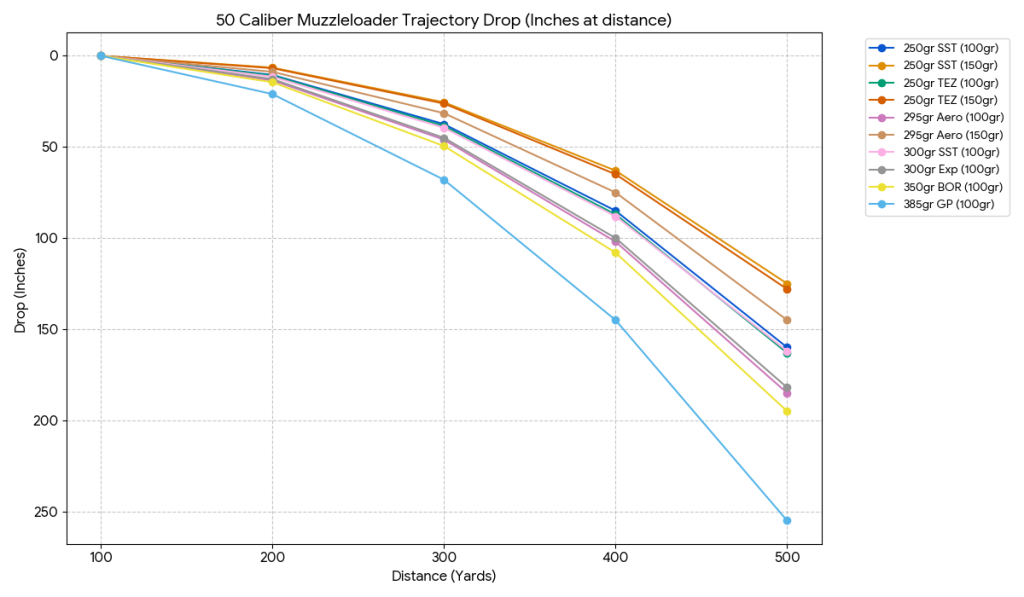
Understanding The Chart
A ballistics chart can look overwhelming at first glance due to the sheer volume of data presented. However, once you break down each column, the numbers paint a brilliantly clear picture of how a specific load will perform in the field. Understanding these distinct metrics is absolutely crucial for maximizing your success during muzzleloader season.
Muzzle Velocity
Muzzle velocity is the exact speed at which the bullet exits the barrel of the firearm, measured in feet per second. Unlike a centerfire cartridge, you control this metric entirely by the amount of powder you load. A standard 100-grain volume charge of modern pellets typically yields between 1700 and 1900 fps depending on bullet weight. Stepping up to a “magnum” 150-grain charge pushes lighter bullets well past 2100 fps, significantly flattening the trajectory at the cost of a massive increase in recoil.
Retained Velocity
Retained velocity refers to the speed of the bullet at specific distances downrange. Air resistance constantly slows the bullet down as it travels through the atmosphere. Retained velocity is incredibly important because expanding hunting bullets—especially solid copper hollow points—require a specific minimum velocity to open up properly upon impact. Because muzzleloader bullets are generally blunt and heavy, they shed velocity extremely fast past 150 yards.
Kinetic Energy
Kinetic energy is the amount of destructive physical force the bullet carries, measured in foot-pounds. It is calculated by utilizing the weight of the bullet and its velocity at any given distance. Hunters must pay close attention to this specific metric to ensure they have enough power to ethically harvest game animals. A 100-grain charge provides highly respectable kinetic energy at close ranges, generating roughly 2000 foot-pounds at the muzzle, which is highly comparable to a 30-30 Winchester.
Trajectory
Trajectory indicates the actual physical path the bullet takes as it flies through the air, factoring in the constant downward pull of gravity. The trajectory chart displays the bullet drop in inches at various yardages relative to your line of sight. By knowing the exact trajectory curve, shooters can adjust their aim to hit targets precisely without guessing. This platform experiences an incredibly steep, arcing bullet drop past 150 yards, which means precise distance estimation is absolutely critical for field success.
Ballistic Coefficient
The Ballistic Coefficient is a numerical value that represents how efficiently a bullet cuts through the air. A higher number means the bullet is much more aerodynamic. Because 50 caliber muzzleloaders fire massive, wide projectiles, their aerodynamic ratings are traditionally very poor. However, when using sabots (which encapsulate a smaller .45 caliber bullet inside a .50 caliber plastic sleeve), the Ballistic Coefficient improves significantly, allowing the bullet to retain much more speed and drift less in the wind.
Sectional Density
Sectional density is the ratio of a bullet weight compared directly to its diameter. A higher sectional density generally results in much deeper penetration into a target. Full-bore 50 caliber bullets require massive weight (350+ grains) to achieve good sectional density. Saboted bullets achieve excellent sectional density at lighter weights (250 grains) because the actual bullet flying through the air is a narrower .45 caliber projectile.
The Powder Charge Variable
The defining characteristic of muzzleloading is the ability to dictate your own ballistics. Modern inline rifles are typically rated for a maximum of 150 grains of volumetric black powder substitute.
- 100-Grain Charge: The traditional modern standard. Usually achieved by dropping two 50-grain pellets down the barrel. This provides the best balance of velocity, manageable recoil, and highly consistent accuracy. It is highly effective for deer out to 150 yards.
- 150-Grain Charge: Known as a “magnum” load, achieved by using three 50-grain pellets. This drastically flattens the trajectory and adds roughly 300 fps to your muzzle velocity. However, it significantly increases recoil, creates a much louder muzzle blast, and in some rifles, can degrade accuracy if the bullet is pushed too fast for the rifling to stabilize.
Common Muzzleloader Projectile Types and Weights
Selecting the proper bullet style and weight is a critical decision for anyone looking to maximize the potential of this historic yet highly modernized weapon system.
250 Grain Sabot
The 250-grain sabot is the absolute gold standard for modern inline whitetail hunters. A sabot is a plastic cup that grips the rifling of the .50 caliber barrel, while holding a smaller, highly aerodynamic .45 caliber pistol or rifle bullet. When the sabot exits the muzzle, the plastic falls away, and the sleek .45 caliber bullet flies toward the target. This provides the highest velocities and flattest trajectories available to muzzleloader hunters.
295 to 300 Grain Sabots and Conicals
Stepping up to a 300-grain weight provides a massive increase in knockdown power. Bullets like the PowerBelt Aerotip (a conical bullet with a plastic gas skirt rather than a full sabot) or a 300-grain Hornady SST offer brilliant weight retention and deep penetration on tough game. This is the premier weight class for hunters pursuing large mule deer, wild hogs, or black bear.
350+ Grain Full Bore Conicals
For states that strictly prohibit the use of plastic sabots during muzzleloader season (such as Colorado or Idaho), hunters must use full-bore conical bullets. Bullets like the Federal B.O.R. Lock MZ or traditional lead conicals weigh between 350 and 400 grains. Because they are massive and heavy, they launch much slower and drop like a stone past 150 yards. However, their massive weight guarantees incredibly deep, bone-crushing penetration on elk and moose at close ranges.
Effective Hunting Range
The effective range of a 50 caliber muzzleloader is heavily dictated by its arcing trajectory and rapid velocity loss. It was designed from the ground up to be a phenomenal close-to-medium range hunting tool.
Whitetail Deer
For whitetail deer, this platform is highly effective out to 200 yards when utilizing a modern inline rifle, a 100 to 150-grain charge, and a premium 250-grain sabot bullet. It delivers devastating hydrostatic shock and provides excellent knockdown power in dense woodland environments and across moderate agricultural clearings.
Elk
Hunting elk with a muzzleloader requires caution and perfect shot placement. Elk are massive, heavily-boned animals that require incredibly deep penetration. Hunters must restrict their shots to incredibly close ranges (strictly under 150 yards) and utilize heavy 300 to 350-grain bullets to guarantee absolutely perfect broadside penetration through the thick shoulder structure.
Black Bear
Black bears share similar anatomy and toughness to wild hogs. A quality 300-grain premium sabot or full-bore conical will deliver devastating results on a black bear inside 100 yards. The platform provides plenty of bone-crushing penetration to reach the vital organs quickly, making it an absolute favorite among hunters hunting over bait in thick timber.
Factors That Affect Muzzleloader Ballistics
Ballistics numbers in a muzzleloader are never completely static. Understanding these distinct variables is the key to achieving true precision.
Barrel Length and Condition
Barrel length has a major direct impact on your final muzzle velocity, but barrel condition matters even more. A fouled, dirty barrel will load differently and shoot differently than a clean barrel. Consistent swabbing between shots is highly recommended to maintain perfectly consistent velocities.
Loose Powder vs. Pellets
Pellets offer unparalleled convenience in the field, but loose powder (like Blackhorn 209) allows the shooter to tune their velocity by the single grain. Loose powder often provides vastly superior accuracy and slightly higher velocities because the shooter can find the exact sweet spot that their specific rifle barrel prefers.
Wind Drift
Wind deflection is a massive challenge for this specific platform. A heavy crosswind will literally push your blunt projectile sideways off its intended path with terrifying ease. Because muzzleloader bullets lack high aerodynamic efficiency, they are highly susceptible to severe wind drift. Shooters must learn to read the wind perfectly when attempting shots past 150 yards.
Best Zero Distance
Selecting the optimal zero distance depends entirely on how you plan to use your rifle in the field.
100 Yard Zero
The 100-yard zero is the absolute gold standard for muzzleloader hunters. It provides a clean and perfect mathematical baseline, allowing the shooter to easily understand the severe bullet drop that occurs once the bullet travels past this exact distance. If you zero at 100 yards with a 100-grain charge, your bullet will typically drop about 10 to 12 inches at 200 yards.
150 Yard MPBR Zero (For Magnum Charges)
If you are utilizing a 150-grain magnum powder charge and a lightweight 250-grain sabot, a 150-yard Maximum Point Blank Range (MPBR) zero is highly effective. By zeroing slightly high at 100 yards, the bullet will strike dead-center at 150 yards, and only drop about 4 to 6 inches at 200 yards. This allows a deer hunter to hold dead-center on the vitals out to nearly 200 yards without calculating complex holdovers.
50 Cal Muzzleloader Compared To Centerfire Cartridges
To truly appreciate the engineering behind modern inline muzzleloaders, we must compare them directly against popular centerfire hunting cartridges.
| Cartridge / Platform | Muzzle Velocity | Muzzle Energy | Trajectory At 200 Yards | Effective Range | Hunting Performance |
| .50 Cal Muzzleloader (250gr/150gr Powder) | 2200 fps | 2686 ft lbs | 6.5 inches drop | 250 Yards | Excellent |
| 450 Bushmaster (250gr) | 2200 fps | 2686 ft lbs | 8.2 inches drop | 250 Yards | Exceptional |
| 45-70 Government (300gr) | 1880 fps | 2354 ft lbs | 8.5 inches drop | 200 Yards | Exceptional |
| 12 Gauge Sabot Slug (300gr) | 2000 fps | 2664 ft lbs | 9.0 inches drop | 150 Yards | Excellent |
| 30-30 Winchester (150gr) | 2390 fps | 1902 ft lbs | 7.5 inches drop | 200 Yards | Excellent |
When loaded with a 150-grain magnum charge and a 250-grain sabot, the modern .50 caliber muzzleloader perfectly mirrors the ballistic performance of the highly popular 450 Bushmaster. It completely matches the kinetic energy and trajectory of modern straight-walled centerfire cartridges, offering the exact same crushing knockdown power on deer and hogs without requiring a modern sporting rifle.
Against the classic 30-30 Winchester, the muzzleloader generates significantly more kinetic energy at the muzzle, hitting with vastly more authority at close range, though the 30-30 will eventually overtake it in trajectory past 200 yards due to a slightly better aerodynamic profile.
Frequently Asked Questions
What is a 50 Caliber Muzzleloader Ballistics Chart?
It is a highly comprehensive reference table that tracks the velocity, kinetic energy, and trajectory curve of muzzleloader projectiles based on specific volumetric powder charges. Shooters heavily rely on this specific data to precisely calculate exactly how much their heavy bullet will drop, allowing for highly accurate elevation adjustments during special hunting seasons.
How far is a .50 cal muzzleloader effective on deer?
With a modern inline rifle, a high-quality sabot bullet, and a 100 to 150-grain powder charge, it is highly effective on medium game out to 200 yards. Pushing past 250 yards requires intimate knowledge of extreme bullet drop and wind drift.
How much does a muzzleloader bullet drop at 200 yards?
With a standard 100-yard zero and a 100-grain powder charge, a typical 250-grain sabot bullet will drop roughly 10 to 11 inches at 200 yards. If utilizing a 150-grain magnum charge, the drop is reduced to roughly 6.5 inches.
Is 100 grains of powder enough for deer?
Absolutely. A 100-grain volumetric charge is the historical and modern standard for whitetail deer hunting. It provides excellent penetration, highly reliable bullet expansion, and is generally considered the most accurate and consistent charge for the widest variety of rifles.
Can a muzzleloader accurately reach 300 yards?
While it is mathematically possible to hit a target at 300 yards, it is generally not recommended for practical hunting applications. The heavy, blunt bullets lack the aerodynamic efficiency required to reach 300 yards without extreme, mortar-like bullet drop (often exceeding 30 to 40 inches). Attempting to shoot game animals at 300 yards invites tragedy due to massive velocity loss and unpredictable wind drift.
Should I use sabots or full-bore conical bullets?
If your state regulations allow it, sabots are universally superior for deer hunting. They allow you to shoot lighter, faster, and more aerodynamic bullets, resulting in vastly flatter trajectories and less recoil. Full-bore conicals should be reserved for states that mandate them, or for hunting massive game like elk where heavy bullet mass is preferred over flat trajectory.
Conclusion
Understanding a 50 Caliber Muzzleloader Ballistics Chart is absolutely essential for any shooter who wants to extract the maximum performance from their inline black powder rifle. Whether you are analyzing a trajectory table to prepare for a late-season whitetail hunt across an open agricultural field, or studying an energy chart to ensure you have enough explosive stopping power for a mountain elk hunt, this data provides the critical foundation for your success in the field.
By mastering your powder charges, learning exactly how your sabot or conical bullet performs at varying distances, and selecting the absolute optimal zero distance, you eliminate all guesswork from your shooting routine. The modern inline muzzleloader is no longer a primitive weapon—it is a highly capable, heavy-hitting tool that delivers devastating terminal performance and precision accuracy when the shooter fully understands their ballistics data.