The biggest difference between the 6.5 Grendel and the .243 Winchester is platform compatibility and velocity. The 6.5 Grendel maximizes the ballistic performance of the standard AR-15 platform, firing highly aerodynamic 6.5mm bullets at moderate speeds. The .243 Winchester requires a larger AR-10 or short-action bolt rifle and launches 6mm projectiles at blistering velocities.
Thanks to its massive case capacity, the .243 Winchester generates significantly higher muzzle velocity and energy, delivering a laser-flat trajectory inside 400 yards. The 6.5 Grendel relies on high ballistic coefficients to resist wind drift and retain energy at extended distances despite its slower start.
In the field, the .243 Winchester delivers explosive hydrostatic shock, making it devastating on coyotes, pronghorn, and whitetail. The 6.5 Grendel utilizes heavier bullets with high sectional density, providing deep, reliable penetration on feral hogs and deer with minimal recoil.
If you prioritize a lightweight AR-15 hunting rig, choose the 6.5 Grendel. If you prioritize maximum velocity and a flat trajectory for medium game, the .243 Winchester is superior.
Quick Comparison Table
| Feature | 6.5 Grendel | .243 Winchester |
| Parent case | .220 Russian / 6.5mm PPC | .308 Winchester |
| Bullet diameter | 0.264 in (6.5mm) | 0.243 in (6mm) |
| Bullet weight | 90 – 130 gr | 55 – 115 gr |
| Typical muzzle velocity | 2,400 – 2,800 fps | 2,900 – 3,900 fps |
| Typical muzzle energy | 1,400 – 1,800 ft-lbs | 1,900 – 2,200 ft-lbs |
| Effective hunting range | 300 – 400 yards | 400 – 500 yards |
| Maximum effective range | 800 yards | 1,000 yards |
| Ballistic coefficient | High (0.450 – 0.530) | Moderate to High (0.350 – 0.450) |
| Recoil | Very Low (~8.5 ft-lbs) | Low (~11 ft-lbs) |
| Wind drift | Excellent | Good |
| Trajectory | Moderate curve | Very flat |
| Magazine capacity | 15-25 (AR-15 platform) | 4-5 (Bolt-action), 10-20 (AR-10) |
| Typical barrel length | 16 – 24 inches | 20 – 24 inches |
| Best use | AR-15 hunting, tactical | Varmint, medium game hunting |
| Best hunting game | Deer, hogs, coyotes | Coyotes, antelope, deer |
| Pros | Fits AR-15, high BC bullets | High velocity, flat trajectory |
| Cons | Slower velocity, arching drop | Requires AR-10 or bolt action |
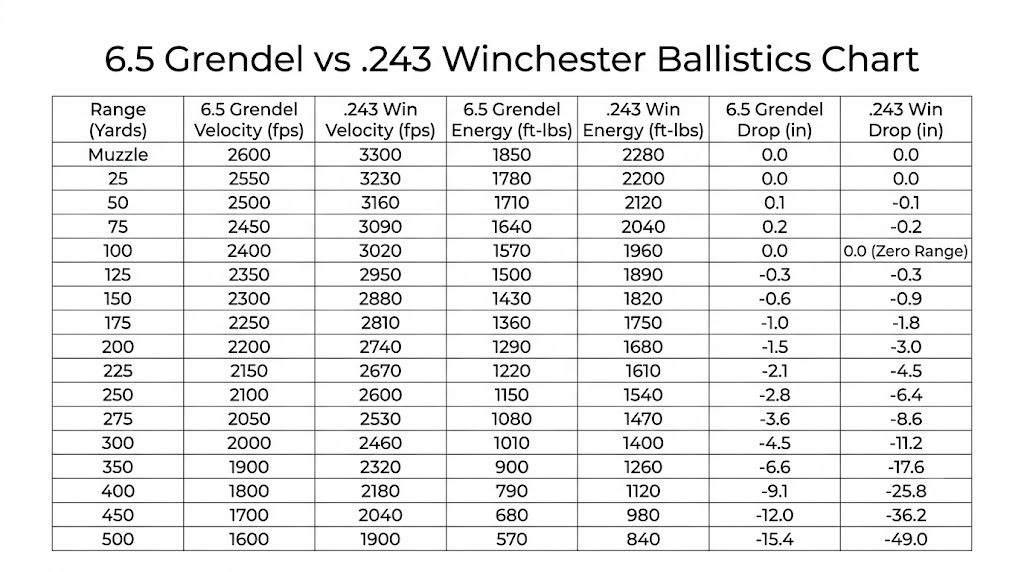
Detailed Ballistics Comparison Chart
Data reflects a 6.5 Grendel firing a 123-grain Hornady SST (G1 BC: .510) and a .243 Winchester firing a 95-grain Hornady SST (G1 BC: .355), both using a 24-inch barrel and a 100-yard zero.
| Range (Yards) | 6.5 Grendel Velocity (fps) | .243 Win Velocity (fps) | 6.5 Grendel Energy (ft-lbs) | .243 Win Energy (ft-lbs) | 6.5 Grendel Drop (in) | .243 Win Drop (in) |
| Muzzle | 2,580 | 3,185 | 1,818 | 2,139 | -1.5 | -1.5 |
| 25 | 2,535 | 3,115 | 1,756 | 2,046 | -0.5 | -0.6 |
| 50 | 2,492 | 3,045 | 1,696 | 1,955 | +0.2 | -0.1 |
| 75 | 2,450 | 2,980 | 1,639 | 1,872 | +0.5 | +0.1 |
| 100 | 2,408 | 2,915 | 1,584 | 1,792 | 0.0 | 0.0 |
| 125 | 2,366 | 2,845 | 1,530 | 1,707 | -0.9 | -0.5 |
| 150 | 2,325 | 2,780 | 1,476 | 1,630 | -2.3 | -1.3 |
| 175 | 2,285 | 2,715 | 1,426 | 1,555 | -4.3 | -2.4 |
| 200 | 2,245 | 2,650 | 1,376 | 1,481 | -6.8 | -3.9 |
| 225 | 2,205 | 2,585 | 1,327 | 1,410 | -9.9 | -5.7 |
| 250 | 2,166 | 2,525 | 1,281 | 1,345 | -13.6 | -8.0 |
| 275 | 2,127 | 2,465 | 1,235 | 1,281 | -18.0 | -10.6 |
| 300 | 2,088 | 2,405 | 1,191 | 1,220 | -23.1 | -13.7 |
| 325 | 2,050 | 2,345 | 1,148 | 1,160 | -28.8 | -17.3 |
| 350 | 2,013 | 2,285 | 1,106 | 1,101 | -35.2 | -21.4 |
| 375 | 1,976 | 2,227 | 1,065 | 1,046 | -42.3 | -26.0 |
| 400 | 1,939 | 2,170 | 1,026 | 993 | -50.1 | -31.3 |
| 425 | 1,902 | 2,112 | 988 | 940 | -58.8 | -37.2 |
| 450 | 1,866 | 2,055 | 951 | 890 | -68.2 | -43.8 |
| 475 | 1,830 | 2,000 | 915 | 843 | -78.6 | -51.1 |
| 500 | 1,795 | 1,945 | 880 | 798 | -89.7 | -59.2 |
Comparison Chart Image
1. Cartridge Overview
Bill Alexander engineered the 6.5 Grendel in 2003 with a singular goal: to push the limits of the AR-15 platform beyond the capabilities of the 5.56 NATO. By modifying the .220 Russian case, Alexander created a short, fat cartridge that fits inside a standard AR-15 magazine well while pushing heavy, aerodynamic 6.5mm projectiles. Shooters quickly adopted the Grendel for tactical applications, target shooting, and medium-game hunting. It essentially transforms a standard modern sporting rifle into a legitimate 400-yard deer rifle with just a barrel, magazine, and bolt change.
Winchester introduced the .243 Winchester in 1955, taking the hunting world by storm. Engineers simply necked down the widely popular .308 Winchester case to accept a .243-caliber (6mm) bullet. This creation offered shooters a versatile, low-recoil cartridge capable of taking both varmints and medium game. Hunters chambered the .243 in short-action bolt rifles, lever actions, and eventually AR-10 platforms. It remains one of the most commercially successful rifle cartridges in history.
While the 6.5 Grendel relies on aerodynamic efficiency and high ballistic coefficients (BC), the .243 Winchester relies on sheer powder volume and hyper-velocity. Both serve similar roles for hunters and target shooters, but they approach the ballistic equation from entirely different directions.
2. Key Differences
The fundamental divergence between these cartridges lies in their design philosophy and platform constraints. The 6.5 Grendel operates under strict dimensional limitations. Because it must fit inside an AR-15 magazine, its overall length cannot exceed 2.260 inches. This restricts powder capacity to approximately 35 grains of water volume. To generate downrange performance, the Grendel relies on the superior aerodynamic efficiency of 6.5mm bullets, which slice through the air and retain their momentum.
The .243 Winchester faces no such AR-15 constraints. Designed for short-action rifles, it boasts a maximum overall length of 2.710 inches and holds roughly 54 grains of water volume. This massive powder charge pushes lightweight 6mm bullets at extreme velocities, producing a flat trajectory and tremendous muzzle energy.
These design parameters dictate the rifles that fire them. You can build a lightweight, compact 6.5 Grendel using a standard AR-15 lower receiver. Firing the .243 Winchester requires a heavier AR-10 receiver set or a traditional bolt-action rifle. Ultimately, the 6.5 Grendel maximizes efficiency within a small footprint, whereas the .243 Winchester uses raw case capacity to overpower drag and gravity.
3. Velocity Comparison
Velocity heavily favors the Winchester cartridge. The .243 Winchester case holds significantly more propellant, allowing it to push a 95-grain Hornady SST bullet out of a 24-inch barrel at a blistering 3,185 feet per second (fps). The 6.5 Grendel, constrained by its smaller powder column, pushes a 123-grain Hornady SST at roughly 2,580 fps from an identical barrel length.
This 600 fps advantage gives the .243 Winchester a massive head start. Even at 300 yards, the .243 Winchester travels at 2,405 fps, which is nearly as fast as the 6.5 Grendel leaving the muzzle. The 6.5 Grendel does utilize bullets with higher ballistic coefficients, meaning it bleeds velocity at a slower rate than the 6mm projectiles. However, the initial speed gap is too large for the Grendel to ever catch up.
By the time both bullets reach 500 yards, the .243 Winchester maintains a speed of 1,945 fps, while the 6.5 Grendel drops to 1,795 fps. Both cartridges stay well above the supersonic threshold at this distance, ensuring stable flight.
Winner: .243 Winchester. Its superior case capacity guarantees higher speeds at the muzzle and at every practical shooting distance.
4. Energy Comparison
Kinetic energy dictates terminal performance, and muzzle energy calculations depend heavily on velocity. The .243 Winchester generates 2,139 foot-pounds (ft-lbs) of energy at the muzzle with a 95-grain bullet. The 6.5 Grendel, firing a heavier 123-grain projectile, produces 1,818 ft-lbs of muzzle energy.
Despite firing a lighter bullet, the .243 Winchester’s extreme velocity translates into roughly 17% more kinetic energy at the muzzle. This raw power creates massive hydrostatic shock upon impact, dropping thin-skinned game instantly.
As the bullets travel downrange, the dynamic changes slightly. The heavy, aerodynamic 6.5mm bullet retains its energy more efficiently than the lighter 6mm bullet. At 300 yards, the .243 Winchester hits with 1,220 ft-lbs, while the 6.5 Grendel strikes with 1,191 ft-lbs. The gap narrows significantly. By 500 yards, the 6.5 Grendel actually surpasses the .243 Winchester, delivering 880 ft-lbs compared to the .243’s 798 ft-lbs.
For practical hunting inside 300 yards, the Winchester hits harder and induces more tissue damage. For extreme long-range target shooting, the Grendel conserves momentum better.
Winner: .243 Winchester. It provides more devastating energy transfer at standard hunting ranges, where kinetic energy matters most.
5. Trajectory & Bullet Drop Comparison
Hunters and precision shooters prefer flat trajectories because they reduce the need for aggressive scope adjustments and minimize holdover errors. The .243 Winchester is famous for its laser-flat flight path.
Assuming a 100-yard zero, a 95-grain .243 Winchester bullet drops just 3.9 inches at 200 yards and 13.7 inches at 300 yards. You can aim directly behind the shoulder of a whitetail deer out to nearly 300 yards without holding over the animal’s back.
The 6.5 Grendel requires significantly more elevation adjustment. With the same 100-yard zero, the 123-grain Grendel bullet drops 6.8 inches at 200 yards and 23.1 inches at 300 yards. By the time the bullet reaches 500 yards, the Grendel drops nearly 90 inches, compared to just 59 inches for the Winchester.
Shooting the 6.5 Grendel at unknown distances requires precise rangefinding and an intimate knowledge of your ballistics table. The .243 Winchester offers a much wider margin of error. If you misjudge a target’s distance by 25 yards with the Winchester, you will likely still hit the vital zone.
Winner: .243 Winchester. The hyper-velocity 6mm projectiles shoot dramatically flatter, simplifying long-range hunting applications.
6. Wind Drift Comparison
Wind deflection ruins more long-range shots than gravity. Bullet drop is a constant, calculable force, but wind speed and direction change constantly. Defeating wind drift requires a high ballistic coefficient (BC) and time-to-target.
The 6.5 Grendel excels in this category. The 6.5mm caliber is legendary for its long, sleek bullet profiles. A 123-grain Hornady SST boasts a G1 BC of .510. The .243 Winchester 95-grain SST features a much lower G1 BC of .355.
Despite the .243 Winchester reaching the target faster, the 6.5 Grendel’s superior aerodynamics make it less susceptible to crosswinds. In a 10-mph full-value crosswind, the 6.5 Grendel deflects roughly 19 inches at 500 yards. Under the exact same atmospheric conditions, the .243 Winchester deflects approximately 23 inches.
For precision rifle competitors shooting beyond 600 yards, this difference is massive. The heavier 6.5mm bullet bucks the wind more efficiently, requiring fewer click adjustments on the scope and providing a higher hit percentage in gusty conditions.
Winner: 6.5 Grendel. The superior ballistic coefficients of 6.5mm projectiles easily outperform standard 6mm hunting bullets in unpredictable winds.
7. Hunting Performance Comparison
Both cartridges successfully harvest a wide variety of North American game, but they excel in different environments. The .243 Winchester is arguably the ultimate dual-purpose cartridge. It vaporizes coyotes and prairie dogs using lightweight 55-grain bullets. When loaded with 95-grain or 100-grain premium projectiles, it drops whitetail deer and antelope in their tracks through massive hydrostatic shock.
The 6.5 Grendel pushes heavier bullets ranging from 110 to 130 grains. These bullets feature exceptional sectional density, allowing them to penetrate deep through thick bone and muscle. This makes the Grendel a superior choice for feral hogs and black bears, where deep penetration is mandatory.
For deer hunting inside 300 yards, the .243 Winchester creates wider wound channels and shorter blood trails. However, the 6.5 Grendel allows you to carry a highly maneuverable AR-15 into the blind or tree stand, which many hunters prefer over a long bolt-action rifle. Neither cartridge is recommended for elk, though both can ethically harvest one with flawless shot placement at close range.
Winner: Tie. The .243 Winchester is better for coyotes, antelope, and open-country deer. The 6.5 Grendel is better for feral hogs and brush-country hunting using the AR-15 platform.
8. Accuracy & Long-Range Performance
Modern manufacturing ensures both cartridges routinely shoot sub-MOA (less than one inch at 100 yards) with match-grade ammunition. The real accuracy difference emerges past 500 yards.
The .243 Winchester has a notorious reputation as a barrel burner. Pushing massive powder charges through a small bore erodes the barrel throat rapidly. Competitive shooters often replace .243 barrels after just 1,500 rounds to maintain peak precision. However, inside that lifespan, the flat trajectory makes hitting steel targets remarkably easy.
The 6.5 Grendel operates at much lower pressures with a smaller powder charge. A quality Grendel barrel easily maintains match-grade accuracy for 5,000 rounds. Furthermore, the Grendel transitions from supersonic to subsonic flight very smoothly, preventing accuracy degradation at extreme ranges. Shooters consistently ring steel at 800 and even 1,000 yards with the 6.5 Grendel using heavy match bullets like the 130-grain Berger Hybrid.
The Winchester shoots flatter, but the Grendel offers far superior barrel life and better aerodynamic stability at extreme distances.
Winner: 6.5 Grendel. It delivers exceptional barrel life and superior wind deflection for dedicated long-range target shooting.
9. Pros and Cons
6.5 Grendel Pros
• Fits perfectly inside a standard AR-15 platform.
• Utilizes high-BC bullets that resist wind drift efficiently.
• Exceptional barrel life due to lower powder capacities and operating pressures.
• Very mild recoil, making it ideal for youth hunters and rapid follow-up shots.
6.5 Grendel Cons
• Slow muzzle velocities create a rainbow trajectory.
• Requires aggressive holdovers past 300 yards.
• AR-15 magazines can suffer from feeding issues due to the fat case design.
.243 Winchester Pros
• Blistering muzzle velocities create a laser-flat trajectory.
• Delivers devastating hydrostatic shock on medium game.
• Massive factory ammunition availability at local sporting goods stores.
• Highly versatile, handling everything from prairie dogs to mule deer.
.243 Winchester Cons
• Requires a heavier AR-10 or a standard short-action bolt rifle.
• Burns through barrels quickly during high-volume shooting sessions.
• Lighter projectiles drift significantly more in crosswinds at long distances.
10. Which One Should You Choose?
Best for deer hunting: .243 Winchester. The sheer speed and energy transfer create massive wound channels, dropping deer instantly at typical hunting distances.
Best for hog hunting: 6.5 Grendel. Feral hogs possess thick cartilage shields. The heavier 123-grain and 130-grain 6.5mm projectiles provide the deep penetration required to reach the vitals, and the AR-15 platform allows for rapid follow-up shots on moving sounders.
Best for target shooting: 6.5 Grendel. You will save money on powder, experience significantly longer barrel life, and enjoy better wind-bucking capabilities at extended ranges.
Best for long range: 6.5 Grendel. While the .243 shoots flatter initially, the Grendel’s superior ballistic coefficients ensure predictable flight dynamics and energy retention past 600 yards.
Best for beginners: .243 Winchester. The recoil is very manageable, and the flat trajectory is extremely forgiving if a new hunter slightly misjudges the distance to the target.
Best all-around cartridge: .243 Winchester. It remains an absolute classic for a reason. Whether you are eradicating varmints at 400 yards, filling your freezer with venison, or punching paper, the .243 handles the job flawlessly without requiring specialized AR parts.