A 30 06 Accelerator Ballistics Chart is a specialized data table that tracks the velocity, energy, trajectory, and aerodynamic efficiency of a unique twenty two caliber sabot projectile fired from a thirty caliber rifle. This detailed reference allows varmint hunters and firearms enthusiasts to understand how the plastic sabot mechanism drastically increases muzzle speed while reducing recoil. By evaluating this rare ballistic information, marksmen can confidently calculate precise holdovers for long distance predator control. Utilizing this chart ensures maximum accuracy when deploying these ultra high velocity specialized rounds in the field.
30 06 Accelerator Ballistics Chart
| Manufacturer | Bullet Weight | Bullet Type | Ballistic Coefficient | Sectional Density | Muzzle Velocity | Velocity At 100 Yards | Velocity At 200 Yards | Velocity At 300 Yards | Velocity At 400 Yards | Velocity At 500 Yards | Muzzle Energy | Energy At 100 Yards | Energy At 200 Yards | Energy At 300 Yards | Energy At 400 Yards | Energy At 500 Yards | Trajectory At 100 Yards | Trajectory At 200 Yards | Trajectory At 300 Yards | Trajectory At 400 Yards | Trajectory At 500 Yards |
| Remington | 55 gr | Pointed Soft Point | 0.202 | 0.157 | 4080 fps | 3410 fps | 2820 fps | 2300 fps | 1845 fps | 1450 fps | 2033 ft lbs | 1420 ft lbs | 971 ft lbs | 645 ft lbs | 415 ft lbs | 256 ft lbs | 0.9 in High | 0.0 in | 4.8 in Low | 15.6 in Low | 34.5 in Low |
| EABCO Custom | 55 gr | V Max Sabot | 0.255 | 0.157 | 4000 fps | 3450 fps | 2960 fps | 2520 fps | 2125 fps | 1770 fps | 1954 ft lbs | 1453 ft lbs | 1070 ft lbs | 775 ft lbs | 551 ft lbs | 382 ft lbs | 1.0 in High | 0.0 in | 4.5 in Low | 14.1 in Low | 30.5 in Low |
Reviewing this specific ballistic layout demonstrates exactly how utilizing a lightweight projectile inside a sabot sleeve unlocks unprecedented muzzle velocities for the classic thirty caliber hunting platform.
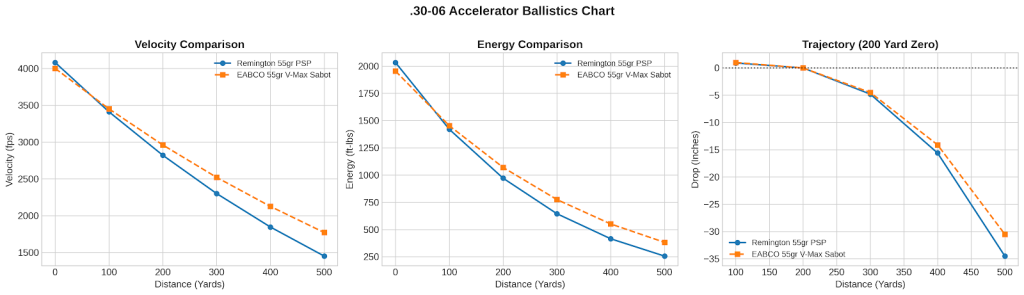
Understanding The 30 06 Accelerator Ballistics Chart
Analyzing the provided data reveals how utilizing a massive powder charge behind an incredibly lightweight projectile completely transforms the external flight dynamics of the rifle.
Velocity Analysis
Evaluating the velocity metrics within the table shows that the Remington 55 grain Pointed Soft Point achieves a truly blistering muzzle velocity of 4080 feet per second.
This exceptional starting speed allows the lightweight projectile to cover the first one hundred yards almost instantaneously.
However, examining the velocity retention reveals that aerodynamic drag takes a massive toll on these lightweight projectiles over long distances.
The Remington factory load drops from 4080 feet per second at the muzzle down to just 1450 feet per second at the five hundred yard mark.
In contrast, the EABCO Custom 55 grain V Max Sabot starts slightly slower at 4000 feet per second but retains speed much better.
By the time it reaches five hundred yards, the polymer tipped V Max bullet still travels at 1770 feet per second.
This specific velocity data proves that while raw muzzle speed is impressive, an aerodynamically efficient projectile shape is required to maintain supersonic stability at extreme hunting ranges.
Energy Analysis
Muzzle energy dictates the sheer physical shock delivered to a target upon initial bullet impact in the field.
The table data highlights that the Remington 55 grain Pointed Soft Point produces a highly respectable initial strike force of 2033 foot pounds of muzzle energy.
The EABCO Custom 55 grain V Max Sabot starts slightly lower, generating 1954 foot pounds of energy at the barrel exit.
Downrange energy retention clearly illustrates the limitations of utilizing such lightweight projectiles for medium sized game hunting.
By the time the projectiles reach the three hundred yard line, the Remington factory load only retains 645 foot pounds of lethal kinetic force.
The EABCO Custom load retains slightly more power, holding onto 775 foot pounds of energy at the same three hundred yard distance.
These low retained energy values guarantee that this specialized ammunition is strictly suited for varmint hunting and predator control rather than pursuing large heavy bodied game animals.
Trajectory Analysis
Reviewing the trajectory profile with a standard two hundred yard zero demonstrates the incredibly flat initial flight path of this unique ammunition.
The flattest shooting factory load at mid range distances is the EABCO Custom 55 grain V Max Sabot.
This polymer tipped projectile exhibits a minimal bullet drop of only 4.5 inches at the three hundred yard mark.
The Remington 55 grain Pointed Soft Point performs very similarly at mid range, dropping just 4.8 inches at three hundred yards.
As distance increases beyond three hundred yards, both projectile designs begin to fall rapidly due to their massive loss of forward velocity.
The Remington factory load plunges drastically over extended open spaces, dropping a full 34.5 inches by the time it reaches the five hundred yard target.
Practical holdover estimates using these chart values indicate that shooters need very little optical dialing inside three hundred yards, making it an exceptional choice for fast moving coyote engagements.
Ballistic Coefficient Analysis
The ballistic coefficient values listed in the table reveal the inherent aerodynamic limitations of standard lightweight varmint bullets.
The EABCO Custom 55 grain V Max Sabot holds the higher category rating with a ballistic coefficient of 0.255.
The traditional Remington 55 grain Pointed Soft Point features a noticeably lower aerodynamic rating of 0.202.
A higher ballistic coefficient allows the polymer tipped bullet to easily slice through dense atmospheric resistance without shedding precious velocity as rapidly.
According to the chart data, this aerodynamic advantage guarantees that the high coefficient bullet arrives at distant targets with significantly flatter pathways and reduced lateral wind drift.
Shooters must understand that despite the extreme initial muzzle velocity, the low ballistic coefficients prevent these loads from competing with modern heavy match bullets at long range.
Sectional Density Analysis
Sectional density directly influences how stable a hunting bullet remains during flight and how deeply it penetrates targets upon arrival.
The chart confirms that both 55 grain projectiles possess an identical sectional density rating of 0.157.
A lower sectional density means the bullet spreads its physical mass over a relatively large cross sectional area compared to its weight.
This specific data confirms that these projectiles are designed for rapid explosive expansion rather than deep pass through penetration.
Hunters pursuing coyotes or groundhogs rely on this low sectional density to ensure the bullet transfers all its energy immediately upon striking thin skinned targets.
Best Factory Loads Based On The Chart
For Extreme Long Range Varmint Shooting, the EABCO Custom 55 grain V Max Sabot is the absolute best choice due to its superior 0.255 ballistic coefficient and better energy retention.
For Precision Predator Hunting inside three hundred yards, the Remington 55 grain Pointed Soft Point provides a perfectly balanced trajectory that requires almost no optical elevation dialing.
If Maximum Initial Velocity is your primary goal, the classic Remington 55 grain Pointed Soft Point takes the absolute top spot by reaching an astonishing 4080 feet per second.
When seeking Maximum Retained Energy at extended distances, the EABCO Custom load wins easily by preserving 382 foot pounds of strike force at five hundred yards.
For General Purpose Varmint Shooting, either load offers reliable terminal expansion and extreme velocities that guarantee instantaneous humane harvesting of small agricultural pests.
Key Takeaways From The Chart
The fastest factory load in the entire chart is the Remington 55 grain Pointed Soft Point at 4080 feet per second.
The highest initial muzzle energy is produced by the Remington factory load at 2033 foot pounds.
The highest retained kinetic energy at five hundred yards belongs to the EABCO Custom load at 382 foot pounds.
The flattest trajectory at five hundred yards is achieved by the EABCO Custom load with a drop of 30.5 inches.
The highest overall ballistic coefficient listed is the EABCO Custom load at 0.255.
The best overall long range varmint hunting performer based on combined energy retention and trajectory metrics is the EABCO Custom 55 grain V Max Sabot.
Common 30 06 Accelerator Bullet Weights
The unique sabot concept allows reloaders and specialty manufacturers to utilize various lightweight twenty two caliber projectiles optimized for distinct hunting roles.
50 Grain
The 50 grain projectile weight is a highly specialized option used by custom ammunition loaders to maximize raw muzzle speed.
Typical muzzle velocity for this specific weight easily breaks the 4150 feet per second barrier when paired with optimized high energy propellants.
The primary advantage of this weight is its incredibly explosive initial velocity, which creates a laser flat flight path inside two hundred yards.
The main disadvantage is that the extremely light mass makes it highly susceptible to being blown entirely off target by mild crosswinds.
This specific weight is best applied in general target practice and short distance explosive varmint control on calm weather days.
52 Grain
The 52 grain projectile represents a classic match grade target bullet weight that many custom loaders place inside the sabot sleeve.
Typical muzzle velocity sits comfortably around 4100 feet per second, generating incredibly consistent shot to shot performance.
The primary advantages of 52 grain options are brilliant rotational stability and a massive selection of premium target bullets available to reloaders.
The primary disadvantage is that these specific bullets often feature hollow point designs that lack the sleek aerodynamic profile of polymer tipped hunting options.
This weight is the absolute ideal choice for attempting precision paper target shooting while utilizing the plastic sabot sleeve delivery system.
55 Grain
The 55 grain projectile weight represents the absolute standard for commercial factory loaded sabot ammunition.
Typical muzzle velocity is roughly 4000 to 4080 feet per second, which translates into an excellent 2000 foot pounds of initial muzzle energy.
The single biggest advantage of this weight is its exceptional balance of explosive velocity and decent medium range trajectory retention.
The primary disadvantage is that factory ammunition utilizing this weight has become increasingly difficult to locate on local sporting goods shelves.
This weight is the ultimate choice for hunters who require reliable performance on coyotes alongside a remarkably flat trajectory curve.
60 Grain
The 60 grain bullet is a slightly heavier option used primarily by handloaders looking for better wind resistance in open country.
Typical muzzle velocity drops down to around 3850 feet per second, though it maintains its structural momentum much better at extended yardages.
The advantage of the 60 grain bullet is its unmatched wind resisting capabilities compared to the lighter options in the sabot family.
The main disadvantage is the severely restricted selection of commercial factory loaded options, requiring shooters to handload these specific components themselves.
This extreme weight is reserved almost exclusively for specialized predator hunting where crosswind drift is prioritized over absolute maximum muzzle velocity.
Effective Range
Understanding the realistic limits of this unique ammunition helps hunters select the correct equipment and optical setups for their specific field goals.
Target Shooting
For standard large scale paper targets, the effective range of the sabot system easily spans from one hundred yards out to three hundred yards.
Beyond three hundred yards, the inherent inconsistencies of the plastic sleeve separating from the bullet can cause group sizes to open up significantly.
Shooters must accept that this specialized ammunition prioritizes extreme velocity over benchrest level precision.
Varmint Hunting
When hunting small agricultural pests like prairie dogs or groundhogs, the ammunition is devastatingly effective inside two hundred and fifty yards.
The extreme velocity practically vaporizes small targets upon impact, ensuring rapid and humane population control.
Hunters appreciate the fact that the lightweight bullet completely fragments upon hitting the ground, minimizing the danger of ricochets in open fields.
Predator Control
For coyote and fox hunting, the effective ethical range stretches comfortably to three hundred yards under calm weather conditions.
At this specific distance, the bullet retains enough kinetic energy and explosive fragmentation properties to instantly anchor medium sized predators.
The flat trajectory allows hunters to hold their crosshairs directly on the target without worrying about complex elevation dialing during fast encounters.
Competition Shooting
This specific cartridge configuration is almost never utilized in formal competition shooting events.
The plastic sabot delivery mechanism simply cannot guarantee the extreme sub minute of angle precision required to win modern accuracy matches.
Additionally, the ultra light bullets drift too radically in the wind to remain competitive during long distance precision rifle series events.
Factors That Affect 30 06 Accelerator Ballistics
External environmental variables and physical firearm attributes combine to drastically shape how this unique projectile behaves once it leaves the muzzle.
Barrel Length
Barrel length plays a crucial role in determining how much velocity the massive powder charge can generate before the bullet exits into the open atmosphere.
A standard twenty four inch barrel allows the slow burning rifle powder to completely ignite, maximizing the initial push on the lightweight sabot.
Shorter barrels can cause a massive loss of up to two hundred feet per second, which noticeably diminishes the explosive downrange performance.
Bullet Weight
Bullet weight dictates the core relationship between quick initial exit speed and late flight momentum conservation.
Lighter bullets leave the barrel much faster but lose speed rapidly due to atmospheric friction dragging on their surface area.
Heavier sixty grain bullets start slightly slower but hold their forward velocity much better over massive open field distances.
Bullet Construction
The physical design of the projectile heavily affects its ability to survive the extreme rotational forces generated by the rifling.
Thin jacketed varmint bullets pushed to four thousand feet per second in a fast twist barrel can actually disintegrate mid air due to extreme centrifugal force.
Shooters must ensure they utilize bullets with sufficiently thick copper jackets to withstand the extreme internal pressures and rotational speeds.
Ballistic Coefficient
The ballistic coefficient measures exactly how easily the small bullet overcomes raw air resistance during its journey to the target.
A higher ballistic coefficient directly reduces vertical bullet drop and minimizes the lateral drift caused by harsh crosswinds in the field.
Polymer tipped boat tail bullets always provide superior aerodynamic performance compared to traditional flat base soft point designs.
Altitude
High altitude mountain environments feature thinner air, which drastically reduces the aerodynamic drag forces acting against the flying bullet.
Hunters operating in elevated regions will notice flatter overall pathways and much higher retained velocities than those shooting near sea level.
Temperature
Air temperature heavily impacts atmospheric density, with freezing cold temperatures creating denser air that slows down the lightweight projectiles much faster.
Additionally, extreme ammunition temperature fluctuations can alter powder burn rates inside the cartridge case, causing unexpected changes in initial muzzle velocity.
Wind
Due to the extreme light weight of the twenty two caliber projectile, crosswinds have a profound and massive effect on the downrange trajectory.
A strong lateral crosswind will push the bullet sideways over long distances, requiring precise windage alignment based on detailed ballistic chart evaluations.
Zero Distance
The specific distance at which a rifle is zeroed determines the entire arc of the flight trajectory relative to the shooter looking through the optic.
An inappropriate zero distance can cause the hyper fast bullet to impact several inches high at close range, leading to frustrating misses on small varmint targets.
Best Zero Distance
Choosing the correct zero distance establishes an incredibly efficient baseline for holding the crosshairs perfectly steady during fast paced predator hunts.
100 Yard Zero
A one hundred yard zero is highly popular among civilian hunters who frequent standard local shooting ranges and dense heavy timber woods.
The primary advantage is that wind interference is practically eliminated during the sight in process, ensuring a perfectly centered rifle alignment.
The main disadvantage is that the bullet will drop noticeably when taking shots at coyotes standing at the three hundred yard line.
This zero is best for general target practice, initial rifle testing, and short range varmint control in thick brush environments.
200 Yard Zero
A two hundred yard zero serves as the absolute optimal baseline for a wide variety of open country varmint hunting conditions.
As demonstrated in our primary chart, utilizing a two hundred yard zero keeps the bullet path incredibly flat through the first two hundred and fifty yards of travel.
The disadvantage is a very slight mid range rise near one hundred yards, though it remains small enough to completely ignore when aiming at the vital zone of a coyote.
This zero is highly recommended for predator hunters who require instant readiness without touching their elevation turrets.
300 Yard Zero
A three hundred yard zero is an incredibly specialized configuration utilized only by hunters operating in massive open agricultural fields.
The massive advantage is that it eliminates the need to hold above the target when engaging distant predators right at the edge of the effective range.
The severe disadvantage is that the bullet flies significantly higher than the line of sight at one hundred and fifty yards, which guarantees misses on small groundhogs.
This approach is best reserved for dedicated medium range field experiments where target distances are consistently uniform and far away.
400 Yard Zero
A four hundred yard zero is entirely impractical for this specific ammunition type due to the massive loss of velocity past three hundred yards.
The major detriment of attempting this zero is that the bullet trajectory forms a massive rainbow arc, making mid range hits mathematically impossible without complex holds.
The lightweight bullet simply lacks the aerodynamic efficiency to maintain a predictable path at this extreme distance.
This zero is strictly an academic target exercise and should never be applied to practical varmint hunting scenarios.
30 06 Accelerator Compared To Similar Cartridges
To understand exactly where this unique sabot ammunition stands, it helps to compare its performance against dedicated high velocity varmint cartridges.
| Cartridge | Velocity | Energy | Trajectory At 400 Yards | Ballistic Coefficient | Effective Range | Recoil | Varmint Hunting Performance |
| 30 06 Accelerator | 4080 fps | 2033 ft lbs | 15.6 in Low | 0.202 | 300 yd | Moderate | Devastating Inside 300 Yards |
| 22 250 Remington | 3600 fps | 1582 ft lbs | 20.0 in Low | 0.250 | 400 yd | Very Low | Supreme Long Range Accuracy |
| 220 Swift | 3800 fps | 1763 ft lbs | 17.0 in Low | 0.250 | 450 yd | Low | Ultimate Flat Trajectory |
| 223 Remington | 3200 fps | 1250 ft lbs | 30.0 in Low | 0.240 | 350 yd | Extremely Low | Excellent Volume Shooting |
| 243 Winchester | 3900 fps | 1950 ft lbs | 16.0 in Low | 0.280 | 500 yd | Low | Best Wind Deflection Resistance |
The major difference shown above is that the sabot load delivers the highest initial muzzle velocity and energy of the entire group. However, dedicated varmint cartridges like the 22 250 Remington provide vastly superior precision and better aerodynamic stability for extreme long range shots. The sabot system allows a hunter to achieve 220 Swift velocities without purchasing a dedicated varmint rifle, making it an incredibly versatile option for occasional predator control.
Frequently Asked Questions
What exactly is a 30 06 Accelerator?
It is a specialized factory loaded cartridge that utilizes a plastic sabot sleeve to fire a lightweight twenty two caliber bullet out of a standard thirty caliber rifle barrel.
Why did Remington invent the sabot load for hunting rifles?
Remington introduced the concept to give big game hunters a convenient way to use their primary deer rifle for high speed varmint hunting during the off season.
Are sabot rounds highly accurate in standard hunting rifles?
Accuracy varies wildly depending on the specific rifle, but generally, they produce groups around two to three inches at one hundred yards due to the sabot separating unevenly.
What is the standard muzzle velocity of the factory load?
The original factory loaded ammunition pushed a lightweight fifty five grain projectile to a staggering muzzle velocity of 4080 feet per second.
Can you safely reload sabot ammunition at home?
Yes, specialty companies sell the plastic sabot sleeves, allowing experienced reloaders to seat their own twenty two caliber bullets and load them into thirty caliber cases.
Does a standard one in ten twist rate affect the lightweight bullet?
Yes, pushing a lightweight projectile at four thousand feet per second through a fast twist barrel creates extreme rotational forces that can sometimes cause thin bullet jackets to fail mid air.
What is the maximum effective range for coyote hunting with this load?
Due to the rapid loss of velocity and low aerodynamic rating, the ethical maximum effective range for clean kills on coyotes is roughly three hundred yards.
How much energy does the projectile retain at three hundred yards?
The standard factory load retains approximately 645 foot pounds of kinetic energy at the three hundred yard mark, which is plenty for small thin skinned predators.
Will the melting plastic sabot foul the rifle barrel over time?
Firing multiple rounds in rapid succession through a hot barrel can leave minor plastic residue inside the rifling, which requires a dedicated solvent to clean out properly.
Why was this specific factory cartridge eventually discontinued?
It was discontinued because dedicated varmint rifles became highly affordable, and the inherent accuracy issues of the sabot mechanism prevented it from gaining long term popularity among serious marksmen.