For hunters relying on “the deadliest mushroom in the woods,” a remington core lokt ballistic chart provides the essential flight path and energy data required for accurate shot placement. This chart outlines exact performance metrics, including muzzle velocity, kinetic energy, ballistic coefficient, and trajectory drops at various distances, for Remington’s legendary lead-core, mechanically locked hunting ammunition. Because Core-Lokt bullets feature traditional flat-base designs (Pointed Soft Point and Soft Point) rather than highly aerodynamic polymer tips, understanding their specific trajectory is critical for ethical impacts at distance. In this article, you will find a highly detailed, research-backed breakdown of factory Remington Core-Lokt ammunition ballistics, followed by an in-depth guide on how to interpret each metric for real-world hunting scenarios. Note that environmental conditions, altitude, and your specific barrel length (factory data typically assumes a 24-inch test barrel) will slightly alter these baseline specifications.
Remington Core Lokt Ballistic Chart
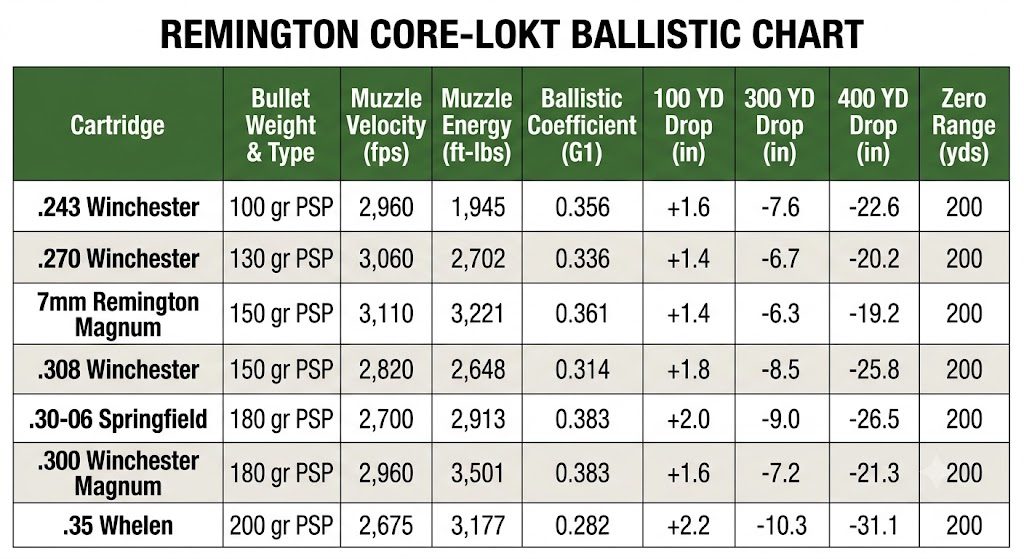
The following data reflects factory specifications for popular Remington Core-Lokt centerfire rifle ammunition tested under standard atmospheric conditions. Trajectory data assumes a 200-yard zero.
| Cartridge | Bullet Weight & Type | Muzzle Velocity (fps) | Muzzle Energy (ft-lbs) | Ballistic Coefficient (G1) | 100 YD Drop (in) | 300 YD Drop (in) | 400 YD Drop (in) | Zero Range (yds) |
| .243 Winchester | 100 gr PSP | 2,960 | 1,945 | 0.356 | +1.6 | -7.6 | -22.6 | 200 |
| .270 Winchester | 130 gr PSP | 3,060 | 2,702 | 0.336 | +1.4 | -6.7 | -20.2 | 200 |
| 7mm Remington Magnum | 150 gr PSP | 3,110 | 3,221 | 0.361 | +1.4 | -6.3 | -19.2 | 200 |
| .308 Winchester | 150 gr PSP | 2,820 | 2,648 | 0.314 | +1.8 | -8.5 | -25.8 | 200 |
| .30-06 Springfield | 180 gr PSP | 2,700 | 2,913 | 0.383 | +2.0 | -9.0 | -26.5 | 200 |
| .300 Winchester Magnum | 180 gr PSP | 2,960 | 3,501 | 0.383 | +1.6 | -7.2 | -21.3 | 200 |
| .35 Whelen | 200 gr PSP | 2,675 | 3,177 | 0.282 | +2.2 | -10.3 | -31.1 | 200 |
Understanding the Chart
To maximize your success in the field, you must understand exactly what the numbers on a ballistics chart mean. Below is a comprehensive breakdown of every column included in the table above.
Cartridge
What it means: This column identifies the specific caliber and chambering of the firearm (e.g., .308 Winchester or .270 Winchester).
Why it matters: Ammunition must be matched perfectly to the firearm’s chamber. The cartridge dictates the internal case capacity, the powder charge, safe operating pressure limits, and the overall ballistic potential of the round.
How to interpret it: Use this column simply to locate the exact ammunition you intend to shoot.
Real-world performance: The cartridge determines the foundational power, range, and recoil of your rifle. A magnum cartridge casing like the .300 Winchester Magnum holds significantly more powder than a .308 Winchester, generating faster velocities and flatter trajectories with the exact same bullet.
Common mistakes: Confusing similar-sounding cartridges. For example, a 7mm-08 Remington and a 7mm Remington Magnum both fire a .284-caliber bullet, but their cases, pressures, and ballistic profiles are vastly different. Always ensure the chart perfectly matches the stamp on your rifle barrel.
Bullet Weight & Type
What it means: This denotes the mass of the projectile measured in grains (gr) and the specific bullet shape. In this chart, PSP stands for Pointed Soft Point.
Why it matters: Bullet weight and construction directly impact velocity, wind resistance, and terminal performance. The Remington Core-Lokt design features a tapered copper jacket locked to a solid lead core, which controls expansion and ensures the bullet stays intact upon striking bone or heavy muscle.
How to interpret it: Heavier bullets for a given caliber (like the 180-grain .30-06) typically fly slower but resist wind better and penetrate deeper. Lighter bullets (like the 150-grain .308) fly faster and flatter but may not penetrate as deeply on large game.
Real-world performance: The PSP (Pointed Soft Point) design provides a better aerodynamic profile than traditional blunt SP (Soft Point) bullets, allowing it to retain velocity better at 200 and 300 yards while still offering rapid, devastating expansion upon impact.
Common mistakes: Assuming heavier is always better. For medium game like whitetail deer, a 150-grain Core-Lokt often provides faster, more dramatic expansion and a flatter trajectory than a heavier 180-grain bullet, which is better suited for larger, tougher game like elk or moose.
Muzzle Velocity (fps)
What it means: Muzzle velocity is the speed of the bullet at the exact moment it exits the rifle’s barrel, measured in feet per second (fps).
Why it matters: Velocity is the engine of ballistics. It dictates how flat a bullet will shoot, how hard it will hit, and whether the soft lead point will successfully mushroom upon impact.
How to interpret it: Higher numbers mean a faster-traveling bullet. This speed will steadily decrease as the bullet travels downrange due to aerodynamic drag.
Real-world performance: A traditional cup-and-core bullet like the Core-Lokt needs sufficient velocity to expand reliably. Fortunately, their soft exposed lead tips initiate expansion at much lower velocities than monolithic copper bullets, making them highly effective even as they slow down at extended ranges.
Common mistakes: Expecting to achieve the exact velocity printed on the box. Factory data is typically recorded using a 24-inch test barrel. If you are hunting with an 18-inch or 20-inch carbine barrel, your actual muzzle velocity will be lower, which will increase your bullet drop at distance.
Muzzle Energy (ft-lbs)
What it means: Muzzle energy measures the kinetic power of the bullet as it leaves the barrel, expressed in foot-pounds (ft-lbs).
Why it matters: Energy is a primary indicator of a cartridge’s stopping power. It is mathematically calculated using a combination of the bullet’s weight and its velocity.
How to interpret it: A higher foot-pound rating indicates a more powerful cartridge. For example, the 7mm Remington Magnum delivers 3,221 ft-lbs at the muzzle, dwarfing the 1,945 ft-lbs of the .243 Winchester.
Real-world performance: Ethical hunting requires specific minimum energy thresholds upon impact, typically around 1,000 ft-lbs for deer-sized game and 1,500 ft-lbs for elk. The muzzle energy shows you the round’s maximum potential before atmospheric drag takes its toll.
Common mistakes: Believing energy alone drops game. While high kinetic energy is important, the Core-Lokt’s reputation comes from its mechanical lock, which ensures the bullet retains its weight and penetrates deeply into vital organs, regardless of the raw energy number.
Ballistic Coefficient (G1)
What it means: The Ballistic Coefficient (BC) is a mathematical value that represents a bullet’s aerodynamic efficiency. The standard measurement model for traditional hunting bullets is the G1 model.
Why it matters: A bullet with a high BC slices through the air more efficiently, meaning it retains its velocity longer, drops less over distance, and is less affected by crosswinds.
How to interpret it: Because Core-Lokt bullets feature traditional flat bases and exposed lead tips, their BCs are relatively modest (typically hovering between 0.300 and 0.390). They are not designed to compete with modern, high-BC polymer-tipped boat-tail bullets.
Real-world performance: Inside of 200 yards, a modest BC matters very little. The Core-Lokt will deliver devastating performance. However, if you shoot past 300 yards, the lower BC means the bullet sheds velocity rapidly and becomes more susceptible to wind drift.
Common mistakes: Obsessing over BC for standard hunting ranges. If you hunt in dense woods or over food plots where shots rarely exceed 150 yards, aerodynamic efficiency is practically irrelevant compared to the bullet’s reliable terminal expansion.
100 YD Drop (in)
What it means: This shows where the bullet impacts relative to the shooter’s line of sight at a distance of 100 yards, measured in inches.
Why it matters: Because gravity acts on a bullet the instant it leaves the barrel, the barrel must be angled slightly upward relative to the scope. This causes the bullet’s trajectory to arc, crossing the line of sight twice.
How to interpret it: You will notice these numbers are positive (e.g., +1.8 inches for the .308). Because the rifle is zeroed at 200 yards, the bullet is still on the upward slope of its arc at 100 yards, meaning it strikes high.
Real-world performance: If a deer steps out at 100 yards and your rifle is zeroed for 200, you simply hold dead center on the vitals. A 1.8-inch high impact is negligible within the 6-to-8-inch vital zone of a whitetail deer.
Common mistakes: Shooters often confuse “drop” with “impact.” A positive drop number actually means a high impact relative to the crosshairs, not that the bullet is physically dropping below your aim point.
300 YD Drop (in)
What it means: This metric dictates how far below the center of the crosshairs the bullet will strike at exactly 300 yards.
Why it matters: This is the distance where gravity and aerodynamic drag begin to heavily influence traditional cup-and-core bullets.
How to interpret it: A negative value, such as -9.0 inches for the .30-06, means you must aim exactly 9 inches above your desired impact point to hit the target.
Real-world performance: 300 yards is approaching the maximum point-blank range limit for most Core-Lokt users. To make a clean hit at this distance, you must understand your holdover. Placing the horizontal crosshair level with the animal’s spine will usually drop the bullet directly into the lungs.
Common mistakes: Taking a 300-yard shot without field verification. While the chart says -8.5 inches, varying altitudes, barometric pressures, and shorter barrel lengths can easily push that actual drop to 10 or 11 inches on the range.
400 YD Drop (in)
What it means: This indicates the bullet’s total vertical drop in inches at a distance of 400 yards relative to your line of sight.
Why it matters: 400 yards is generally considered beyond the optimal performance envelope for standard Remington Core-Lokt ammunition due to its moderate ballistic coefficients.
How to interpret it: The values here plunge drastically (e.g., -26.5 inches). This steep trajectory makes range estimation critical. A miscalculation of just 25 yards can result in a complete miss or a wounded animal.
Real-world performance: At 400 yards, you cannot rely on simple “holdover” guesswork. You must use a ballistic reticle or dial your elevation turret. Furthermore, velocity has dropped significantly by this distance, which may prevent the lead tip from expanding properly upon impact.
Common mistakes: Treating traditional ammunition like modern long-range match ammo. While the Core-Lokt is arguably the most successful deer bullet in history, it is engineered for standard hunting distances, not extreme long-range precision.
Zero Range (yds)
What it means: The distance at which the rifle’s sights (or optic) are calibrated so that the point of aim exactly matches the bullet’s point of impact.
Why it matters: The zero range anchors the entire trajectory chart. The drops at 100, 300, and 400 yards are entirely mathematically dependent on this baseline distance.
How to interpret it: In this chart, the value is 200 yards. This means that at exactly 200 yards, the bullet will hit dead-center where the crosshairs are aimed (0.0 inches of drop).
Real-world performance: A 200-yard zero is the gold standard for modern centerfire bottleneck cartridges. It maximizes your “Maximum Point Blank Range,” allowing a hunter to hold dead-center on a target’s vital zone from the muzzle out to about 250 yards without adjusting their aim.
Common mistakes: Sighting a rifle in at 100 yards but using a 200-yard ballistic chart. If your rifle is physically zeroed at 100 yards, your bullet will drop significantly faster at 200, 300, and 400 yards than the numbers printed in this table. Always ensure your physical rifle zero matches the chart’s baseline data.