The main difference between the 7mm-08 Remington and the .308 Winchester comes down to ballistic efficiency versus bullet mass. While both cartridges are based on the identical parent case, the better choice depends on your specific application in the field.
The 7mm-08 Remington generally offers a flatter trajectory, higher ballistic coefficients, and less recoil. In contrast, the .308 Winchester provides heavier bullet options, greater ammunition availability, and excellent versatility for hunting and target shooting worldwide. If your priority is bucking the wind at extended distances, the 7mm-08 pulls ahead. On the other hand, hunters wanting maximum short-range energy often lean toward the .308. By analyzing a complete 7mm-08 vs .308 ballistics chart, shooters can make an informed decision based on verifiable data.
Table of Contents [Click to open]
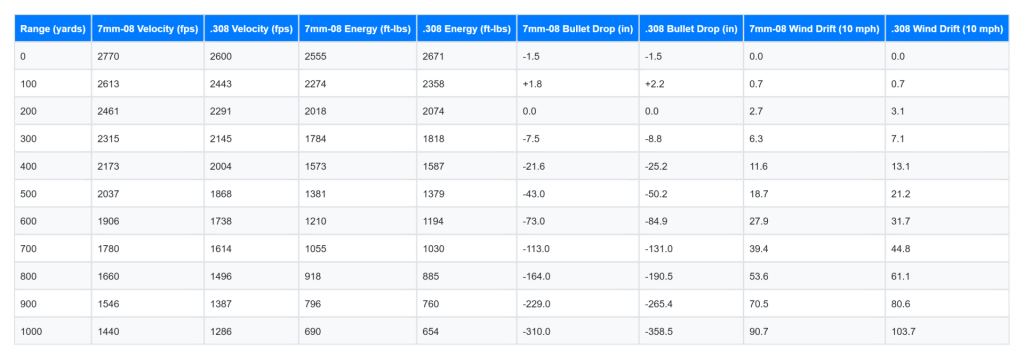
7mm-08 vs .308 Ballistics Chart
| Range (yards) | 7mm-08 Velocity (fps) | .308 Velocity (fps) | 7mm-08 Energy (ft-lbs) | .308 Energy (ft-lbs) | 7mm-08 Bullet Drop (in) | .308 Bullet Drop (in) | 7mm-08 Wind Drift (10 mph) | .308 Wind Drift (10 mph) |
| 0 | 2770 | 2600 | 2555 | 2671 | -1.5 | -1.5 | 0.0 | 0.0 |
| 100 | 2613 | 2443 | 2274 | 2358 | +1.8 | +2.2 | 0.7 | 0.7 |
| 200 | 2461 | 2291 | 2018 | 2074 | 0.0 | 0.0 | 2.7 | 3.1 |
| 300 | 2315 | 2145 | 1784 | 1818 | -7.5 | -8.8 | 6.3 | 7.1 |
| 400 | 2173 | 2004 | 1573 | 1587 | -21.6 | -25.2 | 11.6 | 13.1 |
| 500 | 2037 | 1868 | 1381 | 1379 | -43.0 | -50.2 | 18.7 | 21.2 |
| 600 | 1906 | 1738 | 1210 | 1194 | -73.0 | -84.9 | 27.9 | 31.7 |
| 700 | 1780 | 1614 | 1055 | 1030 | -113.0 | -131.0 | 39.4 | 44.8 |
| 800 | 1660 | 1496 | 918 | 885 | -164.0 | -190.5 | 53.6 | 61.1 |
| 900 | 1546 | 1387 | 796 | 760 | -229.0 | -265.4 | 70.5 | 80.6 |
| 1000 | 1440 | 1286 | 690 | 654 | -310.0 | -358.5 | 90.7 | 103.7 |
Ammunition loads compared in this chart:
- 7mm-08 Remington: Hornady Precision Hunter 150 gr ELD-X
- .308 Winchester: Hornady Precision Hunter 178 gr ELD-X
(Note: Actual results vary depending on barrel length, rifle configuration, ammunition, altitude, temperature, and atmospheric conditions. Chart data assumes a 200-yard zero and a 24-inch test barrel.)
7mm-08 vs .308 Ballistics Chart Image
Velocity Comparison
The 7mm-08 Remington leaves the muzzle 170 fps faster than the .308 Winchester when comparing these premium hunting loads. This initial velocity advantage is maintained entirely out to 1,000 yards.
Bullet weight and ballistic coefficient heavily influence velocity retention. Because the 150-grain 7mm bullet has a higher aerodynamic efficiency (G1 BC of 0.574) compared to the heavier 178-grain .308 bullet (G1 BC of 0.552), the 7mm-08 bleeds off speed at a slower rate. At 1,000 yards, the 7mm-08 is still traveling at 1,440 fps, whereas the .308 has dropped to 1,286 fps.
Energy Comparison
At the muzzle, the heavier .308 Winchester bullet hits harder, generating 2,671 ft-lbs of energy compared to the 7mm-08’s 2,555 ft-lbs.
However, retained energy changes dramatically at distance. Because the 7mm-08 retains velocity better, it slowly closes the energy gap. By 500 yards, both cartridges deliver nearly identical energy (1,381 ft-lbs vs 1,379 ft-lbs). Past 500 yards, the 7mm-08 actually overtakes the .308. For medium and large game hunting, both cartridges deliver devastating terminal performance within ethical hunting ranges.
Bullet Drop Comparison
The 7mm-08 boasts a noticeably flatter trajectory. With a 200-yard zero, the 7mm-08 drops 43.0 inches at 500 yards, while the .308 drops 50.2 inches.
This happens because the 7mm-08 starts faster and resists atmospheric drag better. When dialing for distance, this difference translates directly into MOA and MIL corrections. At 1,000 yards, the 7mm-08 requires approximately 29.6 MOA (8.6 MIL) of elevation adjustment. In contrast, the .308 requires 34.2 MOA (10.0 MIL). The flatter trajectory makes range estimation errors less punishing with the 7mm-08.
Wind Drift Comparison
Wind deflection is often the hardest variable to master in long-range shooting. Comparing resistance to a 10 mph crosswind highlights the 7mm-08’s superior aerodynamic profile.
At 500 yards, the 7mm-08 drifts 18.7 inches, while the .308 drifts 21.2 inches. By 1,000 yards, the gap widens significantly: 90.7 inches for the 7mm-08 versus 103.7 inches for the .308. A higher ballistic coefficient translates directly into less wind drift, making the 7mm-08 much more forgiving in gusty conditions.
Effective Hunting Range Comparison
Ethical hunting ranges depend heavily on the minimum retained energy required to ensure a clean harvest. Most experts recommend 1,000 ft-lbs for deer-sized game and 1,500 ft-lbs for elk or moose.
| Game Animal | 7mm-08 Effective Range | .308 Effective Range | Minimum Recommended Energy |
| Deer | 700 yards | 700 yards | 1,000 ft-lbs |
| Antelope | 700 yards | 700 yards | 1,000 ft-lbs |
| Black Bear | 450 yards | 450 yards | 1,500 ft-lbs |
| Elk | 450 yards | 450 yards | 1,500 ft-lbs |
| Moose | 450 yards | 450 yards | 1,500 ft-lbs |
Recoil Comparison
Recoil is a critical factor for shooter comfort, spotting impacts, and preventing flinches. The 7mm-08 generates roughly 10% to 15% less recoil than the .308 Winchester when fired from identical rifles.
This makes the 7mm-08 an exceptional choice for new shooters, youth hunters, or anyone sensitive to recoil energy.
| Cartridge | Average Rifle Weight | Recoil Energy (ft-lbs) | Recoil Velocity (fps) |
| 7mm-08 Remington | 7.5 lbs | 16.5 | 11.9 |
| .308 Winchester | 7.5 lbs | 18.0 | 12.4 |
Barrel Life Comparison
Both cartridges are known for being extremely easy on barrels. Neither is overbored, meaning they burn relatively modest powder charges relative to their bore diameters.
| Cartridge | Average Barrel Life (Rounds) | SAAMI Max Pressure (psi) |
| 7mm-08 Remington | 4,000 – 5,000 | 61,000 |
| .308 Winchester | 5,000 – 8,000 | 62,000 |
Ammunition Availability and Cost
The .308 Winchester is a global standard used by military, law enforcement, and civilian shooters. It absolutely dominates the 7mm-08 in sheer volume and variety on store shelves.
| Category | 7mm-08 Remington | .308 Winchester |
| Factory Availability | Good | Excellent |
| Hunting Selection | High | Very High |
| Match Ammo Options | Moderate | Exceptional |
| Average Price (Per Box) | $35 – $60 | $25 – $50 |
Hunting Performance Comparison
When discussing terminal performance on game like Whitetail Deer, Mule Deer, and Hogs, both cartridges are overwhelmingly effective. The .308 Winchester’s heavier bullets offer slightly deeper penetration on heavy-boned animals at close range.
However, the 7mm-08 provides better retained energy and velocity for reliable expansion at extended ranges. For Elk and Black Bear, both will do the job perfectly if the hunter does their part and keeps shots within ethical energy limits.
Long-Range Shooting Comparison
For precision rifle cartridges, the 7mm-08 holds a distinct ballistic advantage. It shoots flatter, retains velocity longer, and fights the wind better. Bullet stability remains excellent out to 1,000 yards.
The .308 Winchester is a proven long-range performer but requires the shooter to read the wind more accurately and dial more elevation to achieve the same impacts.
Pros and Cons
| 7mm-08 Remington Pros | 7mm-08 Remington Cons | .308 Winchester Pros | .308 Winchester Cons |
| Flatter overall trajectory | Less factory match ammunition | Massive global ammunition selection | Steeper bullet drop past 400 yards |
| Superior wind resistance | Fewer ultra-heavy bullet choices | Longer barrel life | Slightly more felt recoil |
| Lighter felt recoil | Harder to find in rural stores | Excellent heavy bullets for large game | Lower ballistic coefficients |
| Higher ballistic coefficients | Slightly more expensive ammunition | Widely used in precision rifles | More wind deflection at long range |
Which One Should You Choose?
Choose the 7mm-08 Remington if:
- You are a new shooter or youth hunter looking for light recoil.
- You plan to hunt antelope or mule deer in open country where a flatter trajectory helps.
- You want superior wind bucking capabilities for long-range target shooting.
Choose the .308 Winchester if:
- You want to buy affordable ammunition anywhere in the world.
- You are a budget-conscious buyer who likes to practice frequently.
- You are a reloader looking for the widest possible selection of components and brass.
- You prefer heavier bullets for hunting thick-skinned game in dense timber.