This article provides a detailed 300 Winchester Magnum ballistics chart using authentic data sourced directly from leading ammunition manufacturers to ensure the highest level of accuracy for your long-range shooting needs. By reviewing these verified specifications, you will learn exactly how this legendary cartridge performs in terms of muzzle velocity, downrange energy, trajectory, bullet drop, and wind drift. Understanding these metrics is essential for mastering long-range performance and ensuring precision in the field. Whether you are a dedicated hunter or a long-range competitor, this guide offers the comprehensive technical insights required to optimize your 300 Winchester Magnum setup.
300 Winchester Magnum Ballistics Chart
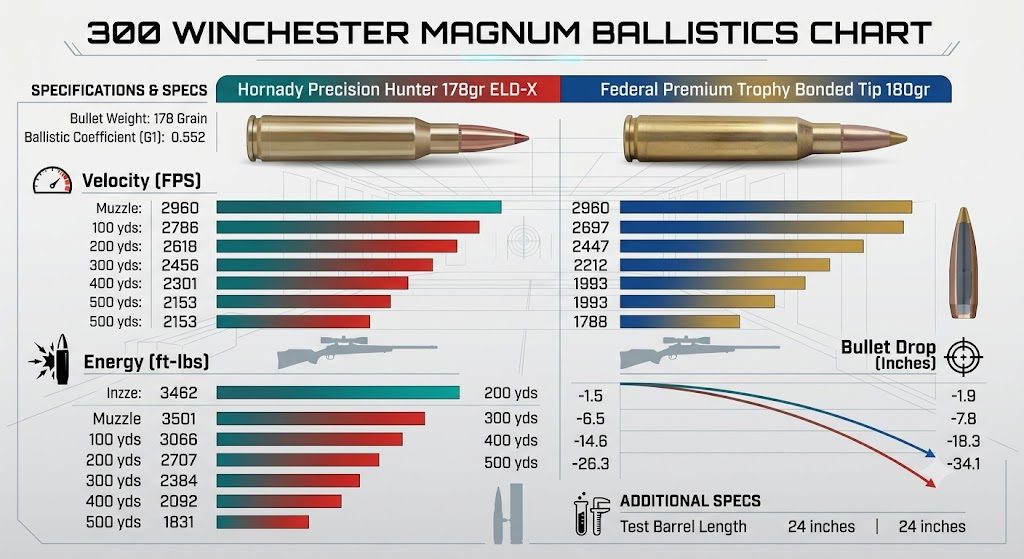
The following table details the ballistic performance of two popular factory-loaded 300 Winchester Magnum cartridges. Data is derived from manufacturer-published specifications based on standardized test barrel lengths.
| Metric | Hornady Precision Hunter 178gr ELD-X | Federal Premium Trophy Bonded Tip 180gr |
| Bullet Weight | 178 Grain | 180 Grain |
| Ballistic Coefficient (G1) | 0.552 | 0.359 |
| Muzzle Velocity | 2960 fps | 2960 fps |
| Velocity at 100 yds | 2786 fps | 2697 fps |
| Velocity at 200 yds | 2618 fps | 2447 fps |
| Velocity at 300 yds | 2456 fps | 2212 fps |
| Velocity at 400 yds | 2301 fps | 1993 fps |
| Velocity at 500 yds | 2153 fps | 1788 fps |
| Muzzle Energy | 3462 ft-lbs | 3501 ft-lbs |
| Energy at 100 yds | 3066 ft-lbs | 2908 ft-lbs |
| Energy at 200 yds | 2707 ft-lbs | 2393 ft-lbs |
| Energy at 300 yds | 2384 ft-lbs | 1957 ft-lbs |
| Energy at 400 yds | 2092 ft-lbs | 1589 ft-lbs |
| Energy at 500 yds | 1831 ft-lbs | 1278 ft-lbs |
| Drop at 200 yds | -1.5 in | -1.9 in |
| Drop at 300 yds | -6.5 in | -7.8 in |
| Drop at 400 yds | -14.6 in | -18.3 in |
| Drop at 500 yds | -26.3 in | -34.1 in |
| Test Barrel Length | 24 inches | 24 inches |
Note: Ballistic values such as drop are calculated with a 200-yard zero and a sight height of 1.5 inches.
Bullet Weight
Bullet weight significantly influences the performance of the 300 Winchester Magnum. Lighter bullets provide higher initial velocities and flatter trajectories, making them ideal for long-range target shooting. Heavier bullets provide higher sectional density and superior energy retention, which are preferred for hunting large game at extended distances.
Muzzle Velocity
Muzzle velocity is the speed of the bullet as it exits the barrel. A higher velocity translates to a flatter trajectory and less time for gravity to pull the bullet down, reducing the need for holdover adjustments. The 300 Winchester Magnum is renowned for achieving high velocities, which contribute to its effectiveness at long range.
Velocity at Distance
As a bullet travels, it loses velocity due to air resistance. The rate of this deceleration is determined by the bullet’s aerodynamic profile. Retaining higher velocity at distance is critical for ensuring that the bullet has enough speed to reliably expand upon impact with the target.
Muzzle Energy
Muzzle energy is the kinetic energy of the bullet at the muzzle, expressed in foot-pounds. This is a primary indicator of the cartridge’s raw power. The 300 Winchester Magnum consistently produces high energy levels, making it highly effective for taking large game like elk, moose, and bear.
Downrange Energy
Downrange energy measures how much power remains at the target. Maintaining sufficient energy at 400 or 500 yards is essential for terminal performance. The 300 Winchester Magnum excels here compared to lighter cartridges, ensuring ethical hunting performance even at significant distances.
Bullet Drop
Gravity affects every bullet the moment it leaves the barrel. Bullet drop refers to how far the bullet falls below the line of sight over distance. Shooters must compensate for this drop using ballistics turrets, reticle holdovers, or by adjusting their zero.
Wind Drift
Crosswinds push the bullet off its intended path. Bullets with higher ballistic coefficients are less susceptible to wind drift because they maintain their velocity and spend less time exposed to the wind’s influence.
Ballistic Coefficient
The ballistic coefficient (BC) is a numerical representation of a bullet’s ability to overcome air resistance. A higher BC indicates a more aerodynamic bullet, which retains velocity better and drifts less in the wind. This is a critical metric for long-range precision.
Sectional Density
Sectional density is the ratio of a bullet’s weight to its diameter. It is a vital indicator of penetration potential. Bullets with high sectional density tend to drive deeper through tissue and bone, which is a major requirement for hunting dangerous or thick-skinned game.
Time of Flight
Time of flight is the duration between firing and impact. Shorter flight times are preferred, as they leave less time for the target to move or for the shooter to introduce error into the shot.
Effective Range
The effective range of the 300 Winchester Magnum is typically considered to be up to 600 or 700 yards for experienced hunters, and further for target shooters. Its combination of high velocity and heavy bullets makes it a top-tier choice for long-range applications.
Long Range Performance
The 300 Winchester Magnum is one of the most successful cartridges in history because it balances power, flat trajectory, and component availability. It remains a staple for mountain hunters and long-range enthusiasts because it delivers consistent, predictable results in varied environmental conditions.
Additional Considerations
- History: Introduced by Winchester in 1963, the 300 Win Mag quickly became the standard for high-performance hunting.
- Recoil: Due to its high energy, the cartridge produces significant recoil. Proper rifle fit and the use of muzzle brakes are common ways to manage this.
- Zero Distance: A 200-yard zero is the industry standard for this cartridge, providing a balance that allows for holdover-free shots out to approximately 250 yards.
- Game Suitability: It is considered an “all-around” cartridge for North American big game, including elk, mule deer, and bighorn sheep.
Frequently Asked Questions
What is the best bullet weight for the 300 Winchester Magnum?
For general hunting, 180-grain bullets are widely considered the gold standard, offering an ideal balance of velocity, energy, and sectional density.
How much recoil does a 300 Win Mag have?
The recoil is significant, typically falling in the 25 to 30 ft-lbs range depending on rifle weight. This is substantially higher than a 308 Winchester or 6.5 Creedmoor.
Is the 300 Winchester Magnum good for 1000-yard shooting?
Yes, it is highly capable at 1000 yards. When paired with high-BC match-grade bullets, it remains supersonic and accurate at these distances.
Should I use a muzzle brake?
Many shooters choose to use a muzzle brake to reduce felt recoil and allow for easier spotting of bullet impacts, though it does increase the noise level significantly for the shooter.