The biggest difference between the 6.5 Grendel and the 5.56 NATO is their approach to delivering downrange energy. The 5.56 NATO relies on a lightweight projectile traveling at a highly elevated muzzle velocity, which creates an exceptionally flat trajectory inside 300 yards. Conversely, the 6.5 Grendel utilizes a significantly heavier bullet with a superior ballistic coefficient. This design allows the Grendel to retain its velocity, resist wind deflection, and deliver nearly 50% more kinetic energy at extended distances.
The 5.56 NATO experiences rapid energy decay past 400 yards, limiting its lethality on medium game. The 6.5 Grendel remains supersonic and retains lethal hunting energy well beyond 500 yards, effectively maximizing the capability of the standard AR-15 platform.
If you prioritize long-range accuracy and ethical hunting performance on medium game, the 6.5 Grendel is the clear winner. If you mainly hunt coyotes inside 300 yards, need inexpensive practice ammunition, or want minimal recoil for high-volume shooting, the 5.56 NATO remains the most practical choice.
Quick Comparison Table
| Feature | 6.5 Grendel | 5.56 NATO |
| Parent Case | .220 Russian | .222 Remington Special |
| Bullet Diameter | 0.264 in (6.5mm) | 0.224 in (5.56mm) |
| Bullet Weight | 90gr – 130gr | 55gr – 77gr |
| Typical Muzzle Velocity | 2,580 fps (123gr) | 3,000 fps (62gr) |
| Typical Muzzle Energy | 1,818 ft-lbs | 1,239 ft-lbs |
| Effective Hunting Range | 400 yards (Medium Game) | 150 yards (Medium Game) |
| Maximum Effective Range | 800+ yards | 500 yards |
| Ballistic Coefficient (G1) | ~0.510 | ~0.304 |
| Recoil | Moderate (~9.0 ft-lbs) | Very Low (~4.5 ft-lbs) |
| Wind Drift (10 mph @ 500y) | ~19.4 inches | ~34.3 inches |
| Trajectory | Pronounced drop past 300y | Flat inside 300y |
| Magazine Capacity (AR-15) | 26 rounds (Standard) | 30 rounds (Standard) |
| Typical Barrel Length | 18″ to 20″ | 14.5″ to 16″ |
| Best Use | Hunting, Long-Range Target | Tactical, Varmint, High-Volume |
| Best Hunting Game | Deer, Hogs, Black Bear | Coyotes, Varmints |
| Pros | High energy, great BC | Cheap ammo, zero recoil |
| Cons | Expensive ammo, less capacity | Poor long-range energy |
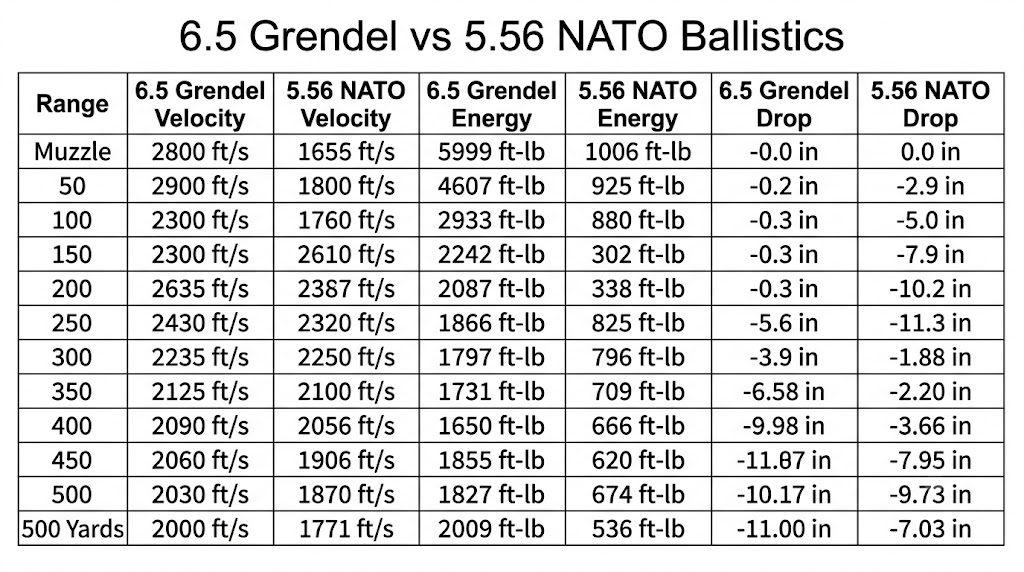
Detailed Ballistics Comparison Chart
Data calculated using a 200-yard zero, 1.5-inch sight height, and a 10 mph crosswind. 6.5 Grendel data reflects a 123gr Hornady SST (BC 0.510). 5.56 NATO data reflects a 62gr M855 (BC 0.304) fired from 16-inch barrels.
| Range (Yards) | 6.5 Grendel Vel. (fps) | 5.56 NATO Vel. (fps) | 6.5 Grendel Energy (ft-lbs) | 5.56 NATO Energy (ft-lbs) | 6.5 Grendel Drop (in) | 5.56 NATO Drop (in) | 6.5 Grendel Wind (in) | 5.56 NATO Wind (in) |
| Muzzle | 2580 | 3000 | 1818 | 1239 | -1.5 | -1.5 | 0.0 | 0.0 |
| 25 | 2530 | 2925 | 1750 | 1178 | -0.3 | -0.5 | 0.0 | 0.1 |
| 50 | 2480 | 2851 | 1680 | 1119 | +0.6 | +0.3 | 0.2 | 0.3 |
| 75 | 2432 | 2779 | 1615 | 1063 | +1.3 | +0.9 | 0.4 | 0.6 |
| 100 | 2385 | 2708 | 1553 | 1009 | +1.7 | +1.2 | 0.7 | 1.1 |
| 125 | 2338 | 2638 | 1493 | 958 | +1.7 | +1.2 | 1.1 | 1.8 |
| 150 | 2292 | 2569 | 1435 | 909 | +1.4 | +0.9 | 1.5 | 2.5 |
| 175 | 2246 | 2502 | 1378 | 862 | +0.8 | +0.4 | 2.1 | 3.5 |
| 200 | 2202 | 2435 | 1324 | 816 | 0.0 | 0.0 | 2.8 | 4.6 |
| 225 | 2157 | 2370 | 1271 | 773 | -1.1 | -0.8 | 3.5 | 5.9 |
| 250 | 2113 | 2305 | 1220 | 732 | -2.6 | -2.0 | 4.4 | 7.4 |
| 275 | 2070 | 2242 | 1170 | 692 | -4.4 | -3.6 | 5.4 | 9.0 |
| 300 | 2027 | 2180 | 1123 | 655 | -6.6 | -5.7 | 6.5 | 10.9 |
| 350 | 1943 | 2058 | 1031 | 583 | -12.1 | -11.2 | 9.0 | 15.3 |
| 400 | 1862 | 1940 | 946 | 518 | -19.2 | -18.7 | 12.0 | 20.6 |
| 450 | 1783 | 1827 | 868 | 459 | -28.2 | -28.6 | 15.5 | 26.8 |
| 500 | 1706 | 1718 | 795 | 406 | -39.2 | -41.3 | 19.4 | 34.3 |
Comparison Chart Image
1. Cartridge Overview
The 5.56 NATO established itself as the global standard for military, law enforcement, and civilian use over the last half-century. Designed around the AR-15 platform, the cartridge relies on lightweight bullets traveling at high velocities to induce rapid fragmentation. It excels in applications requiring high magazine capacity, low recoil, and easy maneuverability. Because of its massive adoption, the 5.56 NATO benefits from unparalleled commercial availability, offering shooters everything from ultra-cheap practice ammunition to premium defensive loads.
The 6.5 Grendel emerged in 2003 through the collaborative efforts of Bill Alexander and Janne Pohjoispää. They sought to extract maximum effective range and terminal performance from the standard AR-15 chassis without compromising the platform’s reliability. By necking down a .220 Russian case to accept aerodynamically superior 6.5mm projectiles, they created an intermediate cartridge that punches far above its weight class.
Upgrading a standard 5.56 NATO rifle to fire 6.5 Grendel requires only a new barrel, a new bolt face, and specialized magazines. This ease of conversion has made the Grendel exceptionally popular among shooters who demand more downrange energy and better wind-bucking capabilities than the 5.56 NATO can physically provide.
2. Key Differences
The primary differences between the 5.56 NATO and the 6.5 Grendel stem from their foundational design philosophies. The 5.56 NATO prioritizes sheer muzzle velocity and minimal felt recoil. Its narrow 0.224-inch projectile achieves extreme speeds, making it highly effective at close to medium ranges. The 5.56 NATO case dimensions allow a standard AR-15 magazine to hold 30 rounds comfortably, maximizing firepower.
The 6.5 Grendel sacrifices magazine capacity and initial muzzle velocity to deploy a significantly heavier, more aerodynamic projectile. Using a fatter casing based on the .220 Russian, the Grendel holds more powder to push a 0.264-inch bullet. Because the case is wider, standard AR-15 magazines can only hold 26 rounds of 6.5 Grendel, and the geometry requires proprietary magazine designs to feed reliably.
These design choices dictate their performance on the range and in the field. The 5.56 NATO acts as a short-to-medium range laser beam, relying on velocity to fragment small bullets. The 6.5 Grendel functions as a miniature long-range precision cartridge, relying on heavy mass and high ballistic coefficients to maintain lethality and accuracy at distances where the 5.56 NATO runs completely out of steam.
3. Velocity Comparison
The 5.56 NATO completely dominates the muzzle velocity metrics. Firing a standard 62-grain bullet from a 16-inch barrel, the 5.56 NATO achieves speeds right at 3,000 feet per second. In stark contrast, the 6.5 Grendel pushing a 123-grain bullet leaves the same barrel at roughly 2,580 feet per second. At the muzzle, the 5.56 NATO possesses a speed advantage of nearly 400 fps.
However, muzzle velocity tells only the beginning of the story. Because the 5.56 NATO utilizes short, lightweight bullets with lower ballistic coefficients, it sheds that initial velocity rapidly as it pushes through the air. The 6.5 Grendel utilizes long, highly aerodynamic projectiles that glide efficiently and resist atmospheric drag.
By the time both bullets cross the 400-yard line, the velocity gap vanishes. At 500 yards, the 5.56 NATO has decayed to roughly 1,718 feet per second, rapidly approaching the transonic zone where accuracy degrades. The 6.5 Grendel remains comfortably supersonic at 1,706 feet per second, proving its superior velocity retention.
Winner: The 5.56 NATO wins for initial muzzle velocity, but the 6.5 Grendel decisively wins for downrange velocity retention.
4. Energy Comparison
For hunters accustomed to the massive 2,900 foot-pounds of energy delivered by .30-06 ballistics, moving to an AR-15 platform requires managing expectations. Neither of these intermediate cartridges rivals full-power rifle rounds. However, the 6.5 Grendel bridges the gap remarkably well, delivering terminal ballistics previously thought impossible for a standard AR-15.
At the muzzle, the 6.5 Grendel generates an impressive 1,818 foot-pounds of kinetic energy. The 5.56 NATO trails significantly behind, generating only 1,239 foot-pounds. This initial 46% energy advantage for the Grendel only compounds as the bullets travel downrange.
At 300 yards, the 5.56 NATO retains a meager 655 foot-pounds of energy—well below the widely accepted 1,000 foot-pound threshold recommended for ethical deer hunting. The 6.5 Grendel easily breaks that threshold, delivering 1,123 foot-pounds at 300 yards. Even at 500 yards, the Grendel hits with nearly double the kinetic force of the 5.56 NATO (795 ft-lbs vs 406 ft-lbs).
Winner: The 6.5 Grendel is the undisputed winner, delivering vastly superior kinetic energy at every measured distance.
5. Trajectory & Bullet Drop Comparison
Shooters prioritize a flat trajectory to minimize the need for complex holdovers at unknown distances. Because the 5.56 NATO launches a light projectile at blistering speeds, it shoots incredibly flat out to 300 yards.
With a 200-yard zero, the 5.56 NATO drops only 5.7 inches at 300 yards. The slower, heavier 6.5 Grendel drops 6.6 inches at the same distance. For point-blank hunting and tactical engagements inside three football fields, the 5.56 NATO requires slightly less vertical compensation.
Beyond 300 yards, the dynamics shift. As the 5.56 NATO bleeds velocity, its trajectory degrades exponentially. At 450 yards, the 5.56 NATO drops 28.6 inches, while the 6.5 Grendel drops 28.2 inches. By 500 yards, the 6.5 Grendel actually shoots flatter, dropping 39.2 inches compared to the 5.56 NATO’s 41.3 inches. The higher ballistic coefficient of the 6.5mm bullet allows it to maintain its arc smoothly at extended ranges, while the 5.56 NATO falls rapidly from the sky.
Winner: The 5.56 NATO shoots flatter inside 300 yards, while the 6.5 Grendel takes the lead past 400 yards.
6. Wind Drift Comparison
Wind deflection separates adequate long-range cartridges from exceptional ones. A bullet’s ability to resist wind drift depends directly on its ballistic coefficient (BC) and its time of flight. The 6.5mm family of bullets is legendary in the precision shooting world for featuring extremely high BCs.
In a 10 mph crosswind, the differences become glaringly apparent early in the bullet’s flight path. At 200 yards, the 6.5 Grendel drifts 2.8 inches, while the 5.56 NATO drifts 4.6 inches. This represents a minor difference for large targets but matters significantly for precision grouping.
At extended ranges, the 5.56 NATO becomes incredibly difficult to manage in the wind. At 400 yards, the 5.56 NATO gets pushed 20.6 inches off target, forcing the shooter to make substantial windage dials. The 6.5 Grendel drifts only 12.0 inches at the same distance. By 500 yards, the Grendel holds a massive 15-inch advantage in wind deflection.
Winner: The 6.5 Grendel is the definitive winner, cutting through the wind with far greater efficiency than the 5.56 NATO.
7. Hunting Performance Comparison
The terminal performance requirements differ wildly depending on the targeted animal. The 5.56 NATO excels at pest control and varmint hunting. With specialized expanding bullets, it humanely dispatches coyotes, prairie dogs, and groundhogs with explosive results and zero pelt damage from excessive recoil. However, using 5.56 NATO on medium game like whitetail deer remains controversial, requiring perfect shot placement to ensure a clean kill.
The 6.5 Grendel completely changes the hunting capabilities of the AR-15. Its heavier 120 to 130-grain projectiles possess the sectional density required to penetrate thick bone and muscle mass. The Grendel reliably takes down whitetail deer, wild hogs, and black bear at ranges up to 300 or 400 yards.
While dedicated big-game hunters prefer larger calibers, the 6.5 Grendel has even been used successfully on elk at close ranges with premium controlled-expansion ammunition. The 5.56 NATO lacks the kinetic energy and penetration capabilities for such large animals.
Winner: The 6.5 Grendel dominates for medium and large game (deer, hogs, bear), while the 5.56 NATO remains the superior dedicated varmint cartridge.
8. Accuracy & Long-Range Performance
Both cartridges deliver excellent mechanical accuracy out of properly built rifles, often producing sub-MOA groups with match-grade ammunition. The true test of accuracy occurs when environmental variables and distance enter the equation.
The 5.56 NATO performs admirably as a precision tool out to 500 or 600 yards. Beyond that distance, standard 5.56 bullets transition from supersonic to subsonic flight. This transonic barrier causes the bullet to become unstable, severely degrading accuracy and making precise hits past 700 yards highly unpredictable.
The 6.5 Grendel was purpose-built for long-range performance. Using heavy match bullets like the 123-grain ELD Match, the Grendel remains supersonic well past 800 yards, and often out to 1,000 yards depending on barrel length and atmospheric conditions. The higher ballistic coefficient means the shooter battles less wind drift and requires less vertical adjustment, resulting in significantly higher hit percentages on long-distance steel plates.
Winner: The 6.5 Grendel is vastly superior for long-range precision shooting past 500 yards.
9. Pros and Cons
Both cartridges bring distinct advantages and limitations to the AR-15 platform. Understanding these trade-offs ensures you select the correct tool for your specific application.
6.5 Grendel Pros
• Delivers exceptional kinetic energy for a short-action cartridge.
• Retains supersonic velocity out to 800+ yards.
• Excellent wind-bucking capabilities due to high BC bullets.
• highly capable of taking deer, hogs, and black bear.
• Fits inside standard AR-15 lower receivers.
6.5 Grendel Cons
• Ammunition is significantly more expensive.
• Limited commercial availability at local sporting goods stores.
• Requires specialized magazines to ensure reliable feeding.
• Magazine capacity reduced to 26 rounds in standard length bodies.
5.56 NATO Pros
• Ammunition is cheap, plentiful, and available everywhere.
• Extremely flat trajectory inside 300 yards.
• Generates virtually zero recoil, allowing rapid follow-up shots.
• Maximum magazine capacity and flawless feeding geometry.
• Standardized parts ensure universal AR-15 compatibility.
5.56 NATO Cons
• Lacks terminal energy for medium and large game.
• High wind deflection at extended ranges.
• Velocity decays rapidly past 400 yards.
• Bullet goes transonic much earlier than 6.5mm projectiles.
10. Which One Should You Choose?
Selecting between these two cartridges depends entirely on your primary shooting applications, target distances, and budget.
Best for deer hunting: 6.5 Grendel. The heavy bullets and retained kinetic energy provide reliable, ethical kills on whitetail and mule deer that the 5.56 NATO simply cannot match.
Best for hog hunting: 6.5 Grendel. Feral hogs possess thick shoulder shields. The superior sectional density of the 6.5mm projectile easily penetrates these tough barriers.
Best for target shooting: 5.56 NATO. For ringing steel plates inside 300 yards or running defensive drills, the low cost per round of 5.56 NATO allows you to shoot twice as much for the same budget.
Best for long range: 6.5 Grendel. If your goal is hitting targets between 500 and 1,000 yards, the wind resistance and supersonic retention of the Grendel make it the undisputed choice.
Best for beginners: 5.56 NATO. The lack of felt recoil prevents new shooters from developing a flinch, and the cheap ammunition encourages high-volume practice.
Best all-around cartridge: 5.56 NATO. For general-purpose utility, home defense, varmint control, and training, the logistics of the 5.56 NATO remain unbeatable. You step up to the 6.5 Grendel only when your specific hunting or distance requirements exceed the physical limitations of the 5.56.