A Remington ballistics chart is a reference table published by Remington Ammunition that details the physical flight characteristics and performance metrics of their factory-loaded ammunition.
Instead of showing data for the firearms themselves, these charts focus entirely on the cartridge, breaking down how a specific bullet behaves from the moment it leaves the muzzle until it hits the target.
Remington Ballistics Chart
| Caliber | Bullet Line & Type | Weight (gr) | Muzzle Velocity (fps) | Muzzle Energy (ft-lbs) |
| .17 HMR | Premier Magnum Rimfire | 17 | 2550 | 245 |
| .22 LR | Thunderbolt Solid | 40 | 1255 | 140 |
| .223 Remington | UMC Full Metal Jacket | 55 | 3240 | 1282 |
| .223 Remington | Premier Match HPBT | 69 | 2850 | 1244 |
| .22-250 Remington | High Performance Rifle SP | 55 | 3680 | 1654 |
| .243 Winchester | Core-Lokt Pointed Soft Point | 100 | 2960 | 1945 |
| .243 Winchester | Core-Lokt Tipped | 95 | 3140 | 2080 |
| .25-06 Remington | Core-Lokt Pointed Soft Point | 120 | 2990 | 2382 |
| 6.5 Creedmoor | Core-Lokt Tipped | 129 | 2945 | 2483 |
| 6.5 Creedmoor | Premier Match | 140 | 2700 | 2266 |
| .270 Winchester | Core-Lokt Pointed Soft Point | 130 | 3060 | 2702 |
| .270 Winchester | Core-Lokt Pointed Soft Point | 150 | 2850 | 2705 |
| 7mm-08 Remington | Core-Lokt Pointed Soft Point | 140 | 2860 | 2542 |
| 7mm Rem Mag | Core-Lokt Pointed Soft Point | 150 | 3110 | 3221 |
| 7mm Rem Mag | Premier Scirocco Bonded | 150 | 3110 | 3221 |
| .30-30 Winchester | Core-Lokt Soft Point | 150 | 2390 | 1902 |
| .30-30 Winchester | Core-Lokt Soft Point | 170 | 2200 | 1827 |
| .300 AAC Blackout | UMC Open Tip Flat Base | 120 | 2200 | 1290 |
| .300 AAC Blackout | Subsonic Open Tip Flat Base | 220 | 1015 | 503 |
| .308 Winchester | Core-Lokt Pointed Soft Point | 150 | 2820 | 2648 |
| .308 Winchester | Premier Match HPBT | 168 | 2680 | 2679 |
| .308 Winchester | Core-Lokt Soft Point | 180 | 2620 | 2743 |
| .30-06 Springfield | Core-Lokt Pointed Soft Point | 150 | 2910 | 2820 |
| .30-06 Springfield | Core-Lokt Tipped | 165 | 2820 | 2913 |
| .30-06 Springfield | Core-Lokt Soft Point | 180 | 2700 | 2913 |
| .300 Win Mag | Core-Lokt Pointed Soft Point | 180 | 2960 | 3501 |
| .300 Win Mag | Premier Scirocco Bonded | 180 | 2960 | 3501 |
| .35 Remington | Core-Lokt Soft Point | 200 | 2080 | 1921 |
| .350 Legend | UMC Full Metal Jacket | 145 | 2250 | 1630 |
| .45-70 Government | Core-Lokt Soft Point | 405 | 1330 | 1590 |
| 9mm Luger | UMC Full Metal Jacket | 115 | 1145 | 335 |
| 9mm Luger | Golden Saber Defense JHP | 124 | 1125 | 349 |
| .45 Auto (ACP) | UMC Full Metal Jacket | 230 | 835 | 356 |
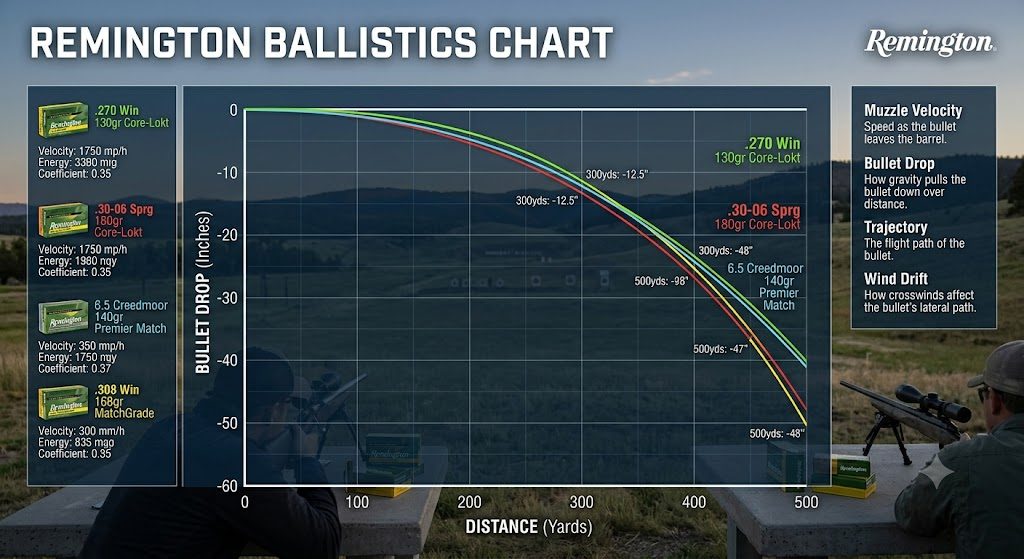
Remington Short-Range Trajectory Chart (100-Yard Zero)
To provide accurate drop values at these shorter distances, the chart below shows the trajectory relative to your line of sight, assuming a standard 100-yard zero with an optic mounted 1.5 inches above the bore.
At 50 yards, you will notice that most fast-moving calibers are slightly negative (meaning the bullet is still rising to meet your crosshairs at 100 yards). Slower, heavier rounds like the .45-70 or .30-30 are intentionally arced higher, so they will strike slightly high at 50 yards before dropping back down to zero at 100.
| Caliber | Bullet Line & Weight | 50 yd | 100 yd | 150 yd | 200 yd |
| .223 Remington | UMC FMJ 55gr | -0.2″ | 0.0″ | -1.1″ | -3.2″ |
| .22-250 Remington | High Perf. SP 55gr | -0.1″ | 0.0″ | -0.6″ | -1.8″ |
| .243 Winchester | Core-Lokt SP 100gr | -0.3″ | 0.0″ | -1.2″ | -3.4″ |
| .243 Winchester | Core-Lokt Tipped 95gr | -0.2″ | 0.0″ | -0.9″ | -2.7″ |
| .25-06 Remington | Core-Lokt SP 120gr | -0.3″ | 0.0″ | -1.1″ | -3.2″ |
| 6.5 Creedmoor | Core-Lokt Tipped 129gr | -0.3″ | 0.0″ | -1.2″ | -3.3″ |
| 6.5 Creedmoor | Premier Match 140gr | -0.4″ | 0.0″ | -1.5″ | -4.4″ |
| .270 Winchester | Core-Lokt SP 130gr | -0.3″ | 0.0″ | -1.0″ | -3.0″ |
| .270 Winchester | Core-Lokt SP 150gr | -0.3″ | 0.0″ | -1.3″ | -3.8″ |
| 7mm-08 Remington | Core-Lokt SP 140gr | -0.3″ | 0.0″ | -1.4″ | -3.9″ |
| 7mm Rem Mag | Core-Lokt SP 150gr | -0.2″ | 0.0″ | -0.9″ | -2.7″ |
| .30-30 Winchester | Core-Lokt SP 150gr | +0.2″ | 0.0″ | -2.5″ | -7.7″ |
| .30-30 Winchester | Core-Lokt SP 170gr | +0.4″ | 0.0″ | -3.2″ | -9.5″ |
| .300 AAC Blackout | UMC OTFB 120gr | +0.4″ | 0.0″ | -3.6″ | -10.5″ |
| .308 Winchester | Core-Lokt SP 150gr | -0.4″ | 0.0″ | -1.5″ | -4.1″ |
| .308 Winchester | Premier Match 168gr | -0.4″ | 0.0″ | -1.6″ | -4.7″ |
| .308 Winchester | Core-Lokt SP 180gr | -0.5″ | 0.0″ | -1.8″ | -5.1″ |
| .30-06 Springfield | Core-Lokt SP 150gr | -0.4″ | 0.0″ | -1.3″ | -3.6″ |
| .30-06 Springfield | Core-Lokt Tipped 165gr | -0.4″ | 0.0″ | -1.4″ | -3.9″ |
| .30-06 Springfield | Core-Lokt SP 180gr | -0.4″ | 0.0″ | -1.6″ | -4.6″ |
| .300 Win Mag | Core-Lokt SP 180gr | -0.3″ | 0.0″ | -1.1″ | -3.4″ |
| .35 Remington | Core-Lokt SP 200gr | +0.6″ | 0.0″ | -4.1″ | -12.5″ |
| .350 Legend | UMC FMJ 145gr | +0.5″ | 0.0″ | -3.4″ | -10.0″ |
| .45-70 Government | Core-Lokt SP 405gr | +1.2″ | 0.0″ | -9.5″ | -32.5″ |
To get the most out of a ballistics chart, it helps to understand exactly what each measurement means and how they interact in the real world.
The Basics: Identifying the Ammunition
Caliber (Cartridge)
- What it is: The specific size and design of the ammunition cartridge. It includes the diameter of the bullet and the dimensions of the brass casing holding the gunpowder.
- Why it matters: Your firearm is machined to shoot exactly one caliber. Firing the wrong caliber is extremely dangerous. Calibers dictate the overall potential of the round—for example, a large magnum cartridge can hold more powder than a compact cartridge, generating higher speeds and power.
Bullet Weight (Measured in Grains)
- What it is: The physical mass of the projectile itself. In ballistics, weight is measured in grains (gr), a tiny unit of measurement where 7,000 grains equal exactly 1 pound.
- Why it matters: Within the same caliber, you can often choose different bullet weights.
- Lighter bullets can be pushed faster by the gunpowder, resulting in a flatter trajectory over short distances, but they lose their momentum quicker.
- Heavier bullets start out slower but retain their momentum and energy better at long ranges, and they are less affected by crosswinds.
Bullet Type / Line
- What it is: The physical design and construction of the bullet (e.g., Soft Point, Full Metal Jacket, Polymer Tipped).
- Why it matters: Bullet design dictates what happens when the bullet hits the target.
- Full Metal Jacket (FMJ): A lead core wrapped in copper that does not expand. Used for target practice.
- Soft Point (SP) / Core-Lokt: Exposed lead at the nose designed to peel back smoothly (mushroom) on impact, transferring massive energy to harvest game ethically.
- Tipped (e.g., Core-Lokt Tipped): A polymer tip added to the nose to make the bullet highly aerodynamic in flight, which then pushes backward into the core on impact to force rapid expansion.
Velocity and Power
Muzzle Velocity (Measured in feet per second / fps)
- What it is: The speed of the bullet at the exact microsecond it leaves the end of the rifle barrel (the muzzle).
- Why it matters: Speed is the enemy of gravity. The faster a bullet travels, the less time gravity has to pull it down toward the earth as it travels toward a distant target, creating a “flatter” path.
Muzzle Energy (Measured in foot-pounds / ft-lbs)
- What it is: A measurement of the kinetic energy (destructive power) carried by the bullet as it exits the barrel. One foot-pound is the amount of energy required to raise a one-pound weight a distance of one foot.
- Why it matters: This represents the hitting power of the cartridge. While velocity tells you how fast it goes, energy tells you how hard it hits. Heavier and faster bullets carry significantly more energy, which is crucial for deep penetration and clean takedowns when hunting larger game like elk or bear.
Flight and Trajectory
Ballistic Coefficient (BC)
- What it is: A mathematical rating of how aerodynamic the bullet is. The higher the decimal number (e.g., 0.520 vs 0.210), the cleaner the bullet slices through the air resistance (drag).
- Why it matters: A bullet with a high BC fights air drag efficiently. It will retain its velocity longer, resist being pushed off-course by crosswinds, and drop less at extreme distances compared to a low-BC bullet.
Rifle “Zero”
- What it is: The distance at which your scope’s crosshairs perfectly align with where the bullet actually hits.
- Why it matters: Because a scope sits roughly 1.5 to 2 inches above the barrel, the barrel must be angled slightly upward to cross paths with your line of sight. A “100-yard zero” means the bullet rises from the barrel, crosses your line of sight, and strikes dead-center exactly at 100 yards.
Bullet Drop / Trajectory (Measured in Inches)
- What it is: The physical distance the bullet falls below your point of aim as it travels downrange.
- Why it matters: Gravity starts pulling the bullet down the instant it leaves the barrel.
- Negative values (-3.2″): This means the bullet has succumbed to gravity and is striking below your crosshairs. You must aim higher (hold over) to hit the target.
- Positive values (+0.5″): This occurs at close ranges (like 50 yards) for slower bullets. Because the barrel is angled slightly upward to hit a 100-yard target, the bullet is still on its upward arc and passes slightly above your line of sight before settling into your 100-yard zero.