The main difference between the .270 Winchester and the .300 Winchester Magnum lies in their intended application: the .270 Winchester is a legendary, moderate-recoil deer rifle known for its flat trajectory and efficiency, while the .300 Win Mag is a heavy-hitting magnum designed for long-range performance and larger game. Although both are excellent, the .270 Winchester provides a flatter trajectory at moderate ranges with significantly less recoil, whereas the .300 Win Mag delivers substantially more downrange energy and velocity with heavier bullets at extended distances. Choosing between them depends on whether your priority is manageable recoil and deer-sized game or maximum stopping power and long-range versatility for elk and moose, making this 270 vs 300 win mag ballistics chart comparison essential for your next build or hunt.
270 vs 300 Win Mag Ballistics Chart
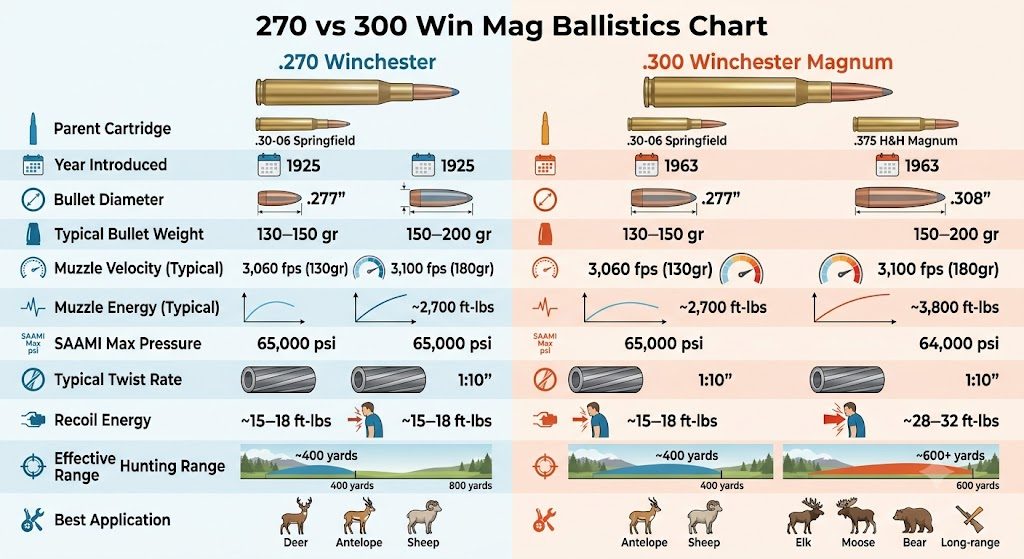
| Feature | .270 Winchester | .300 Winchester Magnum |
| Parent Cartridge | .30-06 Springfield | .375 H&H Magnum |
| Year Introduced | 1925 | 1963 |
| Bullet Diameter | .277″ | .308″ |
| Typical Bullet Weight | 130–150 gr | 150–200 gr |
| Muzzle Velocity (Typical) | 3,060 fps (130gr) | 3,100 fps (180gr) |
| Muzzle Energy (Typical) | ~2,700 ft-lbs | ~3,800 ft-lbs |
| SAAMI Max Pressure | 65,000 psi | 64,000 psi |
| Typical Twist Rate | 1:10″ | 1:10″ |
| Recoil Energy | ~15–18 ft-lbs | ~28–32 ft-lbs |
| Effective Hunting Range | ~400 yards | ~600+ yards |
| Best Application | Deer, Antelope, Sheep | Elk, Moose, Bear, Long-range |
Muzzle Velocity Comparison
The .270 Winchester typically launches 130-grain projectiles at velocities exceeding 3,000 fps, making it exceptionally fast for a non-magnum cartridge. In contrast, the .300 Win Mag propels heavier 180-grain bullets at similar or slightly higher velocities. While the .270 Win maintains speed well due to high ballistic coefficients in its bullet range, the .300 Win Mag offers superior velocity retention with heavy-for-caliber projectiles, allowing it to maintain supersonic speeds significantly further than the .270 Win.
Muzzle Energy Comparison
There is a distinct difference in power output between the two. The .270 Winchester produces roughly 2,700 ft-lbs of energy, which is more than sufficient for medium game like deer. On the other hand, the .300 Win Mag generates upwards of 3,800 ft-lbs of muzzle energy. This increased capacity allows the .300 Win Mag to deliver deeper penetration and more significant shock, which is why it is preferred for larger species like elk or moose.
Downrange Energy Comparison
As distance increases, the higher sectional density and weight of the .300 Win Mag bullets allow them to retain energy much more effectively than the lighter .270 Win offerings. At 500 yards, the .300 Win Mag still carries energy levels that often exceed the muzzle energy of many standard cartridges, whereas the .270 Win energy levels drop off more rapidly after 400 yards, limiting its ethical range on heavy game.
Bullet Drop and Trajectory
Both cartridges are known for being flat-shooting, but they achieve this in different ways. The .270 Winchester relies on lighter, aerodynamic bullets to minimize drop at medium distances. However, the .300 Win Mag features a flatter trajectory at long ranges because its higher velocity and heavy, high-BC bullets resist wind drift and gravity more efficiently. If you are shooting at distances beyond 400 yards, the .300 Win Mag requires less holdover compared to the .270 Win.
Recoil Comparison
Recoil is the most significant trade-off when selecting the .300 Win Mag. The .270 Winchester generates manageable recoil, usually between 15 and 18 ft-lbs, which most shooters can handle without fatigue. In contrast, the .300 Win Mag produces roughly 28 to 32 ft-lbs of recoil. This nearly doubled energy often requires a heavier rifle, a muzzle brake, or significant practice to ensure the shooter remains accurate and does not develop a flinch.
Ammunition Availability and Cost
The .270 Winchester has been a staple in hunting camps for decades, ensuring that ammunition is widely available and generally more affordable. The .300 Win Mag is also extremely popular and found on most shelves, but factory loads are typically more expensive due to the higher volume of powder and premium-grade heavy bullets required for magnum performance.
Which Is Better?
The better choice depends entirely on your specific hunting environment and the species you are targeting. For the average deer hunter who spends most of their time shooting under 400 yards, the .270 Winchester is often better because of its lower recoil, flatter trajectory for medium-range shots, and lower ammunition cost.
For the western hunter or those pursuing elk, moose, or large bear, the .300 Win Mag is the superior tool. It provides the necessary energy and long-range ballistic advantage to ensure clean, ethical harvests on tough, heavy-boned animals. While it is more demanding to shoot, the extra power provides a wider margin for error on big game.
FAQ
Is the .300 Win Mag overkill for deer?
Many hunters consider the .300 Win Mag to be overkill for standard whitetail deer, as it can cause significant meat damage compared to the efficient, light-recoil performance of the .270 Winchester.
Can I shoot long range with a .270 Winchester?
Yes, the .270 Winchester is highly capable out to 400 or 500 yards with high-BC bullets, but it does not maintain the same energy or wind resistance as the .300 Win Mag at extreme ranges.
Why does the .300 Win Mag have more recoil?
The .300 Win Mag burns significantly more powder to push heavier bullets at higher velocities, creating a larger force of gas exiting the barrel, which results in increased rearward recoil energy.
Which is better for a beginner?
The .270 Winchester is significantly better for a beginner because its manageable recoil allows the shooter to practice proper marksmanship fundamentals without developing a recoil-induced flinch.