The Hornady 300 PRC Precision Hunter loaded with the 212-grain ELD-X bullet delivers a muzzle velocity of 2,860 fps and a massive muzzle energy of 3,850 ft-lbs. Designed as a dedicated heavy-bullet magnum, this cartridge provides exceptional aerodynamic efficiency and terminal performance at extended distances. With a 200-yard zero, the projectile experiences only 34.6 inches of bullet drop and retains over 2,300 ft-lbs of energy at 500 yards. The effective hunting range comfortably exceeds 800 yards for large game, making it an elite choice for elk, moose, and bear. By maximizing ballistic coefficient and minimizing wind deflection, this factory load offers competitive shooters and western hunters unparalleled precision in a modern rifle cartridge.
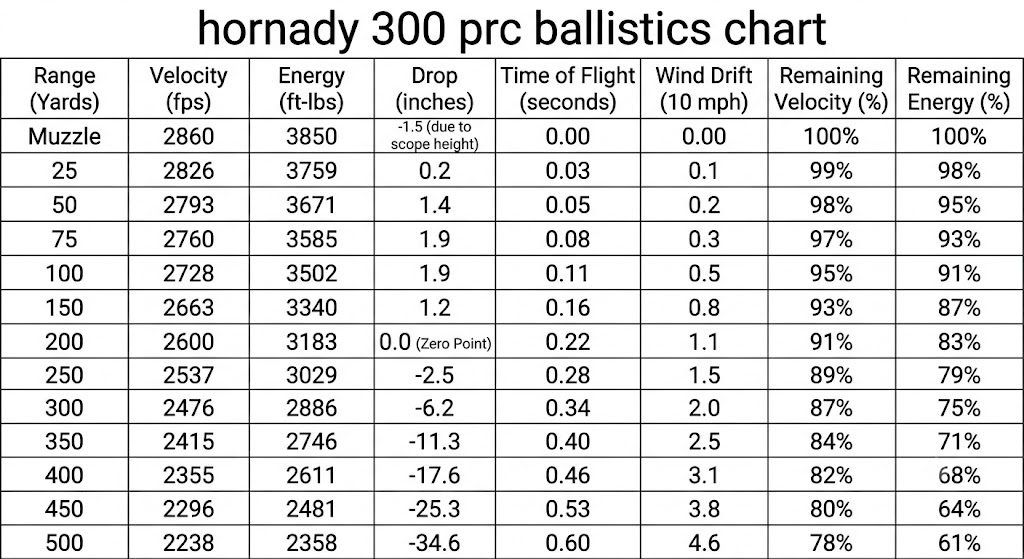
Hornady 300 PRC Ballistics Chart
| Range (Yards) | Velocity (fps) | Energy (ft-lbs) | Drop (inches) | Time of Flight (seconds) | Wind Drift (10 mph) | Remaining Velocity (%) | Remaining Energy (%) |
| Muzzle | 2860 | 3850 | -1.5 | 0.000 | 0.0 | 100% | 100% |
| 25 | 2826 | 3759 | -0.5 | 0.026 | 0.0 | 98% | 97% |
| 50 | 2793 | 3671 | 0.2 | 0.053 | 0.1 | 97% | 95% |
| 75 | 2760 | 3585 | 0.9 | 0.080 | 0.2 | 96% | 93% |
| 100 | 2728 | 3502 | 1.4 | 0.108 | 0.4 | 95% | 91% |
| 125 | 2695 | 3420 | 1.6 | 0.135 | 0.6 | 94% | 88% |
| 150 | 2663 | 3340 | 1.3 | 0.163 | 0.8 | 93% | 86% |
| 175 | 2631 | 3261 | 0.8 | 0.192 | 1.1 | 92% | 84% |
| 200 | 2600 | 3183 | 0.0 | 0.220 | 1.4 | 90% | 82% |
| 225 | 2568 | 3105 | -1.1 | 0.249 | 1.8 | 89% | 80% |
| 250 | 2537 | 3029 | -2.5 | 0.279 | 2.2 | 88% | 78% |
| 275 | 2506 | 2956 | -4.2 | 0.308 | 2.7 | 87% | 76% |
| 300 | 2476 | 2886 | -6.2 | 0.339 | 3.2 | 86% | 75% |
| 325 | 2446 | 2816 | -8.6 | 0.369 | 3.8 | 85% | 73% |
| 350 | 2415 | 2746 | -11.3 | 0.400 | 4.4 | 84% | 71% |
| 375 | 2385 | 2678 | -14.3 | 0.432 | 5.0 | 83% | 69% |
| 400 | 2355 | 2611 | -17.6 | 0.464 | 5.8 | 82% | 67% |
| 450 | 2296 | 2481 | -25.3 | 0.528 | 7.3 | 80% | 64% |
| 500 | 2238 | 2358 | -34.6 | 0.596 | 9.1 | 78% | 61% |
- Zero distance: 200 Yards
- Bullet weight: 212 Grains
- Bullet type: Hornady ELD-X (Extremely Low Drag – eXpanding)
- Ballistic coefficient (BC): .673 (G1) / .336 (G7)
- Sectional density (SD): .319
- Barrel length: 24 Inches
- Sight height: 1.5 Inches
- Atmospheric assumptions: Sea level, 59°F, 29.92 inHg (Standard SAAMI)
1. Overview of the Ammunition
The Hornady Precision Hunter line in 300 Precision Rifle Cartridge (PRC) represents the pinnacle of modern magnum cartridge design. Hornady engineered the 300 PRC to push long, heavy, high-ballistic-coefficient projectiles without seating the bullets deep into the powder column. This solves a major flaw found in older belted magnums like the 300 Winchester Magnum. The non-belted case headspaces off the shoulder, promoting better chamber alignment and inherently superior accuracy.
This specific factory load features the 212-grain ELD-X (Extremely Low Drag – eXpanding) bullet. The ELD-X utilizes a heat-resistant polymer tip—the Heat Shield—that resists aerodynamic heating, ensuring the bullet retains its shape and maintains a consistent ballistic coefficient during flight. The jacket features an InterLock ring to keep the core and jacket together upon impact, ensuring deep penetration and devastating wound channels. This hunting ammunition bridges the gap between match-grade target performance and reliable lethality, making it a favorite for custom bolt-action platforms and precision hunting rifles built for vast, open landscapes.
2. Understanding the Ballistics Chart
Interpreting a ballistics chart correctly allows a shooter to translate laboratory data into practical field application. The range column indicates the distance from the muzzle in 25-yard increments. Velocity, measured in feet per second (fps), dictates how fast the projectile travels at a given distance, directly influencing bullet drop and terminal expansion. Energy, measured in foot-pounds (ft-lbs), indicates the kinetic striking power of the bullet, which is the primary metric for determining clean, ethical kills on large game.
Bullet drop shows the exact trajectory path relative to the line of sight, mapped here with a 200-yard zero. Negative numbers represent the bullet falling below the crosshairs. Wind drift illustrates how far a full-value 10 mph crosswind pushes the bullet horizontally. Time of flight tracks how long the projectile takes to reach its target, an essential metric for judging lead on moving animals. Finally, retained velocity and energy percentages highlight the cartridge’s efficiency, showing exactly how much of the initial muzzle power remains available to the hunter downrange.
3. Velocity Performance
The 300 PRC launches the massive 212-grain projectile at a muzzle velocity of 2,860 fps. While some ultra-magnums boast higher initial speeds, Hornady prioritized aerodynamic efficiency over raw, barrel-burning velocity. The true advantage of this cartridge lies in its velocity retention. Thanks to the ELD-X bullet’s ultra-high G1 ballistic coefficient of .673, the projectile cuts through the air with minimal drag.
At 500 yards, the bullet still travels at 2,238 fps, retaining 78% of its initial speed. This downrange speed is critical for two reasons. First, it minimizes the time of flight, giving environmental factors less time to alter the bullet’s path. Second, the ELD-X bullet requires a minimum impact velocity—typically around 1,600 fps—to initiate reliable expansion. Because the 300 PRC maintains its speed so effectively, this factory ammunition guarantees violent, consistent terminal expansion on game animals well past the 800-yard mark.
4. Energy Performance
Generating 3,850 ft-lbs of muzzle energy, the 300 PRC hits with sledgehammer authority. This astronomical figure comfortably surpasses traditional .30 caliber magnums, allowing hunters to confidently pursue the largest North American game. Energy retention, much like velocity retention, remains exceptionally high due to the bullet’s heavy mass and streamlined profile. The projectile acts like a freight train, refusing to shed its momentum.
At 500 yards, the 212-grain bullet still delivers 2,358 ft-lbs of energy. To put this in perspective, that is more energy at 500 yards than a standard .30-30 Winchester carries at the muzzle. Most hunting guides recommend a minimum of 1,500 ft-lbs of striking energy for ethical shots on bull elk or moose. The Hornady Precision Hunter load exceeds this threshold dramatically, ensuring that even at extended ranges, the bullet possesses enough brute force to smash heavy bone, achieve vital penetration, and produce rapid incapacitation.
5. Trajectory and Bullet Drop
The 300 PRC shoots incredibly flat considering the heavy 212-grain payload it delivers. Utilizing a 200-yard zero, the bullet reaches its maximum height of trajectory at roughly 100 to 125 yards, rising only 1.6 inches above the line of sight. This creates a highly forgiving maximum point blank range (MPBR). A hunter can aim directly at the center of the vital zone on a deer or elk from the muzzle out to roughly 250 yards without needing to dial the scope or hold over the target.
Past 300 yards, gravity inevitably takes hold, but the drop remains manageable and highly predictable. At 400 yards, the drop is -17.6 inches, and at 500 yards, it falls to -34.6 inches. Modern rifle scopes equipped with exposed elevation turrets or specialized ballistic reticles make compensating for this drop mathematically simple. Because the bullet’s ballistic coefficient is so uniform across different velocity bands, the trajectory data aligns perfectly with advanced ballistic calculators, ensuring high first-round hit probabilities at long range.
6. Wind Drift Performance
Wind is the great equalizer in long-range shooting, causing more missed shots than poor distance estimation. The 300 PRC excels in windy environments, making it a premier cartridge for high-altitude mountain hunts and sweeping prairie landscapes. A bullet’s ability to resist wind deflection depends directly on its mass and ballistic coefficient. The 212-grain ELD-X acts as an aerodynamic dart, heavily resisting lateral push.
Assuming a full-value 10 mph crosswind, the bullet drifts only 1.4 inches at 200 yards. Even at a challenging distance of 500 yards, the total wind deflection measures just 9.1 inches. Compared to a standard 165-grain .308 Winchester—which might drift over 20 inches at the same distance under identical conditions—the 300 PRC provides a massive margin for error. This superior wind-bucking capability gives the shooter immense confidence when the canyon thermals shift moments before squeezing the trigger.
7. Effective Hunting Range
Determining the effective hunting range of the 300 PRC relies on both the bullet’s terminal performance thresholds and the shooter’s personal skill level. Mechanically, the Hornady Precision Hunter ammunition remains lethal at astonishing distances. The 212-grain ELD-X bullet maintains the necessary 1,500 ft-lbs of energy and 1,600 fps of velocity required for reliable expansion on large game out to approximately 900 yards at sea level. At higher hunting altitudes, where thinner air reduces drag, this mechanical lethality extends even further.
For practical hunting applications, this cartridge is ideal for deer, wild hogs, black bear, elk, and moose. While the cartridge is mechanically capable of near-mile shots, ethical hunting distances depend heavily on wind reading and shooting stability. For a competent marksman, the 300 PRC turns a 500-yard shot across a windy ravine into a routine, high-percentage ethical harvest, delivering a massive wound channel and ensuring a quick recovery.
8. Accuracy and Real-World Performance
The 300 PRC was approved by SAAMI in 2018 as a precision-first cartridge. Hornady specifically designed the chamber throat and case geometry to optimize bullet seating alignment, effectively bringing handloader-level precision to factory ammunition. In the real world, the Hornady Precision Hunter 300 PRC consistently delivers sub-MOA (Minute of Angle) groups out of quality factory rifles.
Shooters report incredibly low extreme spreads and standard deviations in velocity, which is mandatory for eliminating vertical stringing at long range. Barrel length plays a role; a 24-inch or 26-inch barrel is required to achieve the published 2,860 fps. Because this is a magnum cartridge firing a heavy bullet, managing recoil is the primary hurdle for the shooter. A heavy-profile barrel combined with an efficient muzzle brake or a high-volume suppressor is highly recommended to spot impacts and maintain the fundamental marksmanship required to extract the cartridge’s inherent accuracy.
9. Advantages and Limitations
The primary advantage of the 300 PRC is its uncompromising performance at extreme distances. It outperforms legacy .30 caliber magnums by utilizing modern, heavy-for-caliber projectiles without compromising powder capacity. It offers superior wind resistance, massive energy delivery, and match-grade accuracy straight from a factory box. The cartridge does not require specialized handloading to achieve optimal long-range performance, making it highly accessible to serious hunters.
However, the 300 PRC is not without limitations. The recoil is severe, and the muzzle blast—especially when braked—is punishing. Rifles chambered in 300 PRC are typically long-action, heavy, and less maneuverable in dense timber or heavy brush. Furthermore, factory ammunition is expensive and can sometimes be difficult to source during shortages. For hunters pursuing small-bodied whitetail deer in the thick eastern woods at 50 yards, the 300 PRC is massive overkill; a lighter, short-action cartridge would serve the purpose with far less blast and recoil.
10. Choosing This Ammunition
The Hornady 300 PRC Precision Hunter 212-grain ELD-X is specifically tailored for the dedicated western big game hunter, backcountry guide, and long-range shooting enthusiast. If your hunting scenarios involve glassing deep canyons for elk, stalking moose across wide-open tundra, or hunting sheep in high alpine environments where long shots and unpredictable winds are guaranteed, this ammunition is an unmatched asset.
It combines the devastating kinetic energy required for massive animals with the aerodynamic precision needed for tight target rings. Shooters transitioning from a 300 Winchester Magnum or a 7mm Remington Magnum will instantly notice the superior long-range ballistics and wind deflection characteristics. By mastering the data provided in the ballistics chart and pairing this factory load with a high-quality optic, a hunter transforms their rifle into a highly capable, precision-engineered long-range tool.