Whether you are hitting the flat range, hunting in the backcountry, or setting up a home defense rifle, how you attach your sling matters. A poor mount choice can lead to tangled straps, uncomfortable carry positions, or worse your rifle dropping straight onto the dirt.
Here is a breakdown of the most common rifle sling mount types, their pros and cons, and how to choose the right one for your setup.
Quick Reference: Which One Do You Need?
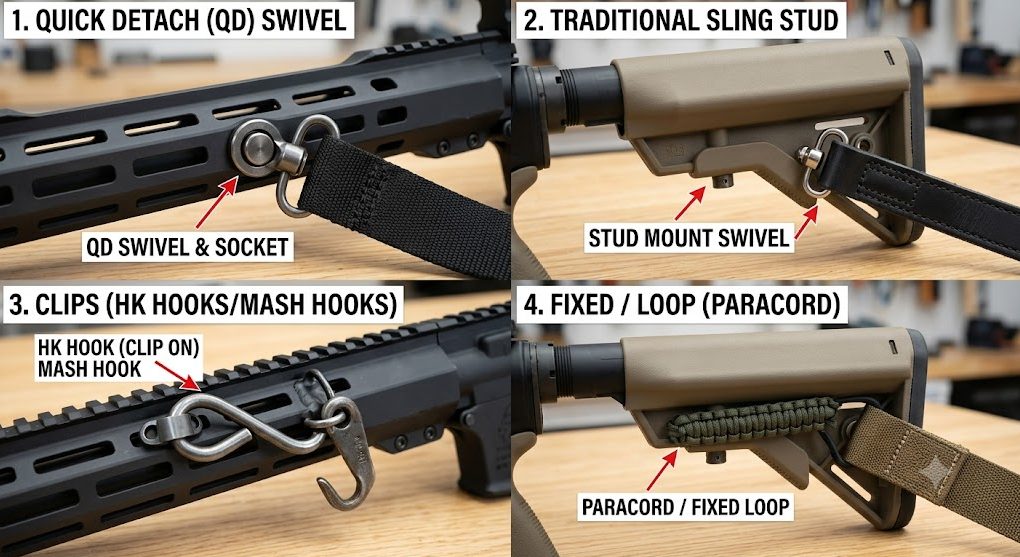
| Mount Type | Best Used For | Key Advantage | Major Drawback | Check |
|---|---|---|---|---|
| QD Swivel | AR-15s, Modern Sporting Rifles | Rapid removal & rotation | Can pack with mud/debris | Check |
| Traditional Stud | Bolt-Action Hunting Rifles | Bulletproof security | Rallies/Squeaks easily | Check |
| HK / MASH Hook | Tactical/Mil-Sim Rifles | Heavy-duty durability | Noisy metal-on-metal | Check |
| Fixed / Loop | Ultralight setups, AKs | Dead silent & cheap | Hard to swap between guns | Check |
Pro Tip: When setting up a dynamic rifle (like an AR-15), try a hybrid setup. Use a solid, fixed loop or QD mount on the buttstock, and a QD mount on the front handguard. This gives you the speed to detach the front of the sling if you need to work on the rifle, while keeping the rear securely anchored.
1. Quick Detach (QD) Swivels and Sockets
The QD system is the reigning king of modern rifle setups. It uses a push-button swivel that inserts into a flush-mounted socket. When you press the button, bearings retract, allowing you to attach or detach the sling in less than a second.
- How it attaches: Sockets are often integrated directly into modern handguards (M-LOK) and buttstocks, or added via aftermarket rail attachments.
- Pros: Extremely fast to remove; clean, snag-free profile; allows the sling to rotate freely (preventing twists).
- Cons: Can collect dirt or mud in the socket, which may prevent a secure lock if not kept clean.
2. Traditional Sling Swivels (Stud Mounts)
If you look at a classic bolt-action hunting rifle, you’ll likely see traditional sling swivel studs. These are small metal pegs with a hole drilled through them. The sling loop pinches over the stud and locks in place with a screw or spring gate.
- How it attaches: Screwed directly into wood or synthetic stocks.
- Pros: Incredibly secure; time-tested; lightweight.
- Cons: Slower to remove than QD; can squeak or rattle; doesn’t allow for easy “tactical” transitions.
3. Clip Attachments (HK Hooks & MASH Hooks)
Originating from military designs (like Heckler & Koch), HK Hooks and MASH Hooks are spring-loaded metal clips that snap onto dedicated loops or eyelets on the rifle.
- How it attaches: Snaps onto small metal loops, gas block eyelets, or specific rail adapters.
- Pros: Highly durable; incredibly secure (especially MASH hooks, which have no moving gates to accidentally open).
- Cons: Metal-on-metal contact means they will scratch your rifle’s finish and can be noisy (clanking) unless muffled with electrical tape or elastic webbing.
4. Fixed / Loop Mounts (Paracord & Webbing)
Sometimes the best mount is the simplest one. Fixed mounts involve threading the sling’s raw webbing directly through a slot in the stock, or using heavy-duty paracord (or specialized loops like Blue Force Gear’s ULoop) to tie the sling to the rifle.
- How it attaches: Threaded through slots in the buttstock or tied around the handguard.
- Pros: 100% silent; practically weightless; universally adaptable to odd-shaped rifle parts.
- Cons: Permanent or slow to remove; webbing can wear down over time if rubbed against sharp metal edges.