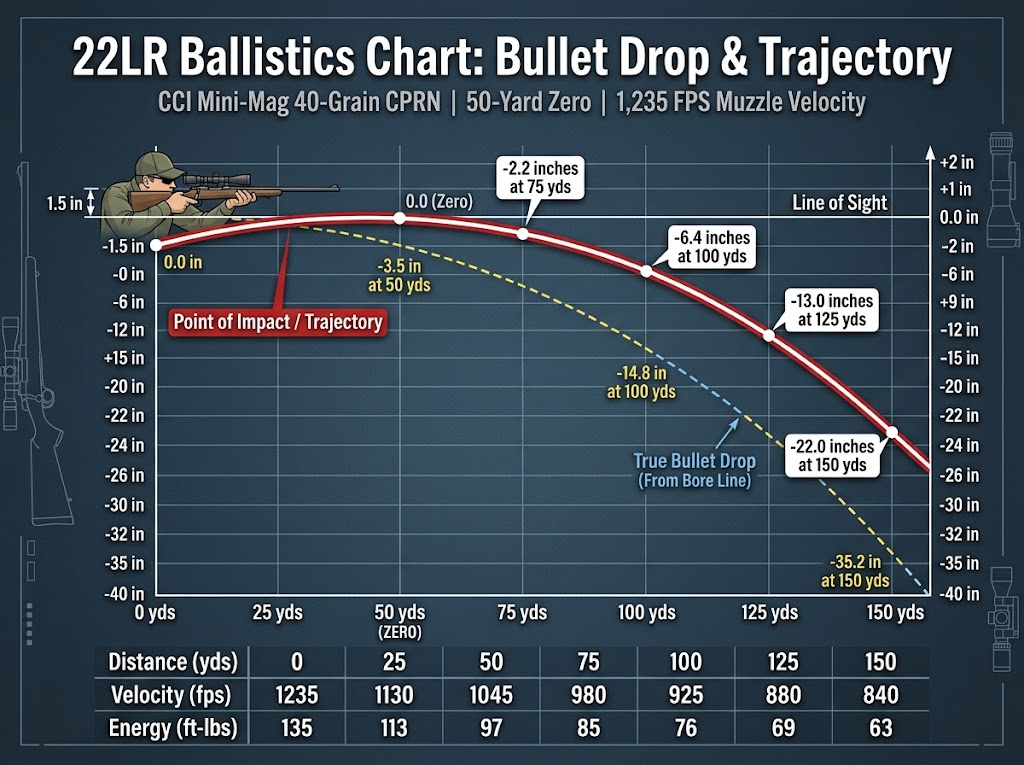
Based on the widely used CCI Mini-Mag 40-grain Copper-Plated Round Nose, the typical .22 LR muzzle velocity is 1,235 feet per second (fps). When zeroed at 50 yards with a 1.5-inch sight height, the bullet strikes exactly on the point of aim at 50 yards, drops 6.4 inches below the line of sight at 100 yards, and plummets 22.0 inches at 150 yards. True bullet drop from the theoretical bore line at 100 yards is 14.8 inches. Keep in mind that ballistic performance varies significantly depending on bullet weight, ammunition type, muzzle velocity, barrel length, sight height, zero distance, and environmental conditions.
Table of Contents [Click to minimize]
22LR Ballistics Chart
| Distance (yards) | Velocity (fps) | Energy (ft-lbs) | Bullet Drop (inches) | Trajectory / Point of Impact |
| 0 (Muzzle) | 1,235 | 135 | 0.0 | -1.5 |
| 25 | 1,130 | 113 | -0.9 | -0.1 |
| 50 | 1,045 | 97 | -3.5 | 0.0 (Zero) |
| 75 | 980 | 85 | -8.1 | -2.2 |
| 100 | 925 | 76 | -14.8 | -6.4 |
| 125 | 880 | 69 | -23.8 | -13.0 |
| 150 | 840 | 63 | -35.2 | -22.0 |
Ammunition Specification Profile:
The data provided in the 22LR ballistics chart above is based on the CCI Mini-Mag 40-grain Copper-Plated Round Nose (CPRN) load. Published muzzle velocity is 1,235 fps. The calculations utilize a 50-yard zero and a standard optic sight height of 1.5 inches above the bore.
Understanding the 22LR Ballistics Chart
The primary 22LR ballistics chart illustrates how the bullet behaves as it travels from the muzzle out to 150 yards. Because the .22 LR is a lightweight, low-velocity cartridge compared to centerfire rifle rounds, its performance degrades rapidly over distance.
Looking at the velocity column, the bullet exits the muzzle at 1,235 fps. By the time it reaches 50 yards, it slows to 1,045 fps, dropping into subsonic speeds. As velocity decreases, so does the retained kinetic energy. The bullet begins with 135 ft-lbs of energy, holds onto 97 ft-lbs at the 50-yard mark, and dwindles to just 76 ft-lbs at 100 yards.
The chart also clearly separates actual bullet drop from the trajectory and point of impact. The bullet drop figures show the absolute gravitational fall from the barrel’s center line. However, the point of impact shows what the shooter experiences. Because the rifle is zeroed at 50 yards, the barrel is angled slightly upward to compensate for gravity. As a result, the point of impact is exactly 0.0 at 50 yards, but the bullet strikes 6.4 inches low at 100 yards and 22.0 inches low at 150 yards.
22LR Bullet Drop Chart
When discussing a 22LR bullet drop chart, it is vital to distinguish between true bore-line drop and the point of impact seen through a scope. Gravity acts on the bullet the exact moment it leaves the barrel.
At 50 yards, the true bullet drop from the bore line is 3.5 inches. At 100 yards, the bullet has dropped 14.8 inches from where the barrel was initially pointing. However, you do not see a 14.8-inch drop when looking through your scope. Because the rifle is sighted in with a 50-yard zero, the barrel is tilted upward relative to the optic. This upward tilt cancels out the first 3.5 inches of drop at 50 yards. Consequently, the actual change in your point of impact at 100 yards is only 6.4 inches below the center of your crosshairs.
22LR Trajectory Chart
A 22LR trajectory chart maps the bullet’s flight path relative to the shooter’s line of sight. Trajectory is dictated by the combination of gravity, muzzle velocity, sight height, and zero distance.
Because the scope sits 1.5 inches above the barrel, the bullet’s point of impact starts at -1.5 inches at the muzzle. Fired from an upward-angled barrel, the bullet climbs to meet the line of sight. At 25 yards, it is nearly perfectly aligned, sitting just 0.1 inches low. It crosses the line of sight exactly at the 50-yard zero. After 50 yards, gravity overcomes the upward trajectory, and the bullet begins to fall steeply. By 75 yards, it strikes 2.2 inches low.
Different ammunition loads will alter this trajectory. A standard velocity load starting around 1,070 fps will exhibit a more arched trajectory and steeper point of impact drops at 100 yards than the high-velocity 1,235 fps load used in our baseline table.
Factors That Affect 22LR Ballistics
Bullet Weight and Bullet Design
The .22 LR is most commonly found with 36-grain or 40-grain bullets. Lighter bullets achieve higher muzzle velocities, creating a flatter short-range trajectory. However, heavier 40-grain bullets retain their momentum and energy better at extended distances. Aerodynamic bullet designs, such as round nose profiles, generally hold their velocity better than blunt hollow points.
Muzzle Velocity
Muzzle velocity dictates how quickly the bullet covers distance. Subsonic loads travel below the speed of sound to eliminate the supersonic crack, but they suffer from severe drop at longer distances. High-velocity and hyper-velocity loads minimize short-range bullet drop but are more susceptible to accuracy degradation when the bullet transitions back down through the sound barrier.
Barrel Length
Unlike large rifle cartridges, the .22 LR uses a very small powder charge that burns quickly. The cartridge achieves its peak velocity in a barrel measuring roughly 14 to 16 inches. Firing .22 LR from a 20-inch or 24-inch barrel will not increase velocity; in fact, the friction of the longer barrel often slows the bullet down slightly.
Zero Distance and Sight Height
Your chosen zero distance sets the baseline for your entire trajectory. A 25-yard zero forces the bullet to climb higher above the line of sight at 50 yards, whereas a 50-yard zero keeps the bullet relatively flat across the most common hunting distances. Additionally, a taller scope mount requires a steeper upward barrel angle, altering the mid-range trajectory arch.
Wind, Temperature, and Air Density
Environmental conditions heavily impact the lightweight .22 LR bullet. A 10 mph crosswind can push a .22 LR bullet several inches off target at 100 yards. Cold weather increases air density, which creates more drag on the bullet, slowing it down faster and increasing the total bullet drop.
Frequently Asked Questions About 22LR Ballistics
1. How much does a .22 LR bullet drop at 100 yards?
With a 50-yard zero, a standard high-velocity .22 LR bullet will impact approximately 5.5 to 7 inches below your line of sight at 100 yards. The exact drop depends on the specific ammunition’s muzzle velocity, the bullet’s aerodynamic profile, and your rifle’s sight height.
2. What is the typical muzzle velocity of .22 LR ammunition?
Typical .22 LR muzzle velocities fall into three main categories: subsonic or standard velocity ranges from 1,000 to 1,080 fps, high velocity spans 1,200 to 1,300 fps, and hyper-velocity rounds can exceed 1,400 to 1,600 fps depending on bullet weight and powder charge.
3. How much energy does a .22 LR bullet retain at 100 yards?
A standard 40-grain high-velocity .22 LR bullet starts with around 135 foot-pounds of energy at the muzzle and retains roughly 70 to 80 foot-pounds of energy at 100 yards. This remaining energy is sufficient for ethical small game hunting and target shooting.
4. What is the effective range of .22 LR?
The effective range of a .22 LR is generally considered to be 50 to 100 yards for small game hunting. For target shooting, experienced marksmen frequently stretch its effective range out to 200 or even 300 yards by carefully adjusting for severe bullet drop and wind deflection.
5. How far can a .22 LR bullet travel?
Despite its small size, a .22 LR bullet can travel over a mile under optimal conditions. If fired at an upward angle of around 30 to 35 degrees, standard and high-velocity bullets can reach maximum distances between 1.25 and 1.5 miles, making a safe backstop essential.
6. What zero distance is commonly used for a .22 LR rifle?
A 50-yard zero is the most commonly used distance for a .22 LR rifle. This zero provides a very flat trajectory for the first 60 yards, keeping the bullet’s point of impact within an inch of the line of sight for typical small game hunting and plinking.
7. How does barrel length affect .22 LR velocity?
The .22 LR ammunition burns its powder charge very quickly. It typically achieves maximum muzzle velocity in a 14-inch to 16-inch barrel. Barrels longer than 18 inches often produce slightly lower velocities because the powder is fully burnt and barrel friction slows the bullet down.
8. Why does .22 LR bullet drop increase at longer distances?
Bullet drop increases exponentially because the bullet is constantly decelerating due to air resistance while gravity pulls it downward at a constant rate. As the bullet slows, it takes longer to cover each subsequent yard, giving gravity more time to pull it down.
9. Does bullet weight affect .22 LR trajectory?
Yes, bullet weight significantly impacts .22 LR trajectory. Lighter 32-grain or 36-grain bullets can be driven to higher velocities, yielding flatter short-range trajectories. Heavy 40-grain bullets carry momentum better, resulting in less wind deflection and more predictable energy retention at extended ranges.
10. How accurate is a .22 LR ballistics chart?
A .22 LR ballistics chart is a highly accurate baseline, but it remains a mathematical prediction based on controlled atmospheric conditions. Real-world performance will vary based on your specific barrel length, exact sight height, altitude, temperature, humidity, and the unique harmonics of your rifle.