For over a century, rimfire cartridges have been the backbone of recreational shooting, small game hunting, and pest control. At first glance, the .22 Long Rifle (LR) and the .22 Winchester Magnum Rimfire (WMR) appear to be close siblings. Both fire projectiles of nearly identical diameter, and both utilize a rimfire priming system.
However, looking past the diameter reveals two entirely different performance profiles. The .22 WMR utilizes a longer, wider case packed with slower-burning powder, launching true jacketed bullets at velocities the .22 LR simply cannot achieve. This article analyzes the hard data to determine exactly how these two cartridges behave in flight and upon impact.
22lr vs 22 Mag Ballistics Chart
To understand the practical differences, we must look at how the bullet behaves at the muzzle and as it travels downrange. The following chart standardizes the data using a 50-yard zero fired from a standard 16-to-18-inch rifle barrel.
| Cartridge | Bullet Weight | Muzzle Velocity (fps) | 100 yd Velocity (fps) | Muzzle Energy (ft-lbs) | 100 yd Energy (ft-lbs) | Drop @ 100 yds |
| .22 LR Standard | 40 grain | 1,070 | 900 | 100 | 72 | -7.4″ |
| .22 LR High-Vel | 40 grain | 1,235 | 1,011 | 135 | 91 | -5.6″ |
| .22 WMR Standard | 40 grain | 1,875 | 1,319 | 312 | 155 | -2.1″ |
| .22 WMR Varmint | 30 grain | 2,200 | 1,421 | 322 | 134 | -1.5″ |
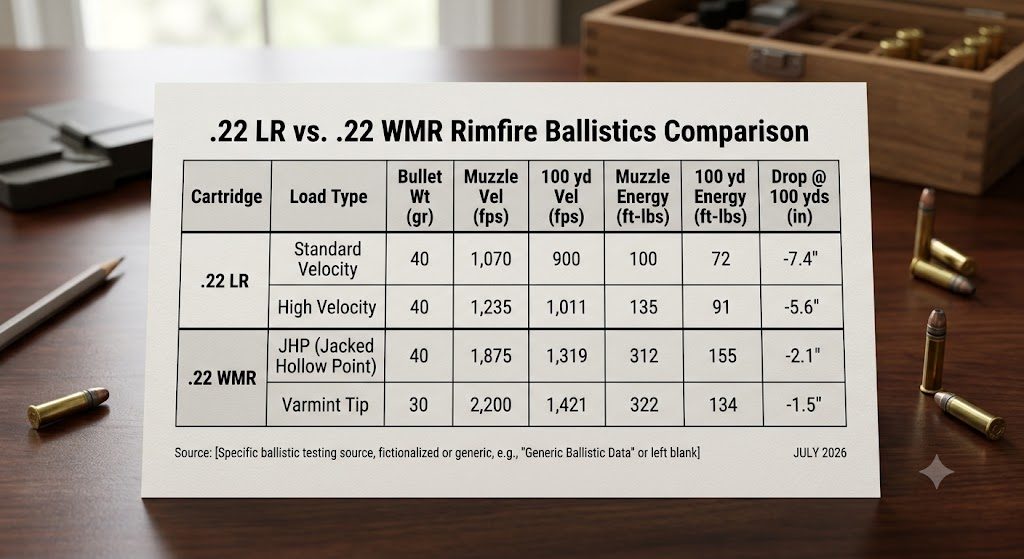
Data Analysis: Translating the Numbers
The raw data exposes three major operational differences between the cartridges: the trajectory curve, kinetic energy retention, and the transonic shift.
1. The Trajectory Curve
Gravity begins pulling a bullet downward the millisecond it leaves the barrel. The faster a bullet travels, the less time gravity has to affect it over a given distance.
Because the .22 WMR (40-grain) exits the muzzle roughly 600 feet per second faster than its .22 LR counterpart, it reaches the 100-yard target significantly sooner. This results in a much flatter trajectory. While a .22 LR shooter must hold their crosshairs nearly 6 inches high to hit a target at 100 yards, the .22 WMR shooter only needs a minor 2-inch adjustment.
2. Kinetic Energy Retention
Energy is the primary metric for hunting ethics. A clean, humane harvest requires sufficient kinetic energy to penetrate and expand the bullet.
- The .22 LR generates roughly 135 foot-pounds (ft-lbs) of energy at the muzzle.
- The .22 WMR delivers roughly 155 ft-lbs of energy at 100 yards.
This means the .22 Magnum strikes a target at a football field’s distance with more devastating force than a .22 LR has at point-blank range.
3. The Transonic Shift
The speed of sound is approximately 1,125 fps. When a bullet transitions from supersonic speed to subsonic speed, it experiences “transonic buffet”—a disruption in air pressure that can destabilize the bullet and ruin accuracy. High-velocity .22 LR rounds start out supersonic but drop below the sound barrier around the 40-to-50-yard mark, exactly where accuracy begins to falter. The .22 WMR stays supersonic well past 100 yards, allowing it to maintain gyroscopic stability much further out.
The Barrel Length Factor
As analyzed in earlier data, ballistic performance is heavily bottlenecked by the firearm’s barrel length due to powder burn rates.
- Fast-Burning Efficiency (.22 LR): The .22 LR requires only 14 to 16 inches of barrel to fully consume its powder and achieve maximum velocity. It remains highly efficient even in short 4-inch handgun barrels, maintaining the majority of its lethal energy.
- Slow-Burning Runway (.22 WMR): The .22 Magnum requires 20 to 22 inches of barrel to reach the 1,900+ fps velocities it is famous for. When fired from a short-barreled handgun, the powder fails to burn completely before the bullet exits. This creates a massive fireball, deafening noise, and crippling velocity loss, rendering the .22 WMR’s ballistic advantage nearly void in pocket-sized revolvers.
Practical Conclusions
The “best” cartridge is entirely dependent on the application.
Choose the .22 LR if:
- You are target shooting, plinking, or training. It costs a fraction of the price of WMR ammunition, allowing for high-volume practice.
- You are hunting small game (squirrels, rabbits) inside of 75 yards where extreme energy is not required.
- You are carrying a short-barreled handgun or a suppressed firearm.
Choose the .22 WMR if:
- You are hunting tougher varmints and predators, such as coyotes, foxes, or groundhogs.
- You regularly take shots between 75 and 125 yards.
- You are utilizing a rifle with at least an 18-inch barrel to maximize the cartridge’s high-pressure potential.