QUICK ACCESS PANEL
The .22 Long Rifle (LR) is the most popular rimfire cartridge in the world, typically firing a 36 to 40-grain bullet. The short answer to .22 LR ballistics is this: A standard high-velocity 40-grain bullet leaves the muzzle at approximately 1,235 feet per second (fps) with 135 foot-pounds (ft-lbs) of energy. When zeroed at 50 yards, it will drop roughly 5.5 inches at 100 yards, maintaining an effective hunting range of 75 to 100 yards before bullet drop and wind drift become too severe to manage.
Detailed Ballistics Chart of 27 Cartridges
This comprehensive .22LR ballistics chart calculates velocity, energy, and bullet drop across popular loads using the industry-standard 50-yard zero. The data was carefully organized by manufacturer and cartridge weight to give you a clear, side-by-side comparison of how each round performs out to 200 yards.
| Load Identity | Bullet Weight (Grains) | Ballistic Coefficient | Muzzle Velocity (fps) | 100 Yds. Velocity (fps) | 200 Yds. Velocity (fps) | Muzzle Energy (ft. lbs.) | 100 Yds. Energy (ft. lbs.) | 200 Yds. Energy (ft. lbs.) | Zero (50 Yds.) | Bullet Drop (75 Yds.) | Bullet Drop (100 Yds.) | Bullet Drop (150 Yds.) | Bullet Drop (200 Yds.) |
| .22LR/(C)/ Mini Mag | 36 | .126 | 1,260 | 1,003 | 874 | 127 | 80 | 61 | 0 | -1.8″ | -5.6″ | -19.9″ | -44.1″ |
| .22LR/(C)/Stinger | 32 | .084 | 1,640 | 1,065 | 857 | 191 | 81 | 52 | 0 | -1.1″ | -3.8″ | -15.2″ | -36.4″ |
| .22LR/(C)/Velocitor | 40 | .126 | 1,435 | 1,084 | 921 | 183 | 104 | 75 | 0 | -1.3″ | -4.3″ | -15.9″ | -36.4″ |
| .22LR/(R)/C-Bee | 33 | .084 | 740 | 637 | 550 | 40 | 30 | 22 | 0 | -6.0″ | -17.0″ | -55.4″ | -118.6″ |
| .22LR/(R)/Cyclone | 36 | .125 | 1,280 | 1,010 | 878 | 131 | 82 | 62 | 0 | -1.8″ | -5.5″ | -19.4″ | -43.4″ |
| .22LR/(R)/ Game Load | 36 | .125 | 1,280 | 1,010 | 878 | 131 | 82 | 62 | 0 | -1.8″ | -5.5″ | -19.4″ | -43.4″ |
| .22LR/(R)/Golden Bullet | 40 | .139 | 1,255 | 1,016 | 892 | 140 | 92 | 71 | 0 | -1.8″ | -5.5″ | -19.5″ | -43.1″ |
| .22LR/(R)/Golden Bullet | 36 | .125 | 1,280 | 1,010 | 878 | 131 | 82 | 62 | 0 | -1.8″ | -5.5″ | -19.4″ | -43.4″ |
| .22LR/(R)/Golden Bullet | 29 | .106 | 1,095 | 903 | 789 | 77 | 53 | 40 | 0 | -2.5″ | -7.5″ | -25.7″ | -56.1″ |
| .22LR/(R)/Sub Sonic | 38 | .125 | 1,050 | 901 | 803 | 93 | 68 | 54 | 0 | -2.7″ | -7.8″ | -26.4″ | -57.0″ |
| .22LR/(R)/Target | 40 | .149 | 1,150 | 975 | 872 | 117 | 84 | 67 | 0 | -2.1″ | -6.4″ | -22.0″ | -47.8″ |
| .22LR/(R)/Thunderbolt | 40 | .139 | 1,255 | 1,016 | 892 | 140 | 92 | 71 | 0 | -1.8″ | -5.5″ | -19.5″ | -43.1″ |
| .22LR/(R)/Viper | 36 | .117 | 1,410 | 1,055 | 896 | 159 | 89 | 64 | 0 | -1.4″ | -4.6″ | -16.9″ | -38.6″ |
| .22LR/(R)/Yellow Jacket | 33 | .107 | 1,500 | 1,075 | 895 | 165 | 85 | 59 | 0 | -1.2″ | -4.1″ | -15.7″ | -36.6″ |
| .22LR/(W)/X22LR SUBA | 40 | .138 | 1,065 | 920 | 826 | 101 | 75 | 61 | 0 | -2.5″ | -7.5″ | -25.3″ | -54.5″ |
| .22LR/(W)/XT22LR | 40 | .148 | 1,150 | 974 | 870 | 117 | 84 | 67 | 0 | -2.1″ | -6.4″ | -22.0″ | -47.9″ |
| .22LR/(W)/WD22LRB | 40 | .148 | 1,150 | 974 | 870 | 117 | 84 | 67 | 0 | -2.1″ | -6.4″ | -22.0″ | -47.9″ |
| .22LR/(W)/WW22LR | 40 | .138 | 1,255 | 1,015 | 891 | 140 | 91 | 71 | 0 | -1.8″ | -5.5″ | -19.5″ | -43.1″ |
| .22LR/(W)/X22LRPP | 40 | .117 | 1,280 | 998 | 863 | 146 | 89 | 66 | 0 | -1.8″ | -5.6″ | -19.9″ | -44.4″ |
| .22LR/(W)/XT22LRS1 | 40 | .138 | 1,300 | 1,036 | 904 | 150 | 95 | 73 | 0 | -1.6″ | -5.1″ | -18.4″ | -41.0″ |
| .22LR/(W)/X22LRH | 37 | .128 | 1,280 | 1,014 | 883 | 135 | 84 | 64 | 0 | -1.7″ | -5.4″ | -19.3″ | -43.0″ |
| .22LR/(W)/22LR222HP | 36 | .084 | 1,280 | 937 | 787 | 131 | 70 | 49 | 0 | -2.0″ | -6.2″ | -22.3″ | -50.4″ |
| .22LR/(W)/XPERT22 | 36 | .084 | 1,280 | 937 | 787 | 131 | 70 | 49 | 0 | -2.0″ | -6.2″ | -22.3″ | -50.4″ |
| .22LR/(W)/22LR333HP | 36 | .084 | 1,280 | 937 | 787 | 131 | 70 | 49 | 0 | -2.0″ | -6.2″ | -22.3″ | -50.4″ |
| .22LR/(W)/S22LRUHV | 32 | .076 | 1,640 | 1,033 | 827 | 191 | 76 | 49 | 0 | -1.2″ | -4.0″ | -16.1″ | -38.7″ |
| .22LR/(W)/X22LRCBMA | 29 | .104 | 770 | 682 | 605 | 38 | 30 | 24 | 0 | -5.3″ | -15.1″ | -48.9″ | -103.9″ |
| .22LR/(W)/X22LRHLF | 26 | .072 | 1,650 | 1,019 | 812 | 157 | 60 | 38 | 0 | -1.2″ | -4.1″ | -16.5″ | -39.7″ |
.22 LR Ballistics Chart (Standard vs High Velocity 40 gr)
Here is the quick-reference ballistics chart for the two most common types of .22 LR loads (Standard Velocity and High Velocity), assuming a standard 40-grain bullet and a 50-yard zero:
| Ammo | Range | Velocity | Energy | Drop |
|---|---|---|---|---|
| Standard Velocity 40 gr | Muzzle | 1,070 fps | 102 ft-lbs | -1.5″ |
| 50 yd | 980 fps | 85 ft-lbs | 0″ | |
| 75 yd | 940 fps | 79 ft-lbs | -2.5″ | |
| 100 yd | 910 fps | 74 ft-lbs | -7.5″ | |
| High Velocity 40 gr | Muzzle | 1,235 fps | 135 ft-lbs | -1.5″ |
| 50 yd | 1,095 fps | 107 ft-lbs | 0″ | |
| 75 yd | 1,045 fps | 97 ft-lbs | -1.2″ | |
| 100 yd | 1,000 fps | 89 ft-lbs | -5.5″ |
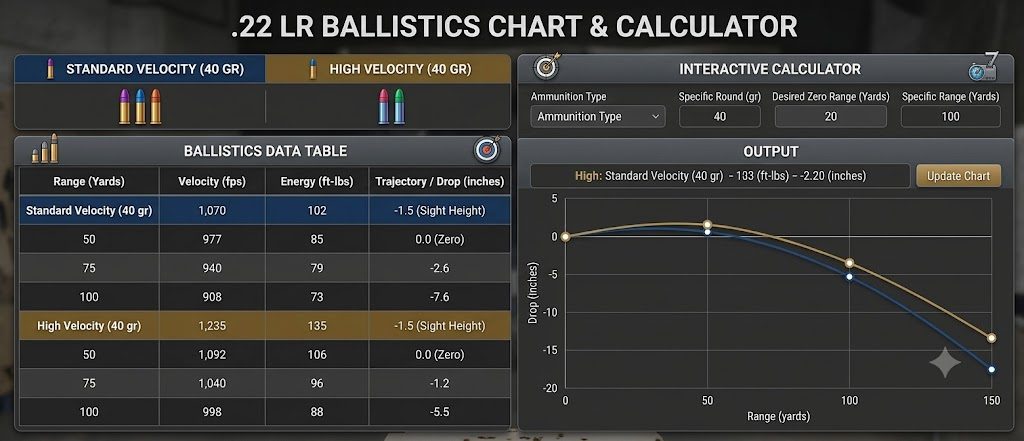
.22 LR Ballistics Calculator
Understanding .22 LR Ballistics
The .22 LR is unique because of its tiny powder charge, lightweight bullet, and rimfire primer design. While it doesn’t boast the flat trajectory or massive kinetic energy of centerfire rifle cartridges like the .223 Remington, its ballistics are perfectly optimized for small game hunting, target shooting, and plinking.
To truly understand how this cartridge performs downrange, you have to look at the three main pillars of its external ballistics: velocity, energy, and bullet drop.
1. Velocity Categories
.22 LR ammunition is generally divided into distinct velocity categories, which drastically change how the bullet performs in flight:
- Subsonic / Standard Velocity (1,000 – 1,135 fps): These rounds travel below the speed of sound (roughly 1,125 fps at sea level). Because they never break the sound barrier, they don’t produce a loud supersonic “crack,” making them ideal for use with suppressors. More importantly, they offer superior accuracy. Bullets that transition from supersonic to subsonic speeds mid-flight experience turbulence that destabilizes them; standard velocity rounds avoid this transition entirely.
- High Velocity (1,200 – 1,310 fps): This is the most common off-the-shelf ammunition. The extra speed flattens the trajectory slightly and delivers more terminal energy upon impact, making it the preferred choice for hunting small game like squirrels and rabbits.
- Hyper-Velocity (1,400+ fps): Loads like the CCI Stinger use a lighter bullet (often 32 grains) and a slightly longer casing to push velocities past 1,600 fps. These shoot the flattest out to 100 yards but are easily blown off course by wind due to their lighter weight.
2. Kinetic Energy and Terminal Performance
For ethical hunting, kinetic energy matters just as much as accuracy. The baseline for cleanly taking small game is generally considered to be around 40 to 50 ft-lbs of energy.
- At the muzzle, a standard high-velocity .22 LR generates around 135 ft-lbs of energy.
- At 50 yards, energy drops to around 100 ft-lbs, which is highly effective and will easily anchor a rabbit or raccoon.
- At 150 yards, the bullet has lost more than half its energy, dropping to roughly 60 ft-lbs.
While 60 ft-lbs is still dangerous, the rapid loss of energy combined with severe bullet drop makes the .22 LR poorly suited for taking game beyond 100 yards.
3. Bullet Drop and The “Rainbow” Trajectory
Because the .22 LR bullet is relatively slow and has a poor Ballistic Coefficient (usually around 0.115 to 0.130), it bleeds speed quickly and drops fast. This creates a pronounced arc, often referred to as a “rainbow trajectory.”
If you zero your rifle at 50 yards (the recommended distance for most .22 LR rifles), you will notice a distinct pattern:
- The bullet strikes about 1.5 inches low right out of the muzzle due to the height of the scope over the bore.
- It rises to meet your line of sight at exactly 50 yards.
- By 100 yards, gravity has taken over, pulling a high-velocity bullet down roughly 5.5 inches (and nearly 8 inches for standard velocity).
- By 150 yards, the drop becomes drastic—often 10 to 12 inches or more.
This rapid drop is why range estimation is critical when shooting a .22 LR past 75 yards. A misjudgment of just 15 or 20 yards can result in a complete miss on a small target.
4. Wind Drift
Wind is the true enemy of the .22 Long Rifle. Because a 40-grain bullet traveling at relatively low speeds spends more time in the air (a higher “time of flight”), crosswinds have more time to push it off course.
A mild 10 mph crosswind will push a standard high-velocity .22 LR bullet about 3.5 inches at 100 yards. At 150 yards, that same wind will drift the bullet over 9 inches. When shooting outdoors at extended rimfire ranges, learning to read the wind is just as important as knowing your bullet drop.