When comparing 9mm Luger vs 9mm NATO, the main difference lies in their pressure specifications and standard bullet weights, despite both being functionally identical in physical size. Both cartridges are based on the 9×19mm design, but they are manufactured to different standards for different intended uses. While 9mm Luger is loaded to commercial pressure limits for universal civilian use, 9mm NATO is loaded to higher military pressure standards designed for reliable cycling in duty firearms under extreme conditions. Because of these variations, not every load is identical, and understanding where they differ in pressure, velocity, and bullet weight is crucial for safe and effective firearm operation.
9mm Luger vs 9mm NATO: Difference Between 9mm Luger and 9mm Nato
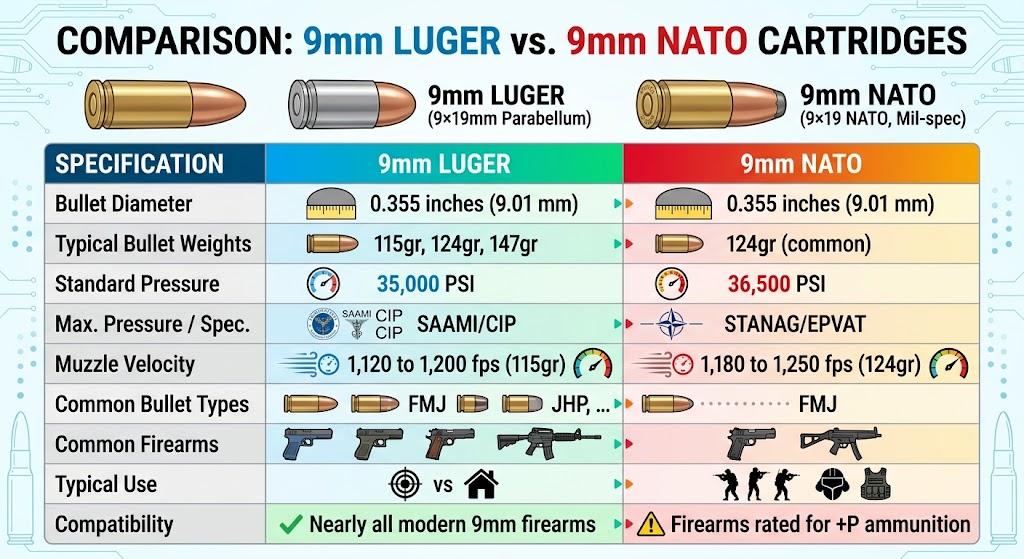
| Specification | 9mm Luger | 9mm NATO |
| Cartridge designation | 9mm Luger | 9mm NATO |
| Other names | 9×19mm Parabellum, 9mm | 9×19 NATO, 9mm mil-spec |
| Bullet diameter | 0.355 inches (9.01 mm) | 0.355 inches (9.01 mm) |
| Case length | 19.15 mm (0.754 in) | 19.15 mm (0.754 in) |
| Overall cartridge length | 29.69 mm (1.169 in) | 29.69 mm (1.169 in) |
| Typical bullet weights | 115 grain, 124 grain, 147 grain | 124 grain (most common) |
| Standard pressure | 35,000 PSI | 36,500 PSI |
| Maximum pressure / applicable specification | SAAMI (US) or CIP (Europe) | STANAG 4090 / EPVAT |
| Typical muzzle velocity | 1,120 to 1,200 fps (115gr) | 1,180 to 1,250 fps (124gr) |
| Typical muzzle energy | 320 to 360 ft-lbs | 380 to 400 ft-lbs |
| Common bullet types | FMJ, JHP, TSJ, Subsonic | FMJ (Full Metal Jacket) |
| Military standard | No | Yes (NATO standardized) |
| Common firearms | Handguns, Pistol Caliber Carbines | Duty pistols, submachine guns |
| Typical use | Target shooting, self-defense | Military combat, duty training |
| Compatibility | Nearly all modern 9mm firearms | Firearms rated for +P ammunition |
| Availability | Widely available commercially | Limited commercial surplus, mil-spec runs |
Winner: 9mm Luger – It offers universal firearm compatibility, lower wear on parts, and a vastly wider selection of bullet weights and projectile designs for commercial shooters.
What Is 9mm Luger?
The 9mm Luger, also commonly known as 9×19mm Parabellum, was designed by Georg Luger in 1901. It has since become the most popular handgun cartridge in the world. Dimensionally, the cartridge features a 19.15mm case and a 0.355-inch diameter bullet. Commercial 9mm Luger ammunition is available in a wide variety of bullet weights, with 115-grain, 124-grain, and 147-grain loads being the most prevalent.
Under the Sporting Arms and Ammunition Manufacturers’ Institute (SAAMI) guidelines, standard 9mm Luger pressure is set at a maximum average of 35,000 PSI. This standard pressure produces a typical velocity of around 1,150 feet per second (fps) with a 115-grain bullet, generating roughly 335 foot-pounds of muzzle energy. Due to its balanced recoil, high magazine capacity, and manageable pressure, it sees widespread commercial use for concealed carry, home defense, and recreational target shooting.
What Is 9mm NATO?
The term 9mm NATO refers specifically to 9×19mm ammunition manufactured to meet the military standards of the North Atlantic Treaty Organization (NATO). It is not a completely different cartridge from the 9mm Luger; rather, it is a specialized, strictly controlled military loading of the exact same 9×19mm casing.
The NATO specification (primarily guided by STANAG 4090) mandates specific performance criteria, including waterproofing, bullet type, and higher pressure limits to guarantee reliable cycling in heavily fouled duty pistols and submachine guns under adverse environmental conditions. Ammunition that passes these rigorous inspections is stamped with the NATO cross symbol on the case head. While 9mm NATO vs 9mm Luger debates often treat them as completely separate, 9mm NATO is fundamentally an overpressured military variant of the standard 9×19mm design.
9mm Luger vs 9mm NATO Pressure
The main difference between 9mm Luger and 9mm NATO pressure lies in the testing standards and the acceptable limits set by their respective governing bodies. You must use caution when comparing them, as SAAMI, CIP, and NATO utilize different testing protocols (such as EPVAT for NATO).
| Specification | 9mm Luger | 9mm NATO |
| Pressure standard | SAAMI | NATO EPVAT (STANAG 4090) |
| Published pressure specification | Maximum Average Pressure (MAP) | Service Pressure |
| Pressure in PSI | 35,000 PSI | ~36,500 PSI |
| Pressure in bar or MPa | 2,413 bar / 241.3 MPa | 2,525 bar / 252.5 MPa |
Because 9mm NATO pressure is roughly 1,500 to 1,600 PSI higher than standard commercial 9mm Luger pressure, it is generally considered equivalent to commercial +P (overpressure) ammunition.
9mm Luger vs 9mm NATO Velocity
The velocity and muzzle energy of both cartridges will vary heavily depending on the ammunition load, bullet weight, test barrel length, and ambient testing conditions. Below is a comparison of representative published loads.
| Cartridge | Bullet Weight | Muzzle Velocity | Test Barrel Length | Muzzle Energy |
| Winchester 9mm Luger FMJ | 115 Grain | 1,190 fps | 4 inches | 362 ft-lbs |
| Winchester 9mm NATO FMJ | 124 Grain | 1,200 fps | 4 inches | 396 ft-lbs |
| Federal American Eagle 9mm Luger | 147 Grain | 1,000 fps | 4 inches | 326 ft-lbs |
| CCI Blazer Brass 9mm Luger | 124 Grain | 1,090 fps | 4 inches | 327 ft-lbs |
Comparing 9mm Luger velocity to 9mm NATO velocity reveals that the NATO specification achieves comparable or higher speeds despite pushing a heavier 124-grain bullet, resulting in higher overall muzzle energy.
9mm Luger vs 9mm NATO Dimensions
Physically, there is no difference in external dimensions between the two cartridges. Both are governed by the foundational 9×19mm design.
- Bullet diameter: 9.01 mm (0.355 in)
- Case length: 19.15 mm (0.754 in)
- Overall cartridge length: 29.69 mm (1.169 in)
- Case dimensions: Tapered rimless case. Base diameter is 9.93 mm.
- Rim dimensions: Rim diameter is 9.96 mm with a thickness of 0.90 mm.
Where the two diverge is strictly in the internal powder charge, primer sealing, and specific bullet designs used. If you place a standard commercial 9mm Luger cartridge next to a military 9mm NATO cartridge, their external geometry is identical.
9mm Luger vs 9mm NATO Bullet Weight
Bullet weight directly affects velocity, muzzle energy, and the bullet’s trajectory.
Commercial 9mm Luger is famously versatile. The vast majority of bulk training ammunition utilizes a 115-grain bullet, though 124-grain and heavier 147-grain subsonic loads are also extremely common.
In contrast, 9mm NATO ammunition is highly standardized. The military specification requires a 124-grain full metal jacket (FMJ) bullet. This weight was chosen to provide optimal penetration and consistent ballistics across various NATO submachine guns and duty sidearms.
| Ammunition Type | Typical Bullet Weight | Impact on Ballistics |
| Standard 9mm Luger | 115 Grain | Higher velocity, flatter trajectory, lower recoil |
| 9mm NATO | 124 Grain | Moderate velocity, higher energy, improved penetration |
| Subsonic 9mm Luger | 147 Grain | Lower velocity, subsonic flight, ideal for suppression |
9mm Luger vs 9mm NATO Compatibility
Can 9mm Luger and 9mm NATO ammunition be used interchangeably? The answer depends entirely on your specific firearm’s manufacturing specifications.
Because 9mm NATO ammunition operates at higher internal pressures, it should only be fired in modern handguns and pistol caliber carbines that are explicitly rated for 9mm +P ammunition by the manufacturer. Using higher pressure 9mm NATO in older, vintage, or cheaply manufactured firearms can cause accelerated wear, parts failure, or catastrophic damage.
Conversely, you can safely shoot standard 9mm Luger ammunition in a firearm chambered for 9mm NATO. The only potential downside is that a heavily sprung military firearm might occasionally fail to cycle fully with lighter-loaded commercial 9mm Luger ammunition. Always consult your firearm’s owner manual for designated ammunition compatibility.
9mm Luger vs 9mm NATO Ballistics
When analyzing 9mm NATO ballistics against commercial 9mm Luger, the differences stem from the powder charge and bullet mass.
- Muzzle velocity:9mm NATO typically drives a 124-grain bullet at 1,200 fps. Standard 124-grain 9mm Luger usually leaves the muzzle around 1,090 to 1,120 fps.
- Muzzle energy: Thanks to the increased speed, 9mm NATO yields closer to 400 ft-lbs of energy, whereas standard 9mm Luger yields around 330 to 350 ft-lbs.
- Trajectory: Both cartridges offer flat trajectories at standard handgun distances (up to 25 yards). At 50 yards, the higher velocity of the NATO round results in slightly less bullet drop.
- Recoil: 9mm NATO produces noticeably sharper recoil due to the increased pressure. 9mm Luger has a milder, highly controllable recoil impulse.
9mm Luger vs 9mm NATO for Military Use
The 9mm NATO cartridge is widely associated with military firearms because it is the standardized handgun and submachine gun cartridge for the NATO alliance. Standardization ensures that allied forces can share ammunition seamlessly during joint operations.
For military applications, the cartridge must reliably penetrate basic barriers, perform in harsh climates, and utilize non-expanding FMJ bullets to comply with the Hague Convention. Standard commercial 9mm Luger ammunition is generally avoided for military combat because its lower pressure might not cycle a dirty duty weapon reliably in extreme field conditions.
9mm Luger vs 9mm NATO for Civilian Use
For civilian use, standard 9mm Luger is the undisputed king. It is used for concealed carry, home defense, competitive shooting, and plinking. Where civilians most often encounter 9mm NATO ammo is in the surplus market or through specialized military-spec product lines like Winchester’s USA 9mm NATO line. Civilians often buy 9mm NATO to train with a round that mimics the snappier recoil of modern +P hollow-point defensive ammunition.
When shopping, check the labeling carefully. Commercial ammunition will be labeled “9mm Luger” or “9mm”, whereas the military-spec ammunition will explicitly state “9mm NATO” and will usually feature the NATO cross stamp on the brass casing.
9mm Luger vs 9mm NATO Pros and Cons
9mm Luger Pros and Cons
Pros:
- Universal compatibility with all modern 9mm firearms.
- Massive variety of bullet weights (115gr, 124gr, 147gr) and types (FMJ, JHP).
- Lower pressure results in milder recoil and faster follow-up shots.
- Causes less wear and tear on firearm internal components.
Cons:
- Standard pressure loads may not cycle weapons equipped with heavy recoil springs.
- Slightly lower muzzle energy compared to military-spec ammunition.
9mm NATO Pros and Cons
Pros:
- Higher velocity and greater muzzle energy.
- Strict manufacturing standards ensure exceptional reliability.
- Excellent for breaking in stiff, new duty firearms.
- Simulates the recoil of +P defensive ammunition for training purposes.
Cons:
- Not safe for older or non-+P rated firearms.
- Harsher recoil can make accuracy more difficult for newer shooters.
- Limited strictly to 124-grain FMJ bullet types.
9mm Luger vs 9mm NATO Cost
When looking at 9mm ammo prices, standard commercial ammunition is generally slightly cheaper due to massive economies of scale, though military-spec loads are still quite affordable.
| Ammunition | Bullet Weight | Quantity | Price | Cost Per Round |
| Blazer Brass 9mm Luger | 115 Grain | 50 Rounds | $14.99 | $0.30 |
| Winchester USA 9mm Luger | 115 Grain | 200 Rounds | $64.00 | $0.32 |
| Winchester USA 9mm NATO | 124 Grain | 50 Rounds | $16.99 | $0.34 |
| Monarch 9mm NATO | 124 Grain | 50 Rounds | $10.99 | $0.22 |
Note: Ammunition prices fluctuate based on market conditions, bulk purchasing, and shipping costs.
9mm Luger vs 9mm NATO FAQs
What is the main difference between 9mm Luger and 9mm NATO?
The main difference is the internal pressure specification. 9mm Luger is loaded to a standard commercial pressure (35,000 PSI), while 9mm NATO is loaded to a higher military pressure (approximately 36,500 PSI) for duty weapon reliability.
Is 9mm NATO the same as 9mm Luger?
They share identical external physical dimensions and case designs, but they are not exactly the same. They adhere to different manufacturing and pressure standards.
Is 9mm NATO more powerful than 9mm Luger?
Yes, standard 9×19 NATO vs 9×19 Luger comparisons show that the NATO round produces higher velocity and muzzle energy due to its heavier powder charge.
Is 9mm NATO higher pressure?
Yes. 9mm NATO ammunition generates around 36,500 PSI compared to the standard 35,000 PSI of standard 9mm Luger.
Can you shoot 9mm NATO in a 9mm Luger pistol?
You can shoot it only if your pistol is explicitly rated by the manufacturer for +P ammunition. Firing it in older or non-rated guns is dangerous.
Can you shoot 9mm Luger in a 9mm NATO firearm?
Yes, you can safely fire 9mm Luger in a firearm chambered for 9mm NATO, as the commercial round produces less pressure than the firearm is designed to withstand.
Is 9mm NATO +P?
Functionally, yes. While not officially designated as “+P” by SAAMI, 9mm NATO operates at higher pressures that closely mirror commercial +P specifications.
What bullet weight does 9mm NATO use?
The strict military standard requires a 124-grain Full Metal Jacket (FMJ) bullet.
What is the velocity of 9mm NATO?
Typical 9mm NATO velocity is approximately 1,200 to 1,250 feet per second, depending on the barrel length of the firearm.
Which has more muzzle energy, 9mm Luger or 9mm NATO?
9mm NATO produces more muzzle energy, typically approaching 400 ft-lbs, compared to standard 9mm Luger which usually ranges between 320 and 360 ft-lbs.
Why is 9mm NATO called NATO?
It is called NATO because the ammunition is manufactured to the specific performance and dimensional standardization agreements (STANAG) established by the North Atlantic Treaty Organization for its member militaries.