The main difference between the 454 Casull and the 44 Magnum is their maximum operating pressure and resulting muzzle energy. The 454 Casull operates at a massive 65,000 PSI compared to the 36,000 PSI limit of the 44 Magnum. This pressure difference allows the 454 Casull to push heavy 300 grain bullets faster than the 44 Magnum can push lighter 240 grain bullets. Consequently, the 454 Casull produces nearly double the kinetic energy of standard 44 Magnum loads at the muzzle. While both straight wall cartridges are highly effective for hunting, the 454 Casull offers superior penetration and a flatter trajectory for dangerous game.
454 Casull vs 44 Magnum Ballistics Chart
| Specification | 454 Casull | 44 Magnum |
| Cartridge Type | Straight Wall Handgun | Straight Wall Handgun |
| Parent Case | 45 Colt | 44 Special |
| Bullet Diameter | 0.452 inches | 0.429 inches |
| Case Length | 1.383 inches | 1.285 inches |
| Overall Length | 1.770 inches | 1.610 inches |
| Typical Bullet Weight | 240 to 360 grains | 200 to 340 grains |
| Common Factory Load | 300 grain Hornady XTP Mag | 240 grain Hornady XTP |
| Muzzle Velocity | 1650 fps | 1350 fps |
| Muzzle Energy | 1813 foot pounds | 971 foot pounds |
| Velocity at 50 Yards | 1490 fps | 1192 fps |
| Velocity at 100 Yards | 1348 fps | 1061 fps |
| Energy at 50 Yards | 1480 foot pounds | 758 foot pounds |
| Energy at 100 Yards | 1210 foot pounds | 600 foot pounds |
| Trajectory at 50 Yards | Plus 1.2 inches | Plus 1.5 inches |
| Trajectory at 100 Yards | Drops 4.4 inches | Drops 5.3 inches |
| Ballistic Coefficient | 0.152 | 0.205 |
| Sectional Density | 0.210 | 0.185 |
| Maximum Average Pressure | 65,000 PSI | 36,000 PSI |
| Recoil Energy | 39.0 foot pounds | 22.5 foot pounds |
| Primary Hunting Use | Large and Dangerous Game | Medium and Large Game |
| Whitetail Suitability | Excellent | Excellent |
| Black Bear Suitability | Excellent | Excellent |
| Elk Suitability | Excellent within 150 yards | Good within 100 yards |
| Typical Twist Rate | 1 in 24 inches | 1 in 20 inches |
| Ammunition Availability | Moderate | High |
| Typical Rifle Platforms | Lever Action and Single Shot | Lever Action and Single Shot |
| Overall Winner | 454 Casull for Power | 44 Magnum for Versatility |
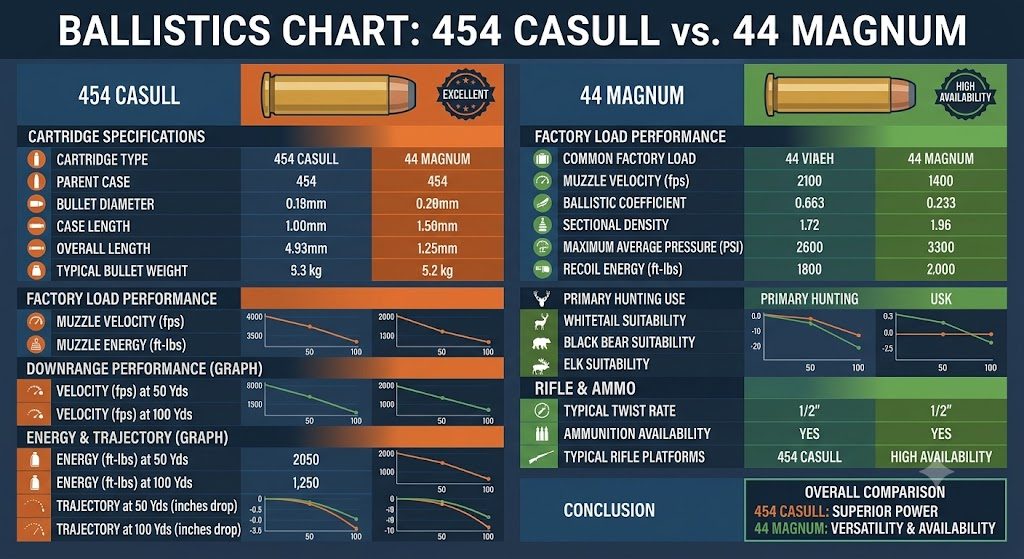
Muzzle Velocity Comparison
The 454 Casull consistently outpaces the 44 Magnum in muzzle velocity despite pushing heavier projectiles. A standard 300 grain bullet from the 454 Casull leaves a revolver barrel at roughly 1650 feet per second. A lighter 240 grain bullet from the 44 Magnum typically exits the muzzle at 1350 feet per second. When fired from a rifle barrel, both cartridges gain significant velocity, but the 454 Casull maintains its substantial speed advantage. This extra velocity directly translates to better terminal ballistics and a flatter trajectory downrange.
Muzzle Energy Comparison
Kinetic energy is where the 454 Casull truly dominates the comparison. Operating at 65,000 PSI allows the 454 Casull to generate over 1800 foot pounds of muzzle energy with typical hunting loads. Standard 44 Magnum ammunition produces around 970 foot pounds of energy at the muzzle. While boutique ammunition manufacturers offer high pressure 44 Magnum loads that increase these numbers, they still cannot match the sheer stopping power of a factory loaded 454 Casull. Hunters pursuing dangerous game rely on this massive energy transfer to quickly stop heavy animals.
Trajectory Comparison
Both of these big bore cartridges were originally designed for handguns, meaning their trajectories resemble an arch rather than a flat line at extended distances. When sighted in at 25 yards, a 44 Magnum bullet will drop about 5.3 inches at the 100 yard mark. Under the same conditions, the much faster 454 Casull drops only 4.4 inches. The flatter trajectory of the 454 Casull makes shot placement easier at distances beyond 75 yards. Firing either cartridge from a carbine length barrel will flatten these trajectories considerably.
Recoil Comparison
The incredible power of the 454 Casull comes with a severe recoil penalty. Firing heavy loads from a standard revolver generates approximately 39 foot pounds of free recoil energy. The 44 Magnum produces a much more manageable 22.5 foot pounds of recoil under similar conditions. Shooters prone to flinching will find the 44 Magnum far easier to shoot accurately. The intense blast and sharp kick of the 454 Casull require significant practice and proper grip technique to master.
Effective Hunting Range Comparison
Maximum effective range depends heavily on whether you are using a handgun or a rifle. With a revolver, most hunters limit the 44 Magnum to 100 yards for ethical kills on medium game. The 454 Casull extends this ethical handgun hunting range to roughly 150 yards due to its retained energy and flatter trajectory. When chambered in a lever action rifle, both cartridges gain about 50 yards of effective range. Beyond 200 yards, both bullets lose velocity quickly and drop too fast for reliable shot placement.
Ammunition Availability Comparison
The 44 Magnum wins easily in terms of factory ammunition availability and variety. Almost every major manufacturer produces multiple 44 Magnum loads ranging from light target practice rounds to heavy hunting hollow points. The 454 Casull is a specialized cartridge with fewer factory options on the market. Additionally, 44 Magnum ammunition is significantly cheaper to shoot than 454 Casull ammunition. Both platforms offer a unique advantage by allowing shooters to use shorter cartridges for practice. A 44 Magnum firearm can safely chamber and fire 44 Special ammunition, while a 454 Casull firearm can safely shoot 45 Colt ammunition.
Which Cartridge Should You Choose
Selecting the right cartridge depends entirely on your intended target and recoil tolerance. The 44 Magnum remains the gold standard for whitetail deer, black bear, and wild hog hunting. It provides plenty of power without subjecting the shooter to punishing recoil. The 454 Casull is a specialized tool built for the largest and most dangerous game on the planet. If you plan to hunt grizzly bear, moose, or large African plains game with a handgun, the 454 Casull is the superior choice.
Frequently Asked Questions
What parent case is the 454 Casull based on?
The 454 Casull is an elongated and strengthened version of the classic 45 Colt case. The case was lengthened to prevent the high pressure cartridge from being accidentally loaded into older 45 Colt revolvers that cannot handle the severe pressure limits.
Can I shoot 45 Colt in my 454 Casull?
Yes, you can safely chamber and fire standard 45 Colt ammunition in any 454 Casull revolver or single shot rifle. This is a great way to practice with less expensive ammunition and significantly less recoil.
Why is the 44 Magnum so popular for hunting?
The 44 Magnum offers the perfect balance of manageable recoil, excellent terminal ballistics, and wide availability. It easily takes down deer and black bear at reasonable distances without destroying excessive amounts of meat.
Is the 454 Casull too big for deer hunting?
Many hunters consider the 454 Casull to be absolute overkill for standard whitetail deer. However, using heavy and tough bullets that do not expand rapidly will prevent massive meat damage while ensuring a quick and ethical harvest.
Which cartridge is better for a lever action rifle?
Both cartridges perform beautifully in lever action carbines. The 44 Magnum is ideal for thick brush deer hunting, while the 454 Casull transforms a lightweight carbine into a legitimate big game rifle capable of dropping elk and moose.
How much pressure does the 454 Casull produce?
The Sporting Arms and Ammunition Manufacturers Institute rates the 454 Casull for a maximum average pressure of 65,000 PSI. This is nearly double the 36,000 PSI maximum limit of the standard 44 Magnum.
Does a longer barrel increase muzzle velocity for these rounds?
Yes, firing either of these handgun cartridges from a 16 inch or 20 inch rifle barrel will drastically increase their velocity. The slow burning powders used in these large capacity cases benefit greatly from the extra time spent accelerating inside a longer barrel.