When hunters and shooters refer generically to the “7mm,” they are almost universally talking about the legendary 7mm Remington Magnum. A 7mm Remington Magnum Ballistics Chart is an incredibly detailed and highly comprehensive reference table that tracks the velocity, kinetic energy, trajectory curve, and wind drift of this world-famous cartridge over various distances. By carefully reviewing this specific chart, you can visualize exactly how your high-ballistic-coefficient bullet will behave from the precise moment it leaves your barrel until it strikes a target hundreds of yards downrange. This critical data allows you to accurately predict bullet drop, compensate for wind deflection, and verify that your projectile retains enough energy for an ethical kill on tough big game animals across vast open terrain.
Shooters, hunters, reloaders, and precision marksmen use a 7mm Rem Mag Ballistics Chart to unlock the absolute true potential of one of the greatest hunting cartridges ever designed. Introduced by Remington in 1962 alongside the iconic Model 700 rifle, the 7mm Remington Magnum took the hunting world by storm by offering a phenomenally flat trajectory, devastating kinetic energy, and recoil that was noticeably more manageable than the .300 Winchester Magnum. By studying the numbers today, a dedicated backcountry hunter can confidently take a challenging shot on a bull elk at five hundred yards, knowing exactly how their polymer-tipped or bonded bullet will perform. In this comprehensive guide, you will learn how to analyze ballistics data, choose the absolute best bullet weight for your specific needs, determine the ideal zero distance, and see exactly how this timeless magnum completely dominates the hunting world today.
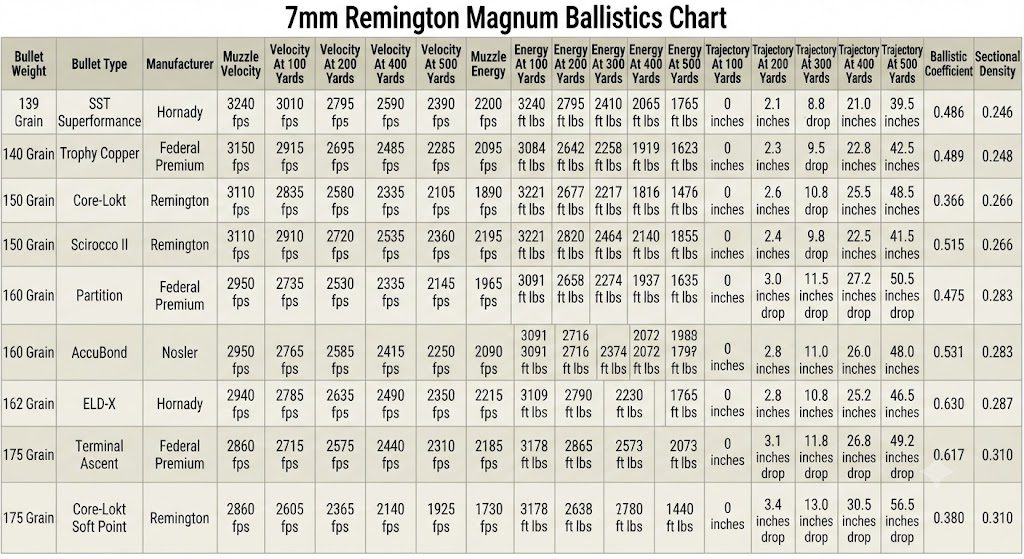
7mm Remington Magnum Ballistics Chart
Below is a detailed ballistics table featuring the most popular and proven factory ammunition loads available for the 7mm Remington Magnum. The data represents a standard 24-inch test barrel and assumes a 100-yard zero under standard sea-level atmospheric conditions.
| Bullet Weight | Bullet Type | Manufacturer | Muzzle Velocity | Velocity At 100 Yards | Velocity At 200 Yards | Velocity At 300 Yards | Velocity At 400 Yards | Velocity At 500 Yards | Muzzle Energy | Energy At 100 Yards | Energy At 200 Yards | Energy At 300 Yards | Energy At 400 Yards | Energy At 500 Yards | Trajectory At 100 Yards | Trajectory At 200 Yards | Trajectory At 300 Yards | Trajectory At 400 Yards | Trajectory At 500 Yards | Ballistic Coefficient | Sectional Density |
| 139 Grain | SST Superformance | Hornady | 3240 fps | 3010 fps | 2795 fps | 2590 fps | 2390 fps | 2200 fps | 3240 ft lbs | 2795 ft lbs | 2410 ft lbs | 2065 ft lbs | 1765 ft lbs | 1495 ft lbs | 0 inches | 2.1 inches drop | 8.8 inches drop | 21.0 inches drop | 39.5 inches drop | 0.486 | 0.246 |
| 140 Grain | Trophy Copper | Federal Premium | 3150 fps | 2915 fps | 2695 fps | 2485 fps | 2285 fps | 2095 fps | 3084 ft lbs | 2642 ft lbs | 2258 ft lbs | 1919 ft lbs | 1623 ft lbs | 1364 ft lbs | 0 inches | 2.3 inches drop | 9.5 inches drop | 22.8 inches drop | 42.5 inches drop | 0.489 | 0.248 |
| 150 Grain | Core-Lokt | Remington | 3110 fps | 2835 fps | 2580 fps | 2335 fps | 2105 fps | 1890 fps | 3221 ft lbs | 2677 ft lbs | 2217 ft lbs | 1816 ft lbs | 1476 ft lbs | 1190 ft lbs | 0 inches | 2.6 inches drop | 10.8 inches drop | 25.5 inches drop | 48.5 inches drop | 0.366 | 0.266 |
| 150 Grain | Scirocco II | Remington | 3110 fps | 2910 fps | 2720 fps | 2535 fps | 2360 fps | 2195 fps | 3221 ft lbs | 2820 ft lbs | 2464 ft lbs | 2140 ft lbs | 1855 ft lbs | 1605 ft lbs | 0 inches | 2.4 inches drop | 9.8 inches drop | 22.5 inches drop | 41.5 inches drop | 0.515 | 0.266 |
| 160 Grain | Partition | Federal Premium | 2950 fps | 2735 fps | 2530 fps | 2335 fps | 2145 fps | 1965 fps | 3091 ft lbs | 2658 ft lbs | 2274 ft lbs | 1937 ft lbs | 1635 ft lbs | 1372 ft lbs | 0 inches | 3.0 inches drop | 11.5 inches drop | 27.2 inches drop | 50.5 inches drop | 0.475 | 0.283 |
| 160 Grain | AccuBond | Nosler | 2950 fps | 2765 fps | 2585 fps | 2415 fps | 2250 fps | 2090 fps | 3091 ft lbs | 2716 ft lbs | 2374 ft lbs | 2072 ft lbs | 1798 ft lbs | 1552 ft lbs | 0 inches | 2.8 inches drop | 11.0 inches drop | 26.0 inches drop | 48.0 inches drop | 0.531 | 0.283 |
| 162 Grain | ELD-X | Hornady | 2940 fps | 2785 fps | 2635 fps | 2490 fps | 2350 fps | 2215 fps | 3109 ft lbs | 2790 ft lbs | 2498 ft lbs | 2230 ft lbs | 1987 ft lbs | 1765 ft lbs | 0 inches | 2.8 inches drop | 10.8 inches drop | 25.2 inches drop | 46.5 inches drop | 0.630 | 0.287 |
| 175 Grain | Terminal Ascent | Federal Premium | 2860 fps | 2715 fps | 2575 fps | 2440 fps | 2310 fps | 2185 fps | 3178 ft lbs | 2865 ft lbs | 2577 ft lbs | 2313 ft lbs | 2073 ft lbs | 1855 ft lbs | 0 inches | 3.1 inches drop | 11.8 inches drop | 26.8 inches drop | 49.2 inches drop | 0.617 | 0.310 |
| 175 Grain | Core-Lokt Soft Point | Remington | 2860 fps | 2605 fps | 2365 fps | 2140 fps | 1925 fps | 1730 fps | 3178 ft lbs | 2638 ft lbs | 2174 ft lbs | 1780 ft lbs | 1440 ft lbs | 1163 ft lbs | 0 inches | 3.4 inches drop | 13.0 inches drop | 30.5 inches drop | 56.5 inches drop | 0.380 | 0.310 |
Understanding The Chart
A ballistics chart can look overwhelming at first glance due to the sheer volume of data presented. Breaking down each individual column reveals key information about how a specific load performs in the field.
Muzzle Velocity
Muzzle velocity is the exact speed at which the bullet exits the barrel of the firearm, measured in feet per second (fps). The 7mm Remington Magnum achieves its legendary status by packing a massive powder charge inside a belted magnum case. This allows it to push highly aerodynamic .284-inch projectiles at blistering speeds, often exceeding 3,100 fps with standard hunting weights. This raw speed is the engine that drives its incredibly flat trajectory.
Retained Velocity
Retained velocity refers to the speed of the bullet at specific distances downrange. Air resistance constantly slows the bullet down as it travels through the atmosphere. Retained velocity is critical for hunters because most expanding hunting bullets require a minimum velocity threshold (typically 1,800 fps) to open up and expand reliably upon impact. Thanks to the incredibly high aerodynamic ratings of modern 7mm bullets, the 7mm Rem Mag easily retains lethal velocity well past 600 yards.
Kinetic Energy
Kinetic energy is the amount of destructive physical force the bullet carries, measured in foot-pounds (ft-lbs). It is calculated by utilizing the weight of the bullet and its velocity at any given distance. Hunters analyze this metric on a 7mm Energy Chart to verify that the load delivers sufficient power for an ethical harvest on massive big game. The cartridge generates over 3,100 ft-lbs of energy at the muzzle and comfortably retains over 1,500 ft-lbs at 500 yards with heavy bullets, guaranteeing deep penetration on elk.
Trajectory
Trajectory indicates the actual physical path the bullet takes as it flies through the air, factoring in the constant downward pull of gravity. The trajectory chart displays bullet drop in inches at various yardages relative to a 100-yard zero line of sight. The incredibly fast velocity combined with sleek bullets gives the 7mm Rem Mag a remarkably flat trajectory. This flat arc minimizes the need for severe holdover adjustments at medium ranges, making distance estimation errors in the field much more forgiving.
Ballistic Coefficient
The Ballistic Coefficient (BC) is a numerical value that represents how efficiently a bullet cuts through the air. A higher number indicates a more aerodynamic bullet that retains velocity and energy better over long distances. High BC bullets also resist lateral displacement from crosswinds much better than lower-rated projectiles. The .284-inch (7mm) bore diameter is legendary for offering some of the absolute highest BC projectiles relative to bullet weight on the market today.
Sectional Density
Sectional density (SD) is the ratio of a bullet weight compared directly to its diameter. This metric indicates potential penetration depth into a target. Higher sectional density values generally correlate with deeper penetration. Heavy 7mm bullets weighing 160 to 175 grains offer extremely high sectional density values (0.283 to 0.310), allowing them to punch completely through thick hide, heavy muscle, and solid bone on tough big game animals like elk and moose.
Common 7mm Remington Magnum Bullet Weights
The performance characteristics of the 7mm Rem Mag shift noticeably based on bullet weight selection and construction, making it one of the most versatile big game magnums in existence.
139 to 140 Grain
Bullet weights in the 140-grain range offer the highest muzzle velocities for the cartridge, often exceeding 3,150 fps. These lightweight, ultra-fast projectiles deliver laser-flat trajectories out to 400 yards, making them ideal choices for open-country hunting of medium game like antelope, mule deer, and whitetails. They provide devastating hydrostatic shock and drop medium game instantly.
150 Grain
The 150-grain category is widely considered the ultimate “do-it-all” weight for North American hunting. Bullets like the Remington Scirocco II or Nosler Partition strike a perfect balance between high velocity, heavy bullet integrity, and deep penetration. They shoot incredibly flat while retaining enough mass to cleanly take larger game like elk at reasonable distances without producing punishing recoil.
160 to 162 Grain
The 160 to 162-grain range represents the true magnum sweet spot for the 7mm Rem Mag. Featuring extremely high Ballistic Coefficients, these heavy 7mm projectiles resist wind drift and retain momentum beautifully downrange. Loaded to velocities around 2,950 fps, they deliver devastating impact force at long distances, making them optimal for bull elk, moose, and cross-canyon mountain hunting where shots stretch past 400 yards.
175 Grain
The 175-grain bullets are reserved for the absolute largest heavy-boned game and extreme deep penetration. Massive, sleek bullets like the Federal Terminal Ascent reward the shooter with maximum wind resistance and extreme energy retention at extreme ranges. Conversely, traditional 175-grain round-nose or soft-point bullets act as incredible sledgehammers for moose hunting in thick timber.
Effective Hunting Range
The 7mm Remington Magnum’s effective range is among the most impressive of any widely available hunting cartridge on earth.
Whitetail Deer and Antelope
For deer, sheep, and antelope, the 7mm Rem Mag is incredibly effective out to 800 yards in the hands of a highly skilled marksman. With proper expanding ammunition, it maintains a completely flat flight path, massive kinetic energy, and velocity levels that guarantee rapid ethical expansion.
Elk and Moose
Elk and moose require heavy energy delivery and deep bone-crushing penetration. The 7mm Rem Mag retains over 1,500 ft-lbs of kinetic energy past 500 yards with heavy 160-grain to 175-grain projectiles. This makes it a premier open-country cartridge for massive game, rivaling the .300 Winchester Magnum but with noticeably less shoulder-pounding recoil.
Black Bear
Black bears feature dense muscle tissue and thick fat layers that require reliable projectile expansion and structural integrity. Heavy bonded or solid copper 160-grain bullets fired from the 7mm Rem Mag easily penetrate to vital organs across deep canyons or heavy timber clearings, guaranteeing complete pass-through penetration and excellent blood trails.
Factors That Affect 7mm Ballistics
Ballistics figures are heavily influenced by physical, mechanical, and environmental variables.
Barrel Length
Barrel length directly influences final velocity. To fully realize the massive powder capacity advantage of the 7mm Remington Magnum, a 24-inch or 26-inch barrel is absolutely mandatory. Shortening the barrel to 20 or 22 inches will cause a severe drop in velocity (roughly 35 to 50 fps per inch), diminishing its ballistic advantage and creating a massive, blinding muzzle flash as unburned powder detonates outside the barrel.
Altitude and Air Density
Higher elevations feature thinner, less dense air, reducing atmospheric drag on the bullet. Shooting the 7mm Rem Mag at 9,000 feet of elevation during a backcountry elk hunt results in a significantly flatter trajectory, less wind drift, and higher retained energy downrange compared to the sea-level data presented in standard charts.
Wind Drift
While the 7mm Rem Mag fires highly aerodynamic bullets, crosswinds still deflect projectiles laterally over long distances. High velocity, high-BC projectiles like the 162-grain ELD-X minimize the bullet’s time of flight, drifting far less in variable crosswinds compared to standard calibers like the .308 Winchester or .270 Winchester.
Best Zero Distance
Selecting the optimal zero distance depends entirely on your scope setup and field application.
100 Yard Zero
A 100-yard zero is the preferred baseline for precision marksmen and long-range hunters who utilize dialable optic turrets or modern ballistic reticles. It establishes a clean mathematical baseline where all turret adjustments for extended distances are dialed strictly upward, eliminating confusing under-holds.
200 Yard Zero
A 200-yard zero is highly recommended for big-game hunters using a Maximum Point-Blank Range (MPBR) strategy. With a fast-moving 150-grain load zeroed at 200 yards, the bullet impacts roughly 1.5 inches high at 100 yards and drops only a few inches at 250 yards. This enables a hunter to hold dead-center on a deer or elk’s vital zone out past 300 yards without ever needing to touch the scope turrets.
7mm Rem Mag Ballistics Compared To Other Cartridges
Below is a comparison table showcasing how 7mm Rem Mag loads evaluate against established hunting and magnum cartridges at 500 yards under standard sea-level conditions.
| Cartridge | Muzzle Velocity | Muzzle Energy | Trajectory At 500 Yards | Recoil | Action Size | Bolt Face |
| 7mm Rem Mag (160gr) | 2950 fps | 3091 ft lbs | 48.0 inches drop | Moderate-Heavy | Standard Long | Magnum (.532″) |
| 7mm-08 Remington (140gr) | 2800 fps | 2437 ft lbs | 57.5 inches drop | Light | Short Action | Standard (.473″) |
| 7mm PRC (175gr) | 3000 fps | 3497 ft lbs | 40.5 inches drop | Heavy | Standard Long | Magnum (.532″) |
| 28 Nosler (175gr) | 3125 fps | 3792 ft lbs | 36.8 inches drop | Very Heavy | Standard Long | Magnum (.532″) |
| 300 Winchester Mag (180gr) | 2960 fps | 3501 ft lbs | 44.0 inches drop | Heavy | Standard Long | Magnum (.532″) |
| 270 Winchester (150gr) | 2850 fps | 2705 ft lbs | 51.5 inches drop | Moderate | Standard Long | Standard (.473″) |
The brilliance of the 7mm Remington Magnum is highly apparent when compared to the legendary .300 Winchester Magnum. The 7mm Rem Mag shoots slightly lighter bullets at nearly identical speeds, resulting in a trajectory that perfectly matches the larger .300 Win Mag. However, the 7mm accomplishes this while generating roughly 15% to 20% less felt recoil, making it significantly more pleasant to shoot accurately during long range sessions.
When compared to the modern 7mm PRC and 28 Nosler, the older 7mm Rem Mag falls slightly behind in raw velocity and the ability to seat ultra-long 180-grain bullets perfectly. However, 7mm Rem Mag ammunition is vastly cheaper, universally available in every hardware store across the globe, and extends barrel life significantly compared to the ultra-magnums.
Frequently Asked Questions
What is a 7mm Ballistics Chart?
It is a data reference table outlining velocity, kinetic energy, trajectory drop, and wind drift metrics for the 7mm Remington Magnum cartridge across various distances. It helps shooters calculate precise elevation drops, wind holds, and energy retention thresholds for ethical hunting and extreme long-range target shooting.
How far is the 7mm Rem Mag effective on elk?
Loaded with premium 160-grain to 175-grain expanding hunting bullets, it carries over 1,500 foot-pounds of kinetic energy past 500 yards. In the hands of a highly experienced shooter, it is a highly capable and devastatingly ethical elk cartridge at those extended distances across open terrain.
Is the 7mm Rem Mag better than the .300 Win Mag?
It depends entirely on your recoil tolerance and target. The .300 Win Mag hits harder and can shoot heavier 200+ grain bullets, making it slightly superior for giant moose or coastal brown bears. However, the 7mm Rem Mag matches the trajectory of the .300 Win Mag while delivering significantly less recoil, making the 7mm much easier for the average hunter to shoot accurately.
Does the 7mm Rem Mag kick hard?
It generates moderate-to-heavy recoil. It kicks noticeably harder than standard cartridges like the .270 Winchester or .30-06 Springfield, but it is generally considered the absolute maximum threshold of recoil that a standard shooter can tolerate comfortably without developing a severe flinch.
Is the 7mm-08 the same as the 7mm Rem Mag?
No. While they fire the exact same diameter bullet (.284-inch), the 7mm-08 Remington uses a much smaller, short-action casing based on the .308 Winchester. The 7mm Rem Mag utilizes a massive belted magnum case, holding vastly more powder and generating significantly higher velocities, energy, and recoil than the 7mm-08.
Conclusion
Understanding a 7mm Remington Magnum Ballistics Chart reveals exactly why this cartridge has remained the absolute king of the magnum hunting world for over sixty years. By combining a large-capacity belted magnum case with incredibly high-BC 7mm projectiles, the 7mm Rem Mag delivers laser-flat trajectories, heavy kinetic energy, and phenomenal wind resistance without the punishing, shoulder-bruising recoil of the .30 caliber magnums. Understanding its trajectory curvature, retained velocity, and energy transfer characteristics enables hunters and long-range precision shooters to extract maximum accuracy and devastating terminal performance across deep canyons, open plains, and high alpine mountain terrain.