The main difference between the 22 ARC and .223 Remington is that the 22 ARC delivers superior long-range ballistic performance with higher retained velocity and energy, while the .223 Remington is a more affordable and versatile cartridge for everyday target shooting, hunting, and defensive applications. Designed to maximize the potential of the AR-15 platform, the 22 Advanced Rifle Cartridge (ARC) utilizes a wider case and faster twist rates to stabilize heavy, high-ballistic-coefficient bullets. This allows it to stay supersonic well past 1,000 yards. Conversely, the .223 Remington has dominated the market for decades, offering unmatched ammunition availability, low recoil, and excellent performance within 400 yards. Whether you are building a precision long-range gas gun or a lightweight varmint rifle, understanding the ballistic differences between these two cartridges is the key to making the right choice for your needs.
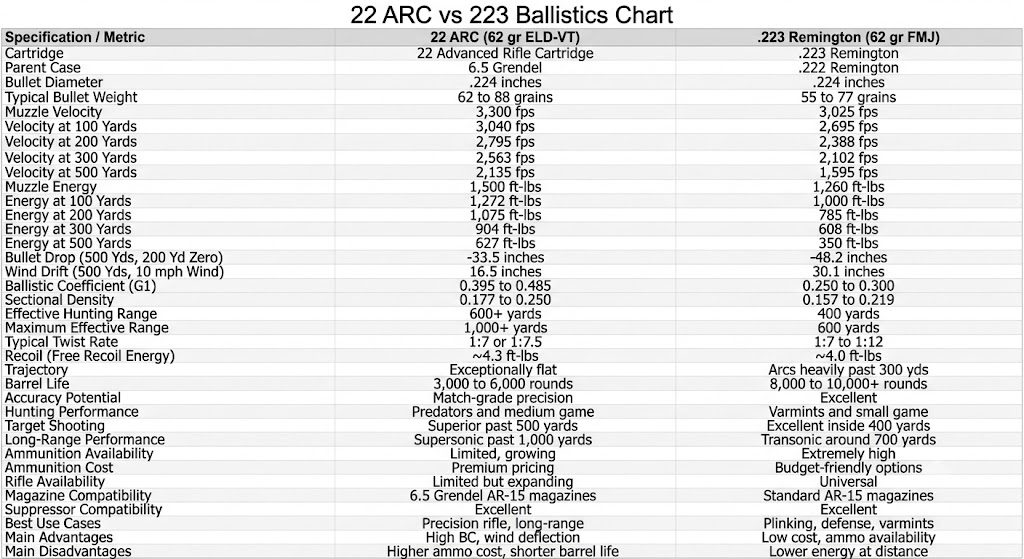
22 ARC vs 223 Ballistics Chart
| Specification / Metric | 22 ARC (62 gr ELD-VT) | .223 Remington (62 gr FMJ) |
| Cartridge | 22 Advanced Rifle Cartridge | .223 Remington |
| Parent Case | 6.5 Grendel | .222 Remington |
| Bullet Diameter | .224 inches | .224 inches |
| Typical Bullet Weight | 62 to 88 grains | 55 to 77 grains |
| Muzzle Velocity | 3,300 fps | 3,025 fps |
| Velocity at 100 Yards | 3,040 fps | 2,695 fps |
| Velocity at 200 Yards | 2,795 fps | 2,388 fps |
| Velocity at 300 Yards | 2,563 fps | 2,102 fps |
| Velocity at 500 Yards | 2,135 fps | 1,595 fps |
| Muzzle Energy | 1,500 ft-lbs | 1,260 ft-lbs |
| Energy at 100 Yards | 1,272 ft-lbs | 1,000 ft-lbs |
| Energy at 200 Yards | 1,075 ft-lbs | 785 ft-lbs |
| Energy at 300 Yards | 904 ft-lbs | 608 ft-lbs |
| Energy at 500 Yards | 627 ft-lbs | 350 ft-lbs |
| Bullet Drop (500 Yds, 200 Yd Zero) | -33.5 inches | -48.2 inches |
| Wind Drift (500 Yds, 10 mph Wind) | 16.5 inches | 30.1 inches |
| Ballistic Coefficient (G1) | 0.395 to 0.485 | 0.250 to 0.300 |
| Sectional Density | 0.177 to 0.250 | 0.157 to 0.219 |
| Effective Hunting Range | 600+ yards | 400 yards |
| Maximum Effective Range | 1,000+ yards | 600 yards |
| Typical Twist Rate | 1:7 or 1:7.5 | 1:7 to 1:12 |
| Recoil (Free Recoil Energy) | ~4.3 ft-lbs | ~4.0 ft-lbs |
| Trajectory | Exceptionally flat | Arcs heavily past 300 yds |
| Barrel Life | 3,000 to 6,000 rounds | 8,000 to 10,000+ rounds |
| Accuracy Potential | Match-grade precision | Excellent |
| Hunting Performance | Predators and medium game | Varmints and small game |
| Target Shooting | Superior past 500 yards | Excellent inside 400 yards |
| Long-Range Performance | Supersonic past 1,000 yards | Transonic around 700 yards |
| Ammunition Availability | Limited, growing | Extremely high |
| Ammunition Cost | Premium pricing | Budget-friendly options |
| Rifle Availability | Limited but expanding | Universal |
| Magazine Compatibility | 6.5 Grendel AR-15 magazines | Standard AR-15 magazines |
| Suppressor Compatibility | Excellent | Excellent |
| Best Use Cases | Precision rifle, long-range | Plinking, defense, varmints |
| Main Advantages | High BC, wind deflection | Low cost, ammo availability |
| Main Disadvantages | Higher ammo cost, shorter barrel life | Lower energy at distance |
Understanding the Comparison Chart
The comparison table above highlights the performance gap between the 22 ARC and the .223 Remington as distance increases. We used comparable 62-grain projectiles to provide an accurate baseline, though it is important to note that the 22 ARC is specifically engineered to shoot heavier bullets even more efficiently.
Right out of the muzzle, the 22 ARC holds a clear velocity advantage. It pushes the exact same bullet weight significantly faster than the .223 Remington. Downrange, this initial speed pairs with high-performance bullet designs to deliver superior energy retention. At 500 yards, the 22 ARC retains nearly double the kinetic energy of a standard .223 round.
Because it launches more aerodynamic bullets at higher speeds, the 22 ARC also exhibits a much flatter trajectory. It drops significantly less than the .223 Remington at 500 yards, making elevation holdovers much easier for the shooter. The higher ballistic coefficient also means the 22 ARC cuts wind deflection nearly in half compared to the older cartridge.
For long-range shooting and hunting, the 22 ARC is clearly the more capable cartridge. However, the .223 Remington remains highly competitive for standard applications. It is much more economical, universally available, and easier on barrels. Both cartridges have almost nonexistent recoil, making them highly versatile options for any shooter.
Detailed Comparison Sections
How to Read the Ballistics Chart
When reading ballistics charts, the most important numbers are velocity, energy, and trajectory. Velocity tells you how fast the bullet is moving, which dictates if the bullet will expand reliably on impact. Energy indicates the hitting power of the round, crucial for humane hunting. Trajectory encompasses bullet drop and wind drift, showing how easy it will be to accurately place rounds on target at extended distances.
Velocity Comparison
The 22 ARC boasts higher muzzle velocities than the .223 Remington when firing identical bullet weights. For example, a 62-grain 22 ARC bullet leaves the barrel at roughly 3,300 fps, compared to 3,025 fps for a standard 62-grain .223 round. More importantly, the 22 ARC maintains that speed much better. At 500 yards, the 22 ARC is still traveling at 2,135 fps, while the .223 Remington has slowed down to 1,595 fps.
Energy Comparison
Kinetic energy is a product of mass and velocity. Because the 22 ARC flies faster and retains its speed longer, it hits significantly harder. At the muzzle, the 22 ARC produces roughly 1,500 ft-lbs of energy. The .223 Remington generates about 1,260 ft-lbs. The gap widens dramatically at distance. At 500 yards, the 22 ARC retains 627 ft-lbs of energy, whereas the .223 Remington drops off to a meager 350 ft-lbs.
Trajectory Comparison
Trajectory dictates the arc of the bullet in flight. A flatter trajectory means the shooter does not have to guess distance as precisely to make a hit. The 22 ARC was built from the ground up to be a flat-shooting cartridge.
Bullet Drop Comparison
With a 200-yard zero, a 62-grain 22 ARC bullet will drop about 33.5 inches at 500 yards. In contrast, a 62-grain .223 Remington bullet will drop 48.2 inches at the same distance. That 15-inch difference can easily be the deciding factor between a clean hit and a complete miss in the field.
Wind Drift Comparison
Wind is the most difficult variable for long-range shooters to read. This is where the 22 ARC truly shines. In a 10 mph crosswind at 500 yards, the 22 ARC will only drift about 16.5 inches. Under the same conditions, the .223 Remington will drift over 30 inches. The 22 ARC essentially cuts your wind-reading errors in half.
Ballistic Coefficient Comparison
Ballistic Coefficient (BC) measures a bullet’s ability to overcome air resistance. Higher numbers mean the bullet is more aerodynamic. The 22 ARC relies on long, sleek bullets with G1 BCs ranging from 0.395 to 0.485. The .223 Remington is typically loaded with shorter, blunter bullets featuring BCs between 0.250 and 0.300. This massive BC advantage is the secret to the 22 ARC’s long-range success.
Accuracy Comparison
Both cartridges are exceptionally accurate. Inside 300 yards, a quality AR-15 chambered in .223 Remington can print incredibly tight groups. However, accuracy is not just about group size on paper; it is about hit probability under field conditions. Because the 22 ARC defies wind drift and drops less, shooters will find it significantly easier to hit small targets at unknown distances.
Effective Range Comparison
The .223 Remington is a proven performer out to 400 yards. Beyond that, the bullet goes transonic (losing stability) and sheds energy rapidly. The 22 ARC, thanks to its high-BC projectiles, remains supersonic past 1,000 yards.
Hunting Performance Comparison
For varmint hunting inside 300 yards, both cartridges are devastating. However, if you are hunting coyotes at 500 yards or pursuing medium game where legal, the 22 ARC is vastly superior. Its heavier bullets offer better sectional density, meaning deeper penetration, while the higher retained energy ensures rapid, ethical expansion.
Target Shooting Comparison
If you spend your weekends doing close-quarters tactical training or shooting steel at 100 yards, the .223 Remington is perfect. For Precision Rifle Series (PRS) gas gun competitions or banging steel at 800 yards, the 22 ARC is the obvious choice.
Long-Range Performance Comparison
There is no contest here. The .223 Remington struggles immensely with wind and drop past 600 yards. The 22 ARC thrives in this environment, offering ballistics that rival larger 6mm cartridges but with a fraction of the recoil.
Recoil Comparison
Both rounds offer virtually zero recoil. A standard .223 Remington generates about 4.0 ft-lbs of free recoil energy, while the 22 ARC generates roughly 4.3 ft-lbs. This difference is entirely imperceptible to the human shoulder. Both are completely comfortable for all-day range sessions and allow shooters to spot their own impacts through the scope.
Barrel Life Comparison
Velocity comes at a cost. The 22 ARC pushes more powder through the same small bore diameter as the .223 Remington, resulting in higher heat and pressure. You can expect a 22 ARC barrel to maintain peak precision for 3,000 to 6,000 rounds. A standard .223 Remington barrel can easily surpass 8,000 to 10,000 rounds before accuracy degrades noticeably.
Ammunition Cost Comparison
The .223 Remington is one of the cheapest centerfire rifle cartridges in the world, with bulk training ammunition readily available. The 22 ARC is a premium, specialized cartridge. You can expect to pay significantly more per round for 22 ARC ammunition compared to standard .223 practice ammo.
Ammunition Availability
You can find .223 Remington ammunition in almost any sporting goods store, gas station, or gun shop across the country. The 22 ARC is much newer, and while gaining popularity quickly, factory loads are currently limited to a handful of premium options from major manufacturers.
Rifle Compatibility
The .223 Remington is the native chambering for the AR-15 platform. The 22 ARC also fits in standard AR-15 upper and lower receivers, but it requires specific parts. To convert a standard AR-15 to shoot 22 ARC, you must swap out the barrel, install a 6.5 Grendel bolt face, and use dedicated 6.5 Grendel style magazines to ensure reliable feeding.
Pros and Cons of 22 ARC
Pros:
- Excellent long-range ballistics and wind resistance.
- Supersonic flight past 1,000 yards.
- Hits harder at longer distances for hunting.
- Drops cleanly into the AR-15 platform.
Cons:
- Premium ammunition cost.
- Shorter barrel life.
- Requires specialized bolts and magazines.
Pros and Cons of .223 Remington
Pros:
- Incredibly cheap and abundant ammunition.
- Outstanding barrel life.
- Universal parts compatibility.
- Ideal for home defense and training.
Cons:
- Poor energy retention beyond 400 yards.
- Susceptible to heavy wind drift.
- Not suited for larger game at extended distances.
Which Cartridge Is Better for Beginners?
The .223 Remington is the ultimate beginner’s centerfire cartridge. The ammunition is inexpensive, allowing new shooters to practice frequently without breaking the bank. The complete lack of recoil helps prevent bad habits like flinching, and the rifles are easy to find and modify.
Which Cartridge Is Better for Hunting?
If you are strictly shooting prairie dogs inside 300 yards, the .223 Remington is fantastic and cost-effective. However, for anything larger or further away, the 22 ARC is the better hunting cartridge. It retains the energy and velocity required to ensure humane, clean harvests on predators and medium game at extended ranges.
Which Cartridge Is Better for Long-Range Shooting?
The 22 ARC easily wins the long-range category. Its ability to fire heavy, high-BC bullets out of fast-twist barrels gives it a ballistic profile that the .223 Remington simply cannot match. It dominates the wind and maintains a flat trajectory out to 1,000 yards.
Which Cartridge Should You Choose?
If you want an affordable, do-it-all rifle for home defense, range training, and short-range hunting, pick the .223 Remington. If you want to maximize the long-range potential of your AR-15, ring steel at 800 yards, or hunt at extended ranges, build a rifle chambered in 22 ARC.
Verdict
The 22 ARC and the .223 Remington serve completely different roles within the AR-15 platform. The .223 Remington remains the undisputed king of utility. It offers unmatched cost-effectiveness, reliability, and barrel life, making it the perfect choice for 90% of shooters who do their work inside 300 yards. The 22 ARC is a specialized tool. It provides a massive leap in long-range capability, effectively turning a standard AR-15 into a 1,000-yard precision rifle. Neither cartridge is universally better; the right choice simply depends on the distances you plan to shoot.
FAQs
Does the 22 ARC fit in a standard AR-15?
Yes, but you need to change three specific components. You must install a 22 ARC barrel, utilize a 6.5 Grendel bolt face, and use 6.5 Grendel style magazines for proper feeding. It fits perfectly within standard AR-15 upper and lower receivers.
What is the effective range of the 22 ARC?
The 22 ARC can remain supersonic past 1,000 yards, making it highly effective for long-range target shooting. For hunting applications, its effective range on coyotes and medium game comfortably extends out to 600 yards.
Is 22 ARC better than 223 for deer hunting?
Yes. The 22 ARC retains significantly more kinetic energy downrange and utilizes heavier, high-sectional-density bullets. This provides deeper penetration and reliable expansion, making it a much more capable choice for medium game in states where .22 caliber rifles are legal.
Why is the .223 Remington so popular?
The .223 Remington is popular because it offers essentially zero recoil, exceptional ammunition availability, affordable pricing, and proven reliability. It has decades of military and civilian history backing its performance.
Does the 22 ARC have more recoil than the .223 Remington?
Technically yes, but the difference is virtually unnoticeable to the shooter. Both cartridges produce roughly 4 foot-pounds of free recoil energy, making them incredibly pleasant to shoot during long range sessions.
Will the 22 ARC replace the .223 Remington?
No. The .223 Remington is too entrenched in the global market and remains too cost-effective for general use. The 22 ARC is a specialized upgrade specifically designed for shooters who require superior long-range performance from a gas gun.