The main difference between the 6mm PPC and the 6mm ARC is their primary design purpose and platform optimization. The 6mm PPC is a legendary benchrest precision cartridge designed specifically for bolt-action rifles to deliver microscopic, single-hole groups at short to medium ranges, while the 6mm ARC is a modern tactical intermediate cartridge engineered by Hornady for the AR-15 platform to provide elite long-range performance, barrier penetration, and multi-role tactical capability.
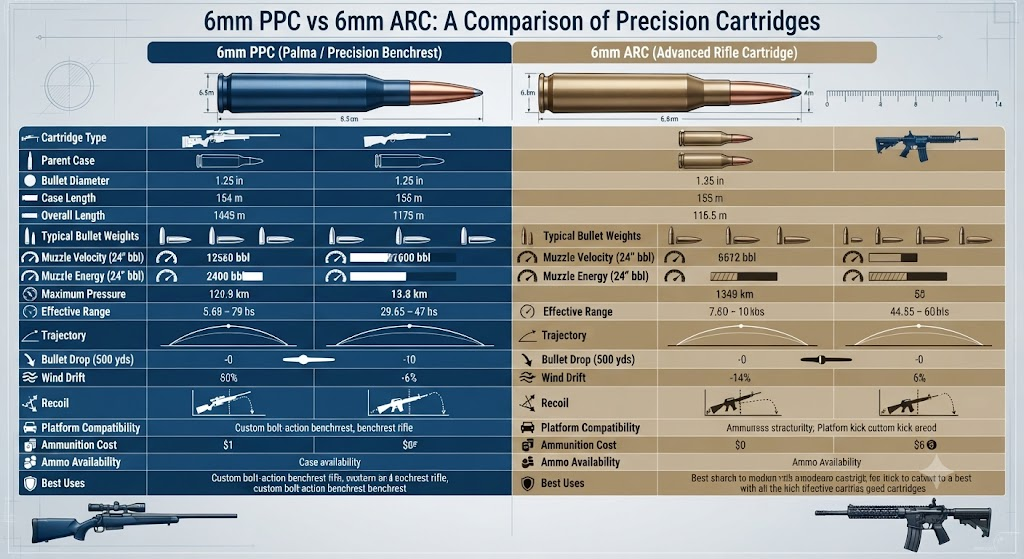
6mm PPC vs 6mm ARC Comparison Table
To accurately compare these two precision 6mm cartridges, we must examine their physical dimensions, pressure limits, and baseline ballistic performance. The data below represents standard premium capabilities, comparing a typical handloaded 68-grain benchrest load for the 6mm PPC against a standard 108-grain ELD Match factory load for the 6mm ARC.
| Specification | 6mm PPC (Palma / Precision Benchrest) | 6mm ARC (Advanced Rifle Cartridge) |
| Cartridge Type | Bolt-Action Benchrest | Intermediate Rifle (Gas Gun & Bolt) |
| Parent Case | .228 Richter / .220 Russian | .220 Russian / 6.5 Grendel |
| Bullet Diameter | .243 inches (6mm) | .243 inches (6mm) |
| Case Length | 1.515 inches | 1.490 inches |
| Overall Length | 2.150 inches to 2.200 inches | 2.260 inches (Max for AR-15) |
| Typical Bullet Weights | 65 grains to 80 grains | 103 grains to 108 grains |
| Muzzle Velocity (24 inch bbl) | 3,350 fps (68gr Benchrest load) | 2,750 fps (108gr ELD Match) |
| Muzzle Energy (24 inch bbl) | 1,694 foot-pounds | 1,710 foot-pounds |
| Maximum Pressure | 50,000 to 55,000+ psi (Handload/Custom) | 52,000 psi (SAAMI) |
| Effective Range | 100 to 300 yards (Extreme precision) | 1,000+ yards (Long-range precision/Tactical) |
| Trajectory | Laser Flat (At benchrest distances) | Extremely Flat |
| Bullet Drop (500 yds) | Steep (Rapid velocity decay with light bullets) | Approximately 41 inches |
| Wind Drift | Moderate at short range, high at long range | Exceptionally Low (High BC heavy bullets) |
| Recoil | Very Mild (Approx. 4 to 5 foot-pounds) | Very Mild (Approx. 7.5 foot-pounds) |
| Platform Compatibility | Custom bolt-action benchrest rifles | AR-15 rifles, bolt-action rifles |
| Ammunition Cost | Very High (Custom brass, handloaded) | Moderate |
| Ammo Availability | Specialty / Handload only | Good |
| Best Uses | Short-range benchrest competition (100-300 yds) | PRS gas-gun competition, military duty, hunting |
Understanding the Engineering
The technical differences between these cartridges reflect two entirely different eras of precision shooting evolution.
The 6mm PPC (Palzis-Pignol-Cuthbertson) was developed in the mid-1970s by Lou Palmisano and Ferris Pindell. They took the .220 Russian rimfire-derived case, expanded the neck to accept a 6mm bullet, moved the shoulder forward, and made it exceptionally steep. The result was a short, fat, highly efficient powder column that burns completely and evenly. For decades, the 6mm PPC completely dominated short-range benchrest shooting, setting world records for accuracy that stood untouched for years. However, it is an inherently specialized wildcat/custom cartridge that requires custom bolt-action rifles with tight tolerances and specialized reamers.
The 6mm ARC was introduced by Hornady in 2020. Hornady took a similar conceptual approach—utilizing the efficient .220 Russian / 6.5 Grendel parent case geometry—but optimized it for a completely different century. Instead of focusing solely on 100-yard paper punching with lightweight 68-grain bullets, the 6mm ARC was engineered to fit inside the 2.260-inch overall length constraint of an AR-15 magazine. This allows it to seat massive, ultra-high-ballistic-coefficient 108-grain match bullets that excel at pushing past 1,000 yards.
Velocity Comparison
Velocity dictates initial trajectory flatness and time-to-target.
When examining their typical loads, the 6mm PPC and the 6mm ARC represent an absolute weight-versus-speed trade-off.
The 6mm PPC fires ultra-lightweight match bullets (typically 65 to 68 grains) at blistering speeds, leaving the muzzle at roughly 3,350 feet per second. It acts like a hyper-velocity laser inside 300 yards.
The 6mm ARC fires heavy, sleek match bullets (105 to 108 grains) at a much more moderate 2,750 feet per second. While it starts slower, its massive aerodynamic advantage ensures it retains its speed much more efficiently downrange.
Muzzle Energy Comparison
Muzzle energy measures the absolute kinetic force transferred to a target upon impact.
Despite their different velocities and projectile weights, these two cartridges produce remarkably similar muzzle energy figures. A 68-grain 6mm PPC moving at 3,350 fps generates roughly 1,694 foot-pounds of energy. A 108-grain 6mm ARC moving at 2,750 fps generates about 1,710 foot-pounds.
However, because the 6mm ARC uses heavy, high-mass projectiles, it retains its kinetic energy drastically better at extended distances than the lightweight 6mm PPC.
Trajectory and Long-Range Performance
A flat trajectory minimizes error at known distances, but aerodynamic design dictates long-range survival.
Inside 300 yards, the 6mm PPC shoots laser-flat due to its incredible muzzle velocity, making it unmatched for traditional benchrest grouping.
Beyond 500 yards, however, the 6mm PPC suffers because its lightweight bullets lack high Ballistic Coefficients, causing them to shed velocity rapidly and drift heavily in crosswinds. The 6mm ARC was specifically built for this exact domain; its heavy, high-BC bullets defy crosswinds and maintain stable flight well past 1,000 yards.
Platform and Practical Application
This is where the two cartridges diverge entirely into separate worlds.
The 6mm PPC is exclusively a bolt-action benchrest cartridge. It is fired off heavy, custom-weighted rests on concrete benches by competitive marksmen chasing the smallest possible group measurements at 100 and 200 yards. Factory ammunition is exceptionally rare, and most shooters form their own brass and handload every single round.
The 6mm ARC is a tactical, versatile intermediate cartridge. It is designed to run reliably in semi-automatic AR-15 rifles as well as bolt-action platforms. It serves active-duty military and law enforcement roles, wins Precision Rifle Series (PRS) gas-gun matches, and handles medium-game hunting duties with ease.
Pros and Cons
6mm PPC
Pros
- Legendary, undisputed mechanical accuracy at short ranges (100-300 yards).
- Highly efficient powder column produces incredible consistency.
- Minimal recoil allows for effortless shot tracking.
Cons
- Extremely limited effective range due to lightweight, low-BC bullets.
- Obsolete for modern tactical or semi-automatic gas gun platforms.
- Requires custom rifles, custom reamers, and meticulous handloading.
- Factory ammunition is virtually non-existent.
6mm ARC
Pros
- Exceptional long-range performance and wind resistance out to 1,000+ yards.
- Fits natively into standard AR-15 rifles and magazines.
- Backed by widespread factory ammunition and component support.
- Fully capable of ethical medium-game hunting (deer, hogs).
Cons
- Cannot match the hyper-precise, single-hole group sizes of a specialized 6mm PPC benchrest rifle at 100 yards.
- Requires a dedicated 6.5 Grendel Type II bolt face in an AR-15.
Final Verdict
Choosing between the 6mm PPC and the 6mm ARC is a choice between a specialized paper-punching icon and a modern tactical powerhouse.
- For Short-Range Benchrest Competition: Choose the 6mm PPC. If your goal is to shoot microscopic, sub-quarter-MOA groups at 100 to 200 yards from a custom bolt gun, the 6mm PPC remains a masterclass in short-range engineering.
- For Modern Tactical Shooting and Long-Range Precision: Choose the 6mm ARC. For AR-15 compatibility, extended range capabilities past 1,000 yards, factory ammo availability, and real-world utility, the 6mm ARC is vastly superior.
FAQ
Is the 6mm ARC based on the 6mm PPC?
Not directly, though they share a common ancestral lineage. Both cartridges utilize cases derived from the Russian military rifle family (.220 Russian). However, the 6mm PPC was necked down and shortened for benchrest bolt guns, while the 6mm ARC was engineered around the 6.5 Grendel to fit inside AR-15 magazines.
Can I shoot 6mm PPC in an AR-15?
No. The 6mm PPC has an overall length and case geometry that will not feed reliably from standard AR-15 box magazines. It is strictly chambered in custom bolt-action rifles.
Why is the 6mm PPC so accurate?
The 6mm PPC’s accuracy stems from its short, fat powder column, small primer pocket, steep shoulder angle, and tight neck tolerances. This geometry ignites gunpowder uniformly and aligns the bullet perfectly with the bore, minimizing velocity deviations between shots.
Which one is better for hunting?
The 6mm ARC is significantly better for hunting. Its heavy bullets carry the mass, energy, and momentum required to ethically harvest medium game like deer and hogs at moderate distances, whereas the 6mm PPC is strictly a lightweight varmint and target cartridge.