The main difference between the 22 ARC and 6mm ARC is that the 6mm ARC fires heavier bullets that deliver greater kinetic energy and deeper penetration for hunting medium game, while the 22 ARC pushes lighter bullets at higher velocities to provide a flatter trajectory and superior wind resistance for predator control and long distance target shooting. Both cartridges represent the absolute pinnacle of modern AR-15 design. By utilizing the 6.5 Grendel parent case, they allow shooters to achieve magnum level ballistics from a lightweight semi automatic rifle. The 6mm ARC was built as a multi purpose combat and hunting round that hits with serious authority. The 22 ARC was engineered to maximize aerodynamic efficiency, offering a completely flat flight path with virtually zero recoil. Choosing the right cartridge depends on whether you value heavy hitting energy or laser focused precision.
22 ARC vs 6mm ARC Ballistics Chart
| Specification / Metric | 22 ARC (88 gr ELD Match) | 6mm ARC (108 gr ELD Match) |
| Cartridge | 22 Advanced Rifle Cartridge | 6mm Advanced Rifle Cartridge |
| Parent Case | 6.5 Grendel | 6.5 Grendel |
| Bullet Diameter | .224 inches | .243 inches (6mm) |
| Typical Bullet Weight | 62 to 88 grains | 103 to 108 grains |
| Muzzle Velocity | 2,820 fps | 2,750 fps |
| Velocity at 100 Yards | 2,680 fps | 2,618 fps |
| Velocity at 200 Yards | 2,544 fps | 2,490 fps |
| Velocity at 300 Yards | 2,413 fps | 2,366 fps |
| Velocity at 500 Yards | 2,163 fps | 2,129 fps |
| Muzzle Energy | 1,553 ft-lbs | 1,813 ft-lbs |
| Energy at 100 Yards | 1,403 ft-lbs | 1,644 ft-lbs |
| Energy at 200 Yards | 1,264 ft-lbs | 1,487 ft-lbs |
| Energy at 300 Yards | 1,137 ft-lbs | 1,342 ft-lbs |
| Energy at 500 Yards | 914 ft-lbs | 1,086 ft-lbs |
| Bullet Drop (500 Yds, 200 Yd Zero) | -41.0 inches | -43.5 inches |
| Wind Drift (500 Yds, 10 mph Wind) | 16.5 inches | 17.5 inches |
| Ballistic Coefficient (G1) | 0.545 | 0.536 |
| Sectional Density | 0.250 | 0.261 |
| Effective Hunting Range | 600 yards (varmints) | 600 yards (medium game) |
| Maximum Effective Range | 1,000+ yards | 1,000+ yards |
| Typical Twist Rate | 1:7 | 1:7.5 |
| Recoil (Free Recoil Energy) | ~4.8 ft-lbs | ~6.5 ft-lbs |
| Trajectory | Exceptionally flat | Very flat |
| Barrel Life | 3,000 to 5,000 rounds | 4,000 to 6,000 rounds |
| Accuracy Potential | Match-grade precision | Match-grade precision |
| Hunting Performance | Predators, coyotes, small pests | Deer, antelope, feral hogs |
| Target Shooting Performance | Elite for precision gas guns | Elite for precision gas guns |
| Long-Range Performance | Supersonic past 1,100 yards | Supersonic past 1,100 yards |
| Ammunition Availability | Limited but growing | Growing rapidly |
| Ammunition Cost | Premium pricing | Premium pricing |
| Rifle Availability | Limited but expanding | Common in modern ARs |
| Magazine Compatibility | 6.5 Grendel magazines | 6.5 Grendel magazines |
| Suppressor Compatibility | Excellent | Excellent |
| Best Use Cases | Predator hunting, target matches | Medium game hunting, tactical |
| Main Advantages | Ultra low recoil, flat trajectory | Retained energy, deeper penetration |
| Main Disadvantages | Lower energy on large targets | Slightly more bullet drop |
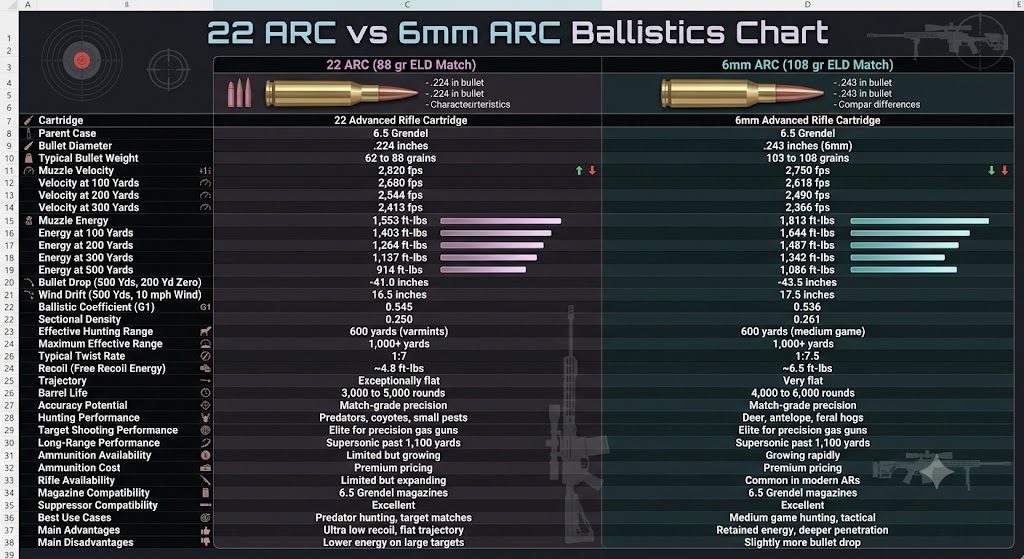
The comparison table above clearly illustrates how bullet mass changes the dynamic of two cartridges that share the exact same parent case. Because the 22 ARC pushes a lighter 88 grain bullet, it holds a distinct velocity advantage right out of the muzzle. This extra speed translates into a flatter trajectory and slightly less wind drift at 500 yards compared to the heavier 6mm ARC.
However, the 6mm ARC completely dominates the energy category. By launching a heavier 108 grain bullet, the 6mm ARC generates significantly more kinetic energy at the muzzle and retains that massive power all the way downrange. At 500 yards, the 6mm ARC still holds over 1,000 foot pounds of energy, making it a highly capable cartridge for hunting medium game animals. The 22 ARC drops below that critical energy threshold much sooner.
For real world shooting applications, the decision comes down to your primary target. The 22 ARC provides a laser flat path and virtually zero recoil, making it the ultimate tool for picking off coyotes at unknown distances or ringing steel plates. The 6mm ARC offers a more balanced approach, sacrificing a tiny amount of aerodynamic efficiency to deliver the heavy hitting penetration necessary for hunting whitetail deer and antelope.
Detailed Comparison Sections
Understanding the Comparison Chart
To truly understand the 22 ARC vs 6mm ARC ballistics chart, you must look at their shared foundation. Both cartridges are built upon the 6.5 Grendel casing. Engineers took that highly efficient case design and necked it down to hold smaller, more aerodynamic bullets. This allows both cartridges to maximize the limited powder capacity available inside a standard AR-15 magazine.
How to Read the Ballistics Chart
When analyzing these two modern cartridges, pay close attention to the retained energy and wind drift columns. Retained energy dictates the ethical hunting limits of the bullet upon impact. Wind drift is the most critical factor for long range target shooting, as wind is the most difficult environmental variable to predict accurately.
Velocity Comparison
The 22 ARC is the faster of the two cartridges due to its lighter projectile. Firing a heavy 88 grain match bullet, the 22 ARC leaves the muzzle at roughly 2,820 fps. The 6mm ARC pushes a heavier 108 grain bullet at about 2,750 fps. This 70 fps advantage helps the 22 ARC reach distant targets slightly faster, giving gravity less time to act upon the bullet during flight.
Energy Comparison
Kinetic energy belongs entirely to the 6mm ARC. Mass is a massive factor in energy calculations. At the muzzle, the 6mm ARC generates 1,813 foot pounds of energy compared to the 1,553 foot pounds of the 22 ARC. This gap persists all the way downrange. At 500 yards, the 6mm ARC retains 1,086 ft-lbs of energy, easily outclassing the 914 ft-lbs retained by the 22 ARC. This is the primary reason hunters prefer the 6mm version for larger animals.
Trajectory Comparison
A flat trajectory removes the guesswork when engaging targets at unknown distances. The 22 ARC was built specifically to shoot as flat as possible from a gas operated rifle.
Bullet Drop Comparison
If you zero both rifles at 200 yards, the trajectory gap becomes apparent as the distance increases. At 500 yards, the 22 ARC will drop about 41.0 inches. The 6mm ARC will drop roughly 43.5 inches. While a 2.5 inch difference is relatively small, it gives the 22 ARC a more forgiving margin of error for precision shooters.
Wind Drift Comparison
Both cartridges are exceptional in windy conditions, but the 22 ARC takes a very slight lead. In a 10 mph crosswind at 500 yards, the 22 ARC will drift 16.5 inches off target. The 6mm ARC will drift 17.5 inches. Both numbers are phenomenally low for the AR-15 platform, rivaling traditional long action bolt rifles.
Ballistic Coefficient Comparison
Ballistic Coefficient measures how efficiently a bullet slices through the air. Hornady specifically designed both cartridges to fire the highest BC bullets possible for their respective calibers. The heavy 88 grain bullet of the 22 ARC boasts a stunning G1 BC of 0.545. The 108 grain bullet of the 6mm ARC features a G1 BC of 0.536. These incredibly high ratings allow both cartridges to maintain supersonic flight past 1,000 yards.
Accuracy Potential
Both cartridges offer elite level accuracy. The 6mm ARC was adopted by specialized military units specifically for its predictable precision. The 22 ARC benefits from decades of bullet design advancements and delivers match grade performance right out of the box. You can confidently expect sub MOA precision from quality rifles chambered in either caliber.
Effective Range Comparison
For competitive target shooting, both cartridges will effortlessly ring steel plates out to 1,000 yards and beyond. For practical hunting, their effective ranges diverge. The 22 ARC is highly effective on coyotes and varmints out to 600 yards. The 6mm ARC is highly effective on deer sized game out to 500 or 600 yards, providing the necessary energy for a clean harvest.
Hunting Performance Comparison
If your primary goal is predator control, the 22 ARC is the undisputed champion. It shoots incredibly flat, minimizes pelt damage, and drops coyotes instantly. However, if you are hunting whitetail deer, feral hogs, or antelope, the 6mm ARC is the much smarter choice. Its heavier bullets offer superior sectional density, ensuring deep penetration through thick bone and muscle tissue.
Target Shooting Comparison
For Precision Rifle Series gas gun matches, both cartridges are dominant forces. The 22 ARC offers a slight advantage for shooters who want absolutely zero recoil, allowing them to easily spot their own impacts through the scope. The 6mm ARC provides heavier impacts on distant steel targets, which can be helpful for range officers calling hits in loud environments.
Long-Range Performance Comparison
There is virtually no other cartridge that fits in an AR-15 and performs as well at long range as these two options. By keeping heavy, high BC bullets supersonic past 1,100 yards, they completely outperform older standards like the .223 Remington and .308 Winchester when it comes to wind resistance and trajectory.
Recoil Comparison
Both cartridges are extremely comfortable to shoot. The 6mm ARC generates roughly 6.5 foot pounds of free recoil energy, making it feel very similar to a .243 Winchester. The 22 ARC generates a tiny 4.8 foot pounds of free recoil energy. This practically non existent recoil makes the 22 ARC perfect for youth hunters, beginners, and high volume target shooters.
Barrel Life Comparison
Because both cartridges push large amounts of powder through small bore diameters, they do create significant heat. A 6mm ARC barrel will typically maintain peak precision for 4,000 to 6,000 rounds. The 22 ARC, utilizing a slightly smaller bore, will typically see peak accuracy begin to fade around 3,000 to 5,000 rounds.
Ammunition Cost Comparison
Neither cartridge is considered budget friendly. They are specialized, high performance rounds loaded almost exclusively with premium match and hunting bullets. You will not find cheap bulk practice ammunition for either caliber. Expect to pay premium prices for every box you purchase.
Ammunition Availability
The 6mm ARC has been on the market slightly longer and has gained a very strong following, meaning ammunition is becoming much easier to find at local retailers. The 22 ARC is newer and is currently produced by fewer manufacturers. You will likely need to order 22 ARC ammunition online until its popularity grows further.
Rifle Compatibility
Both cartridges were explicitly engineered to drop into the AR-15 platform. To convert a standard 5.56 NATO rifle to either caliber, you simply need to purchase a new barrel, a 6.5 Grendel bolt carrier group, and dedicated 6.5 Grendel style magazines. The lower receiver and all other parts remain identical.
Pros and Cons of 22 ARC
Pros:
- Laser flat trajectory out to 600 yards.
- Extremely high ballistic coefficient bullets.
- Virtually zero felt recoil.
- The ultimate predator hunting cartridge for the AR-15.
Cons:
- Lacks the kinetic energy for large game hunting.
- Ammunition is currently expensive and limited.
Pros and Cons of 6mm ARC
Pros:
- Massive kinetic energy retention for medium game hunting.
- Excellent wind bucking capabilities at 1,000 yards.
- Adopted by military groups for proven reliability.
- Fits perfectly into the modular AR-15 platform.
Cons:
- Slightly more bullet drop than the 22 ARC.
- Slightly more recoil than standard .22 caliber rounds.
Which Cartridge Is Better for Beginners?
The 22 ARC is the absolute best choice for a beginner. The total lack of recoil ensures a new shooter will not develop a flinch in anticipation of the shot. Furthermore, the exceptionally flat trajectory makes it much easier for a beginner to successfully hit targets at unknown distances while learning the fundamentals of marksmanship.
Which Cartridge Is Better for Hunting?
This depends entirely on the size of the animal you are pursuing. If you are exclusively hunting coyotes, foxes, and prairie dogs, the 22 ARC is the perfect tool. If you plan to hunt whitetail deer, feral hogs, or antelope, the heavier bullets and deeper penetration of the 6mm ARC make it the only ethical choice between the two.
Which Cartridge Is Better for Long-Range Shooting?
Both cartridges are phenomenal at long range. The 22 ARC offers slightly less wind drift and bullet drop, making the mathematical calculations slightly easier. However, the 6mm ARC delivers more energy to the target, making it easier to hear and see impacts on heavy steel plates at 1,000 yards. Both will serve a precision shooter flawlessly.
Which Cartridge Should You Choose?
Choose the 22 ARC if you want to build a highly accurate, zero recoil AR-15 specifically for ringing steel targets and dropping predators at extreme distances. Choose the 6mm ARC if you want a versatile, do everything rifle capable of taking deer and hitting long range targets with serious authority.
Verdict
The 22 ARC and the 6mm ARC are sister cartridges that perfectly represent the modern era of ballistic engineering. By utilizing heavy, aerodynamic bullets and efficient powder columns, they extract bolt action magnum performance out of the lightweight AR-15 platform. The 22 ARC is a highly specialized scalpel. It delivers blistering speed, a laser flat trajectory, and defies the wind better than almost any other .22 caliber cartridge in existence. The 6mm ARC is the ultimate multi tool. It hits with the power of a traditional hunting rifle while maintaining the precision needed to win long range target matches. If you need a dedicated varmint gun, the 22 ARC is unmatched. If you want one rifle capable of defending your property, winning a PRS match, and filling your freezer with venison, the 6mm ARC is the clear winner.
FAQs
Can you shoot 22 ARC in a 6mm ARC rifle?
No. It is extremely dangerous to mix these cartridges. While they share the same parent case and base dimensions, the bullet diameters and neck sizes are different. Attempting to fire the wrong cartridge will result in a catastrophic failure, destroying the rifle and potentially injuring the shooter.
Do both cartridges use the same magazines?
Yes. Both the 22 ARC and the 6mm ARC utilize the exact same 6.5 Grendel style AR-15 magazines. These magazines feature specific feed lip geometries designed to reliably feed the wider casing of the Grendel family.
Is the 6mm ARC good for deer hunting?
Yes, the 6mm ARC is an excellent cartridge for deer hunting out to 400 or 500 yards. It provides kinetic energy levels very similar to the legendary .243 Winchester, making it highly effective on whitetail deer, mule deer, and antelope when using proper hunting bullets.
Which cartridge has better barrel life?
The 6mm ARC generally provides slightly better barrel life. Because it pushes powder through a slightly larger .243 inch bore compared to the tight .224 inch bore of the 22 ARC, it operates with slightly less intense throat erosion over high round counts.
What bolt face do I need for a 6mm ARC build?
To build a rifle chambered in either 6mm ARC or 22 ARC, you must use a standard AR-15 bolt carrier group fitted with a 6.5 Grendel bolt head. Standard 5.56 NATO bolts will not fit the wider rim of the ARC cartridges.