The main difference between the 6mm ARC and the 6mm MAX is the underlying case architecture and the bolt face they require in the AR-15 platform. The 6mm ARC is based on the wider 6.5 Grendel case, requiring a specialized bolt that removes material from the bolt lugs to fit the fat cartridge, while the 6mm MAX is based on the .350 Legend case, allowing it to utilize a standard 5.56 NATO bolt for vastly superior mechanical durability while matching or exceeding the powder capacity of the ARC.
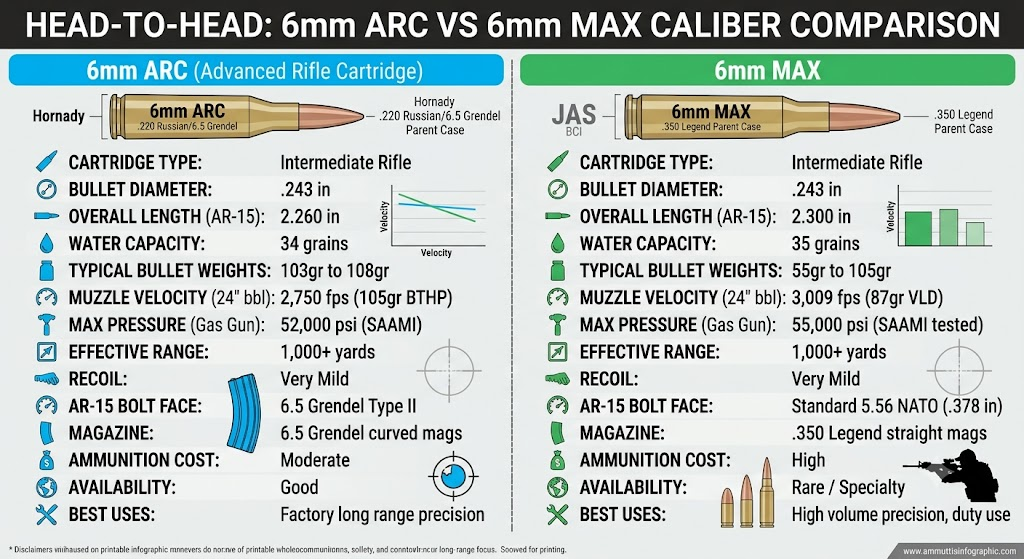
6mm ARC vs 6mm MAX Comparison Table
To accurately compare these two advanced 6mm intermediate cartridges, we must examine their physical dimensions, pressure limits, and mechanical requirements for the AR-15 platform. The data below represents standard premium capabilities for both cartridges.
| Specification | 6mm ARC (Advanced Rifle Cartridge) | 6mm MAX |
| Cartridge Type | Intermediate Rifle | Intermediate Rifle |
| Parent Case | .220 Russian / 6.5 Grendel | .350 Legend |
| Bullet Diameter | .243 inches (6mm) | .243 inches (6mm) |
| Overall Length (AR-15) | 2.260 inches | 2.300 inches |
| Water Capacity | 34 grains | 35 grains |
| Typical Bullet Weights | 103 grains to 108 grains | 55 grains to 105 grains |
| Muzzle Velocity (24 inch bbl) | 2,750 fps (105gr BTHP) | 3,009 fps (87gr VLD) |
| Muzzle Energy (24 inch bbl) | 1,761 foot pounds | 1,749 foot pounds |
| Maximum Pressure (Gas Gun) | 52,000 psi (SAAMI) | 55,000 psi (SAAMI tested) |
| Effective Range | 1,000+ yards | 1,000+ yards |
| Trajectory | Extremely Flat | Extremely Flat |
| Recoil | Very Mild | Very Mild |
| AR-15 Bolt Face Required | 6.5 Grendel Type II | Standard 5.56 NATO (.378 inch) |
| Magazine Compatibility | 6.5 Grendel curved magazines | .350 Legend straight magazines |
| Ammunition Cost | Moderate | High |
| Ammo Availability | Good | Rare / Specialty |
| Best Uses | Factory supported long range precision | High volume precision, duty use |
Understanding the Engineering
The 6mm Advanced Rifle Cartridge (ARC) was developed by Hornady in 2020 for the United States Department of Defense. It uses a shortened 6.5 Grendel case to hold roughly 34 grains of water capacity. However, the fat Grendel case requires a specialized bolt with a wider face. To make this fit inside a standard AR-15 bolt carrier, engineers must cut away steel from the bolt lugs, weakening the bolt. To prevent these thinner lugs from shearing off, the 6mm ARC is strictly limited to 52,000 psi in semi-automatic gas guns.
The 6mm MAX was developed by BC Precision Ballistics and championed by Sons of Liberty Gun Works. They wanted 6mm ARC ballistics without the weak bolt lugs. They necked down the .350 Legend case, which shares the exact same base diameter as the 5.56 NATO.This allows the 6mm MAX to use a standard, full strength mil-spec 5.56 bolt.Surprisingly, because the case has less body taper, it actually holds 35 grains of water capacity.With the full strength bolt lugs, the 6mm MAX can safely operate at a higher 55,000 psi.
Velocity Comparison
Velocity dictates long range performance and wind deflection.
The 6mm ARC pushes heavy 105 grain match bullets at roughly 2,750 feet per second from a 24 inch barrel. The 6mm MAX, utilizing its slightly larger powder capacity and higher pressure limit, can push lighter 87 grain bullets just over 3,000 feet per second from the same barrel length.When comparing identical bullet weights, the 6mm MAX generally yields a slight velocity advantage over the 6mm ARC due to its 55,000 psi operating pressure compared to the conservative 52,000 psi limit of the ARC.
Muzzle Energy Comparison
Both cartridges hover in the exact same power class, generating roughly 1,750 foot pounds of kinetic energy at the muzzle from a 24 inch barrel. The 6mm ARC relies on slightly heavier 108 grain bullets moving a bit slower, while the 6mm MAX factory data often highlights 85 grain to 90 grain bullets moving much faster. Both provide excellent energy transfer for taking medium game like deer or antelope at extended distances.
Trajectory and Wind Drift
Because both cartridges fire incredibly aerodynamic 6mm projectiles, they both shoot exceptionally flat and cut through the wind beautifully.
The 6mm ARC is highly standardized around heavy 108 grain ELD Match bullets that possess phenomenal ballistic coefficients. These heavy bullets resist wind drift perfectly at 1,000 yards. The 6mm MAX can also load heavy 105 grain bullets, but because it uses a longer 2.30 inch overall length, the bullets do not have to be seated as deeply into the powder column. This extra room allows the 6mm MAX to match or slightly beat the trajectory of the 6mm ARC at extreme ranges.
Recoil Comparison
Both cartridges produce very mild recoil. Fired from a standard 8 pound AR-15, they generate roughly 7 to 8 foot pounds of free recoil. This is slightly more than a standard 5.56 NATO, but significantly less than an AR-10 chambered in .308 Winchester or 6.5 Creedmoor. Both allow shooters to easily spot their own bullet impacts through a magnified optic.
Mechanical Reliability and Bolt Life
This is the most critical mechanical difference between the two platforms.
The 6mm ARC suffers from documented bolt life issues for high volume competitors. The thin lugs on the 6.5 Grendel Type II bolt are prone to premature wear or shearing under heavy use due to the lack of steel material.
The 6mm MAX completely solves this issue by utilizing the standard .378 inch bolt face of the 5.56 NATO.The mil-spec 5.56 bolt retains its full lug integrity, making the 6mm MAX exponentially more durable and reliable for high volume precision shooters or tactical duty use.
Magazine Compatibility
The 6mm ARC requires dedicated 6.5 Grendel magazines, which feature an exaggerated curve to accommodate the heavily tapered cases. These magazines can sometimes be finicky to tune for perfect reliability.
The 6mm MAX utilizes standard .350 Legend magazines.These magazines feature a straight body design that feeds the straight walled parent case flawlessly, providing excellent feed geometry.Furthermore, .350 Legend magazines allow for a longer 2.30 inch overall cartridge length, whereas standard AR-15 magazines limit the 6mm ARC to 2.26 inches.
Ammo Cost and Availability
The 6mm ARC is a massive commercial success supported heavily by Hornady. You can find factory loaded match and hunting ammunition for the 6mm ARC at almost any major sporting goods store.
The 6mm MAX is a brand new, highly specialized wildcat style cartridge. Ammunition is virtually non-existent on the shelves of local gun stores. Shooters interested in the 6mm MAX must order their ammunition directly from specialty manufacturers or commit entirely to reloading their own brass.
Reloading
The 6mm ARC has abundant brass, dies, and load data available globally.
The 6mm MAX is gaining traction, but load data is still relatively guarded. However, for the experienced handloader, the 6mm MAX is a dream. You can form the brass from straight walled .350 Legend cases and tune powder charges to fully exploit the higher 55,000 psi pressure limit and the longer 2.30 inch overall length.
Pros and Cons
6mm ARC
Pros
- Massive commercial support with abundant factory ammunition.
- Proven sub-MOA accuracy with heavy 108 grain match bullets.
- Dies and reloading components are available everywhere.
Cons
- Requires a weakened 6.5 Grendel bolt face that is prone to breakage.
- Limited to 52,000 psi in gas guns to protect the bolt lugs.
6mm MAX
Pros
- Uses a standard 5.56 NATO bolt for unmatched durability.
- 55,000 psi pressure limit yields higher velocities.
- Straight body .350 Legend magazines offer highly reliable feeding.
- Slightly longer 2.30 inch overall length maximizes powder capacity.
Cons
- Factory ammunition is incredibly rare and expensive.
- Lacks the widespread industry adoption of the Hornady cartridge.
Final Verdict
Choosing between the 6mm ARC and the 6mm MAX is a decision between commercial convenience and mechanical durability.
- For the Average Shooter: Choose the 6mm ARC. The sheer abundance of factory ammunition and aftermarket barrels makes it the easiest way to get into long range AR-15 shooting without worrying about sourcing custom components.
- For the High Volume Competitor: Choose the 6mm MAX. If you reload your own ammunition and shoot thousands of rounds a year, the standard 5.56 bolt face of the 6mm MAX will prevent the broken bolt lugs that sometimes plague the 6mm ARC platform.
- For the Tactical Builder: Choose the 6mm MAX. The ability to swap only a barrel and use a standard, highly proven 5.56 bolt carrier group provides a massive logistical advantage for reliability and spare parts compatibility.
FAQ
Is the 6mm MAX faster than the 6mm ARC?
Yes. Because the 6mm MAX uses a stronger bolt, it can safely operate at 55,000 psi compared to the 52,000 psi limit of the 6mm ARC.This higher pressure, combined with 35 grains of water capacity, gives the 6mm MAX a slight velocity edge with identical bullet weights.
Can I use my 5.56 bolt for 6mm MAX?
Yes. This is the primary design feature of the 6mm MAX. It uses a .350 Legend parent case, which shares the standard .378 inch rim diameter of the 5.56 NATO, allowing you to use a standard mil-spec bolt.
What magazines does the 6mm MAX use?
The 6mm MAX uses standard .350 Legend magazines.These magazines feature a straight body design that feeds the cartridge very reliably and allows for a longer 2.30 inch overall length.
Why do 6mm ARC bolts break?
To fit the fat 6.5 Grendel parent case of the 6mm ARC, engineers must widen the bolt face. This requires cutting away steel from the bolt lugs, making them thinner and weaker than standard 5.56 NATO lugs, which can lead to premature failure under heavy use.