The main difference between the cartridges is that the .300 PRC is a modern, ultra-precise magnum designed around high-BC, heavy .30-caliber bullets for extreme long-range target shooting and big game hunting, whereas the .30-06 Springfield is a legendary, versatile all-around medium-to-long-range cartridge optimized for standard-length rifle actions and traditional hunting distances.
.300 PRC vs .30-06 Comparison
| Feature | .300 PRC | .30-06 Springfield |
| Bullet Diameter | 0.308 in (7.82 mm) | 0.308 in (7.82 mm) |
| Typical Bullet Weight | 212 gr – 225 gr (typically 225 gr) | 150 gr – 180 gr (typically 150–180 gr) |
| Muzzle Velocity | 2,810 – 3,100 fps (24–26 in barrel) | 2,700 – 2,900 fps (24 in barrel) |
| Muzzle Energy | 3,800 – 4,150 ft-lbs | 2,700 – 3,000 ft-lbs |
| Momentum | ~90.0 lb-fps (225 gr at 2,810 fps) | ~71.0 lb-fps (180 gr at 2,700 fps) |
| Maximum Pressure | 65,000 psi (SAAMI) | 60,000 psi (SAAMI) |
| Ballistic Coefficient | Very High (e.g., ~0.777 for Hornady 225 gr ELD Match) | Moderate to High (e.g., ~0.505 for Hornady 178 gr ELD-X) |
| Effective Range | 1,000+ yards (Supersonic past 1,200+ yds) | 500 – 600 yards |
| Action Length Required | Magnum / Long Action | Standard Long Action |
| Recoil Energy | Heavy (~25–30 ft-lbs in standard rifles) | Moderate (~15–20 ft-lbs in standard rifles) |
| Ammo Availability | Moderate (Match/Hunting specialty, rising popularity) | Extremely High (Globally ubiquitous) |
| Ammo Cost | Expensive ($2.50 – $4.00+ per round) | Moderate ($1.25 – $2.25 per round) |
| Best Use | Extreme long-range target shooting, elk/moose/elaphine hunting | North American big game, general hunting, historical use |
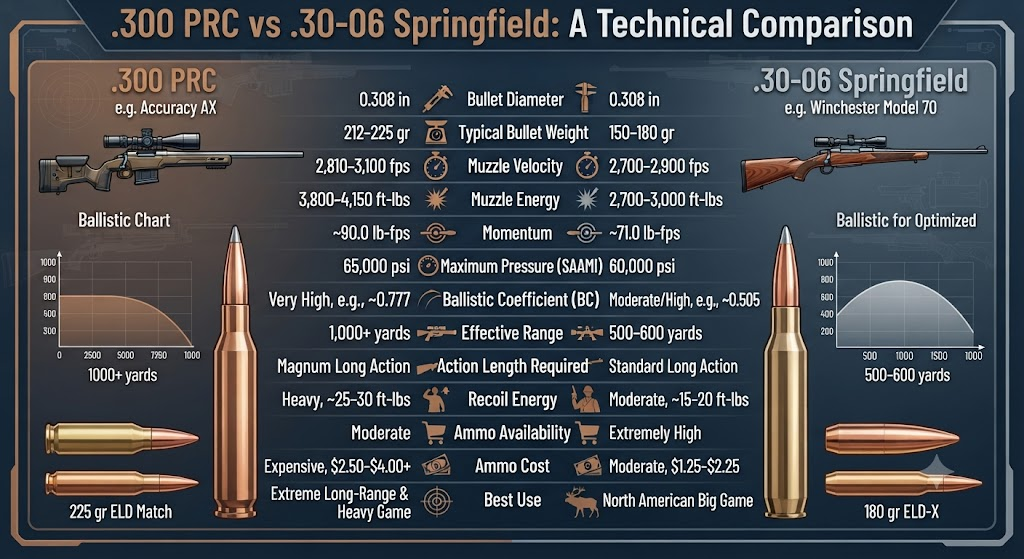
.300 PRC vs .30-06 Springfield Ballistics
The .300 PRC (Precision Rifle Cartridge) was developed by Hornady and adopted into military trials (such as the U.S. Navy’s Advanced Sniper Rifle program) with a singular objective: to fire long, heavy, ultra-low-drag (LD) bullets at optimized velocities without destabilizing them at transonic ranges. Built on a non-belted, rebated magnum case head derived from the .375 Ruger, it operates at a SAAMI maximum pressure of 65,000 psi.
In contrast, the .30-06 Springfield (originating as the .30-03 and standardized in 1906) is the quintessential American military and sporting cartridge. Operating at 60,000 psi, it balances manageable recoil, efficient case capacity, and ample power for nearly any game animal in North America within standard ethical distances.
Representative factory loads demonstrate their respective performance metrics:
- Load A (.300 PRC): Hornady 225-grain ELD Match. Tested from a 24-inch test barrel: Muzzle Velocity = 2,810 fps, Muzzle Energy = 3,940 ft-lbs, Ballistic Coefficient (G1) = 0.777.
- Load B (.300 PRC): Hornady 212-grain ELD-X Precision Hunter. Tested from a 24-inch barrel: Muzzle Velocity = 2,860 fps, Muzzle Energy = 3,850 ft-lbs, Ballistic Coefficient (G1) = 0.673.
- Load C (.30-06): Federal Premium 180-grain Nosler Partition. Tested from a 24-inch test barrel: Muzzle Velocity = 2,700 fps, Muzzle Energy = 2,913 ft-lbs, Ballistic Coefficient (G1) = 0.474.
- Load D (.30-06): Hornady 178-grain ELD-X Precision Hunter. Tested from a 24-inch barrel: Muzzle Velocity = 2,750 fps, Muzzle Energy = 2,989 ft-lbs, Ballistic Coefficient (G1) = 0.505.
.300 PRC vs .30-06 Velocity and Energy Retention
While muzzle velocities between the two cartridges can appear somewhat close on paper (around 2,700 to 2,850 fps depending on bullet weight), the downrange velocity and energy retention heavily favor the .300 PRC due to its extreme ballistic coefficients.
- Downrange Velocity at 500 Yards:
- .300 PRC (225 gr ELD Match): ~2,280 fps
- .30-06 (180 gr Partition):* ~1,980 fps
- .300 PRC (225 gr ELD Match): ~2,280 fps
- Downrange Energy at 500 Yards:
- .300 PRC: ~2,600 ft-lbs (Retains over 65% of its muzzle energy)
- .30-06: ~1,565 ft-lbs (Retains roughly 53% of its muzzle energy)
The .300 PRC is purposefully engineered to keep heavy, high-BC bullets supersonic well past 1,200 yards, whereas the .30-06 typically begins dropping below the speed of sound (approx. 1,125 fps) around 950 to 1,000 yards depending on environmental conditions.
Trajectory and Bullet Drop
Calculations assume a standard scope height of 1.5 inches above the bore and a zero distance of 200 yards.
| Distance | .300 PRC (225 gr at 2,810 fps) Drop | .30-06 (180 gr at 2,700 fps) Drop |
| Muzzle | -1.5 inches | -1.5 inches |
| 100 Yards | +1.8 inches | +1.7 inches |
| 200 Yards | 0.0 inches (Zero) | 0.0 inches (Zero) |
| 300 Yards | -6.2 inches | -7.5 inches |
| 400 Yards | -16.5 inches | -20.4 inches |
| 500 Yards | -32.1 inches | -41.2 inches |
Because the .300 PRC fires heavier bullets with exceptional aerodynamic profiles, its trajectory flattens out noticeably at distances beyond 300 yards, resisting crosswinds with significantly less deflection than the .30-06.
Recoil and Shootability
Recoil energy is directly tied to powder charge weight, bullet mass, and rifle weight.
- Recoil Energy: A standard 8.5-pound hunting rifle chambered in .30-06 generates approximately 20 to 22 foot-pounds of free recoil energy. A heavier precision or long-range rifle chambered in .300 PRC weighing 10 to 11 pounds generates roughly 25 to 30 foot-pounds of free recoil energy.
- Felt Experience: The .300 PRC produces a substantial, heavy linear shove accompanied by a loud muzzle report, virtually necessitating the use of a muzzle brake or suppressor for extended shooting sessions. The .30-06 is widely considered the upper threshold of comfortable, all-day shooting without requiring specialized recoil-mitigation hardware.
Terminal Ballistics and Hunting Application
- The .300 PRC is purpose-built for ethical, high-velocity terminal performance on large or dangerous game (elk, moose, brown bear, eland) at extended distances. Its heavy bullets retain high momentum and expand reliably even after shedding velocity 600 or 800 yards away.
- The .30-06 Springfield remains an exceptional medium-to-large game cartridge for traditional hunting ranges (0 to 400 yards). With 150-grain to 180-grain controlled-expansion bullets, it harvests deer, elk, and hogs cleanly and efficiently.
.300 PRC Pros and Cons
Pros
- Exceptional long-range accuracy and stability with high-BC bullets
- Maintains supersonic flight past 1,200 yards
- Resists crosswind drift significantly better than traditional cartridges
- Designed specifically for modern, heavy long-range projectiles without seating depth limitations
Cons
- Substantially heavier recoil requiring robust rifle platforms
- Expensive ammunition and limited component availability compared to standard calibers
- Longer, heavier rifle platforms are required to manage the magnum action and barrel length
.30-06 Springfield Pros and Cons
Pros
- Ubiquitous global ammunition availability and diverse load options
- Manageable recoil that facilitates accurate marksmanship without a muzzle brake
- Fits in standard, lighter-weight long-action hunting rifles
- Proven century-old track record on virtually every big-game species worldwide
Cons
- Struggles at extreme long ranges (1,000+ yards) compared to modern high-BC magnums
- Standard case geometry limits the use of ultra-long, high-BC bullets without sacrificing internal powder capacity
Final Comparison
| Category | Winner | Reason |
| Velocity | .300 PRC | Magnum powder capacity drives heavy bullets faster |
| Muzzle Energy | .300 PRC | Generates ~4,000 ft-lbs vs ~2,900 ft-lbs for .30-06 |
| Long-Range Ballistics | .300 PRC | Superior ballistic coefficients and wind resistance |
| Trajectory (500+ yds) | .300 PRC | Flatter trajectory and less bullet drop at extended distances |
| Recoil Control | .30-06 | Generates notably less recoil energy in standard-weight rifles |
| Ammo Availability | .30-06 | Found in virtually every hardware and sporting goods store globally |
| Ammo Cost | .30-06 | Significantly cheaper for practice and volume shooting |
| Rifle Weight/Portability | .30-06 | Works efficiently in lightweight, nimble mountain rifles |
| Overall Hunting (0–400 yds) | Tie | Both deliver lethal terminal performance within standard ethical ranges |
.300 PRC vs .30-06: Which Should You Choose?
- Choose the .300 PRC if your primary focus is extreme long-range target shooting (ELR), competitive precision shooting, or hunting big game at distances exceeding 500 yards where wind drift and energy retention are critical.
- Choose the .30-06 Springfield if you want a reliable, soft-recoiling, highly accessible, and historically proven hunting rifle for traditional distances out to 400 or 500 yards.
FAQs
Is .300 PRC more powerful than .30-06?
Yes, the .300 PRC generates significantly higher muzzle energy (roughly 3,900 to 4,100 ft-lbs) compared to the .30-06 Springfield (roughly 2,700 to 3,000 ft-lbs).
Which has more muzzle energy?
The .300 PRC produces substantially more muzzle energy due to its larger magnum case capacity and higher operating pressures.
Which is better for long-range shooting?
The .300 PRC is vastly superior for extreme long-range shooting (600 to 1,000+ yards), engineered specifically to stabilize ultra-high-BC bullets and resist wind drift.
Which has more recoil?
The .300 PRC produces heavier recoil (approx. 25–30 ft-lbs), while the .30-06 produces a more moderate, manageable recoil impulse (approx. 15–20 ft-lbs).
Which is better for hunting big game at standard distances?
For standard hunting distances (0 to 400 yards), both cartridges are exceptionally lethal, though the .30-06 does so with significantly less recoil and lighter rifle weight.
Which has a flatter trajectory?
The .300 PRC features a flatter trajectory at extended distances (300 to 600+ yards) because it retains velocity far more efficiently downrange.
Is .300 PRC legal for standard big game?
Yes, the .300 PRC is widely used and exceptionally effective for large game like elk, moose, caribou, and African plains game.
Which is cheaper to shoot?
The .30-06 Springfield is much cheaper and more accessible for high-volume practice compared to specialty match and hunting loads for the .300 PRC.
Which has better ammunition availability?
The .30-06 has ubiquitous global ammunition availability, whereas .300 PRC ammunition is primarily stocked as specialty match or premium hunting lines.
Is .300 PRC faster than .30-06?
Yes, the .300 PRC propels heavier bullets (such as 225 grains) at velocities (2,810 fps) that match or exceed lighter bullets fired from a .30-06.
Which requires a larger rifle action?
The .300 PRC requires a dedicated magnum-length bolt-action rifle, while the .30-06 fits comfortably in a standard long-action receiver.
Which is easier to shoot accurately?
Most shooters find the .30-06 easier to shoot accurately without flinching because its recoil is notably lighter and less punishing during extended range sessions.
Which has better ballistics?
The .300 PRC features superior ballistic coefficients, wind resistance, and energy retention at long ranges.
Which should you choose?
Choose the .300 PRC for extreme long-range precision and extended-range hunting, or choose the .30-06 for a classic, globally available, moderate-recoiling hunting rifle.