A 6.8 Western Trajectory Chart is a sophisticated ballistic reference guide that details the flight path and vertical drop of this modern short action magnum cartridge across distances from 100 to 1,000 yards. Engineered to maximize the ballistic potential of heavy, high-BC .277 caliber projectiles, the 6.8 Western provides a uniquely flat trajectory that bridges the gap between traditional hunting rounds and extreme long range target calibers. By utilizing the verified factory data in this chart, hunters and precision shooters can calculate the necessary elevation holdovers to ensure successful engagements at any range. Mastering this data allows you to optimize your rifle setup for superior accuracy and terminal performance, even in challenging environmental conditions.
Table of Contents [Click to open]
6.8 Western Trajectory Chart
| Manufacturer | Load Name | Weight (gr) | Type | BC | MV (fps) | 100y | 300y | 500y | 700y | 900y | 1000y | Zero (y) |
| Winchester | Expedition | 165 | AccuBond | 0.620 | 2970 | 0.0 | -6.1 | -19.4 | -43.2 | -81.4 | -106.8 | 200 |
| Browning | Long Range | 175 | Tipped Match | 0.618 | 2835 | 0.0 | -6.5 | -20.9 | -47.1 | -89.2 | -117.4 | 200 |
| Winchester | Copper Impact | 162 | Extreme Point | 0.528 | 3000 | 0.0 | -6.0 | -19.0 | -42.8 | -81.2 | -106.5 | 200 |
| Nosler | Trophy Grade | 150 | AccuBond | 0.490 | 3125 | 0.0 | -5.7 | -18.1 | -40.8 | -77.5 | -101.9 | 200 |
| Hornady | Precision Hunter | 170 | ELD X | 0.620 | 2925 | 0.0 | -6.3 | -20.0 | -44.5 | -84.2 | -110.8 | 200 |
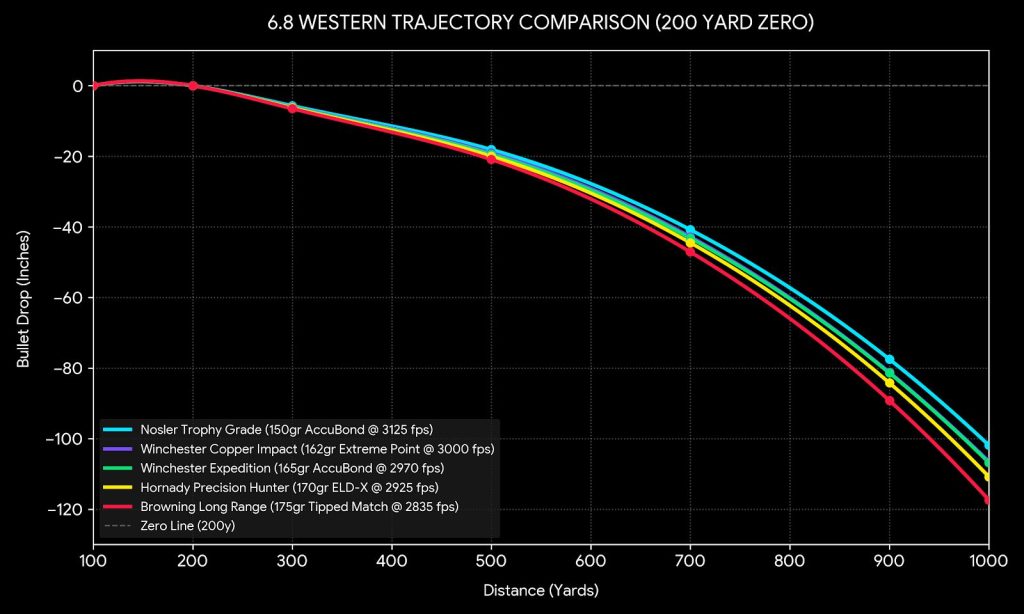
To effectively use this chart, identify the specific factory load and bullet weight you are currently shooting. With a 200 yard zero, the drop values represent the total vertical adjustment in inches required at each distance. For example, the 165 grain Winchester Expedition load requires a 43.2 inch holdover at 700 yards. Always supplement these figures with current atmospheric data from your local area, as variations in altitude and temperature can slightly alter the actual drop compared to these standardized test values.
Understanding The 6.8 Western Trajectory Chart
The data provided in the table acts as your baseline for ballistic success in the field. Understanding these values helps you anticipate how different bullet weights react to gravity over long distances.
Trajectory Analysis
Comparing the 150 grain Nosler AccuBond to the 175 grain Browning Tipped MatchKing shows the versatility of the 6.8 Western. At 500 yards, the 150 grain load drops 18.1 inches, while the heavier 175 grain load drops 20.9 inches. This demonstrates that while the 6.8 Western is capable of extreme speeds with lighter bullets, its true strength lies in its ability to launch heavy, high-BC projectiles with a very manageable trajectory profile.
Velocity Analysis
Muzzle velocity is the primary driver of the 6.8 Western’s performance. The 150 grain Nosler AccuBond starts at an impressive 3125 fps, which yields the flattest trajectory in our table. In contrast, the heavier 175 grain Browning load starts at 2835 fps, necessitating a slightly more aggressive holdover at distances beyond 300 yards. The data confirms that high muzzle velocity is the key to maintaining a flat flight path for this cartridge.
Ballistic Coefficient Analysis
Ballistic coefficient (BC) is the key to this cartridge’s long range success. The 165 grain Winchester Expedition and 170 grain Hornady ELD X both boast a high BC of 0.620, allowing them to resist air resistance and wind deflection far better than lower-BC options. This efficiency ensures that the bullets retain their energy and fly truer as they move toward the 1,000 yard mark, providing more consistent hits in adverse conditions.
Best Factory Loads Based On The Chart
For big game hunting at extended ranges, the 165 grain Winchester Expedition AccuBond is an outstanding choice, offering a perfect balance of high BC and deep terminal penetration. For long range target shooting, the 175 grain Browning Tipped MatchKing is the superior option, as its high BC helps buck wind more effectively than lighter loads. If you prioritize maximum velocity and a flatter flight path for medium-range hunting, the 150 grain Nosler AccuBond is an excellent factory load.
Key Takeaways From The Chart
The 150 grain Nosler AccuBond is the fastest factory offering in our table at 3125 fps, resulting in the flattest trajectory. The 165 grain Winchester Expedition and 170 grain Hornady ELD X maintain the highest ballistic coefficients at 0.620, making them the most efficient loads for retaining velocity downrange. The 175 grain Browning load provides the most robust option for extreme range target work where wind resistance is a priority.
Common 6.8 Western Bullet Weights
The 6.8 Western platform is optimized for modern, high-BC bullet weights that take advantage of its fast 1:8″ barrel twist rate.
150 Grain
These bullets are designed for high speed and flat trajectories. They are excellent for hunters who primarily engage targets within 300 to 400 yards and want to minimize the need for complex elevation adjustments.
162/165 Grain
This weight class is the heart of the 6.8 Western. It provides a highly efficient ballistic profile that makes it easy to shoot at 500+ yards. These bullets retain energy and resist wind better than almost any other standard .277 caliber load.
170/175 Grain
These are the heavy-hitters for the platform. They are optimized for extreme distance and deep penetration on large game. While they have more drop than the 150 grain loads, their ability to perform at 600+ yards is unmatched in the .277 class.
Effective Range
Big Game Hunting
The 6.8 Western is effectively an 800+ yard hunting cartridge. The trajectory data confirms that drop remains predictable and energy retention is significant, allowing for ethical harvests at distances where other cartridges struggle.
Long Range Target Shooting
This cartridge is capable of reaching 1,000 yards and beyond. With the right high-BC bullet and precise environmental data, the 6.8 Western is a highly accurate tool for extreme long range target work.
Factors That Affect 6.8 Western Trajectory
Bullet Weight
The 6.8 Western shines with heavier bullets. While the 150 grain load is faster, the 165-175 grain bullets are less affected by wind, which is crucial for extreme long range success.
Muzzle Velocity
High velocity is a hallmark of this cartridge. Every extra foot per second at the muzzle reduces the time of flight, which helps keep the bullet path flat and minimizes the impact of wind.
Ballistic Coefficient
The 6.8 Western’s main advantage is its ability to use high-BC bullets. This efficiency allows for less drop and less drift, making it easier to hit targets at long range compared to traditional cartridges.
Wind
Like all long range rounds, the 6.8 Western is affected by wind. However, by utilizing heavy, high-BC bullets, shooters can significantly reduce the amount of drift, leading to more consistent hits.
Zero Distance
A 200 yard zero is the standard recommendation for the 6.8 Western. It centers the trajectory arc perfectly for most hunting scenarios, requiring minimal holdover out to 250 or 300 yards.
Frequently Asked Questions
Is the 6.8 Western good for long range?
Yes, it is specifically designed for long range performance and excels at delivering heavy bullets with high BCs at extended distances.
What is the ideal bullet weight for 6.8 Western?
For most hunters and target shooters, the 162 to 175 grain range is considered the sweet spot for the cartridge.
Does it kick like a magnum?
The 6.8 Western is designed to offer magnum-level ballistics with less recoil than traditional long-action magnums like the 7mm Rem Mag.
Can I hunt elk with it?
Yes, the 6.8 Western is highly effective on elk and other large game due to its combination of energy and penetration.
Why do my shots strike lower than the chart?
This is usually due to lower muzzle velocity caused by shorter-than-standard barrel lengths or different environmental conditions.
Is it hard to find 6.8 Western ammunition?
It is widely available from premium manufacturers, though it may be less common than mainstream cartridges like the 270 Winchester.
What twist rate does my rifle need?
The 6.8 Western requires a 1:8″ twist rate to properly stabilize the heavy, long bullets it was designed to shoot.
Can I handload for better performance?
Yes, it is an excellent cartridge for handloaders who want to fine-tune their ammunition for maximum precision and velocity.
Is the 6.8 Western better than 270 WSM?
It offers significantly better long-range performance due to its ability to stabilize heavier, higher-BC bullets that the 270 WSM cannot handle.
What is the best zero distance for hunting?
A 200 yard zero is widely considered the best setup for general hunting, providing the most versatile point-blank range.
How would you like to proceed with your ballistics website development, or is there another cartridge trajectory chart you would like me to generate for your database?