A .357 Magnum Trajectory Chart is a critical ballistic reference tool that visually displays exactly how much this versatile, high-velocity revolver cartridge drops across various downrange distances. Renowned for its ability to bridge the gap between small-game rimfires and heavy big-game rifles, the .357 Magnum offers a flat trajectory that makes it a favorite for both hunters and precision handgunners. By diligently studying these ballistic values, you can master your firearm’s flight path, calculate precise holdovers for targets beyond the typical defensive range, and ensure your shots strike with lethal consistency. Reviewing this trajectory data guarantees you will fully maximize the speed and terminal performance potential of this iconic, wide-ranging centerfire cartridge.
Table of Contents [Click to open]
.357 Magnum Trajectory Chart
| Manufacturer | Bullet Weight | Bullet Type | Ballistic Coefficient | Muzzle Velocity | 50 Yard Drop | 100 Yard Drop | 150 Yard Drop | 200 Yard Drop | 250 Yard Drop | 300 Yard Drop | Recommended Zero | Max Point Blank |
| Hornady | 125 Grain | XTP Hollow Point | 0.150 | 1600 FPS | +0.5 | Zero | -5.5 | -16.5 | -35.0 | -62.0 | 100 Yards | 115 Yards |
| Federal | 140 Grain | Fusion Soft Point | 0.165 | 1450 FPS | +0.8 | Zero | -6.8 | -19.5 | -41.0 | -75.0 | 100 Yards | 110 Yards |
| Barnes | 140 Grain | VOR-TX XPB | 0.160 | 1400 FPS | +0.9 | Zero | -7.2 | -20.5 | -43.0 | -78.0 | 100 Yards | 108 Yards |
| Winchester | 158 Grain | JSP | 0.175 | 1235 FPS | +1.5 | Zero | -9.5 | -27.0 | -58.0 | -105.0 | 100 Yards | 105 Yards |
| Remington | 158 Grain | SJHP | 0.160 | 1250 FPS | +1.4 | Zero | -9.0 | -26.0 | -55.0 | -100.0 | 100 Yards | 105 Yards |
| Buffalo Bore | 158 Grain | Hard Cast | 0.180 | 1475 FPS | +0.8 | Zero | -6.5 | -18.5 | -39.0 | -70.0 | 100 Yards | 110 Yards |
| Underwood | 158 Grain | Gold Dot JHP | 0.185 | 1475 FPS | +0.8 | Zero | -6.5 | -18.5 | -39.0 | -70.0 | 100 Yards | 110 Yards |
| Sig Sauer | 125 Grain | V-Crown | 0.150 | 1500 FPS | +0.6 | Zero | -6.0 | -17.5 | -37.5 | -68.0 | 100 Yards | 112 Yards |
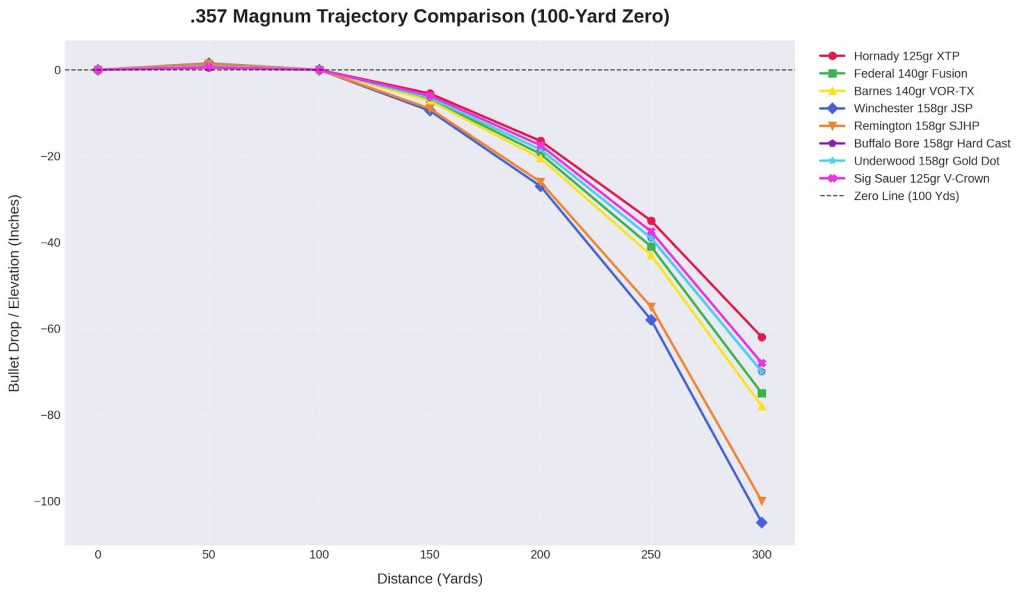
Note: Data assumes a 6-inch revolver barrel. Velocity and drop will vary significantly when using lever-action carbines, which typically achieve much higher velocities.
This professional trajectory chart provides .357 Magnum shooters with precise measurements to compensate for gravity. Always match your specific load to your firearm’s zero to ensure ethical shot placement, especially when hunting at distances beyond the standard handgun range.
Understanding The .357 Magnum Trajectory Chart
The data in this table is vital for any shooter carrying a .357 Magnum, as the cartridge is famous for its high-velocity capabilities compared to standard semi-automatic handgun rounds. Analyzing these statistics helps you understand the balance between the cartridge’s flat-shooting nature and its rapid energy loss at longer ranges.
Trajectory Analysis
Bullet drop for the .357 Magnum is relatively moderate at short ranges but becomes extreme as the projectile passes 100 yards. When you look at the 100-yard zero column, you will notice that the bullet begins to fall off sharply as soon as it passes the target distance.
For example, the Hornady 125-grain XTP drops 5.5 inches at 150 yards and 16.5 inches at 200 yards. This means if you are aiming at the vitals of a target at 200 yards, you must hold significantly higher than your target to account for the rapid decline of the bullet.
Heavy 158-grain loads drop even faster, with some showing nearly a 27-inch drop at 200 yards. This data clearly illustrates that the .357 Magnum is a specialized cartridge designed for incredible power at close-to-medium ranges rather than long-range precision.
Velocity Analysis
Muzzle velocity is the speed of the bullet as it leaves the barrel. In the .357 Magnum, this varies significantly based on whether you are firing from a revolver or a carbine. Revolvers typically produce velocities around 1,200 to 1,600 FPS, while carbine barrels can easily push these bullets much faster, resulting in a significantly flatter trajectory.
High-velocity loads like the Hornady 125-grain XTP move at 1,600 FPS, providing a flatter arc and less holdover at distance. This speed is what allows the .357 Magnum to perform so well on varmints and medium-sized game.
However, even the fastest .357 loads lose speed quickly because the bullets used are often optimized for expansion rather than long-range aerodynamics. Velocity is the primary driver of the flat-shooting characteristics of this round, but you must respect its physical limitations beyond 150 yards.
Ballistic Coefficient Analysis
The ballistic coefficient (BC) measures how well a bullet resists air resistance; higher numbers mean the bullet slows down less over time. Most .357 Magnum bullets have low BC ratings, usually ranging from 0.150 to 0.185.
These low BC numbers are the reason the .357 Magnum loses energy and trajectory height so quickly after the first 100 yards. A bullet like the Underwood 158-grain Gold Dot, with a BC of 0.185, is aerodynamically superior to the standard blunt-nose lead bullets.
Sectional density remains very high for most .357 Magnum loads. Even when the bullet slows down and drops, it retains massive sectional density, which is why the .357 Magnum is prized for its ability to penetrate tough hide and bone at reasonable hunting distances.
Best Hunting Loads Based On The Chart
Whitetail deer hunters should look to the 158-grain loads from Buffalo Bore or Underwood. These loads offer the best balance of penetration and energy retention, and while they require more holdover than 125-grain loads, they are far more reliable for an ethical harvest on deer-sized game.
Varmint hunters should rely on the Hornady 125-grain XTP. Its trajectory is the flattest listed in the chart, and its design ensures rapid, explosive expansion on small targets, making it the most versatile choice for varmint control.
For hunters in dense brush where range is short, the Federal Fusion 140-grain Soft Point is an excellent option. It offers a respectable trajectory that allows for confident shots out to 100 yards, and its bonding process ensures the bullet stays together during tough impacts.
Key Takeaways From The Chart
The trajectory chart proves that the .357 Magnum is highly effective within 100 yards. Beyond 100 yards, bullet drop becomes extreme, making it difficult for the average shooter to guarantee an ethical shot without significant practice and range estimation.
The 100-yard zero remains the industry standard for this cartridge. It provides a simple reference point, allowing shooters to easily calculate their holdover for distances of 150 or 200 yards using the data provided in our chart.
The maximum point-blank range is quite short, typically under 115 yards. Knowing this range helps you stay within your limits, ensuring you don’t overestimate the flat-shooting nature of the cartridge when taking shots in the field.
Common .357 Magnum Bullet Weights
125 Grain
The 125-grain projectile is a legendary weight for the .357 Magnum, often associated with the highest velocities and the flattest trajectory. These bullets are the preferred choice for those who want to turn their revolver into a high-speed varmint or defensive tool.
The primary advantage is speed, which flattens the trajectory and reduces the holdover needed at distance. These bullets expand very reliably on soft targets, making them a popular choice for both target practice and defensive carry.
The disadvantage is a lower sectional density, which can lead to less penetration on very large animals compared to heavier options. They also lose velocity very quickly past the 150-yard mark due to their shape.
158 Grain
The 158-grain bullet is the classic, historic weight for the .357 Magnum and is widely considered the “do-it-all” load. These heavy projectiles move slower but offer massive energy and superior penetration through thick cover.
The advantage is terminal performance; there is almost no medium game in North America that this bullet cannot anchor. It is the preferred weight for those who value penetration and weight retention above all else.
The disadvantage is the significant bullet drop. Shooters must become adept at estimating range, as the bullet drops significantly more than the 125-grain options.
Effective Hunting Range
Deer
Deer hunters can confidently shoot out to 100-125 yards with high-quality 158-grain loads. The cartridge possesses more than enough energy to harvest deer at this distance; the challenge is accurately calculating the trajectory drop.
Always use a rangefinder when hunting in open areas, as the .357 Magnum drop is deceptive. At 150 yards, you may be looking at a 6 to 9-inch drop, which is enough to cause a miss if you do not aim high.
Varmints
Varmints are best hunted within 100 yards with high-velocity 125-grain loads. At this range, the cartridge’s trajectory is flat, and the terminal performance is explosive, making it perfect for small pest management.
While some shooters take longer shots, the speed of the .357 Magnum makes it easy to stay on target. Keeping shots under 100 yards simplifies the trajectory, allowing for fast, accurate follow-up shots if needed.
Factors That Affect .357 Magnum Trajectory
- Bullet Weight: Lighter bullets provide a flatter trajectory and higher velocity, while heavier bullets offer more energy but a steeper arc.
- Muzzle Velocity: Higher muzzle velocity flattens the trajectory. Remember that a 6-inch revolver barrel will produce much lower velocity than a 16-inch lever-action carbine barrel.
- Ballistic Coefficient: Most .357 bullets have low BCs. Choosing more aerodynamic bullets can slightly improve trajectory performance at distance.
- Zero Distance: A 100-yard zero is the standard. It minimizes holdover errors at typical hunting distances and provides a manageable flight path.
Frequently Asked Questions
What Is A .357 Magnum Trajectory Chart
It is a ballistic table showing the bullet’s flight path, helping you see how much the bullet falls at different distances so you can adjust your aim.
What Is The Maximum Effective Range Of A .357 Magnum
Most hunters limit the .357 Magnum to 100–125 yards. Beyond that, the bullet drop becomes extreme, making it difficult to guarantee an ethical kill.
Is The .357 Magnum Better Than The .44 Magnum
The .44 Magnum provides more energy and is better for larger game, while the .357 Magnum has a flatter trajectory and less recoil, making it easier to shoot accurately.
What Is The Best Zero For .357 Magnum
A 100-yard zero is the standard. It provides the most intuitive holdovers and reduces the risk of shooting over targets at close range.
Does Barrel Length Affect .357 Magnum Ballistics
Yes, significantly. Lever-action carbines with long barrels will produce much higher velocities and flatter trajectories than revolvers.
What Is The Best .357 Magnum Hunting Load
158-grain soft points are excellent for deer, while 125-grain hollow points are preferred for varmint hunting due to their high speed.
One follow-up question: Are you planning to use your .357 Magnum primarily in a revolver or a lever-action carbine, as the trajectory will differ significantly between the two?