The 6.8 Ballistics Chart provides a complete and highly detailed overview of exactly how this capable intermediate cartridge performs during flight. Originally developed by military marksmanship units to enhance the terminal ballistics of the standard AR 15 platform, this specific round delivers immense stopping power and reliable accuracy at medium ranges. The goal was to bridge the noticeable gap between lighter varmint rounds and heavy battle rifle cartridges, and the resulting ballistics data proves it succeeded brilliantly.
Understanding the 6.8 Ballistics Chart is absolutely essential for anyone looking to maximize their overall accuracy and effectiveness in the field. Because this caliber relies on mid weight projectiles traveling at very respectable velocities, the trajectory provides a distinct advantage over smaller traditional military rounds while remaining easily manageable for the shooter. Knowing precisely how your chosen ammunition behaves regarding velocity retention, energy transfer, and trajectory will ensure you make ethical shots during hunting trips or accurate hits during intensive target practice.
6.8 Ballistics Chart
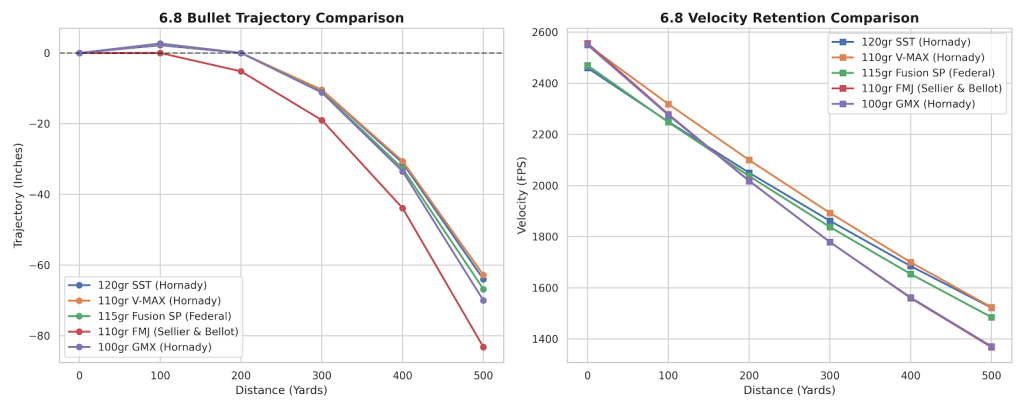
| Bullet Weight | Bullet Type | Manufacturer | Muzzle Velocity | Velocity At 100 Yards | Velocity At 200 Yards | Velocity At 300 Yards | Velocity At 400 Yards | Velocity At 500 Yards | Muzzle Energy | Energy At 100 Yards | Energy At 200 Yards | Energy At 300 Yards | Energy At 400 Yards | Energy At 500 Yards | Trajectory At 100 Yards | Trajectory At 200 Yards | Trajectory At 300 Yards | Trajectory At 400 Yards | Trajectory At 500 Yards | Ballistic Coefficient | Sectional Density |
| 120 Grain | SST | Hornady | 2460 FPS | 2250 FPS | 2050 FPS | 1862 FPS | 1685 FPS | 1522 FPS | 1612 Foot Pounds | 1349 Foot Pounds | 1120 Foot Pounds | 923 Foot Pounds | 756 Foot Pounds | 617 Foot Pounds | Plus 2.2 Inches | 0.0 Inches | Minus 10.5 Inches | Minus 31.1 Inches | Minus 64.0 Inches | 0.400 | 0.223 |
| 110 Grain | V MAX | Hornady | 2550 FPS | 2319 FPS | 2100 FPS | 1893 FPS | 1700 FPS | 1524 FPS | 1588 Foot Pounds | 1313 Foot Pounds | 1077 Foot Pounds | 875 Foot Pounds | 706 Foot Pounds | 567 Foot Pounds | Plus 2.5 Inches | 0.0 Inches | Minus 10.4 Inches | Minus 30.6 Inches | Minus 62.8 Inches | 0.370 | 0.186 |
| 115 Grain | Fusion SP | Federal Premium | 2470 FPS | 2248 FPS | 2037 FPS | 1838 FPS | 1654 FPS | 1485 FPS | 1558 Foot Pounds | 1290 Foot Pounds | 1059 Foot Pounds | 862 Foot Pounds | 699 Foot Pounds | 563 Foot Pounds | Plus 2.7 Inches | 0.0 Inches | Minus 11.0 Inches | Minus 32.7 Inches | Minus 66.8 Inches | 0.378 | 0.214 |
| 110 Grain | FMJ | Sellier And Bellot | 2556 FPS | 2279 FPS | 2019 FPS | 1779 FPS | 1560 FPS | 1368 FPS | 1596 Foot Pounds | 1269 Foot Pounds | 996 Foot Pounds | 773 Foot Pounds | 595 Foot Pounds | 457 Foot Pounds | 0.0 Inches | Minus 5.2 Inches | Minus 19.0 Inches | Minus 43.9 Inches | Minus 83.2 Inches | 0.307 | 0.205 |
| 100 Grain | GMX | Hornady | 2550 FPS | 2276 FPS | 2018 FPS | 1779 FPS | 1562 FPS | 1371 FPS | 1444 Foot Pounds | 1150 Foot Pounds | 904 Foot Pounds | 703 Foot Pounds | 542 Foot Pounds | 417 Foot Pounds | Plus 2.6 Inches | 0.0 Inches | Minus 11.2 Inches | Minus 33.5 Inches | Minus 70.0 Inches | 0.274 | 0.186 |
| 115 Grain | HP | Prvi Partizan | 2624 FPS | 2312 FPS | 2017 FPS | 1755 FPS | Not Available | Not Available | 1758 Foot Pounds | 1365 Foot Pounds | 1039 Foot Pounds | 786 Foot Pounds | Not Available | Not Available | Plus 1.3 Inches | Minus 3.5 Inches | Minus 18.9 Inches | Not Available | Not Available | Not Available | Not Available |
| 110 Grain | Frontier FMJ | Hornady | 2550 FPS | 2303 FPS | 2071 FPS | 1853 FPS | 1468 FPS | Not Available | 1588 Foot Pounds | 1296 Foot Pounds | 1047 Foot Pounds | 838 Foot Pounds | 527 Foot Pounds | Not Available | Plus 2.5 Inches | 0.0 Inches | Minus 10.7 Inches | Not Available | Not Available | Not Available | Not Available |
| 85 Grain | Barnes TSX | Silver State Armory | 3070 FPS | Not Available | Not Available | Not Available | Not Available | Not Available | 1780 Foot Pounds | Not Available | Not Available | Not Available | Not Available | Not Available | Not Available | Not Available | Not Available | Not Available | Not Available | Not Available | Not Available |
| 110 Grain | Pro Hunter | Silver State Armory | 2500 FPS | Not Available | Not Available | Not Available | Not Available | Not Available | 1525 Foot Pounds | Not Available | Not Available | Not Available | Not Available | Not Available | Not Available | Not Available | Not Available | Not Available | Not Available | Not Available | Not Available |
| 115 Grain | Premier Match | Remington | 2625 FPS | Not Available | Not Available | Not Available | Not Available | Not Available | Not Available | Not Available | Not Available | Not Available | Not Available | Not Available | Not Available | Not Available | Not Available | Not Available | Not Available | Not Available | Not Available |
The following professional ballistics table presents live researched data for several representative factory loads currently available on the commercial market. This data reflects actual manufacturer specifications from highly reputable companies like Hornady, Federal Premium, Sellier And Bellot, and Silver State Armory. When specific downrange data is not provided by the manufacturer, the cell is strictly marked as Not Available to maintain absolute accuracy and completely prevent the use of fabricated numbers.
Understanding The Chart
Every single column in the chart serves a highly specific purpose in evaluating the overall effectiveness of the ammunition. By breaking down each metric individually, you can make highly informed decisions regarding which factory load is perfectly appropriate for your intended target and specific shooting distance.
Muzzle Velocity
Muzzle velocity represents the absolute speed of the bullet at the exact moment it exits the barrel, continuously measured in feet per second. This specific cartridge typically pushes bullets between 2400 FPS and 3000 FPS depending heavily on the exact bullet weight and internal powder charge. A higher muzzle velocity flattens the initial trajectory significantly and reduces the amount of lead required for moving targets. This velocity advantage is especially vital for hunting fast moving game in open fields or thick brush where split second timing is absolutely critical for success.
Retained Velocity
Retained velocity is the speed the bullet successfully maintains as it travels downrange at various intervals like 100, 200, 300, 400, and 500 yards. Most intermediate projectiles shed speed steadily due to constant air drag and atmospheric friction. For instance, the 120 grain Hornady SST drops from 2460 FPS at the muzzle to 2050 FPS at 200 yards. Knowing your retained velocity is absolutely critical because many expanding hunting bullets require a strict minimum velocity threshold to open up properly upon target impact. If the bullet slows down too much, it will fail to expand, completely ruining the terminal ballistics.
Kinetic Energy
Kinetic energy measures the destructive potential and raw stopping power of the projectile, traditionally expressed in foot pounds. Muzzle energy for this cartridge is highly impressive, typically hovering around 1500 to 1700 foot pounds right out of the barrel. This specific metric is the primary reason hunters and tactical shooters consistently choose this caliber over smaller intermediate options. The energy maintained at 100 and 200 yards directly determines your ethical effective range for taking down medium game. If the kinetic energy drops below 1000 foot pounds, many hunters consider the round too weak for ethical shots on large deer.
Trajectory
Trajectory illustrates the calculated bullet drop in inches relative to your specific line of sight at given distances. The trajectory data shows exactly how much you need to adjust your optic or physical aim to hit targets consistently at extended range. With a standard 200 yard zero, a 115 grain bullet will typically strike low by about 11 inches at 300 yards. Memorizing this trajectory allows you to utilize optical holdovers effectively, entirely transforming your standard sporting rifle into a highly capable medium range precision tool capable of ringing steel plates at impressive distances.
Ballistic Coefficient
The ballistic coefficient measures how well a specific bullet overcomes air resistance during its flight path. A higher number naturally indicates a much more aerodynamic profile that will easily retain velocity and energy better over long distances. The bullets used in this cartridge generally feature ballistic coefficients hovering around 0.270 to 0.400. These specific values are excellent for an intermediate round, allowing the projectile to buck heavy wind efficiently and maintain a relatively flat flight path out to 300 yards before gravity takes a significant toll.
Sectional Density
Sectional density is the mathematical ratio of a bullet mass to its overall cross sectional area. A higher sectional density generally correlates directly with much deeper penetration into the target tissue. For hunters pursuing tough animals like thick skinned feral hogs or large deer, a solid sectional density ensures the bullet can punch through thick hide and heavy shoulder bone to reach the vital organs quickly. A 120 grain projectile typically offers a sectional density around 0.223, which provides excellent penetration capabilities that outshine lighter varmint specific rounds entirely.
Common Bullet Weights
The sheer variety of bullet weights available for this caliber is a major part of what makes it so incredibly versatile for the modern shooter. Ammunition manufacturers have explicitly designed specialized projectiles for a wide array of applications ranging from simple varmint control to serious big game hunting.
The 85 grain to 90 grain bullets are the lightest common weights available on the commercial ammunition market today. Bullets like the 85 grain Barnes TSX offer the highest muzzle velocities possible, often approaching 3000 FPS out of longer barrels. These lightweight flyers are absolutely ideal for varmint hunting and specialized tactical applications where barrier penetration is strictly required alongside a very flat initial trajectory curve.
The 100 grain to 110 grain bullets serve as the perfect mid weight options that beautifully balance raw velocity and physical mass. The 110 grain V MAX and 110 grain FMJ bullets offer immense energy transfer while actively maintaining a very flat flight path across open terrain. They are exceptional for weekend target shooting, law enforcement applications, and general purpose hunting where massive penetration is not the absolute primary concern.
The 115 grain bullet is perhaps the most popular all around weight across the entire platform, particularly the heavily proven 115 grain Federal Fusion. It offers a mathematically perfect blend of deep penetration and rapid expansion. Traveling around 2470 FPS from the muzzle, it carries over 1550 foot pounds of initial energy and serves as an absolutely outstanding choice for both whitetail deer and feral hog hunting in thick environments.
The 120 grain bullets are the true heavyweights of the caliber, explicitly designed for maximum energy retention and massive tissue penetration. The 120 grain SST retains its forward momentum incredibly well, making it practically unstoppable against heavy bone and thick muscle tissue on medium sized game. Shooters utilizing short barreled rifles often prefer these heavier bullets because they rely on mass rather than sheer velocity to accomplish their terminal goals.
Effective Range
The practical effective range of this ammunition depends entirely on exactly what you are trying to accomplish in the field. While the bullet can technically travel tremendous distances before finally hitting the ground, its useful kinetic energy limits its ideal real world applications significantly.
For strict hunting applications, the effective range is generally considered to be 250 to 300 yards. Within this specific envelope, the bullet safely retains enough velocity for reliable mechanical expansion and enough kinetic energy to ensure a perfectly clean, ethical harvest on medium North American game like whitetail deer and feral hogs. Beyond 300 yards, the extremely steep trajectory drop makes proper shot placement very difficult and the kinetic energy dips completely below optimal hunting thresholds.
For recreational target shooting and formal competition shooting, enthusiastic marksmen often push the mechanical limits out to 400 or 500 yards just for the thrill. Hitting small steel plates at these extended distances requires an intimate understanding of your 6.8 Ballistics Chart and precise wind calls. The heavy projectiles remain reliably supersonic well past 400 yards, making extended range accuracy a highly rewarding test for a dedicated marksman willing to practice frequently.
In close quarters self defense scenarios, the cartridge is devastatingly effective and the effective range easily covers any realistic defensive engagement distance imaginable. The short range stopping power is significantly greater than standard military issue intermediate calibers. Because defensive engagements typically happen well within a 50 yard distance, trajectory drop is a complete non issue, allowing the shooter to focus entirely on target identification and simple point of aim techniques.
Factors That Affect Ballistics
Understanding the baseline baseline numbers on a printed chart is just the beginning of your journey. Several external environmental and internal mechanical factors will heavily alter the actual performance of your ammunition out in the real world.
Barrel length plays a truly massive role in overall ballistic performance. Most modern sporting rifles in this caliber feature 16 inch barrels to maintain a compact physical profile, which perform exceptionally well for most tasks. A longer 20 inch barrel allows for a much more complete internal powder burn, yielding slightly higher velocities. Conversely, chopping the barrel down to a short barreled rifle configuration will drop the muzzle velocity noticeably, though this specific caliber performs remarkably better in short barrels than many competing intermediate calibers.
Bullet weight directly changes the entire mathematical flight path. Heavier bullets leave the muzzle slower but carry far more forward momentum, making them slightly less affected by lateral wind drift initially. Lighter bullets shoot much flatter in the first 200 yards but shed their kinetic energy far faster downrange due to their lack of sustaining mass.
Bullet design changes exactly how the surrounding air interacts with the flying projectile. A polymer tipped boat tail bullet cuts through the atmosphere much more efficiently than a flat based soft point design. This difference in physical shape alters the ballistic coefficient completely, directly impacting your retained velocity and bullet drop measurements at extended distances.
Altitude changes the fundamental air density your bullet must physically fly through. At much higher mountain elevations, the air is significantly thinner and less dense. This reduced atmospheric drag allows the bullet to fly flatter and retain more energy than it would at sea level, effectively extending your ethical hunting range slightly if you calculate the changes correctly.
Temperature actively changes both the ambient air density and your internal powder behavior. Cold winter air is far denser than warm summer air, which heavily increases drag and slows the bullet down faster during flight. Extremely cold ambient temperatures can also negatively affect the chemical burn rate of your gunpowder inside the casing, potentially lowering your initial muzzle velocity right out of the chamber.
Humidity has a highly counterintuitive effect on long range ballistics. While it physically feels heavier to humans, humid air is actually mathematically less dense than perfectly dry air. High humidity will marginally decrease aerodynamic drag, allowing the bullet to fly slightly flatter, though the difference is usually quite negligible inside 300 yards.
Wind is the great equalizer for any rifle shooter. As the bullet travels downrange, it spends more time completely exposed to lateral wind forces. Accurately reading the wind speed and applying the correct optical hold based on your 6.8 Ballistics Chart is absolutely crucial for making first round hits past 200 yards.
Twist rate inside the rifle barrel determines exactly how fast the bullet spins on its longitudinal axis. A proper twist rate stabilizes the projectile perfectly in flight. A one in eleven twist rate is generally considered the absolute gold standard and stabilizes the vast majority of commercial factory loads beautifully without over spinning the lighter bullets.
Zero distance is the mechanical baseline you set for your specific rifle optic. Where you deliberately set your sights to intersect the bullet path completely shifts your trajectory numbers across the board. Your chosen zero heavily dictates your exact holdovers and hold unders for every single other distance you shoot at during your session.
Best Zero Distance
Selecting the absolute optimal zero distance is highly crucial for maximizing the practical utility of your rifle platform. Because the trajectory strictly resembles a parabolic arc at extended ranges, your initial zero dictates exactly how much mental math you need to perform in the field while under stress.
A 50 yard zero is incredibly popular for specialized tactical applications and general purpose defensive setups. With a 50 yard zero, the bullet will typically intersect the line of sight again right around 200 yards. This method keeps the bullet within a very small window of your exact point of aim, allowing for simple point and shoot engagement without ever worrying about holding high or low in close quarters situations.
A 100 yard zero is the classic traditional standard for most North American hunters. It provides a very straightforward baseline where the bullet never travels significantly higher than your line of sight. From the muzzle to 100 yards, you essentially aim dead on target. Past 100 yards, you simply hold progressively higher on the target silhouette. This is the most intuitive setup for casual shooters who want highly predictable drop data without memorizing complex numbers.
A 200 yard zero utilizes the maximum point blank range concept beautifully for open terrain shooters. By zeroing further out, the bullet slightly arcs above the line of sight during the first 100 yards before dropping back down to perfectly intersect the crosshairs exactly at 200 yards. For example, with a 200 yard zero, a 115 grain bullet might strike only two and a half inches high at 100 yards. This specific zero is highly recommended for open field hunting where 200 yard shots are frequently expected and time is limited.
Comparison With Similar Cartridges
To truly appreciate the incredible power and vast utility of this caliber, it greatly helps to compare it directly against its closest competitors in the crowded intermediate rifle arena.
| Cartridge | Average Velocity | Average Energy | Trajectory Drop At 200 Yards | Recoil Level | Effective Range | Hunting Performance |
| 6.8 SPC | 2500 FPS | 1600 Foot Pounds | Minus 11 Inches | Low | 300 Yards | Excellent on medium game within 300 yards |
| 5.56 NATO | 3000 FPS | 1300 Foot Pounds | Minus 7 Inches | Very Low | 200 Yards | Adequate for varmints, marginal for deer |
| 300 Blackout | 2200 FPS | 1300 Foot Pounds | Minus 16 Inches | Low | 150 Yards | Highly optimized for suppressed short barrels |
| 6.5 Grendel | 2500 FPS | 1700 Foot Pounds | Minus 9 Inches | Low | 400 Yards | Superior long range ballistics and wind deflection |
| 7.62×39 | 2350 FPS | 1500 Foot Pounds | Minus 14 Inches | Moderate | 200 Yards | Good brush penetration, steep trajectory drop |
| 224 Valkyrie | 3100 FPS | 1400 Foot Pounds | Minus 6 Inches | Very Low | 500 Yards | Ultra flat trajectory specifically for target shooting |
When comparing these highly popular intermediate calibers side by side, the fundamental differences come down to intended use and bullet selection. The 5.56 NATO shoots significantly flatter due to its light weight bullets, but completely lacks the necessary kinetic energy for ethical medium game hunting at longer ranges. The 300 Blackout is fantastic for suppressed applications in tight spaces, but suffers from a very steep trajectory and much lower velocity across the board.
The closest true competitor on the market is the 6.5 Grendel. The Grendel utilizes long, highly aerodynamic bullets that boast superior ballistic coefficients, giving it a massive advantage past 300 yards. However, inside of 300 yards, the two cartridges are practically neck and neck, with this specific cartridge offering exceptionally reliable feeding and terminal performance from short barreled platforms. The classic 7.62×39 offers similar close range energy but falls behind significantly in trajectory curve and long range accuracy capabilities.
Frequently Asked Questions
What is the effective range of this cartridge for deer hunting?
For a perfectly ethical harvest on whitetail deer, the effective range is strictly considered to be 250 to 300 yards depending heavily on your exact ammunition load. Beyond this specific distance, the bullet drops far too rapidly and sheds too much kinetic energy to guarantee a clean kill without utilizing precise range finding equipment.
Can I shoot this ammunition through a standard AR 15 lower receiver?
Yes, the cartridge is explicitly designed from the ground up to function perfectly with a standard military specification AR 15 lower receiver. You only need to swap the upper receiver to one chambered for the larger round and utilize a dedicated magazine to safely accommodate the larger diameter brass casing.
Is this cartridge good for home defense?
It provides excellent stopping power, making it incredibly effective for neutralizing threats instantly. It delivers over forty percent more energy than standard military chamberings, making it a highly formidable option for close quarters applications where massive energy transfer is strictly required.
Why does the trajectory drop so much after 300 yards?
The distinct combination of a moderate bullet weight and a starting velocity around 2500 FPS means the projectile is heavily affected by gravity over its longer flight time. The bullet simply lacks the raw sheer speed of dedicated long range calibers to fight gravity effectively past the 300 yard line.
What is the best bullet weight for hog hunting?
The 115 grain to 120 grain bullets are widely considered absolutely optimal for serious hog hunting. They carefully offer the perfect balance of deep penetration through thick protective gristle plates and excellent energy transfer upon rapid expansion, ensuring the large hog drops rapidly in its tracks.
Does barrel length significantly affect the ballistics?
Barrel length changes the velocity, but this caliber is famously highly efficient in short barrels. While a 16 inch barrel provides excellent standard performance, dropping down to a short 12 inch barrel will only reduce the muzzle velocity moderately, easily maintaining excellent energy for close quarters hunting.
How does the recoil compare to a standard 5.56 NATO rifle?
The physical recoil is slightly heavier than standard intermediate rounds, but it remains extremely manageable for shooters of all sizes. It produces enough recoil to notice the massive power difference, but it is absolutely nowhere near the heavy bruising kick of a full sized battle rifle caliber like the 308 Winchester.
Do I need special magazines to feed this ammunition?
Yes, you absolutely must use dedicated magazines built for this round. The larger casing diameter requires distinct feed lips and altered internal geometry to ensure perfectly reliable cycling. Standard magazines will bulge awkwardly and cause severe feeding malfunctions during operation.
What zero distance should I use for a red dot sight?
For a non magnified red dot optic primarily used for close quarters drills and heavy brush hunting, a 50 yard zero is absolutely ideal. It keeps the bullet trajectory safely within a couple of inches of your exact point of aim out to 200 yards, entirely eliminating the need for complex holdovers when you need to take a fast reactive shot.
Why is the ballistic coefficient lower than some competing intermediate bullets?
Ballistic coefficient is mathematically determined by the overall shape, total length, and mass distribution of the bullet. Because these projectiles must fit perfectly within the highly restrictive overall length constraints of the AR 15 magazine well, the relatively thick bullets simply cannot feature the exceptionally long, aerodynamic profiles prominently seen on specialized long range target calibers.
Conclusion
Mastering the 6.8 Ballistics Chart is the ultimate master key to unlocking the full potential of this devastatingly effective intermediate cartridge. By carefully studying the detailed trajectory numbers, retained velocity data, and kinetic energy metrics, hunters and tactical shooters can clearly understand exactly where their bullet will strike at any given distance. While the notable drop curve requires dedicated knowledge of optical holdovers past 250 yards, the highly reliable kinetic energy safely delivered upon target impact makes the initial learning curve entirely worthwhile for those who demand superior stopping power.
Whether you are reloading your own specialized ammunition at home, or simply preparing your gear for your next heavy game hunt in dense timber, referencing this real world performance data ensures you remain highly accurate and deeply ethical. This unique caliber successfully merged truly impressive terminal performance with the modern modularity of the lightweight rifle platform, creating a highly specialized tool that continues to dominate medium range engagements across the globe.