The remington 6.8 spc ballistics chart provides a detailed breakdown of the trajectory, velocity, and kinetic energy for the 6.8mm Special Purpose Cartridge. Designed to offer superior terminal performance compared to the 5.56 NATO in short-barreled rifles, the 6.8 SPC excels in close to medium-range engagements and hunting applications. Below, you will find comprehensive data covering popular loads from major ammunition brands, illustrating how bullet weight, barrel length, and bullet design influence real-world performance out to 300 yards. This table allows shooters to quickly compare different ammunition types and make informed decisions for their specific needs without needing to test every round manually.
Table of Contents [Click to open]
Remington 6.8 SPC Ballistics Chart
| Manufacturer | Bullet Weight (Grains) | Bullet Type | Barrel Length (Inches) | Zero Distance (Yards) | Muzzle Velocity (fps) | Muzzle Energy (ft-lbs) | Velocity at 100 yds (fps) | Energy at 100 yds (ft-lbs) | Bullet Drop at 300 yds (inches) | Ballistic Coefficient (G1) | Sectional Density |
| Hornady | 120 | SST | 16 | 200 | 2460 | 1612 | 2250 | 1349 | -10.5 | 0.400 | 0.223 |
| Hornady | 110 | V-MAX | 16 | 200 | 2550 | 1588 | 2319 | 1313 | -10.4 | 0.370 | 0.205 |
| Federal | 115 | Fusion SP | 16 | 200 | 2470 | 1558 | 2248 | 1290 | -11.0 | 0.378 | 0.214 |
| Sellier & Bellot | 110 | FMJ | 16 | 100 | 2556 | 1596 | 2279 | 1269 | -19.0 | 0.307 | 0.205 |
| Hornady | 100 | GMX | 24 | 200 | 2550 | 1444 | 2276 | 1150 | -11.2 | 0.274 | 0.186 |
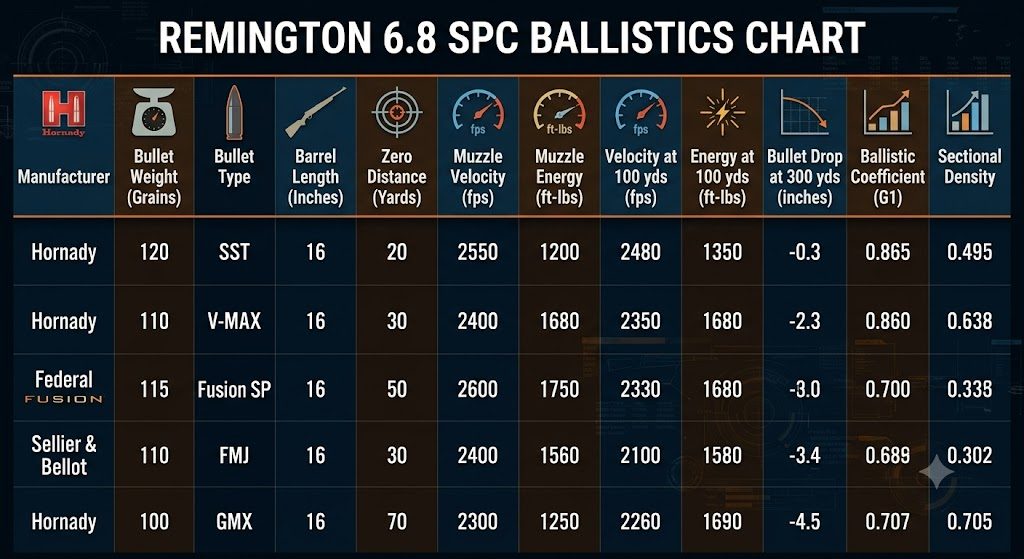
Understanding the Chart
Manufacturer
The manufacturer is the company responsible for producing and assembling the ammunition. This metric matters because each brand utilizes proprietary powders, primers, and brass cases. Interpreting this column involves matching the brand to your intended application, as companies like Federal and Hornady often specialize in premium hunting rounds, while others focus on high-volume training ammo. In real-world scenarios, finding a manufacturer that cycles reliably in your specific rifle is critical for consistency. A common mistake is assuming that rounds from different manufacturers will share the same point of impact just because they have identical bullet weights.
Bullet Weight (Grains)
Bullet weight is measured in grains, a standard unit in the firearms industry where 437.5 grains equal one ounce. This measurement is crucial because it directly influences both recoil and terminal ballistics. You can interpret this metric by understanding that lighter bullets typically achieve higher velocities, while heavier bullets retain their energy better over long distances. In the field, a 120-grain bullet provides deeper penetration on medium game like deer, whereas a 90-grain or 110-grain bullet is often preferred for varmint hunting. Shooters often make the mistake of believing heavier bullets always cause more damage, ignoring the fact that velocity plays an equally important role in bullet expansion.
Bullet Type
Bullet type describes the physical design and construction of the projectile. This matters immensely because the shape and material dictate how the bullet behaves upon impact. When interpreting this column, look for designations like SST (Super Shock Tip) for rapid expansion, FMJ (Full Metal Jacket) for target practice, or SP (Soft Point) for controlled expansion. Real-world performance relies heavily on this choice; an FMJ will likely pass cleanly through a target with minimal tissue damage, while an expanding bullet will dump its kinetic energy immediately. A frequent misconception is that match-grade target bullets are suitable for hunting, which is false since they are not designed to expand ethically on game animals.
Barrel Length (Inches)
Barrel length indicates the distance the bullet travels inside the firearm before exiting the muzzle. This metric is vital because the 6.8 SPC was specifically engineered to achieve optimal powder burn in shorter carbine barrels. You interpret this column by noting how the length affects velocity; a 24-inch barrel will yield slightly higher velocities than a standard 16-inch barrel. In practical terms, shorter barrels offer better maneuverability in dense brush or tight spaces without severely handicapping the 6.8 SPC’s kinetic energy. Shooters commonly misunderstand barrel length, assuming that a longer barrel always guarantees better mechanical accuracy, when it primarily just adds velocity and sight radius.
Zero Distance (Yards)
Zero distance represents the exact range at which the point of aim aligns perfectly with the bullet’s point of impact. This baseline matters because it serves as the reference point for calculating all subsequent bullet trajectory and drop. To interpret this, know that a 200-yard zero means the bullet will impact slightly high at 100 yards and begin to drop off rapidly beyond 200 yards. In real-world hunting, establishing a 200-yard zero allows a shooter to aim directly at the center of a target out to 250 yards without needing to hold over. A major mistake novices make is zeroing their rifle at 50 yards and assuming the bullet will fly perfectly flat out to 300 yards.
Muzzle Velocity (fps)
Muzzle velocity measures the speed of the bullet in feet per second the exact moment it leaves the barrel. This figure matters because speed is the driving force behind a bullet’s kinetic energy and its ability to defeat wind resistance. Interpreting this metric requires understanding that higher muzzle velocities result in flatter trajectories and less time for wind to push the bullet off course. In the real world, a faster bullet requires less lead time when shooting at moving targets. A common misconception is taking the printed box velocity as absolute truth, whereas actual muzzle velocity will fluctuate based on your specific rifle barrel, altitude, and ambient temperature.
Muzzle Energy (ft-lbs)
Muzzle energy calculates the destructive power of the bullet as it exits the barrel, expressed in foot-pounds. This value is critical for determining the lethality and stopping power of the cartridge. You can interpret this column by recognizing that it requires a combination of high velocity and substantial bullet weight to generate high energy numbers. In practical applications, high muzzle energy ensures ethical harvests on medium-sized game like feral hogs and whitetail deer. Shooters often mistakenly judge a cartridge solely by its velocity, forgetting that a fast but ultra-light bullet sheds its kinetic energy much faster than a heavy projectile.
Velocity at 100 yds (fps)
This metric shows the retained speed of the bullet after it has traveled 100 yards downrange. It is important because air resistance immediately begins slowing the projectile down the moment it leaves the muzzle. Interpreting this data helps you understand the aerodynamic efficiency of the bullet. In the field, knowing your retained velocity is essential because many expanding hunting bullets require a minimum speed threshold to open properly upon impact. A frequent mistake is assuming a bullet that is fast at the muzzle will automatically be fast at 100 yards, which is not true if the bullet has poor aerodynamics.
Energy at 100 yds (ft-lbs)
Energy at 100 yards measures the remaining kinetic power of the bullet at a common hunting distance. This matters because it dictates the terminal performance of the round at the actual point of impact, rather than just at the barrel. You should interpret this value to confirm whether the bullet retains enough force to ethically take down your intended target. Real-world performance dictates that many hunters consider 1,000 foot-pounds of energy the minimum threshold for harvesting deer. A common misconception is looking only at muzzle energy and failing to realize that blunt-nosed bullets bleed their energy incredibly fast by the time they reach 100 yards.
Bullet Drop at 300 yds (inches)
Bullet drop at 300 yards quantifies how far the projectile falls below the line of sight due to gravity at that specific distance. This is a critical metric for long-range precision and ethical hunting. To interpret this column, you must combine it with your known zero distance to calculate the necessary optical holdover or scope adjustment. In a real-world scenario, knowing your 300-yard drop allows you to quickly adjust your aim above a target’s vital zone to ensure a successful hit. Beginners routinely make the mistake of ignoring bullet drop, aiming directly at the center of a 300-yard target, and subsequently shooting completely under it.
Ballistic Coefficient (G1)
The Ballistic Coefficient, commonly listed in the G1 standard, is a mathematical rating of a bullet’s aerodynamic profile and its ability to overcome air resistance. This number matters because a higher coefficient means the bullet will fly flatter, drift less in the wind, and retain more energy at distance. You interpret this metric by comparing numbers; a 0.400 BC is vastly superior to a 0.200 BC for long-range shooting. In practice, selecting a bullet with a high ballistic coefficient makes hitting targets beyond 200 yards significantly easier in windy conditions. A common misconception is that heavy bullets automatically have a higher BC, but the physical shape and boat-tail design of the projectile are equally crucial factors.
Sectional Density
Sectional density is the ratio of a bullet’s weight to its diameter, indicating how well it can penetrate a target. This measurement is deeply important for hunters because it predicts how deeply a bullet will drive through muscle and bone. Interpreting this metric is straightforward: the higher the sectional density number, the better the bullet will penetrate. In real-world hunting, a high sectional density ensures that the bullet reaches the vital organs even if it strikes a heavy shoulder bone first. Many shooters mistakenly overlook sectional density, focusing entirely on expanding tips, which can lead to shallow wounds if the bullet lacks the mass-to-diameter ratio needed to push through tough barriers.