A barnes ttsx ballistic chart provides hunters and precision shooters with the essential flight data, drop metrics, and velocity retention necessary for accurate, ethical shots in the field. The Barnes Tipped Triple-Shock X (TTSX) is a monolithic, 100% copper bullet renowned for double-diameter expansion, deep penetration, and nearly 100% weight retention. The data below outlines exactly how these projectiles perform across various popular calibers, giving you immediate access to bullet drop, kinetic energy, and aerodynamic performance at standard hunting distances.
It is important to note that actual field performance will vary. The specifications in this chart are derived from standard 24-inch test barrels under controlled environmental conditions. Altering your barrel length, hunting at extreme altitudes, or shooting handloads with different powder charges will directly impact your muzzle velocity and downrange trajectory.
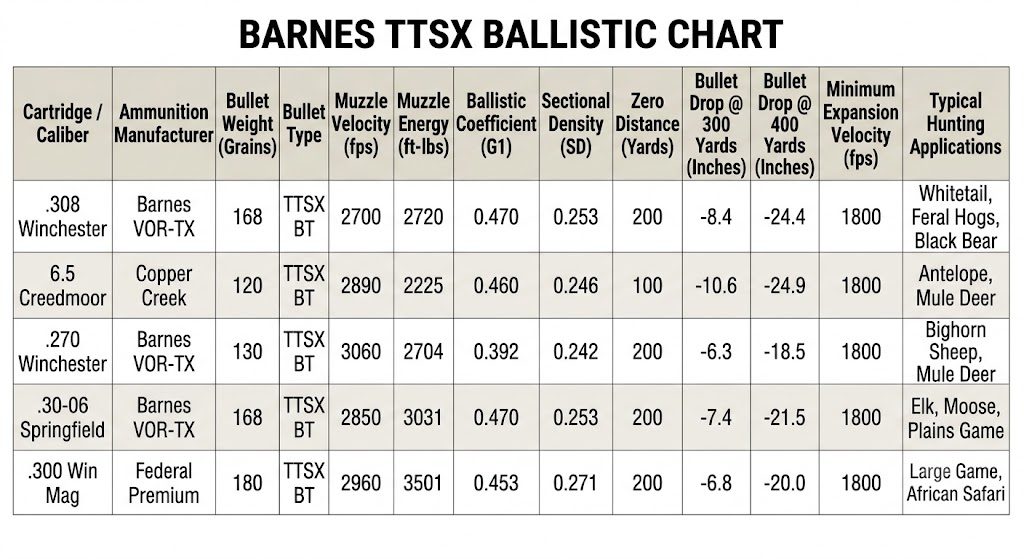
Barnes TTSX Ballistic Chart
| Cartridge / Caliber | Ammunition Manufacturer | Bullet Weight (Grains) | Bullet Type | Muzzle Velocity (fps) | Muzzle Energy (ft-lbs) | Ballistic Coefficient (G1) | Sectional Density (SD) | Zero Distance (Yards) | Bullet Drop @ 300 Yards (Inches) | Bullet Drop @ 400 Yards (Inches) | Minimum Expansion Velocity (fps) | Typical Hunting Applications |
| .308 Winchester | Barnes VOR-TX | 168 | TTSX BT | 2700 | 2720 | 0.470 | 0.253 | 200 | -8.4 | -24.4 | 1800 | Whitetail, Feral Hogs, Black Bear |
| 6.5 Creedmoor | Copper Creek | 120 | TTSX BT | 2890 | 2225 | 0.460 | 0.246 | 100 | -10.6 | -24.9 | 1800 | Antelope, Mule Deer |
| .270 Winchester | Barnes VOR-TX | 130 | TTSX BT | 3060 | 2704 | 0.392 | 0.242 | 200 | -6.3 | -18.5 | 1800 | Bighorn Sheep, Mule Deer |
| .30-06 Springfield | Barnes VOR-TX | 168 | TTSX BT | 2850 | 3031 | 0.470 | 0.253 | 200 | -7.4 | -21.5 | 1800 | Elk, Moose, Plains Game |
| .300 Win Mag | Federal Premium | 180 | TTSX BT | 2960 | 3501 | 0.453 | 0.271 | 200 | -6.8 | -20.0 | 1800 | Large Game, African Safari |
Understanding The Chart
Cartridge / Caliber
This column identifies the specific rifle chambering. The caliber heavily dictates the case capacity and the amount of powder driving the bullet, which in turn determines the overall baseline performance. When reading a ballistic chart, always ensure you are looking at the exact cartridge your rifle is chambered for, as confusing a .308 Winchester with a .300 Winchester Magnum will result in wildly inaccurate holdover calculations and dangerous pressure assumptions.
Ammunition Manufacturer
Factory loads utilize different powder blends, primers, and brass, meaning two different manufacturers loading the exact same Barnes TTSX bullet will achieve slightly different ballistic results. Barnes loads their own proprietary VOR-TX line, while boutique loaders like Copper Creek and major brands like Federal Premium also load the TTSX. Recognizing the manufacturer helps you account for velocity differences when buying off-the-shelf ammunition.
Bullet Weight (Grains)
Measured in grains (where 7,000 grains equal one pound), this metric denotes the physical mass of the projectile. Because the Barnes TTSX is a monolithic copper bullet lacking a dense lead core, it is longer than a lead bullet of the exact same weight. Due to copper’s near-100% weight retention upon impact, a lighter TTSX (like a 130-grain .270) will routinely penetrate as deeply as a traditional 150-grain lead-core bullet, allowing hunters to drop bullet weight to achieve higher muzzle velocities and flatter trajectories.
Bullet Type
This column specifies the physical profile of the projectile. “TTSX” stands for Tipped Triple-Shock X, which utilizes a polymer tip pushed into a specially engineered nose cavity to initiate rapid expansion. “BT” stands for Boat Tail, indicating that the base of the bullet is tapered to reduce aerodynamic drag in flight. This design keeps the bullet flying faster, longer, and makes it less susceptible to wind drift compared to flat-base (FB) bullets.
Muzzle Velocity (fps)
Muzzle velocity is the speed of the bullet the exact moment it exits the rifle barrel, measured in feet per second (fps). It is the engine driving all subsequent ballistic calculations. Higher muzzle velocities result in flatter trajectories and harder impacts downrange. Keep in mind that factory muzzle velocities are typically recorded using standard 24-inch test barrels. If you shoot a shorter 18-inch or 20-inch barrel, you will lose approximately 20 to 30 fps per inch of barrel reduction.
Muzzle Energy (ft-lbs)
Muzzle energy measures the destructive kinetic force the bullet carries upon exiting the barrel, expressed in foot-pounds. It is calculated using a combination of the bullet’s mass and its velocity. Energy dictates the bullet’s ability to transfer shock and cause lethal internal damage to an animal. While energy constantly bleeds off as the bullet travels through the air, starting with a high muzzle energy ensures enough force remains at extended ranges to achieve a clean, humane kill.
Ballistic Coefficient (G1)
The Ballistic Coefficient (BC) is a mathematical representation of how efficiently the bullet cuts through the air and resists drag. Most hunting bullet charts use the G1 drag model. A higher BC means the bullet sheds its velocity slower, drops less at long range, and resists being blown off target by crosswinds. The polymer tip and boat tail on the TTSX help push these values high, allowing calibers like the 6.5 Creedmoor (BC 0.460) to maintain excellent long-range stability.
Sectional Density (SD)
Sectional density is the ratio of a bullet’s weight to its diameter. In traditional terminal ballistics, a higher sectional density indicates better penetration potential, as a heavier, narrower object drives deeper through muscle and bone. However, because the TTSX bullet does not fragment like a lead-core bullet, it punches far above its listed SD. You can confidently rely on a lower-SD monolithic bullet to out-penetrate a higher-SD lead bullet.
Zero Distance (Yards)
This is the specific distance at which the rifle scope is sighted in so that the point of aim perfectly matches the bullet’s point of impact. The zero distance acts as the baseline for all trajectory measurements. A 200-yard zero is the standard for most modern bottleneck hunting cartridges, as it allows a hunter to aim dead-center on the vitals of a medium-to-large game animal from 0 to roughly 250 yards without needing to adjust for drop.
Bullet Drop @ 300 Yards (Inches)
This metric shows exactly how many inches the bullet will fall below the line of sight at 300 yards, based on the established zero distance. For a rifle zeroed at 200 yards, the 300-yard drop indicates how high you must hold your crosshairs (or dial your elevation turret) to hit the target. Understanding this metric is critical; guessing holdovers at 300 yards often leads to wounded game or complete misses.
Bullet Drop @ 400 Yards (Inches)
At 400 yards, gravity has significantly more time to act on the slowing bullet, resulting in a much steeper drop curve. A .308 Winchester that drops 8.4 inches at 300 yards plummets to -24.4 inches by 400 yards. At this distance, holding “a little high” is no longer a viable strategy. Shooters must use a laser rangefinder paired with specific reticle subtensions (like MOA or MRAD) to compensate for this exact geometric fall.
Minimum Expansion Velocity (fps)
Unlike soft lead that deforms easily at low speeds, copper is tough. The TTSX requires hydraulic pressure from the animal’s tissue to force the polymer tip backward, peeling the copper into four razor-sharp petals. For this mechanical action to occur reliably, the bullet must strike the target traveling at roughly 1,800 feet per second. If the bullet impacts at slower speeds (typically past 400-500 yards, depending on the caliber), it may pencil straight through the animal like a full metal jacket, drastically reducing stopping power.
Typical Hunting Applications
This column pairs the caliber’s velocity, energy, and bullet weight with the game animals it is best suited to ethically harvest. While shot placement is always the most important factor in hunting, selecting the correct cartridge ensures you have the adequate kinetic energy required to break through heavy shoulder bones and reach the vital organs of the targeted species. Lighter TTSX loads are ideal for thin-skinned game like deer, while heavier loads in magnum calibers are required for dense, heavy-boned animals like elk and moose.