The 6.5 Creedmoor is famous for delivering excellent long-range ballistics without punishing the shooter’s shoulder. By combining heavy, aerodynamic bullets with moderate powder charges, it produces a mild recoil impulse that promotes accuracy and faster follow-up shots. Whether you are a new shooter or an experienced competitor, understanding 6.5 Creedmoor recoil will help you choose the right rifle and ammunition for your needs.
Table of Contents [Click to open]
6.5 Creedmoor Recoil Chart
| Bullet Weight | Typical Muzzle Velocity | Rifle Weight | Free Recoil Energy | Recoil Velocity |
| 120 grains | 2,885 fps | 8.0 lbs | 11.5 ft-lbs (Estimate) | 9.6 fps (Estimate) |
| 123 grains | 2,850 fps | 8.0 lbs | 11.7 ft-lbs (Estimate) | 9.7 fps (Estimate) |
| 129 grains | 2,800 fps | 8.0 lbs | 12.2 ft-lbs (Estimate) | 9.9 fps (Estimate) |
| 130 grains | 2,800 fps | 8.0 lbs | 12.3 ft-lbs (Estimate) | 9.9 fps (Estimate) |
| 140 grains | 2,710 fps | 8.0 lbs | 13.0 ft-lbs (Estimate) | 10.2 fps (Estimate) |
| 143 grains | 2,700 fps | 8.0 lbs | 13.3 ft-lbs (Estimate) | 10.3 fps (Estimate) |
| 147 grains | 2,695 fps | 8.0 lbs | 13.7 ft-lbs (Estimate) | 10.5 fps (Estimate) |
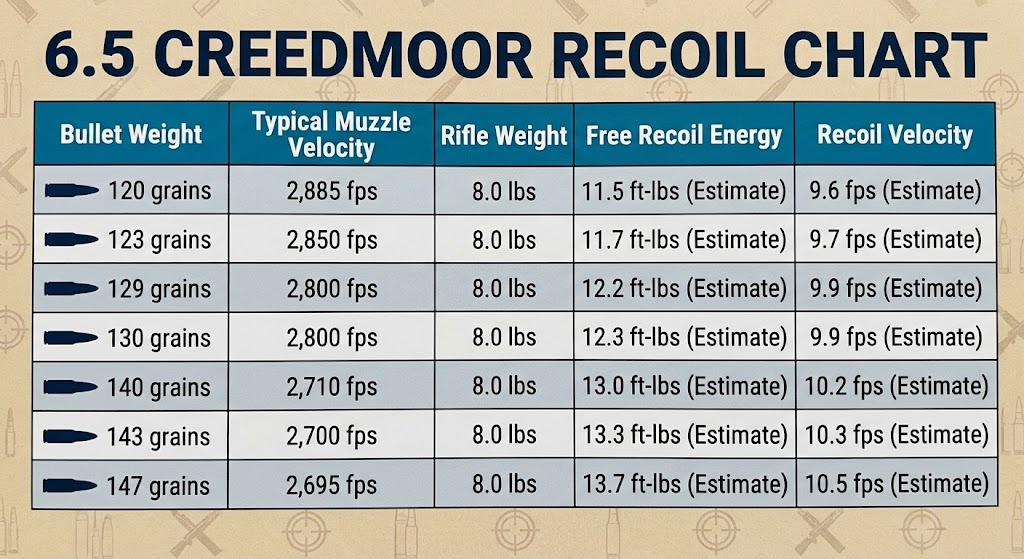
To build this 6.5 Creedmoor recoil chart, we used an 8.0-pound rifle weight, which is a highly realistic baseline for a modern hunting or target rifle equipped with a standard scope. Because exact recoil figures are rarely printed on ammunition boxes, these values are mathematical estimates based on verified factory velocities and an average powder charge of 41 grains.
We calculate these estimates in plain English by taking the mass of the bullet and the mass of the burning powder, factoring in how fast they leave the rifle barrel, and then applying that rearward force against the overall physical weight of the rifle. This gives us free recoil energy, which is a strictly numerical measurement of rearward kinetic energy expressed in foot-pounds.
What Does 6.5 Creedmoor Recoil Feel Like?
There is a distinct difference between free recoil energy on paper and felt recoil at the shooting bench. Free recoil energy measures raw physical force, while felt recoil describes the shooter’s physical perception of that force.
When firing a 6.5 Creedmoor, the recoil typically feels like a firm, steady push rather than a sharp, violent snap. Because the recoil velocity hovers around 10 feet per second, the rifle moves backward smoothly. This gentle physical experience means shooters do not have to fight heavy muzzle rise or brace for a painful impact. As a result, the 6.5 Creedmoor allows you to stay relaxed behind the scope, track your own bullet impacts, and take rapid follow-up shots without excessive fatigue.
6.5 Creedmoor Recoil Comparison
| Cartridge | Bullet Weight | Typical Muzzle Velocity | Rifle Weight | Estimated Free Recoil Energy |
| .243 Winchester | 100 grains | 2,960 fps | 8.0 lbs | 9.8 ft-lbs |
| 6.5 Creedmoor | 140 grains | 2,710 fps | 8.0 lbs | 13.0 ft-lbs |
| 7mm-08 Remington | 140 grains | 2,800 fps | 8.0 lbs | 14.6 ft-lbs |
| .308 Winchester | 150 grains | 2,820 fps | 8.0 lbs | 16.7 ft-lbs |
| .270 Winchester | 130 grains | 3,060 fps | 8.0 lbs | 17.1 ft-lbs |
| 6.5 PRC | 143 grains | 2,960 fps | 8.0 lbs | 18.5 ft-lbs |
This 6.5 Creedmoor recoil comparison highlights why the cartridge has become so popular. To ensure the comparison is meaningful, we used the exact same 8.0-pound rifle weight assumption for every caliber in the table.
As the data shows, the 6.5 Creedmoor generates less free recoil energy than traditional mainstays like the .308 Winchester and the .270 Winchester. If you shoot a 6.5 Creedmoor and a .308 Winchester from identical rifles, the 6.5 Creedmoor will yield approximately 20 to 30 percent less recoil.
On the lighter end of the spectrum, the .243 Winchester produces less recoil than the 6.5 Creedmoor. However, the 6.5 Creedmoor carries heavier bullets that resist wind drift more effectively at long ranges. When compared to its larger sibling, the 6.5 PRC, the standard 6.5 Creedmoor provides a significantly softer shooting experience because it burns less powder to achieve its velocities.
Factors That Affect 6.5 Creedmoor Recoil
Bullet weight and muzzle velocity
Heavier bullets require more force to push down the barrel, and basic physics dictates that this forward force creates an equal rearward reaction. Firing a heavy 147-grain match bullet will naturally generate slightly more recoil energy than firing a lighter 120-grain target load.
Rifle weight
A heavier rifle absorbs more rearward energy before that energy reaches your shoulder. A 12-pound precision competition rifle chambered in 6.5 Creedmoor will have almost zero felt recoil. Conversely, a lightweight 6-pound backcountry hunting rifle will kick noticeably harder.
Powder charge and ammunition selection
The amount of gunpowder inside the cartridge directly influences recoil. Ammunition loaded to maximum pressures for extreme long-range velocities will kick harder than standard target loads. Selecting moderate factory ammunition is a simple way to keep 6.5 Creedmoor recoil to a minimum.
Muzzle brakes and suppressors
Adding a muzzle brake or a suppressor physically alters how gases exit the barrel. A quality muzzle brake can reduce 6.5 Creedmoor recoil by over 30 percent by redirecting expanding gases sideways and backward. Suppressors also reduce felt recoil by slowing the release of gases and adding physical weight to the muzzle of the rifle.
Stock design and recoil pads
A rifle stock that fits your body properly will distribute rearward energy evenly across your shoulder, making the recoil feel much softer. High-quality rubber recoil pads also compress during firing to absorb a significant portion of the kinetic shock before it reaches your body.
Is 6.5 Creedmoor Recoil Good for Beginners?
The 6.5 Creedmoor is highly regarded as an excellent centerfire cartridge for beginners. Developing basic marksmanship fundamentals is very difficult if a new shooter is terrified of their rifle. Heavy recoil often causes a flinch response, where the shooter anticipates the kick and pulls the rifle off target right before the shot breaks.
Because 6.5 Creedmoor recoil is exceptionally moderate, it allows beginners to focus entirely on trigger control, breathing, and sight alignment. With proper instruction and a rifle that fits correctly, a beginner can comfortably shoot a 6.5 Creedmoor during their very first range session. However, it is always wise to start new shooters with the lightest bullet weights available and gradually introduce heavier loads as their confidence grows.
6.5 Creedmoor Recoil for Hunting and Target Shooting
In a hunting scenario, recoil considerations dictate how well you can place an ethical shot under field conditions. Hunters often carry lighter rifles into the woods, which naturally increases free recoil energy. Fortunately, the 6.5 Creedmoor remains completely manageable even in lightweight hunting platforms, allowing hunters to maintain precision when it matters most.
For target shooting, recoil mitigation is about endurance. Competitive shooters often fire 50 to 100 rounds in a single day. The low recoil of the 6.5 Creedmoor prevents the physical fatigue and bruising that typically accompany high-volume shooting sessions with heavier calibers. This combination of low shooter fatigue and high ballistic performance is exactly why the 6.5 Creedmoor dominates modern precision rifle competitions.
Frequently Asked Questions
1. How much recoil does a 6.5 Creedmoor have? In an average 8.0-pound rifle, a 6.5 Creedmoor produces between 11.5 and 14.0 foot-pounds of free recoil energy, depending on the exact bullet weight and ammunition specifications used.
2. Is 6.5 Creedmoor recoil considered heavy? No, it is universally considered a mild and manageable cartridge. It sits squarely in the lower-middle tier of centerfire rifle recoil.
3. How many foot-pounds of recoil does a 6.5 Creedmoor produce? You can expect roughly 11.5 foot-pounds with light 120-grain target loads, and up to 13.7 foot-pounds with heavy 147-grain match loads in a standard weight rifle.
4. Does a 6.5 Creedmoor have less recoil than a .308 Winchester? Yes. The 6.5 Creedmoor typically produces 20 to 30 percent less recoil energy than a standard .308 Winchester load fired from a rifle of the same weight.
5. Is 6.5 Creedmoor good for beginners? Yes, it is an outstanding choice for beginners because the mild recoil impulse helps prevent shooters from developing a flinch response while learning fundamental marksmanship.
6. Does bullet weight affect 6.5 Creedmoor recoil? Yes. Selecting a lighter 120-grain bullet will reduce both the free recoil energy and the rearward recoil velocity compared to shooting a heavier 143-grain or 147-grain bullet.
7. Does a heavier rifle reduce 6.5 Creedmoor recoil? Yes. Adding physical mass to the firearm limits how fast the rifle can move backward, resulting in significantly softer felt recoil at your shoulder.
8. How does 6.5 Creedmoor recoil compare with 6.5 PRC? The 6.5 PRC burns substantially more powder to push bullets at higher speeds, which translates to noticeably more recoil than the standard 6.5 Creedmoor.
9. Does a suppressor reduce felt recoil? Yes. A suppressor captures and slows the escaping gases at the muzzle while also adding physical weight to the end of the barrel, both of which work together to noticeably reduce felt recoil.
10. Is 6.5 Creedmoor recoil manageable for extended range sessions? Absolutely. The cartridge was originally designed for high-volume target competition, and its low recoil allows shooters to practice all day without experiencing severe shoulder fatigue or bruising.