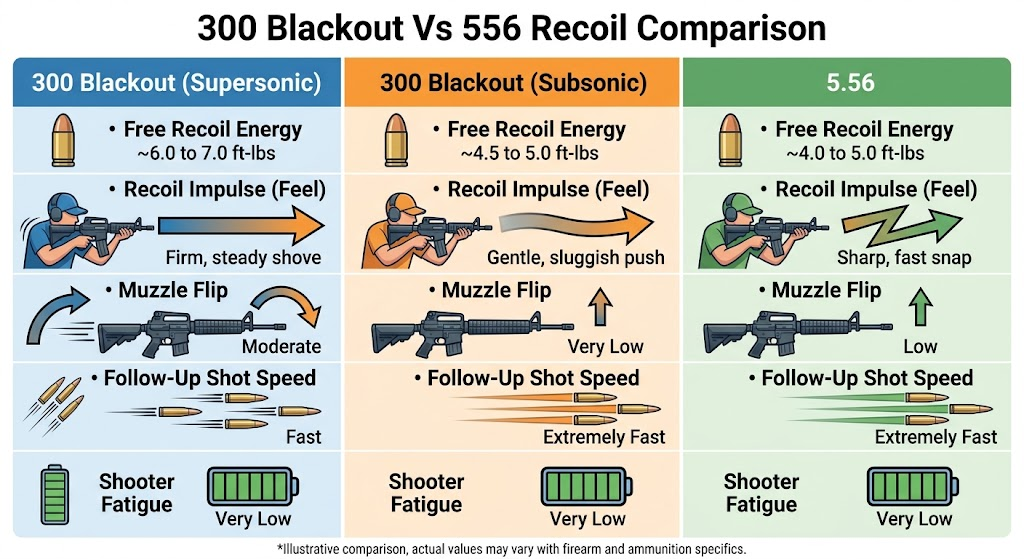
The main difference in the 300 Blackout Vs 556 Recoil comparison is the total free recoil energy generated by each cartridge upon firing. The 556 typically produces a very mild 4.0 to 5.0 foot-pounds of recoil energy, resulting in a sharp, fast snap. Supersonic 300 Blackout loads generate a slightly heavier 6.0 to 7.0 foot-pounds of recoil energy, delivering a firm shove into the shoulder. Subsonic 300 Blackout loads drop back down to match the 556 at roughly 4.5 to 5.0 foot-pounds of free recoil energy.
300 Blackout Vs 556 Recoil Comparison
| Feature | 300 Blackout (Supersonic) | 300 Blackout (Subsonic) | 556 |
| Free Recoil Energy | ~6.0 to 7.0 ft-lbs | ~4.5 to 5.0 ft-lbs | ~4.0 to 5.0 ft-lbs |
| Recoil Impulse (Feel) | Firm, steady shove | Gentle, sluggish push | Sharp, fast snap |
| Muzzle Flip | Moderate | Very Low | Low |
| Follow-Up Shot Speed | Fast | Extremely Fast | Extremely Fast |
| Shooter Fatigue | Very Low | Very Low | Very Low |
While the table above focuses strictly on recoil metrics, the differences in these physical impulses are dictated entirely by other ballistic statistics namely bullet weight, powder charge, and muzzle velocity. Because both cartridges fire from the exact same AR-15 platform (using the same bolt, buffer weight, and spring), the physical mass of the projectile exiting the barrel is the primary variable determining how hard the rifle kicks back into the shooter.
The Physics of the Recoil Difference
To objectively evaluate why the recoil differs, we must examine the standard factory ammunition statistics that generate these physical forces. These calculations assume both cartridges are fired from an identical 7-pound AR-15 rifle.
- Load A (556 Standard Ball): 55-grain bullet traveling at 3,100 fps. The powder charge is roughly 25 grains. This generates approximately 4.5 foot-pounds of free recoil energy.
- Load B (556 Heavy Match): 77-grain bullet traveling at 2,750 fps. The powder charge is roughly 23 grains. This generates approximately 4.8 foot-pounds of free recoil energy.
- Load C (300 Blackout Supersonic): 110-grain bullet traveling at 2,350 fps. The powder charge is roughly 19 grains. This generates approximately 6.0 foot-pounds of free recoil energy.
- Load D (300 Blackout Subsonic): 220-grain bullet traveling at 1,020 fps. The powder charge is roughly 11 grains. This generates approximately 4.8 foot-pounds of free recoil energy.
Supersonic Recoil Dynamics
When comparing standard supersonic defensive or hunting loads, the 556 is the softer-shooting cartridge.
Even though the 556 bullet is traveling significantly faster (over 3,000 fps), it is incredibly light (55 grains). The 300 Blackout pushes a bullet that is twice as heavy (110 grains) at roughly 2,350 fps. The physical mass of the heavier .30-caliber bullet exiting the barrel creates a stronger equal-and-opposite reaction, driving the rifle backward into the shooter’s shoulder with roughly 25% to 30% more kinetic force than the 556.
However, in absolute terms, 6.0 foot-pounds of recoil is still remarkably mild. For context, a standard 12-gauge shotgun produces over 20 foot-pounds of recoil.
Subsonic Recoil Dynamics
The recoil dynamic completely changes when you switch to heavy subsonic 300 Blackout ammunition.
Subsonic loads utilize massive 200-to-220-grain bullets, but they are driven by a very small powder charge to ensure they never exceed the speed of sound (~1,100 fps). Because the powder charge is so small and the velocity is so low, the recoil drops dramatically.
A heavy subsonic 300 Blackout load generates roughly the exact same free recoil energy (4.5 to 5.0 ft-lbs) as a standard 556 load.
Perceived Feel: The Snap vs The Shove
“Felt recoil” is highly subjective and depends on how the pressure curve translates through the rifle’s buffer system.
The 556 is widely described as a fast “snap.” It operates at a high 62,000 psi, causing the AR-15 bolt to cycle incredibly fast. The recoil impulse is sharp but over in a microsecond, allowing the shooter’s red dot or crosshairs to settle back on target instantly.
The 300 Blackout is widely described as a “shove.” It operates at a lower 55,000 psi. Pushing a heavier bullet slower down the barrel creates a recoil impulse that feels longer and more drawn out. The supersonic loads create a firm push into the shoulder with slightly more muzzle rise, while the subsonic loads feel like a slow, gentle, sluggish push that barely disturbs the sights.
300 Blackout Pros And Cons
Pros
- Massive versatility allows the shooter to switch between supersonic and subsonic rounds with just a magazine change
- Unmatched performance out of extremely short barrels (7 to 9 inches) where the 556 struggles
- Larger, heavier bullets provide better barrier penetration for home defense
- Subsonic loads are the gold standard for suppressed AR-15 shooting
Cons
- Generates roughly 25% more recoil than the 556 in supersonic configurations
- Heavier bullets drop rapidly past 150 yards, severely limiting long-range accuracy
- Ammunition is significantly more expensive than standard 556
556 Pros And Cons
Pros
- Exceptionally mild, snappy recoil allows for blisteringly fast follow-up shots
- Laser-flat trajectory allows for accurate target engagements out to 500+ yards
- Ubiquitous, globally standardized ammunition makes practice extremely affordable
- Lighter ammunition weight allows you to carry more rounds into the field
Cons
- Relies heavily on hyper-velocity to fragment; performance degrades significantly in barrels shorter than 10.3 inches
- Standard supersonic rounds remain loud and produce a supersonic crack even when fired through a suppressor
Final Recoil and Performance Summary
| Category | Winner | Reason |
| Recoil Control | 556 | Generates only 4.5 ft-lbs of recoil, allowing for perfectly flat rapid fire |
| Follow-Up Shots | 556 | Less muzzle flip keeps the red dot locked on target effortlessly |
| Shooter Fatigue | 556 | Marginally softer recoil makes high-volume carbine classes less taxing |
| Short Barrel Use | 300 Blackout | Achieves full powder burn and optimal ballistics in 9-inch barrels |
| Suppressor Use | 300 Blackout | Subsonic loads avoid the supersonic crack, offering whisper-quiet shooting |
| Ammo Cost | 556 | Massive global military production keeps bulk ammunition dirt cheap |
Which Should You Choose?
Selecting the winner depends entirely on your barrel length, suppressor ownership, and recoil sensitivity.
Choose the 556 if you are running a standard 16-inch rifle for general-purpose defense, tactical training, or target shooting. The remarkably low recoil allows anyone to master rapid-fire marksmanship quickly. Furthermore, the ammunition is cheap enough that you can afford to practice regularly, and the flat trajectory allows you to ring steel out to 500 yards with ease.
Choose the 300 Blackout if you plan to build a short-barreled rifle (SBR) or an AR pistol, and especially if you own a suppressor. While the supersonic recoil is slightly heavier than the 556, it remains incredibly mild, and the ability to load subsonic ammunition makes it the ultimate close-quarters, low-recoil defensive tool.
FAQs
Does 300 Blackout kick harder than 556?
Yes, in standard supersonic configurations, the 300 Blackout kicks slightly harder. It generates roughly 6.0 foot-pounds of free recoil energy compared to the 4.5 foot-pounds generated by the 556. However, both are considered extremely mild-recoiling cartridges.
Do I need a different buffer spring to reduce 300 Blackout recoil?
Usually, no. The 300 Blackout was specifically designed to run on a standard AR-15 carbine buffer and spring setup. Unless you are tuning a heavily suppressed rifle or running exclusively subsonic ammunition without a silencer, a standard H1 or H2 buffer is perfectly fine for managing the recoil.
Why is subsonic 300 Blackout recoil so low?
Subsonic 300 Blackout ammunition uses a very small powder charge to ensure the bullet never exceeds the speed of sound. Because there is significantly less gunpowder detonating inside the chamber, the resulting recoil impulse pushing backward into the shooter’s shoulder is drastically reduced.
Can you shoot 300 Blackout out of a 556 rifle?
No. This is incredibly dangerous. While the 300 Blackout uses the same magazine and bolt as a 556 rifle, the bullet is .30 caliber (0.308 inches). If you accidentally chamber and fire a 300 Blackout round in a 556 barrel (which has a 0.224-inch bore), the gun will catastrophically explode, potentially causing severe injury or death.
Which is better for home defense?
Both are elite choices for home defense. The 556 is often preferred because its lightweight bullets tend to fragment immediately upon hitting drywall, reducing the risk of over-penetration into adjacent rooms while producing minimal recoil. The 300 Blackout is preferred by those using short barrels and suppressors to protect their hearing during an indoor encounter.