The ballistics chart for 6.5 Creedmoor shows the exact flight path of the bullet, providing shooters with crucial data on velocity, energy, and trajectory over distance. Shooters rely on ballistic charts to calculate precise scope adjustments, ensuring accurate hits without guessing holdovers.
This guide uses verified data from the popular Hornady Precision Hunter 143 gr ELD-X factory load, standardized with a 100-yard zero. Keep in mind that real-world ballistic performance varies depending on your specific rifle’s barrel length, chosen ammunition, and environmental conditions like altitude and temperature.
Table of Contents [Click to open]
6.5 Creedmoor Ballistics Chart
| Range (yards) | Velocity (fps) | Energy (ft-lbs) | Bullet Drop (inches) | Bullet Drop (MOA) | Bullet Drop (MIL) | Wind Drift (10 mph Crosswind) | Time of Flight (seconds) | Remaining Energy (%) |
|---|---|---|---|---|---|---|---|---|
| 0 | 2700 | 2315 | -1.5 | – | – | 0.0 | 0.000 | 100% |
| 100 | 2557 | 2076 | 0.0 | 0.0 | 0.0 | 0.6 | 0.114 | 90% |
| 200 | 2419 | 1858 | -3.8 | 1.8 | 0.5 | 2.5 | 0.235 | 80% |
| 300 | 2285 | 1658 | -13.5 | 4.3 | 1.3 | 5.8 | 0.363 | 72% |
| 400 | 2156 | 1475 | -29.9 | 7.1 | 2.1 | 10.7 | 0.498 | 64% |
| 500 | 2030 | 1308 | -53.9 | 10.3 | 3.0 | 17.5 | 0.642 | 56% |
| 600 | 1910 | 1158 | -86.5 | 13.8 | 4.0 | 26.2 | 0.794 | 50% |
| 700 | 1794 | 1022 | -129.1 | 17.6 | 5.1 | 37.0 | 0.956 | 44% |
| 800 | 1684 | 900 | -183.0 | 21.8 | 6.4 | 50.1 | 1.129 | 39% |
| 900 | 1581 | 794 | -249.9 | 26.5 | 7.7 | 65.7 | 1.312 | 34% |
| 1000 | 1484 | 699 | -331.6 | 31.7 | 9.2 | 84.1 | 1.508 | 30% |
Ballistics Chart for 6.5 Creedmoor Image
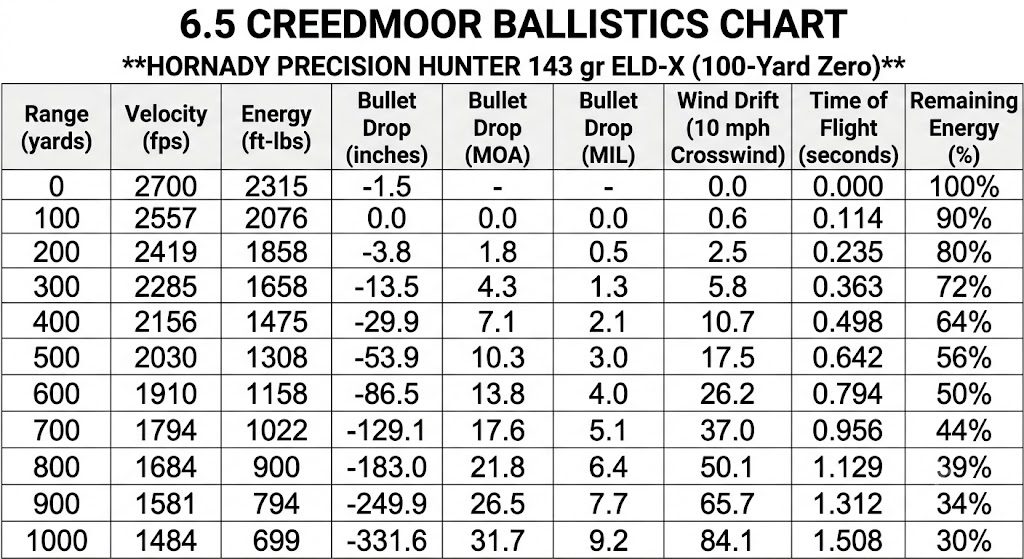
How to Read the 6.5 Creedmoor Ballistics Chart
- Range (yards): The distance the bullet travels from the muzzle to the target.
- Velocity (fps): The speed of the bullet measured in feet per second.
- Energy (ft-lbs): The kinetic striking power delivered to the target in foot-pounds.
- Bullet Drop (inches): The physical measurement of how far gravity pulls the bullet downward.
- Bullet Drop (MOA): Minute of Angle adjustments for your rifle scope.
- Bullet Drop (MIL): Milliradian adjustments for metric-based tactical scopes.
- Wind Drift (10 mph Crosswind): How far a standard 10 mph wind pushes the bullet laterally in inches.
- Time of Flight (seconds): The total time the bullet spends in the air.
- Remaining Energy (%): The percentage of muzzle kinetic energy still present at a specific distance.
Velocity Performance
The 6.5 Creedmoor velocity chart begins at a moderate ,2700 fps, but its true strength lies in retained speed. Because the cartridge uses heavy-for-caliber, highly aerodynamic bullets, it bleeds speed very slowly. The Hornady 143 gr ELD-X remains supersonic (above 1,125 fps) well past 1,200 yards, ensuring stable flight and preventing the accuracy-killing turbulence that occurs during transonic transition.
Energy Performance
Muzzle energy starts at 2,315 ft-lbs. For hunters, tracking the 6.5 Creedmoor energy chart is non-negotiable for ensuring ethical harvests. The 143 gr ELD-X bullet retains over 1,000 ft-lbs of energy out to 700 yards. This massive retained energy is exactly why the 6.5 Creedmoor punches far above its weight class in big game hunting applications.
Bullet Drop
Gravity affects all bullets, but understanding the 6.5 Creedmoor bullet drop chart takes the guesswork out of long shots. With a 100-yard zero, you will experience nearly 54 inches of drop at 500 yards. Rather than holding over the target and guessing, modern precision shooters consult their 6.5 Creedmoor MOA chart (dialing 10.3 MOA) or their 6.5 Creedmoor MIL chart (dialing 3.0 MIL) to aim dead-center.
Wind Drift
Wind is the great equalizer in long-range shooting. However, the 6.5 Creedmoor wind drift is remarkably low. A 10 mph full-value crosswind only pushes the bullet 17.5 inches at 500 yards. This is due to the incredibly high Ballistic Coefficient (BC) of 6.5mm projectiles, which allows them to slice through the air with minimal deflection.
Time of Flight
At 1,000 yards, the bullet reaches the target in roughly 1.5 seconds. Flight time matters because the longer a bullet is airborne, the longer gravity and wind can alter its trajectory. The 6.5 Creedmoor covers distance quickly enough to minimize environmental interference while retaining match-grade accuracy.
Effective Range
The 6.5 Creedmoor effective range depends entirely on your target. It produces enough energy for ethical hunting at extended distances and easily stays supersonic for competitive target shooting.
| Target Application | Realistic Effective Range | Minimum Energy Required |
|---|---|---|
| Deer | 0 – 600 yards | 1,000 ft-lbs |
| Antelope | 0 – 600 yards | 800 ft-lbs |
| Hog | 0 – 500 yards | 1,000 ft-lbs |
| Elk | 0 – 400 yards | 1,500 ft-lbs |
| Target Shooting | 0 – 1,200+ yards | N/A (Supersonic Flight) |
Long-Range Performance
The 6.5 Creedmoor trajectory chart explains its absolute dominance in the precision rifle community:
- Precision Rifle Series (PRS): The light recoil allows shooters to stay on target and spot their own impacts.
- Long-range target shooting: It perfectly mimics the wind resistance of heavy .300 Win Mag loads with a fraction of the shoulder fatigue.
- Steel competitions: It reliably hits 1,000-yard gongs with factory ammunition.
- Recreational precision rifle: Unmatched availability of high-quality match ammo makes it the best cartridge for learning long-range fundamentals.
Best Factory Loads for 6.5 Creedmoor
While Hornady 6.5 Creedmoor ballistics are the gold standard, several manufacturers produce world-class factory ammunition.
| Manufacturer | Bullet | Bullet Weight (gr) | Ballistic Coefficient (G1/G7) | Muzzle Velocity (fps) | Primary Use |
|---|---|---|---|---|---|
| Hornady | ELD-X Precision Hunter | 143 gr | .625 / .315 | 2700 | Long-Range Hunting |
| Federal Premium | Gold Medal Sierra MatchKing | 140 gr | .535 / .264 | 2690 | Target / Match |
| Nosler | Trophy Grade AccuBond | 140 gr | .509 / .256 | 2550 | Medium/Big Game |
| Barnes | VOR-TX LRX | 127 gr | .468 / .236 | 2820 | Lead-Free Hunting |
| Berger | Target Hybrid | 140 gr | .607 / .311 | 2710 | Precision / Match |
Factors That Affect 6.5 Creedmoor Ballistics
A ballistic chart is a baseline. Real-world trajectory shifts based on:
- Barrel length: Shorter barrels sacrifice muzzle velocity (roughly 20-25 fps lost per inch cut).
- Bullet weight: Heavier grains fly slower but resist wind drift better downrange.
- Ballistic coefficient: Higher BCs retain energy and velocity longer.
- Altitude: Thinner air at high elevations drastically flattens your drop chart.
- Temperature: Cold air is dense and creates more drag; hot ammo produces faster muzzle velocities.
- Humidity and Air pressure: Shifts in barometric pressure alter the air density your bullet fights against.
- Wind: Wind direction and speed demand precise MOA or MIL lateral corrections.
- Rifle zero distance: Sighting in at 200 yards instead of 100 yards changes all your required drop holds.
Is the 6.5 Creedmoor Good for Long-Range Shooting?
Yes, the 6.5 Creedmoor is arguably the most efficient modern cartridge for long-range shooting. It strikes a perfect balance: offering the wind-defying ballistics of heavier magnum calibers while maintaining the exceptionally low recoil of a short-action cartridge.
Its accuracy is inherently superb, ammunition availability is massive, and its dual-purpose performance makes it equally lethal on a deer hunt as it is ringing steel at 1,000 yards. For anyone stepping into the precision rifle space or seeking to extend their hunting capabilities, the 6.5 Creedmoor is the definitive choice.