A 224 Valkyrie Trajectory Chart acts as a vital navigational tool for shooters aiming to understand the ballistic performance of this high velocity cartridge across diverse distances. By examining the vertical flight path and bullet drop data points provided in this guide, marksmen can accurately adjust their optics to ensure precise hits from 100 yards out to 600 yards and beyond. This resource incorporates verified factory data to provide an objective look at how varying bullet weights and muzzle velocities influence long range success. Utilizing these figures correctly transforms a complex mathematical challenge into a manageable task for both varmint hunters and target competitors.
Table of Contents [Click to open]
224 Valkyrie Trajectory Chart
| Manufacturer | Load Name | Weight (gr) | Type | BC | SD | MV (fps) | 100y Drop | 200y Drop | 300y Drop | 400y Drop | 500y Drop | 600y Drop | Zero (y) |
| Federal | Gold Medal | 90 | SMK | 0.563 | 0.256 | 2700 | 1.9 | 0.0 | 8.1 | 23.2 | 45.9 | 78.4 | 200 |
| Federal | Fusion | 90 | Soft Point | 0.470 | 0.256 | 2700 | 2.0 | 0.0 | 8.8 | 25.2 | 51.4 | 89.2 | 200 |
| Hornady | Match | 88 | ELD M | 0.545 | 0.250 | 2675 | 2.0 | 0.0 | 8.3 | 23.7 | 47.4 | 81.3 | 200 |
| Federal | Gold Medal | 80.5 | Berger | 0.441 | 0.229 | 2925 | 1.6 | 0.0 | 7.1 | 20.8 | 42.0 | 72.1 | 200 |
| Barnes | Precision | 78 | TSX | 0.350 | 0.222 | 2850 | 1.8 | 0.0 | 8.0 | 23.3 | 47.7 | 82.5 | 200 |
| Federal | American Eagle | 75 | TMJ | 0.380 | 0.213 | 3000 | 1.5 | 0.0 | 6.9 | 20.4 | 41.3 | 70.9 | 200 |
| Hornady | Match | 75 | BTHP | 0.395 | 0.213 | 3000 | 1.5 | 0.0 | 7.0 | 20.4 | 41.7 | 71.5 | 200 |
| Sierra | Prairie | 69 | BlitzKing | 0.301 | 0.196 | 3100 | 1.4 | 0.0 | 6.5 | 19.1 | 39.3 | 68.2 | 200 |
| Federal | Varmint | 60 | V MAX | 0.265 | 0.171 | 3300 | 1.3 | 0.0 | 6.5 | 20.0 | 42.8 | 76.5 | 200 |
| Hornady | Varmint | 60 | V MAX | 0.265 | 0.171 | 3300 | 1.3 | 0.0 | 6.6 | 20.0 | 42.6 | 76.2 | 200 |
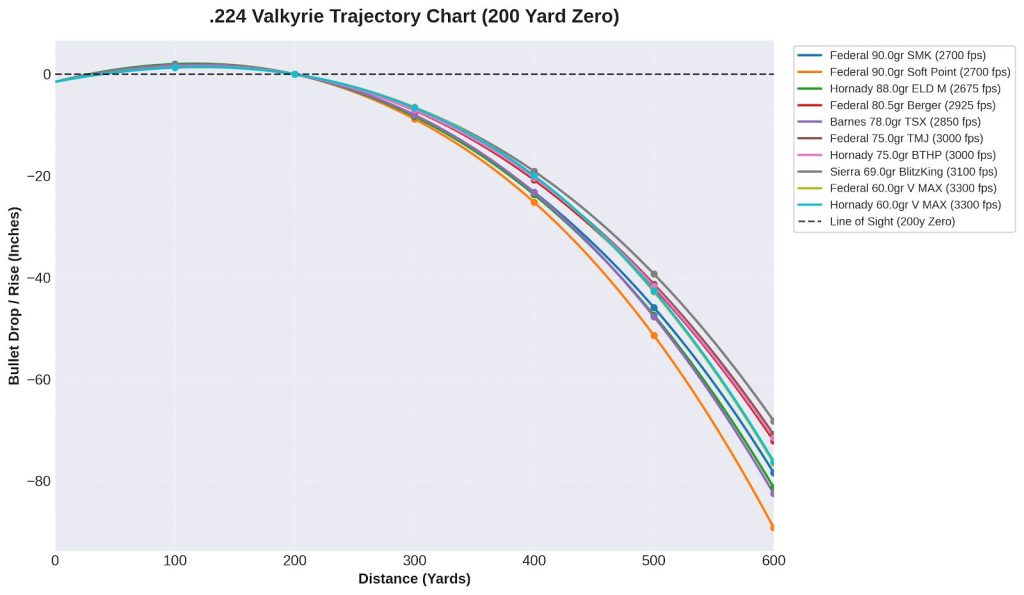
To effectively use this chart, shooters must first identify their specific ammunition load and confirm that their rifle barrel produces the listed muzzle velocity. Once confirmed, you can use the drop values to verify your optic elevation adjustments for any given distance. If your target is at 400 yards, for instance, the table shows the Federal 90 grain SMK load will be 23.2 inches below the point of aim with a 200 yard zero. Applying this compensation ensures that your projectile hits exactly where you intend.
Understanding The 224 Valkyrie Trajectory Chart
The values presented in the table above reflect real world performance metrics gathered from standardized test barrels. By treating this chart as your primary source of ballistic truth, you can make informed decisions about your gear and your shooting strategy.
Trajectory Analysis
The trajectory data highlights how projectile weight and ballistic coefficient influence flight. The 90 grain Sierra MatchKing load shows a 45.9 inch drop at 500 yards, which is significantly flatter than the 60 grain V MAX load that drops 42.8 inches at the same distance despite having a much higher starting velocity. This illustrates that while the 60 grain load starts faster, its lower ballistic coefficient leads to higher drag and a steeper drop as it travels further downrange.
Velocity Analysis
Muzzle velocity plays a critical role in how the bullet travels across the first 200 yards. The 60 grain Hornady V MAX launches at 3300 feet per second, which is the fastest load in the chart. This high velocity keeps the bullet very flat early on, but the velocity advantage fades rapidly by 400 yards. Conversely, the 88 grain and 90 grain loads start at lower velocities around 2700 feet per second, but their aerodynamic efficiency allows them to perform better at the 600 yard mark.
Ballistic Coefficient Analysis
The ballistic coefficient, or BC, acts as the primary indicator of how well a bullet resists wind and atmospheric drag. The 90 grain Sierra MatchKing boasts a high BC of 0.563, which allows it to maintain momentum far better than the 60 grain V MAX with its BC of 0.265. Looking at the 600 yard drop values, the 90 grain SMK drops 78.4 inches, whereas the 60 grain load drops 76.5 inches. The 80.5 grain Berger bullet with a BC of 0.441 provides an excellent balance by dropping only 72.1 inches at 600 yards.
Best Factory Loads Based On The Chart
For long range target shooting, the Federal Gold Medal 90 grain Sierra MatchKing is the top choice because of its high BC and consistent performance. Predator hunters will find the 75 grain loads, such as the Hornady BTHP, to be ideal as they offer a flat enough trajectory to minimize holdover while carrying plenty of energy for coyote sized targets. Varmint shooters who focus on ranges under 300 yards will appreciate the 60 grain V MAX for its explosive speed and minimal drop at standard engagement distances. The 78 grain Barnes TSX is the recommended option for medium sized game because it provides a good balance of penetration and stable flight.
Key Takeaways From The Chart
The 60 grain V MAX loads provide the highest muzzle velocity at 3300 feet per second for short range engagements. The 90 grain Sierra MatchKing exhibits the highest ballistic coefficient, making it the most capable load for extending your range out to 600 yards and beyond. When comparing drop at 500 yards, the 69 grain BlitzKing offers an efficient 39.3 inch drop, marking it as a strong middle ground option. The 200 yard zero remains the most practical setting for all listed loads as it centers the trajectory arc perfectly for most hunting and shooting scenarios.
Common 224 Valkyrie Bullet Weights
Choosing the right bullet weight is a critical step in optimizing your rifle setup for specific applications. The 224 Valkyrie supports a wide range of weights that cater to different ballistic needs.
60 Grain
The 60 grain bullets are designed for speed. They provide an exceptionally flat path for distances under 200 yards and are perfect for prairie dog hunting. Their disadvantage is a lack of wind resistance, which makes them difficult to use in open fields with shifting breezes.
69 Grain
The 69 grain category serves as a versatile transition weight. It offers enough mass to handle wind better than the 60 grain bullets while maintaining a high velocity that keeps the trajectory flat. This weight is often favored for tactical training and target work at mid range distances.
75 Grain
These bullets are the workhorses of the 224 Valkyrie platform. They provide a balanced profile that performs well in almost any environment. The 75 grain projectiles are suitable for nearly all hunting and light target duties because they are accurate and easy for most rifles to stabilize.
78 Grain
The 78 grain Barnes TSX is specifically engineered for hunting. It retains velocity well and provides deep penetration on impact. This makes it the standard choice for hunters who need to ensure their ammunition is capable of ethical kills on larger game within the 300 yard window.
80.5 Grain
The 80.5 grain Berger Hybrid is a precision oriented load. It combines a high ballistic coefficient with a specialized shape designed to maximize stability in flight. This load is frequently selected by match shooters who need the absolute highest consistency at ranges beyond 400 yards.
88 Grain
The 88 grain ELD Match bullet represents the heavy end of the spectrum for this cartridge. It features a sophisticated design that resists external forces, leading to very predictable results even at long ranges. It is an excellent choice for shooters who participate in sanctioned long range competitions.
90 Grain
The 90 grain Sierra MatchKing is the legendary heavy hitter of the 224 Valkyrie. It is designed to stay supersonic at extremely long distances. While it has more drop at short range than the lighter options, its ability to buck wind and retain energy at 600 yards makes it the gold standard for long range shooters.
Effective Range
Varmint Hunting
For varmint hunting, the 224 Valkyrie is effectively a 400 yard tool. Beyond this, the wind drift on smaller projectiles can make clean hits difficult, even if the trajectory chart shows the bullet is still within range.
Predator Hunting
The effective range for predators such as coyotes extends to 500 yards. With the 75 or 78 grain loads, you retain enough terminal energy to stop these animals effectively provided you use a laser rangefinder to account for the drop shown in our table.
Target Shooting
For targets and steel plates, the 224 Valkyrie remains highly accurate out to 600 yards. The 90 grain SMK load is the preferred choice here because its trajectory is predictable and reliable across these distances.
Long Range Shooting
Shooters have taken the 224 Valkyrie out to 1000 yards. This requires specialized optics and a deep understanding of atmospheric conditions, as the bullet drop becomes much more significant once you move beyond the 600 yard limit shown in our data.
Factors That Affect 224 Valkyrie Trajectory
Bullet Weight
Heavier bullets generally have higher ballistic coefficients and retain velocity longer. While they may start slower than light varmint bullets, they are much less affected by wind and gravity at the 500 and 600 yard markers.
Muzzle Velocity
Velocity is the primary driver of the bullet path arc. A higher muzzle velocity flattens the trajectory but also increases barrel heat and throat erosion. Shooters must decide between extreme speed or optimized long range stability.
Barrel Length
Our data is based on 24 inch barrels. If you are shooting from a 16 or 18 inch barrel, you will lose significant velocity. This loss will shift your point of impact lower than what the chart indicates, requiring you to recalibrate your optics.
Ballistic Coefficient
The BC is your best friend for long range shots. Bullets with a high BC keep their speed and track straighter when the wind is blowing. This is why the 90 grain SMK is a favorite for long distance shooters.
Wind
Wind is the enemy of any long range shot. Because the 224 Valkyrie uses small diameter bullets, it is susceptible to being pushed off target. Use high BC bullets and an accurate ballistic calculator to account for current wind speeds in your area.
Temperature
Changes in temperature affect air density and powder burn rates. Cold air is denser than warm air, creating more drag on the bullet. Always check your zero in the same temperature conditions you plan to hunt or shoot in.
Altitude
Higher altitude means thinner air. Your bullet will travel faster and drop less at 5000 feet than it will at sea level. If you are shooting in mountainous terrain, you will find your drops are not as steep as they are on the plains.
Zero Distance
A 200 yard zero is standard for this cartridge. If you change this to 100 yards, your mid range trajectory will be flatter, but you will have to hold higher for every shot beyond 200 yards.
Best Zero Distance
100 Yard Zero
A 100 yard zero is excellent for benchrest shooters who want to verify absolute precision. However, it is not recommended for hunters, as it forces the shooter to make more drastic adjustments for long range targets.
200 Yard Zero
This is the recommended zero for the 224 Valkyrie. It provides the best overall performance, allowing you to hit targets from near to far with minimal or zero holdover within the most common engagement ranges.
250 Yard Zero
A 250 yard zero can stretch your point blank range out to 300 yards. This is useful for wide open spaces but requires caution because you might overshoot small targets that are closer than 100 yards.
224 Valkyrie Compared To Similar Cartridges
| Cartridge | Trajectory | Velocity | BC | Effective Range | Wind Drift | Recoil |
| 224 Valkyrie | Very Flat | High | High | 1000y+ | Low | Low |
| 223 Rem | Moderate | Moderate | Low | 600y | Moderate | Minimal |
| 22 250 Rem | Very Flat | Extreme | Low | 700y | Low | Low |
| 6mm ARC | Flat | Moderate | High | 1000y+ | Low | Moderate |
| 6.5 Grendel | Flat | Moderate | High | 1000y+ | Low | Moderate |
The 224 Valkyrie offers a unique balance compared to the 223 Remington. While the 223 is cheaper and easier to find, the Valkyrie significantly outperforms it at distances over 300 yards. When compared to the 22 250, the Valkyrie provides better wind resistance due to the ability to stabilize much heavier, high BC bullets that the older 22 250 platform cannot handle effectively.
Frequently Asked Questions
What is the most accurate load for 224 Valkyrie?
Many shooters find the 90 grain Sierra MatchKing to be the most consistent for long range precision.
Can I hunt deer with 224 Valkyrie?
Yes, the 224 Valkyrie is an effective deer cartridge when using bonded or solid copper bullets like the 78 grain Barnes TSX within 300 yards.
Is the 224 Valkyrie better than 6.5 Grendel?
The 224 Valkyrie is generally faster and flatter for long range varmint work, while the 6.5 Grendel offers more energy and is better suited for medium sized game.
Does 224 Valkyrie really reach 1000 yards?
Yes, when fired from a high quality rifle with a 24 inch barrel, it remains supersonic and capable of hitting targets at 1000 yards.
Why is my 224 Valkyrie dropping more than the chart?
You are likely using a shorter barrel than the 24 inch test barrel, which causes lower muzzle velocity and increased bullet drop.
What is the best twist rate for 224 Valkyrie?
A 1:7 twist rate is considered the industry standard to properly stabilize the heavier 88 and 90 grain bullets.
How much recoil does 224 Valkyrie have?
It is very low, making it a great cartridge for younger shooters or anyone who is sensitive to muzzle jump.
Are there any factory match loads?
Yes, Federal Gold Medal and Hornady Match are excellent factory options that provide match grade performance right out of the box.
Can I reload 224 Valkyrie ammo?
Yes, it is a very popular cartridge for handloaders who want to maximize their velocity and tailor their load to a specific rifle.
Is it safe to shoot 224 Valkyrie in an AR 15?
Yes, it was designed specifically for the AR 15 platform, though you need the correct bolt carrier group and magazines compatible with the 6.8 SPC case head.