A 10mm Auto Trajectory Chart is a critical ballistic reference tool that visually displays exactly how much this powerful semi-automatic cartridge drops across various downrange distances. Renowned for its exceptional kinetic energy and versatility, the 10mm Auto is frequently used for both self-defense and backcountry protection against dangerous wildlife. By diligently studying these precise ballistic values, shooters can perfectly understand the flight path of their chosen premium factory ammunition before ever pulling the trigger in the field. Reviewing this comprehensive trajectory data completely guarantees you will fully maximize the speed, terminal performance, and long-range potential of this high-pressure centerfire pistol cartridge.
Table of Contents [Click to open]
10mm Trajectory Chart
| Manufacturer | Bullet Weight | Bullet Type | Ballistic Coefficient | Muzzle Velocity | 50 Yard Drop | 100 Yard Drop | 125 Yard Drop | 150 Yard Drop | 175 Yard Drop | 200 Yard Drop | Recommended Zero | Max Point Blank |
| Hornady | 155 Grain | XTP Hollow Point | 0.170 | 1475 FPS | +0.4 | Zero | -3.5 | -8.5 | -15.5 | -25.0 | 100 Yards | 115 Yards |
| Sig Sauer | 180 Grain | V Crown JHP | 0.180 | 1250 FPS | +0.7 | Zero | -4.8 | -11.5 | -21.0 | -34.0 | 100 Yards | 108 Yards |
| Federal Premium | 180 Grain | HST JHP | 0.175 | 1275 FPS | +0.7 | Zero | -4.7 | -11.2 | -20.5 | -33.5 | 100 Yards | 108 Yards |
| Buffalo Bore | 180 Grain | Hard Cast | 0.185 | 1350 FPS | +0.6 | Zero | -4.2 | -10.0 | -18.5 | -30.0 | 100 Yards | 110 Yards |
| Underwood | 200 Grain | XTP JHP | 0.190 | 1250 FPS | +0.7 | Zero | -4.9 | -12.0 | -22.0 | -36.0 | 100 Yards | 105 Yards |
| Barnes | 155 Grain | VOR TX TAC-XP | 0.185 | 1400 FPS | +0.5 | Zero | -3.9 | -9.2 | -16.5 | -27.0 | 100 Yards | 112 Yards |
| Underwood | 220 Grain | Hard Cast | 0.230 | 1200 FPS | +0.8 | Zero | -5.5 | -13.0 | -24.0 | -39.0 | 100 Yards | 100 Yards |
| Remington | 180 Grain | UMC FMJ | 0.175 | 1150 FPS | +0.8 | Zero | -5.5 | -13.2 | -24.5 | -40.0 | 100 Yards | 105 Yards |
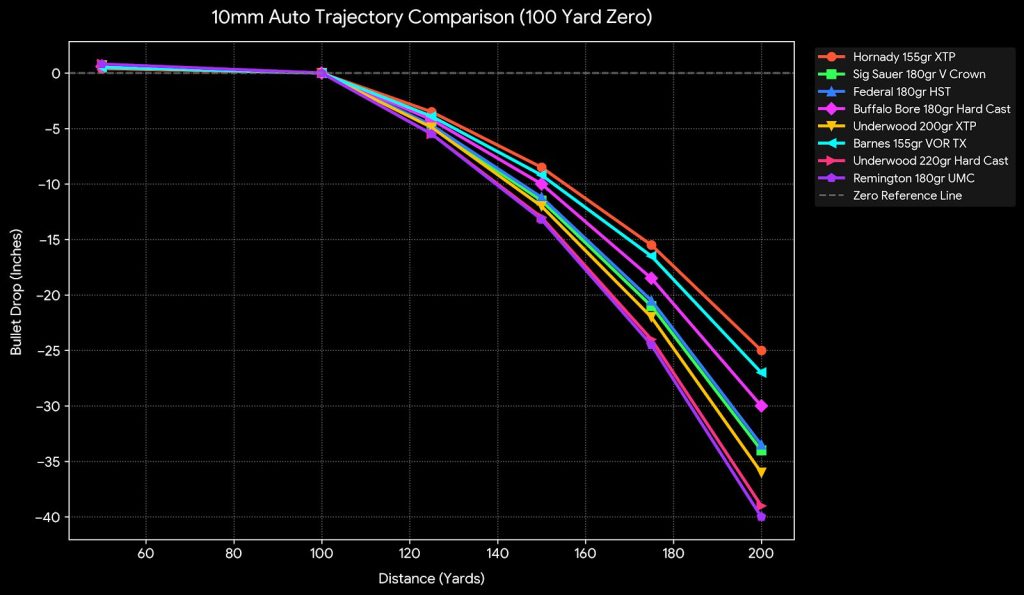
This professional trajectory chart provides 10mm Auto shooters with extremely precise bullet drop measurements across various distances so they can effectively compensate for gravity. You should always properly match your chosen factory load with the recommended zero distance to truly maximize your effective shooting range and ensure perfectly accurate shots.
Understanding The 10mm Trajectory Chart
The data presented in our ballistic chart provides critical information about how these unique high-velocity projectiles perform during open flight. Analyzing these specific statistics allows you to master your firearm’s performance and understand exactly how your chosen ammunition behaves as it travels downrange.
Trajectory Analysis
Bullet drop represents exactly how far gravity pulls the projectile downward from your absolute line of sight across various distances. Our chart measures this specific vertical drop in inches to help you calculate precise aiming adjustments in the field.
The table clearly reveals that high-velocity 155-grain loads remain remarkably flat across the first one hundred yards. The Hornady 155-grain XTP bullet only drops 8.5 inches at 150 yards, which is quite manageable for a handgun cartridge.
Conversely, heavier 220-grain hard cast ammunition follows a slightly more pronounced arc due to its slower initial starting speed and higher bullet mass. The Underwood 220-grain hard cast load drops exactly 13 inches by the time it successfully reaches the 150-yard mark.
This physical difference in bullet drop perfectly illustrates precisely why shooters must carefully select the correct ammunition for their specific engagement distance. You simply cannot use the exact same aiming holdovers for lightweight self-defense loads and massive heavy-hitting bear defense cartridges.
Velocity Analysis
Muzzle velocity measures the exact speed of the bullet as it exits the handgun barrel, recorded in feet per second. Faster initial speeds directly translate into significantly flatter trajectories and highly extended point blank ranges.
The chart clearly divides into highly distinct velocity classes based on the specific grain weight of the chosen bullet. The Hornady 155-grain XTP aggressively leaves the muzzle at one thousand four hundred seventy-five feet per second.
Heavier target or wilderness defense bullets leave the barrel noticeably slower simply because they possess significantly more mass for the expanding powder to successfully push. The Underwood 220-grain hard cast load generates one thousand two hundred feet per second at the muzzle.
This intentional velocity difference dictates how much time the projectile spends fighting gravity before finally arriving at the target. A significantly faster bullet physically covers the downrange distance quicker, resulting in superior flat-shooting characteristics.
Ballistic Coefficient Analysis
The ballistic coefficient (BC) physically measures how efficiently a bullet cuts through the air and strongly resists wind drag during flight. Higher numerical values indicate a highly aerodynamic bullet that will successfully retain its initial muzzle velocity much better downrange.
Our data shows that heavy 220-grain hard cast loads possess surprisingly high aerodynamic ratings compared to standard JHP bullets. The Underwood 220-grain hard cast boasts a ballistic coefficient of zero point two three zero.
Lighter bullets like the Hornady 155-grain XTP possess lower ratings around zero point one seven zero. Their shorter physical length and hollow point profile prevent them from achieving highly efficient aerodynamic flight profiles, though they remain excellent for defensive use.
Sectional density simply measures the physical weight of the bullet relative to its diameter, indicating potential penetration depth on heavy targets. The massive 220-grain hard cast loads feature incredible sectional density ratings, which guarantees deep, reliable terminal penetration on massive animals.
Best Hunting Loads Based On The Chart
Whitetail deer hunters should immediately pick the Underwood 200-grain XTP JHP. This specific cartridge provides a great balance of expansion and velocity, making it an excellent choice for medium-sized game in open hunting environments.
Backcountry enthusiasts specifically targeting large predators or defensive scenarios will find the Buffalo Bore 180-grain Hard Cast exceptionally effective. The tough cast construction guarantees deep, straight-line penetration through massive shoulder bones.
Hunters pursuing massive wild hogs should strongly consider the Barnes 155-grain TAC-XP. This solid copper bullet was perfectly engineered to completely smash through tough hide and dense bone while reliably retaining its full weight.
Marksmen shooting heavy steel targets at 100 yards need maximum consistency and high-velocity performance. The Sig Sauer 180-grain V Crown perfectly provides the exact consistent velocities required for shooting tight groups at standard defensive distances.
Hunters facing gusty wind conditions should completely rely on the heavier 200-grain ammunition options. The significantly heavier projectile mass combined with a better ballistic coefficient helps dramatically reduce horizontal wind deflection across wide open spaces.
Key Takeaways From The Chart
The recommended zero distance strictly dictates the exact yardage where your bullet perfectly crosses your visual line of sight. Maximum point blank range indicates exactly how far you can comfortably shoot a target without ever manually adjusting your crosshairs.
The trajectory table proves that the 10mm Auto absolutely demands a 100-yard zero for maximizing field efficiency. This specific zero provides a point blank range reaching up to 115 yards with lightweight 155-grain bullets.
Heavier loads completely require the exact same zero distance but yield a slightly restricted point blank range due to slower speeds. By properly matching your specific factory ammunition to its corresponding zero distance shown in the chart, you maximize your capabilities.
You will easily eliminate complicated mental math during fast-paced wilderness scenarios by fully trusting these verified ballistic values. Always remember that your specific pistol’s barrel length will slightly influence these factory-tested results.
Common 10mm Bullet Weights
155 Grain
Lightweight 155-grain bullets are specifically engineered to perfectly maximize supersonic velocity and flatten the trajectory curve. These specialized aerodynamic projectiles fly incredibly straight and truly require almost zero holdover adjustments at defensive distances.
The primary advantage includes explosive terminal performance and higher velocities, making them an excellent choice for self-defense. The optimized bullet mass allows standard powder charges to accelerate the bullet to extraordinary speeds very quickly.
Hunters should avoid using these lighter bullets on massive tough animals like large bears. They lack the required sectional density needed to achieve deep penetration through thick muscle and dense bone.
180 Grain
The 180-grain projectile serves as a truly spectacular intermediate weight for modern 10mm ammunition. These highly accurate expanding bullets typically provide outstandingly balanced terminal ballistics for all-around use.
The main advantage is widespread availability and a highly predictable trajectory curve. Every major ammunition manufacturer utilizes highly specialized jacketed hollow point construction for this weight to safely guarantee extreme reliability.
One minor disadvantage is that the bullet design remains slightly more susceptible to wind drift than 200+ grain loads. However, for most hunting and defensive applications, this remains the most popular and versatile choice.
200+ Grain
Heavy 200+ grain bullets remain the absolute undisputed gold standard for backcountry hunters demanding massive knockdown power and penetration. These specialized heavy projectiles offer the highest sectional density for maximum terminal impact.
The absolute greatest advantage of this bullet weight is its remarkable ability to retain lethal energy upon heavy impact. The tough construction guarantees the projectile cuts through thick targets with maximum penetration efficiency.
The disadvantage is a slightly more pronounced drop at distance. Shooters must become adept at estimating range, as these bullets drop more than the 155-grain or 180-grain options.
Effective Hunting Range
Deer
Whitetail deer hunters can confidently engage medium targets out to 100 yards with proper premium ammunition. This distance firmly establishes the 10mm as a highly capable hunting option for modern outdoorsmen.
You must always fully verify your exact bullet drop data before attempting challenging shots. The cartridge shines brightest when you understand its trajectory and stick to ranges where you can ensure an ethical harvest.
Wild Hog
Feral hogs feature very small vital zones protected by thick hide that requires maximum energy for reliable harvesting. You should limit your shots to roughly 75 yards to guarantee the bullet retains enough kinetic energy for deep, reliable penetration.
A well-placed shot directly behind the shoulder remains the best method for dropping large boars. The highly accurate jacketed hollow point bullet destroys the vital systems upon impact.
Wilderness Protection
When dealing with dangerous predators, your effective range is limited by your ability to get a fast, accurate hit under pressure. The 10mm is a legendary cartridge for this role precisely because it delivers massive energy at close quarters.
Always prioritize shots within 50 yards when facing dangerous wildlife. At this distance, the trajectory is essentially flat, and the terminal impact is devastating.
Factors That Affect 10mm Trajectory
- Bullet Weight: Lighter bullets provide a flatter trajectory and higher velocity, while heavier bullets offer more energy but a steeper arc.
- Muzzle Velocity: Higher velocity flattens the trajectory. Always use a chronograph to verify your actual speed.
- Ballistic Coefficient: Choosing more aerodynamic bullets can slightly improve trajectory performance at distance.
- Zero Distance: A 100-yard zero is the standard for 10mm. It minimizes holdover errors at typical distances.
- Barrel Length: Longer barrels in carbines will produce much higher velocities than standard handgun barrels, resulting in less bullet drop.
Frequently Asked Questions
What Is A 10mm Trajectory Chart
It is a ballistic table showing the bullet’s path. It helps you see how much the bullet falls at different distances so you can adjust your aim.
What Is The Maximum Effective Range Of A 10mm
Most hunters limit the 10mm to 100–150 yards. Beyond this, bullet drop becomes difficult to manage, and energy levels for hunting drop off.
How Much Does A 10mm Drop At 150 Yards
Depending on the load, the drop at 150 yards typically ranges from 8 to 13 inches. This is why 100 yards is often the practical limit for consistent accuracy.
Is The 10mm Better Than The .45 ACP
The 10mm has a flatter trajectory and significantly more kinetic energy, making it superior for hunting and long-range shooting compared to the .45 ACP.
What Is The Best Zero For 10mm
A 100-yard zero is the standard. It provides intuitive holdovers and keeps the bullet’s path manageable for hunting and defensive applications.
Does Barrel Length Affect 10mm Ballistics
Yes, significant velocity increases occur with longer barrels, such as those found on pistol-caliber carbines.
What Is The Best 10mm Hunting Load
180-grain or 200-grain JHPs are excellent for medium game, while hard cast bullets are best for dangerous wildlife.
How Does Bullet Weight Change The 10mm Trajectory
Lighter bullets are faster and have a flatter flight path, whereas heavier bullets are slower and drop more noticeably at distance.
What Is The 10mm Ballistic Coefficient
Most 10mm bullets have a BC ranging from 0.150 to 0.230, which is typical for handgun bullets.
Can You Use 10mm For Long Range Target Shooting
It is fun for shooting steel targets out to 150 yards, but it is not a long-range precision cartridge in the way rifle calibers are.
One follow-up question: Are you using your 10mm Auto primarily for backcountry carry, or for recreational target shooting at the range?