Introduced by Weatherby in 2016, the 6.5-300 Weatherby Magnum holds the undisputed title of the fastest commercially produced 6.5mm cartridge on earth. By necking down the massive .300 Weatherby Magnum case, this hot-rod cartridge sends high-ballistic-coefficient projectiles downrange at blazing, hyper-velocity speeds. The result is laser-flat trajectories and relentless energy retention that pushes long-range hunting limits further than conventional 6.5mm rounds ever could.
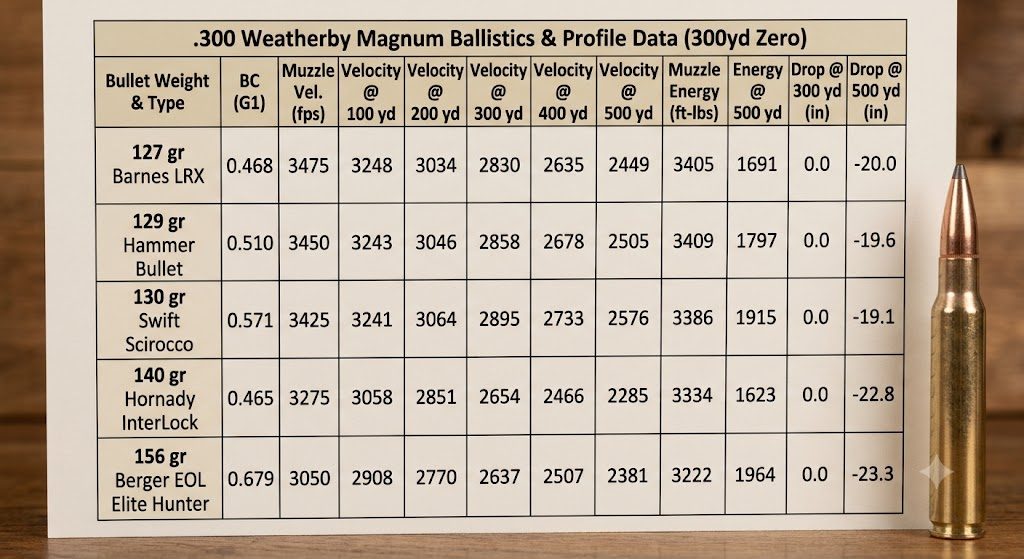
6.5-300 Weatherby Ballistics Chart
The following data represents the official factory load ballistics from Weatherby. All figures are established using a standard 26-inch test barrel with the rifle zeroed at 200 yards (unless noted as 0.0″ at 300 yards for specific trajectory profiles).
| Bullet Weight & Type | BC (G1) | Muzzle Vel. (fps) | 100 yd | 200 yd | 300 yd | 400 yd | 500 yd | Muzzle Energy (ft-lbs) | 500 yd Energy | Drop @ 300 yd | Drop @ 500 yd |
| 127 gr Barnes LRX | 0.468 | 3475 | 3248 | 3034 | 2830 | 2635 | 2449 | 3405 | 1691 | 0.0″ | -20.0″ |
| 129 gr Hammer Bullet | 0.510 | 3450 | 3243 | 3046 | 2858 | 2678 | 2505 | 3409 | 1797 | 0.0″ | -19.6″ |
| 130 gr Swift Scirocco | 0.571 | 3425 | 3241 | 3064 | 2895 | 2733 | 2576 | 3386 | 1915 | 0.0″ | -19.1″ |
| 140 gr Hornady InterLock | 0.465 | 3275 | 3058 | 2851 | 2654 | 2466 | 2285 | 3334 | 1623 | 0.0″ | -22.8″ |
| 156 gr Berger EOL Elite Hunter | 0.679 | 3050 | 2908 | 2770 | 2637 | 2507 | 2381 | 3222 | 1964 | 0.0″ | -23.3″ |
Understanding the Ballistics Metrics
- Velocity (fps): Measured in feet per second. High muzzle velocity ensures shorter flight times and less time for outside forces like wind or gravity to impact the bullet. Notice how the 6.5-300 keeps velocities at 500 yards that many standard cartridges boast at the muzzle.
- Energy (ft-lbs): Foot-pounds of energy quantify the bullet’s striking force. For reference, 1,000 ft-lbs is widely considered the ethical baseline for deer hunting, while 1,500 ft-lbs is the baseline for larger game like elk. Every single 6.5-300 factory load sails clean over these metrics even at 500 yards.
- Ballistic Coefficient (BC G1): A measure of how efficiently a bullet cuts through the air. A higher BC number (like the 156 gr Berger’s 0.679) means the bullet resists air drag and wind drift far better over long distances.
- Trajectory & Bullet Drop: These figures show the physical path of the bullet when zeroed tightly. The “0.0” at 300 yards in the table marks specific optimized trajectories where shooters utilize a 300-yard dead-on zero to map out exact drops at extended distances like 500 yards.
Factory Load Showdown & Top Performers
Flattest-Shooting Load
The 130 gr Swift Scirocco takes this crown. Thanks to an optimized blend of blazing muzzle velocity (3,425 fps) and a slick 0.571 BC, it loses only 19.1 inches of drop at 500 yards when zeroed out at 300.
Fastest Load
The 127 gr Barnes LRX breaks the radar at a staggering 3,475 fps at the muzzle. If you want raw, explosive velocity out of the gate, this monolithic option dominates.
Highest Retained Energy
The heavy-hitting 156 gr Berger EOL Elite Hunter takes a slight hit in muzzle velocity but prints a massive 1,964 ft-lbs of energy at 500 yards. Because its massive 0.679 BC resists air resistance so effectively, it arrives at long distances with maximum hammer-like force.
Best Long-Range Load
The 156 gr Berger EOL Elite Hunter is built exactly for long-range precision. Its ultra-high BC means it ignores crosswinds significantly better than its lighter siblings, making it the most predictable choice beyond 400 yards.
Best Hunting Load for Deer
The 129 gr Hammer Bullet or 127 gr Barnes LRX are spectacular choices here. Deer do not require heavy, deeply penetrating bullets; instead, they benefit from the massive hydrostatic shock and clean, devastating energy transfer delivered by these blistering fast, lighter options.
Best Hunting Load for Elk
The 130 gr Swift Scirocco offers a thick, bonded copper jacket and a heavy lead core. This design prevents the bullet from fragmenting prematurely upon hitting dense elk bone or muscle at ultra-high velocities, ensuring deep penetration into vital organs.
Best Hunting Load for Moose
The 156 gr Berger EOL Elite Hunter is the definitive choice for the largest game. The sheer sectional density (how heavy a bullet is relative to its width) ensures deep penetration through heavy hide and large rib cages, backed by nearly 2,000 ft-lbs of downrange energy.
Real-World Factors Affecting Ballistics
- Barrel Length: Weatherby factory ballistics are calculated using a 26-inch barrel. Dropping down to a 24-inch barrel will generally cost you roughly 25 to 50 fps per inch of barrel lost, slightly altering your drop charts.
- Altitude and Temperature: The 6.5-300 is a speed demon that thrives in high altitude. Thin mountain air provides less aerodynamic resistance, flattening your trajectory even further. Conversely, freezing temperatures can slightly lower powder burning efficiency, causing mild velocity drops compared to a warm day at sea level.
- Zero Distance: Altering your zero completely changes your mid-range rise. A standard 200-yard zero will keep your bullet within a few inches of your crosshairs all the way out to 250 yards, eliminating the need to hold over on medium-sized game.
- Bullet Design: Monolithic copper bullets (like the Barnes LRX) are longer than traditional lead-core bullets of the same weight. This design difference shifts how the bullet stabilizes and retains downrange energy, meaning you cannot safely swap data between different bullet compositions.
Frequently Asked Questions
1. What is the effective hunting range of the 6.5-300 Weatherby Magnum?
For medium game like deer, its ethical energy and flat trajectory make it effective out to 600–700 yards in skilled hands. For larger game like elk, it retains the recommended 1,500 ft-lbs of energy past 500 yards.
2. Does the 6.5-300 Weatherby burn out barrels quickly?
Yes. Because it burns a very large volume of powder through a relatively small 6.5mm bore, it is considered an “overbore” cartridge. To maximize barrel life, avoid rapid-fire strings and allow the barrel to cool completely between shots.
3. How does the recoil compare to a 6.5 Creedmoor?
The 6.5-300 Weatherby has significantly more recoil than a 6.5 Creedmoor. Its recoil profile behaves much more like a heavy 7mm Remington Magnum or a .30-006.
4. Can I shoot standard 6.5 PRC or 6.5 Creedmoor ammo in a 6.5-300 Weatherby rifle?
Absolutely not. The 6.5-300 Weatherby Magnum uses a completely unique, massive belted case. Firing incorrect ammunition is incredibly dangerous and will cause catastrophic firearm failure.
5. What is the best barrel twist rate for the 6.5-300 Weatherby?
A 1:8″ twist rate is standard for factory Weatherby rifles. This rapid twist rate is essential for stabilizing long, heavy, high-BC projectiles like the 156-grain Berger Elite Hunter.
6. Is the 6.5-300 Weatherby Magnum suitable for target shooting?
While highly accurate, it is not an ideal high-volume target cartridge due to rapid barrel heating and throat erosion. It is primarily designed as an elite, flat-shooting hunting cartridge.
7. Who makes factory ammunition for the 6.5-300 Weatherby?
Weatherby is the primary supplier of factory loaded ammunition for this proprietary cartridge, utilizing premium projectiles from brands like Barnes, Swift, and Berger.
8. What primer type does the 6.5-300 Weatherby require for reloading?
It requires Large Rifle Magnum primers. The massive powder column needs an intense, prolonged spark to ensure consistent and reliable ignition.
9. Why is there a belt at the base of the 6.5-300 Weatherby case?
The belt is a historical design characteristic inherited from its parent case, the .300 Weatherby Magnum (originally derived from Holland & Holland cases). It was originally used to control headspacing.
10. How much flat-shooting advantage does it give over a 6.5 Creedmoor at 500 yards?
At 500 yards, a 6.5 Creedmoor typically drops around 45 to 50 inches (with a 200-yard zero). The 6.5-300 Weatherby drops roughly half that amount, cutting bullet drop nearly in half and vastly reducing wind drift.