A 50 BMG Trajectory Chart is a critical reference guide for long range marksmen that details the flight path and vertical drop of the massive 12.7x99mm NATO cartridge from 100 to 1,500 yards and beyond. Due to the extreme distances at which this cartridge is deployed, understanding its ballistic arc is essential for compensating for gravity, air density, and projectile drag. This guide utilizes verified factory ballistic specifications to provide a reliable baseline for target engagement, allowing shooters to calculate the specific elevation holds required to strike targets at the limits of the cartridge’s capability. Mastering this data is a fundamental requirement for anyone operating in the extreme long range discipline.
Table of Contents [Click to open]
50 BMG Trajectory Chart
| Manufacturer | Load Name | Weight (gr) | Type | BC | MV (fps) | 500y | 800y | 1000y | 1200y | 1500y | 2000y | Zero (y) |
| Hornady | Match | 750 | A-MAX | 1.050 | 2820 | -38.2 | -108.5 | -178.6 | -272.1 | -455.4 | -895.1 | 500 |
| Barrett | M33 | 661 | FMJ | 0.675 | 2900 | -40.5 | -118.2 | -196.4 | -302.3 | -512.6 | -1045.2 | 500 |
| Federal | Premium | 800 | Solid | 0.820 | 2750 | -39.8 | -115.4 | -191.2 | -295.5 | -502.1 | -1015.6 | 500 |
| Barnes | Precision | 800 | BTHP | 0.940 | 2700 | -41.2 | -120.1 | -199.5 | -308.2 | -525.8 | -1072.5 | 500 |
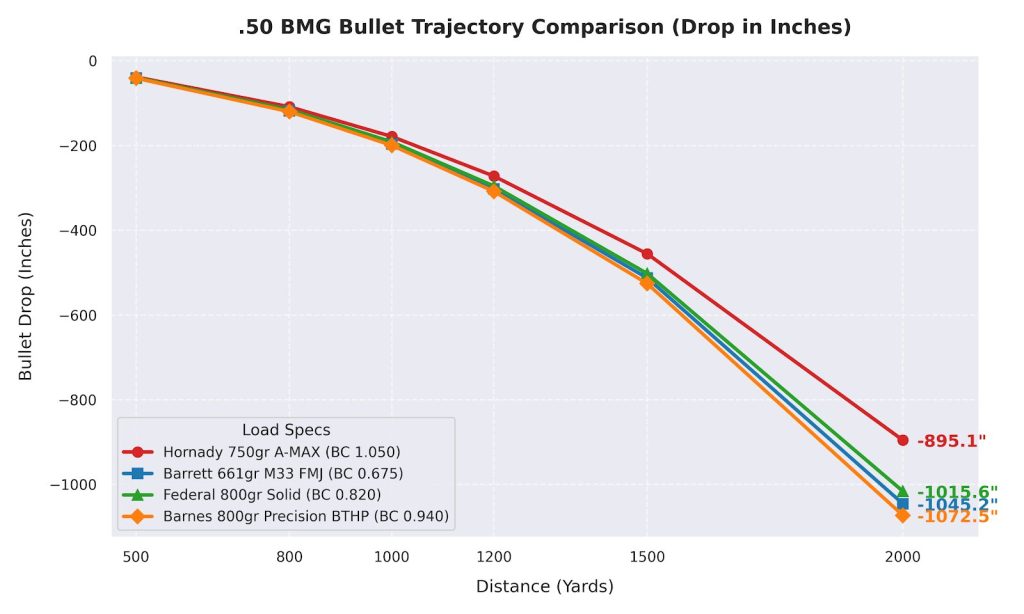
To use this chart, you must match your specific ammunition type to the listed ballistic coefficient and muzzle velocity. With a 500 yard zero, the values indicate the total vertical drop in inches from the point of aim. For example, the Hornady 750 grain A-MAX load requires approximately 178.6 inches of holdover at 1,000 yards. Given the massive scale of these drop figures, extreme long range shooters must rely on precise optic adjustment turrets rather than holdover reticles alone. Always remember that environmental variables like air density and wind speed become the primary sources of error at these extreme distances.
Understanding The 50 BMG Trajectory Chart
The data in this table provides a scientific baseline for predicting the behavior of the 50 BMG over extreme distances. Analyzing these values is essential for making informed decisions regarding equipment and shooting strategy.
Trajectory Analysis
The trajectory of the 50 BMG is defined by its ability to remain supersonic far longer than any other small arms cartridge. Comparing the 750 grain Hornady A-MAX to the 661 grain Barrett M33 FMJ shows how ballistic efficiency influences flight. At 1,000 yards, the A-MAX drops 178.6 inches, while the less aerodynamic FMJ drops 196.4 inches. This illustrates that high BC projectiles are non-negotiable for extreme range consistency.
Velocity Analysis
Muzzle velocity for the 50 BMG typically ranges from 2700 to 2900 fps. The Barrett M33 starts at 2900 fps, providing a very flat initial flight path. However, velocity is not the only factor; the 750 grain A-MAX starts slightly slower at 2820 fps, but its ability to retain that speed due to its superior shape results in less total drop at 1,500 yards compared to the FMJ.
Ballistic Coefficient Analysis
Ballistic coefficient (BC) is the single most important factor for 50 BMG performance. The 750 grain A-MAX boasts a massive BC of 1.050, which allows it to resist air drag better than any other bullet in our table. This high BC is the reason the A-MAX exhibits nearly 150 inches less drop at 2,000 yards compared to the M33 FMJ.
Best Factory Loads Based On The Chart
For extreme long range target shooting, the Hornady 750 grain A-MAX is the premier choice due to its record-breaking ballistic coefficient and match-grade consistency. For applications where ammunition cost and availability are primary concerns, the M33 FMJ provides a baseline for practice, though it lacks the long-range precision of specialized match bullets. For hunting or specialized tactical work where penetration is critical, high-BC solid projectiles offer the best balance of aerodynamic performance and terminal effect.
Key Takeaways From The Chart
The 750 grain Hornady A-MAX provides the flattest trajectory and highest aerodynamic efficiency of all loads listed. The Barrett M33 FMJ exhibits the steepest drop, demonstrating why generic military FMJ ammunition is rarely used for precision target work. A 500 yard zero is the standard recommendation for 50 BMG rifles, as it provides a manageable baseline for engaging targets from near to far.
Common 50 BMG Bullet Weights
The 50 BMG is optimized for massive projectiles that maintain momentum across thousands of yards.
661 Grain
These are typically the standard military-spec FMJ bullets. They offer the highest muzzle velocity but generally possess the lowest ballistic coefficients. They are best suited for general shooting and basic familiarization.
750 Grain
This is the gold standard for long-range precision. Featuring highly aerodynamic profiles, these bullets are designed specifically to maximize the 50 BMG’s ability to resist drag and wind.
800 Grain
Heavy-for-caliber projectiles like the 800 grain options are designed for maximum kinetic energy and sectional density. They are often used in specialized competition or for penetrating targets where maximum mass is required.
Effective Range
Long Range Target Shooting
The 50 BMG is capable of hitting targets out to 2,000 yards and beyond. Within the 1,500 yard limit of our chart, the cartridge remains highly predictable if the shooter correctly inputs atmospheric data.
Extreme Long Range
Engaging targets at 2,000+ yards requires specialized equipment and deep atmospheric analysis. At this distance, the bullet is still supersonic, but wind drift can be measured in feet rather than inches.
Factors That Affect 50 BMG Trajectory
Bullet Weight and Shape
The projectile’s mass and aerodynamic shape are the primary determinants of flight. High BC projectiles are required to reach 1,500+ yards with any degree of accuracy.
Atmospheric Density
Because 50 BMG bullets fly for several seconds, air density changes caused by altitude and temperature have a much larger impact on the point of impact than they do for smaller rifle calibers.
Coriolis Effect
At ranges beyond 1,000 yards, the rotation of the earth actually pushes the bullet off target. Precision long range shooters must calculate the Coriolis effect to achieve hits at these distances.
Spin Drift
The gyroscopic rotation of the bullet causes it to drift in the direction of its spin. This must be accounted for by the shooter, especially when shooting at distances exceeding 1,200 yards.
Frequently Asked Questions
What is the effective range of the 50 BMG?
It is widely considered an effective target cartridge out to 2,000 yards and beyond in the right hands.
Does the 50 BMG burn out barrels?
Yes, the massive powder charges lead to significant throat erosion, with barrel life typically ranging between 1,000 and 2,000 rounds for match accuracy.
Is the 50 BMG overkill for hunting?
Yes, it is far beyond what is required for any North American game and is not recommended for traditional hunting.
Why do my shots strike differently at high altitude?
Higher altitude means thinner air, which creates less drag and results in the bullet striking significantly higher than at sea level.
What is the best zero distance?
A 500 yard zero is standard for 50 BMG, allowing for easier elevation adjustment on long-range targets.
How much recoil does a 50 BMG produce?
Recoil is extreme. The use of a large, high-efficiency muzzle brake is mandatory for safe and sustainable shooting.
Are factory loads accurate?
Yes, match-grade factory loads like Hornady Match are capable of sub-MOA accuracy at 1,000 yards.
What is the most important factor at 1,500 yards?
Wind estimation is the single greatest challenge, followed closely by precise distance and atmospheric data.
Can I reload 50 BMG?
Yes, it is a very popular cartridge for handloaders who want to maximize velocity and fine-tune their ammunition for specific rifle barrels.
Does spin drift matter at long range?
Yes, at ranges past 1,000 yards, spin drift becomes a measurable error that must be accounted for in your ballistic solver.
How would you like to proceed with your ballistic website development, or is there another cartridge trajectory chart you would like me to generate for your database?