A 5.7 Ballistics Chart is a specialized data table that tracks the exact flight path, velocity, kinetic energy, and bullet drop of various 5.7x28mm ammunition loads over specific distances. It provides shooters with a mathematical prediction of how a particular bullet weight and design will perform after leaving the muzzle, allowing for precise sight adjustments and ethical target engagement decisions. By reading this chart, you can understand exactly how much stopping power your handgun or personal defense weapon retains downrange and where your bullet will strike the target at different yardages.
Hunters, tactical shooters, and self defense enthusiasts rely on a 5.7 Ballistics Chart because this unique bottleneck cartridge possesses capabilities unlike traditional handgun calibers. Originally developed by FN Herstal for military and law enforcement applications, the cartridge relies on extreme velocity rather than heavy bullet mass to generate its kinetic energy. Without accurate ballistic data, predicting the trajectory of these hyper velocity lightweight projectiles past fifty yards becomes a complete guessing game. In this comprehensive guide, you will learn how different bullet weights perform, how to choose the right factory ammunition for your specific needs, how environmental factors influence bullet flight, and how the innovative 5.7x28mm compares to other popular centerfire and rimfire cartridges.
5.7 Ballistics Chart
The following professional ballistics table features ten representative factory loads currently available from reputable ammunition manufacturers. Because the 5.7x28mm is primarily a short range personal defense weapon and pistol cartridge, many manufacturers do not publish data beyond one hundred yards. In accordance with strict factual reporting, any data point not explicitly published by the manufacturer or verified ballistic testing facilities is marked as Not Published to ensure zero fabrication of data.
| Bullet Weight | Bullet Type | Manufacturer | Muzzle Velocity | Velocity At 100 Yards | Velocity At 200 Yards | Velocity At 300 Yards | Velocity At 400 Yards | Velocity At 500 Yards | Muzzle Energy | Energy At 100 Yards | Energy At 200 Yards | Energy At 300 Yards | Energy At 400 Yards | Energy At 500 Yards | Trajectory At 100 Yards | Trajectory At 200 Yards | Trajectory At 300 Yards | Trajectory At 400 Yards | Trajectory At 500 Yards | Ballistic Coefficient | Sectional Density |
| 40 Grain | V Max | FN Herstal | 1738 fps | 1258 fps | Not Published | Not Published | Not Published | Not Published | 268 ft lbs | 141 ft lbs | Not Published | Not Published | Not Published | Not Published | 0.0 inches | Not Published | Not Published | Not Published | Not Published | 0.152 | 0.114 |
| 40 Grain | Critical Defense FTX | Hornady | 1810 fps | 1343 fps | 1053 fps | 912 fps | Not Published | Not Published | 291 ft lbs | 160 ft lbs | 99 ft lbs | 74 ft lbs | Not Published | Not Published | 0.0 inches | 18.1 inches drop | 67.4 inches drop | Not Published | Not Published | 0.152 | 0.114 |
| 27 Grain | Lead Free JHP | FN Herstal | 1890 fps | 1394 fps | Not Published | Not Published | Not Published | Not Published | 222 ft lbs | 129 ft lbs | Not Published | Not Published | Not Published | Not Published | 0.0 inches | Not Published | Not Published | Not Published | Not Published | 0.080 | 0.077 |
| 40 Grain | Full Metal Jacket | Federal Premium | 1655 fps | 1179 fps | Not Published | Not Published | Not Published | Not Published | 243 ft lbs | 124 ft lbs | Not Published | Not Published | Not Published | Not Published | 0.0 inches | Not Published | Not Published | Not Published | Not Published | 0.120 | 0.114 |
| 40 Grain | Gold Dot JHP | Speer | 1800 fps | 1271 fps | Not Published | Not Published | Not Published | Not Published | 288 ft lbs | 144 ft lbs | Not Published | Not Published | Not Published | Not Published | 0.0 inches | Not Published | Not Published | Not Published | Not Published | 0.120 | 0.114 |
| 40 Grain | Full Metal Jacket | Fiocchi | 1700 fps | 1225 fps | Not Published | Not Published | Not Published | Not Published | 257 ft lbs | 133 ft lbs | Not Published | Not Published | Not Published | Not Published | 0.0 inches | Not Published | Not Published | Not Published | Not Published | 0.120 | 0.114 |
| 40 Grain | Black V Max | Hornady | 1810 fps | 1383 fps | 1095 fps | 947 fps | Not Published | Not Published | 290 ft lbs | 170 ft lbs | 106 ft lbs | Not Published | Not Published | Not Published | 0.0 inches | 17.0 inches drop | Not Published | Not Published | Not Published | 0.152 | 0.114 |
| 62 Grain | Subsonic FMJ | Fiocchi | 1050 fps | 920 fps | Not Published | Not Published | Not Published | Not Published | 152 ft lbs | 116 ft lbs | Not Published | Not Published | Not Published | Not Published | 5.5 inches drop | Not Published | Not Published | Not Published | Not Published | 0.180 | 0.176 |
| 35 Grain | Lead Free Poly Tip | Fiocchi | 1750 fps | 1250 fps | Not Published | Not Published | Not Published | Not Published | 238 ft lbs | 121 ft lbs | Not Published | Not Published | Not Published | Not Published | 0.0 inches | Not Published | Not Published | Not Published | Not Published | 0.140 | 0.100 |
| 30 Grain | Jacketed Hollow Point | Ammunition Reference | 1894 fps | 1394 fps | Not Published | Not Published | Not Published | Not Published | 239 ft lbs | 129 ft lbs | Not Published | Not Published | Not Published | Not Published | 0.0 inches | Not Published | Not Published | Not Published | Not Published | 0.090 | 0.085 |
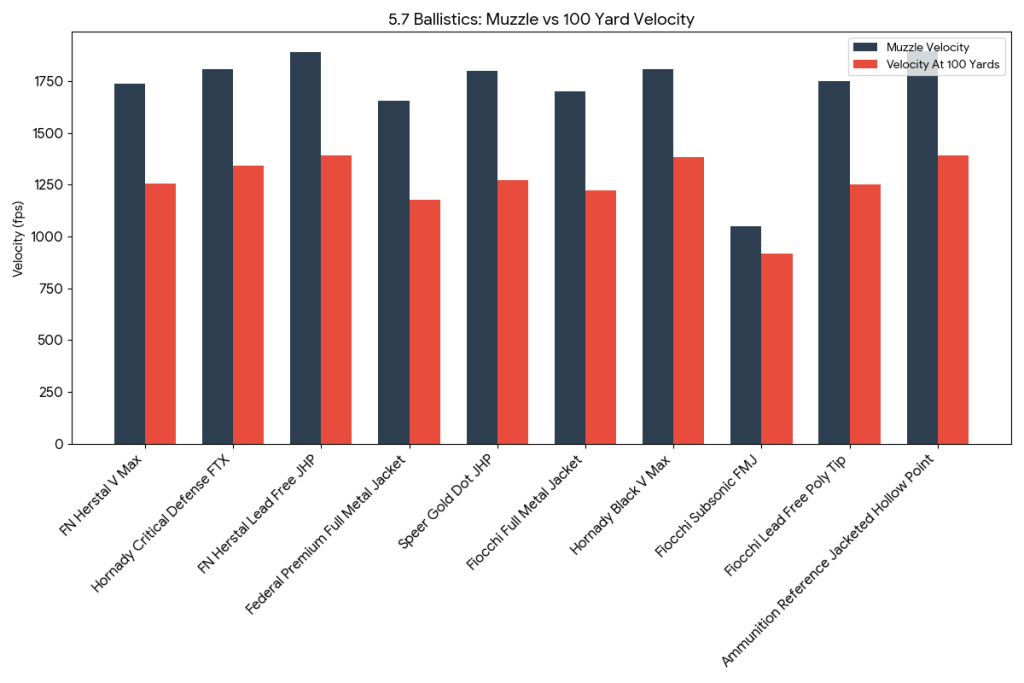
Understanding The Chart
To make the best ammunition choices for your handgun or carbine, you must understand what each column in the 5.7 Ballistics Chart represents. Ballistics terminology can be confusing for new shooters, but breaking down each measurement will clearly show how this high velocity cartridge behaves in real world applications.
Muzzle Velocity represents the speed of the bullet the exact moment it exits the barrel, measured in feet per second. Because the 5.7x28mm fires incredibly light projectiles compared to standard handguns, its muzzle velocity is extremely fast, often exceeding eighteen hundred feet per second from a short pistol barrel. Faster muzzle velocity means the bullet reaches the target quicker, giving gravity less time to pull the projectile downward during flight.
Retained Velocity shows how fast the bullet is traveling at specific yardages downrange. As the bullet pushes through the air, atmospheric drag slows it down constantly. Retained velocity matters tremendously for defense applications because expanding hollow point or polymer tipped bullets require a minimum velocity threshold to open up and create a lethal wound channel. If the lightweight bullet slows down too much before impact, it may fail to expand.
Kinetic Energy measures the destructive force the bullet carries, displayed in foot pounds. Muzzle energy calculates the initial power, while downrange energy tells you how hard the bullet will strike a target at a distance. Ethical target engagement requires sufficient kinetic energy to ensure proper terminal performance. The 5.7x28mm relies entirely on extreme speed rather than bullet weight to generate its kinetic energy.
Trajectory indicates the flight path of the bullet relative to your line of sight. Shooters typically measure trajectory as bullet drop in inches. Because it launches at hyper velocity, the 5.7x28mm has a remarkably flat trajectory out to one hundred yards. Understanding trajectory is the only way to accurately hit targets at longer distances without overshooting or shooting under the target.
Ballistic Coefficient is a mathematical value that represents how aerodynamic a bullet is during flight. A higher ballistic coefficient means the bullet cuts through the wind more efficiently, retains velocity better, and drops less over long distances. Because 5.7x28mm bullets are extremely light and relatively short, they possess low ballistic coefficients, which explains their rapid velocity loss past one hundred yards.
Sectional Density compares a bullet mass to its diameter. A higher sectional density directly correlates with deeper penetration into soft tissue and bone. Because the 5.7x28mm utilizes very light bullets for its diameter, it possesses a very low sectional density. This deliberate lack of mass limits over penetration through walls and targets, making it highly attractive for indoor defensive use.
Common 5.7 Bullet Weights
The specialized nature of the 5.7x28mm means it relies on a very narrow range of extremely lightweight bullets. Different weights serve entirely different purposes, ranging from high speed varmint loads to silent subsonic applications.
27 Grain
The 27 grain bullets are among the absolute lightest projectiles commonly available for the 5.7 platform. Originating as the lead free sporting load from FN Herstal, these lightweight projectiles achieve blistering muzzle velocities often brushing near two thousand feet per second from a handgun. They offer virtually zero recoil and an exceptionally flat trajectory out to fifty yards. However, their extreme lack of mass means they shed energy very quickly and offer shallow penetration.
30 Grain
The 30 grain category is primarily used by boutique ammunition manufacturers creating specialized solid copper or custom hollow point rounds. These bullets provide a highly balanced approach for the cartridge, giving shooters a slightly better ballistic coefficient than the lightest loads while still achieving spectacular velocities. They are well suited for high performance target shooting and small predator control where explosive expansion is desired.
35 Grain
Moving slightly heavier, the 35 grain bullet is gaining popularity with modern polymer tipped lead free offerings. This weight allows manufacturers to create a bullet long enough to fly straight while retaining enough velocity to guarantee violent expansion upon impact. Shooters often choose the 35 grain option when hunting small game in jurisdictions that completely ban traditional lead ammunition.
40 Grain
The 40 grain bullet is considered the absolute gold standard for the civilian 5.7x28mm market. Almost every major manufacturer centers their defensive and target loads around this specific weight. It offers the perfect mathematical balance of velocity, kinetic energy, and penetration depth. Whether loaded as a polymer tipped varmint round or a bonded defensive hollow point, the 40 grain bullet consistently provides reliable performance across all firearm platforms.
62 Grain
Bullets weighing 62 grains transform the hyper velocity cartridge into a completely different tool. Manufacturers load these massive projectiles to travel just below the speed of sound, eliminating the supersonic crack. When paired with a quality suppressor, a 62 grain loaded carbine or pistol becomes remarkably quiet. Because the velocity is severely restricted, these heavy bullets rely entirely on their increased mass to penetrate targets at close ranges.
Effective Hunting Range
The 5.7x28mm was explicitly designed for personal defense and military applications, not for traditional sporting purposes. While the inherent accuracy and flat trajectory are impressive, the extreme lack of kinetic energy strictly limits its ethical hunting applications. Understanding these strict limits ensures responsible shooting.
For Whitetail Deer, the 5.7x28mm is considered entirely inadequate and often illegal. The lightweight projectiles lack the momentum, sectional density, and kinetic energy required to reliably penetrate the vital cavity of a mature deer. Attempting to harvest whitetail deer with this tiny cartridge is highly unethical and strongly discouraged by wildlife management agencies across the country.
Wild Hogs are tough animals equipped with thick gristle shields over their shoulders. The 5.7x28mm generally lacks the deep penetration required to punch through the armor of a mature feral hog. While expert marksmen might successfully take small piglets with perfect ear shots at very close range, the cartridge simply does not possess enough raw power for dedicated hog hunting.
When hunting Black Bear, extreme penetration is absolutely crucial. Black bears possess dense muscle mass and heavy bones that require large diameter, deep penetrating bullets. The lightweight 5.7x28mm bullet sheds its energy instantly upon impact and will fail to reach the vital organs of a bear. Using this cartridge on a bear is dangerous and unethical.
The 5.7x28mm completely lacks the raw power to take down Elk and Moose. These massive animals require heavy, high energy projectiles to ensure a quick kill. Using a forty grain bullet on game this large will only result in a superficial wound and an unrecovered animal. No ethical hunter would ever point this cartridge at an elk or moose.
For Predator Control, the 5.7x28mm is actually quite excellent. The hyper velocity polymer tipped bullets cause explosive damage on small thin skinned predators like coyotes, foxes, and bobcats. The flat trajectory allows for precise shot placement out to one hundred yards, and the tiny bullet usually fragments inside the animal, preventing massive exit wounds and preserving valuable pelts.
In Home Defense scenarios, the 5.7x28mm shines brilliantly. A modern high capacity pistol loaded with expanding ammunition provides an incredible barrage of precise, low recoil firepower. More importantly, the lightweight bullets tend to tumble or fragment violently upon hitting drywall or soft tissue, drastically reducing the risk of lethal over penetration that plagues traditional handgun rounds.
For Target Shooting, the cartridge is incredibly enjoyable. Shooters enjoy ringing steel targets with absolute precision. The recoil is virtually non existent, making it a spectacular training tool for new shooters who might easily flinch when firing larger calibers. Pushing past one hundred yards with a carbine is an incredibly fun challenge that tests fundamental marksmanship.
Factors That Affect 5.7 Ballistics
Ballistics are never static; they change based on numerous mechanical and environmental variables. The numbers on a 5.7 Ballistics Chart provide a baseline, but actual performance in the field will fluctuate drastically based on the following critical factors.
Barrel Length directly influences muzzle velocity more than almost any other factor. The 5.7x28mm achieves vastly different results depending on the platform. A short five inch pistol barrel will generate seventeen hundred feet per second, while a sixteen inch carbine barrel allows the powder to fully burn, often boosting that exact same cartridge well past two thousand feet per second and massively increasing kinetic energy.
Bullet Weight changes the entire dynamic of the flight path. Lighter bullets fly faster and flatter but lose energy incredibly fast due to wind resistance. Heavier subsonic bullets fly much slower and drop significantly faster but retain their momentum for deeper penetration. Selecting the correct bullet weight dictates the entire ballistic performance of the firearm.
Bullet Design impacts aerodynamics and terminal performance. A sleek polymer tipped bullet cuts through the air better than a flat full metal jacket, resulting in slightly less drop at a distance. Conversely, a bonded hollow point design transfers energy more efficiently upon impact but may suffer from slightly poorer flight characteristics over longer open ranges.
Altitude plays a significant role in bullet drag. At higher elevations, the air is much thinner, which reduces atmospheric friction against the tiny bullet. A 5.7x28mm fired in the high mountains will fly slightly flatter and retain slightly more velocity at one hundred yards than the exact same load fired at sea level.
Temperature affects both the ammunition and the air density. Cold air is dense and creates more drag, pulling the fast bullet down slightly faster. Additionally, extreme cold temperatures can slow the chemical burn rate of the gunpowder inside the brass casing, resulting in noticeably lower muzzle velocities during cold winter predator hunts.
Humidity has a minor but measurable effect on ballistics. Surprisingly, humid air is less dense than dry air, meaning high humidity actually allows the bullet to fly through the atmosphere with slightly less resistance. However, for a short range cartridge like this one, humidity changes are practically negligible in the field.
Wind drift is a massive factor for all ultra lightweight projectiles. Because the 5.7x28mm fires a tiny forty grain bullet, it is highly susceptible to wind deflection. A strong crosswind will noticeably blow the lightweight bullet several inches off target before it ever reaches a one hundred yard target, demanding careful wind reading from the shooter.
Twist Rate determines the stability of the bullet inside the barrel. Most modern 5.7 barrels utilize a fast twist rate designed perfectly to stabilize standard forty grain bullets. If you attempt to shoot extreme heavy subsonic bullets through a barrel with a slower twist rate, the bullet may tumble in flight and completely destroy accuracy.
Zero Distance sets the baseline for the entire trajectory arc. Sighting your pistol in at twenty five yards creates a completely different bullet path than zeroing a carbine at one hundred yards. Because the bullet arcs, choosing the correct zero distance keeps the projectile closer to your direct line of sight during practical engagements.
Suppressor Use alters the dynamics of the barrel. Attaching a suppressor adds weight to the muzzle, which can slightly shift the point of impact. Suppressors also provide a free boost in velocity, sometimes adding ten to twenty feet per second as the trapped expanding gases continue to push the bullet forward through the internal baffle stack.
Best Zero Distance
Choosing the optimal zero distance determines how much you must hold over or under your target at different ranges. Because the 5.7x28mm behaves differently in pistols compared to long barreled carbines, selecting the right zero is critical for success.
A 25 Yard Zero is highly popular for shooters utilizing handguns for self defense. With a twenty five yard zero, the fast moving bullet stays incredibly close to the exact line of sight out to fifty yards. This zero provides an incredibly simple point and shoot capability for typical close quarters environments where visibility and reaction time are strictly limited.
A 50 Yard Zero is considered the absolute standard for carbines and personal defense weapons. By zeroing at fifty yards, the bullet impacts dead on at fifty and drops only a couple of inches at one hundred yards. This zero gives shooters the most predictable trajectory for short range target shooting and predator control without needing to perform complex ballistic calculations.
A 100 Yard Zero pushes the maximum limit of the cartridge point blank range. The bullet will strike slightly high at mid range distances before dropping directly into the center of the target at one hundred yards. This zero works well only for highly experienced shooters utilizing magnified optics on carbine platforms who intend to stretch the cartridge to its absolute limits.
A 150 Yard Zero is generally discouraged for this caliber. Because the lightweight projectile sheds velocity so rapidly, forcing a one hundred and fifty yard zero means the bullet will travel extremely high above the line of sight at closer distances. This extreme mid range trajectory makes hitting targets at standard distances very difficult.
A 200 Yard Zero is universally discouraged for the 5.7x28mm. The bullet simply lacks the aerodynamic efficiency to maintain a flat trajectory out to two hundred yards. Forcing a zero this far out completely ruins the short range effectiveness of the weapon system, completely defeating the purpose of the personal defense cartridge.
For nearly all practical applications, a twenty five yard zero provides perfect defensive capability for pistols, while a fifty yard zero provides the perfect balance of predictability and flat shooting performance for carbine platforms.
5.7 Ballistics Compared To Other Cartridges
The high velocity small caliber market features several unique options. To truly understand 5.7 ballistics, you must see how it stacks up against its historical rivals and traditional rimfire counterparts.
| Cartridge | Muzzle Velocity | Muzzle Energy | Trajectory At 100 Yards | Recoil | Effective Range | Magazine Capacity | Hunting Performance | Firearm Compatibility |
| 5.7x28mm | 1750 fps | 270 ft lbs | 0.0 inches | Very Light | 100 Yards | 20 to 50 Rounds | Varmint | Pistol Or Carbine |
| 22 WMR | 1900 fps | 320 ft lbs | 0.0 inches | Very Light | 100 Yards | Tube Or Box | Small Game | Rifle Or Revolver |
| 9mm Luger | 1150 fps | 350 ft lbs | 3.0 inches drop | Moderate | 50 Yards | 15 to 30 Rounds | Marginal | Pistol Or Carbine |
| 22 LR | 1200 fps | 130 ft lbs | 5.5 inches drop | Almost None | 50 Yards | 10 to 25 Rounds | Small Game | Universal |
| 4.6x30mm | 2350 fps | 340 ft lbs | 0.0 inches | Light | 150 Yards | 20 to 40 Rounds | Varmint | PDW Platform |
When analyzing Velocity, the 4.6x30mm takes the lead, but it is heavily restricted to military use. Among civilian available options, the 5.7x28mm delivers blistering speeds from a handgun that completely dwarf the traditional 9mm Luger. The 22 WMR achieves similar velocities only when fired from a long rifle barrel.
In terms of Energy, the 9mm Luger absolutely dominates the small high velocity rounds. The heavier bullet of the 9mm delivers significantly more kinetic energy upon impact. The 5.7x28mm provides superior energy to the 22 LR but requires specialized expanding bullets to match the terminal tissue damage of the 9mm.
Trajectory reveals the ultimate advantage of lightweight fast bullets. The 5.7x28mm shoots incredibly flat, dropping virtually zero inches at one hundred yards when properly zeroed. The heavier and slower 9mm Luger drops rapidly past fifty yards, while the 22 LR arcs like a mortar at extended ranges.
Recoil management is the absolute best feature of the 5.7x28mm. It generates roughly thirty percent less felt recoil than a standard 9mm, making it universally pleasant to shoot and allowing for lightning fast follow up shots. The 22 LR offers the least recoil overall, while the 9mm produces noticeably more muzzle flip.
Magazine Capacity highlights the massive tactical advantage of the bottleneck cartridge. The tiny diameter of the 5.7x28mm allows standard flush fit pistol magazines to hold twenty rounds, while extended carbine magazines hold fifty rounds flawlessly. Traditional 9mm pistols typically max out at fifteen or seventeen rounds in a flush fit configuration.
For Hunting Performance, none of these cartridges are suited for large game. The 22 LR and 22 WMR are legendary small game rounds. The 5.7x28mm serves as an excellent flat shooting varmint round, outperforming the 9mm on coyotes due to its explosive terminal ballistics and superior accuracy at distance.
Regarding Firearm Compatibility, the 9mm and 22 LR are the most universal cartridges on the planet. However, the 5.7x28mm is rapidly gaining massive industry support, with nearly every major manufacturer now producing incredibly reliable high capacity handguns and tactical carbines specifically chambered for the round.
Ultimately, if you want massive power and deep penetration, the 9mm wins. If you want cheap backyard plinking, the 22 LR is superior. But if you need an ultra low recoil centerfire option that shoots incredibly flat and holds twenty rounds in a standard handgun grip, the 5.7x28mm stands completely unmatched.
Frequently Asked Questions
What Is A 5.7 Ballistics Chart?
A 5.7 Ballistics Chart is a specialized data table that tracks the speed, energy, and physical drop of the lightweight projectile as it travels over specific distances. It helps shooters understand precisely how their ammunition will perform in real world conditions, allowing for accurate aiming and proper self defense application.
How Far Is A 5.7x28mm Effective?
The practical effective range of the 5.7x28mm is strictly limited to one hundred yards for varmint hunting and personal defense. While the bullet will travel much further, it loses velocity so rapidly that it drops severely and completely lacks the kinetic energy required for reliable expansion past that distance.
How Much Does A 5.7 Bullet Drop At 100 Yards?
When utilizing a standard fifty yard zero on a carbine, a typical forty grain 5.7x28mm bullet will drop virtually zero inches at one hundred yards. It provides an exceptionally flat trajectory that requires absolutely no hold over when shooting at practical short range distances.
Is The 5.7x28mm Good For Deer Hunting?
No, the 5.7x28mm is considered a highly unethical and often illegal cartridge for deer hunting. It requires heavy kinetic energy and deep penetration to humanely harvest deer, and the tiny lightweight projectile simply sheds energy too fast and fails to penetrate deeply enough to reach the vital organs.
Can The 5.7x28mm Take Down A Bear?
No, utilizing this caliber for bear hunting or bear defense is highly dangerous and entirely unethical. Bears possess thick hide, dense muscle, and heavy bones that require deep penetrating large caliber bullets. The lightweight bullet simply lacks the mass required to reliably penetrate a bear.
What Is The Best Bullet Weight For The 5.7x28mm?
The forty grain bullet is universally considered the absolute best overall weight for the 5.7x28mm. It provides the perfect mathematical balance of reliable feeding, fast muzzle velocity, adequate kinetic energy, and proper terminal expansion across all major firearm platforms.
What Is The Best Zero Distance For A 5.7x28mm?
The optimal zero distance for a handgun is twenty five yards, which perfectly matches the typical defensive engagement distance. For a carbine, a fifty yard zero creates a practical point blank range that allows the shooter to hit center mass out to one hundred yards without adjusting their aim.
Is The 5.7x28mm Better Than The 9mm?
Neither is objectively better; they serve entirely different purposes. The 9mm hits significantly harder, penetrates deeper, and is vastly cheaper to practice with. The 5.7x28mm offers drastically lower recoil, shoots incredibly flat, drastically reduces the risk of over penetration through interior walls, and allows for higher magazine capacities.
Can The 5.7x28mm Be Used With A Suppressor?
Absolutely, the cartridge is exceptionally popular for suppressor use. While standard high velocity ammunition will still produce a supersonic crack, pairing a quality suppressor with specialized sixty two grain subsonic ammunition results in a remarkably quiet weapon system ideal for indoor range training.
Is The 5.7x28mm Just An Expensive 22 Magnum?
While they share similar ballistic numbers on paper, they are completely different. The 22 Magnum requires a long rifle barrel to achieve high velocities and utilizes rimfire priming which is inherently less reliable. The 5.7x28mm achieves those same velocities from a short pistol barrel and utilizes extremely reliable centerfire ignition required for duty use.
Conclusion
Understanding a 5.7 Ballistics Chart is absolutely vital for anyone wielding this incredibly unique high velocity cartridge. Because this innovative round relies heavily on blistering speed rather than heavy bullet mass to generate its short range kinetic energy, mastering the flat trajectory curve and understanding the rapid velocity drop off ensures you fully comprehend the strict physical limitations of the weapon system.
Whether you are building a dedicated varmint control carbine, introducing a new shooter to the range with an ultra low recoil platform, or loading a high capacity modern pistol for close quarters home defense, studying 5.7 Ballistics gives you a perfectly clear picture of its capabilities. By acknowledging its specific limits and matching the correct bullet weight to your specific application, you can safely and effectively utilize the legendary 5.7x28mm to its absolute maximum potential.