This ballistic chart for 7mm-08 provides a complete overview of trajectory, velocity, energy, and wind drift out to 1,000 yards. Hunters and long-range shooters rely on this data to make precise elevation and windage adjustments, ensuring ethical and accurate shots at extended distances. The trajectory data below reflects the highly popular Hornady Superformance 139 gr SST factory hunting load zeroed at 200 yards. Keep in mind that actual performance will vary slightly depending on your specific barrel length, ammunition lot, altitude, and current weather conditions.
Table of Contents [Click to open]
Ballistic Chart for 7mm-08
Load: Hornady Superformance 139 gr SST (200-Yard Zero | 0.486 G1 BC)
| Range (yards) | Velocity (fps) | Energy (ft-lbs) | Bullet Drop (inches) | Bullet Drop (MOA) | Bullet Drop (MIL) | Wind Drift (10 mph Crosswind) | Time of Flight (seconds) | Remaining Energy (%) |
| 0 | 2950 | 2686 | -1.5 | 0.0 | 0.0 | 0.0″ | 0.000 | 100% |
| 100 | 2757 | 2346 | +1.5 | -1.4 | -0.4 | 0.6″ | 0.105 | 87% |
| 200 | 2572 | 2042 | 0.0 | 0.0 | 0.0 | 2.5″ | 0.218 | 76% |
| 300 | 2395 | 1770 | -6.8 | 2.2 | 0.6 | 6.0″ | 0.339 | 66% |
| 400 | 2224 | 1527 | -19.7 | 4.7 | 1.4 | 11.2″ | 0.469 | 57% |
| 500 | 2061 | 1311 | -39.6 | 7.6 | 2.2 | 18.5″ | 0.609 | 49% |
| 600 | 1904 | 1119 | -67.7 | 10.8 | 3.1 | 28.0″ | 0.760 | 42% |
| 700 | 1755 | 951 | -105.5 | 14.4 | 4.2 | 40.0″ | 0.924 | 35% |
| 800 | 1616 | 805 | -154.9 | 18.5 | 5.4 | 54.8″ | 1.102 | 30% |
| 900 | 1487 | 683 | -218.4 | 23.2 | 6.7 | 72.8″ | 1.296 | 25% |
| 1000 | 1371 | 580 | -298.8 | 28.5 | 8.3 | 94.0″ | 1.507 | 22% |
Ballistic Chart for 7mm-08 Image
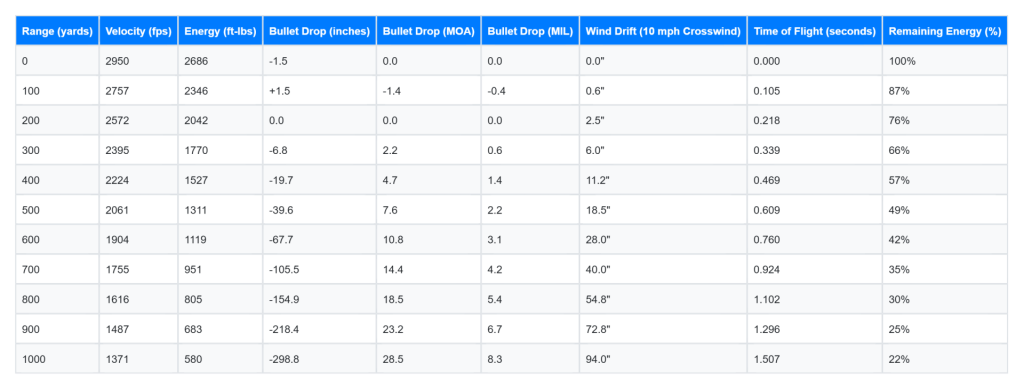
How to Read the 7mm-08 Ballistic Chart
- Range (yards): The distance from the muzzle to the target.
- Velocity (fps): The speed of the bullet measured in feet per second.
- Energy (ft-lbs): The kinetic power of the bullet, crucial for ethical hunting.
- Bullet Drop (inches): The physical distance the bullet falls from the line of sight.
- Bullet Drop (MOA / MIL): The angular adjustments needed on your rifle scope to hit the target.
- Wind Drift: How far a 10 mph crosswind blows the bullet horizontally in inches.
- Time of Flight: How long it takes the bullet to reach the target in seconds.
- Remaining Energy (%): The percentage of muzzle energy the bullet retains downrange.
Velocity Performance
The 7mm-08 pushes a 139-grain bullet out of the muzzle at an impressive 2,950 fps in the Superformance load. Muzzle velocity dictates how flat a bullet shoots and how hard it hits.
As the bullet travels downrange, air resistance slows it down. The 7mm-08 retains its speed exceptionally well thanks to the high ballistic coefficient of 7mm bullets. It stays supersonic (above ~1,125 fps) well past 1,000 yards, which prevents accuracy-destroying turbulence associated with transonic flight.
Energy Performance
Muzzle energy for this 7mm-08 load is a potent 2,686 ft-lbs. Retained energy is the primary factor in determining effective hunting range.
For medium game like deer, an impact energy of at least 1,000 ft-lbs is widely recommended. As the 7mm-08 energy chart shows, the 139 gr SST stays above that threshold past 600 yards. For larger game like elk, 1,500 ft-lbs is preferred, making this load a reliable elk cartridge out to 400 yards.
Bullet Drop
Trajectory is flat out to 300 yards, dropping only 6.8 inches with a 200-yard zero. This means a hunter can hold dead-center on a deer’s vitals from zero to roughly 250 yards without dialing the scope.
Beyond 400 yards, gravity and decreasing velocity cause the 7mm-08 bullet drop chart to curve sharply downward. At 600 yards, the bullet drops over 5 feet (67.7 inches). Shooters must rely on the MOA or MIL column to dial their scope turrets for accurate hits at these extended ranges.
Wind Drift
Wind deflection is often the hardest variable to master in long-range shooting. A 10 mph crosswind pushes the 7mm-08 bullet just 6 inches at 300 yards, but that drift expands rapidly to 28 inches at 600 yards.
The 7mm-08 excels here because 7mm (.284 caliber) bullets typically boast high ballistic coefficients (BC). A high BC means the bullet cuts through the wind more efficiently, resulting in less horizontal drift compared to many .308 Winchester loads.
Time of Flight
Time of flight dictates how much time environmental variables have to act on the bullet. A bullet taking 1.5 seconds to reach 1,000 yards gives wind gusts plenty of time to push the projectile off course.
In hunting scenarios, long flight times (over 0.5 seconds) also increase the risk of an animal taking a step before the bullet arrives, leading to a poor hit.
Effective Hunting Range
The 7mm-08 is widely celebrated as a highly versatile big-game cartridge. Its combination of mild recoil, flat trajectory, and heavy-hitting 7mm bullets makes it effective on a wide variety of North American game.
| Species | Min. Recommended Energy (ft-lbs) | Max Ethical Range (139 gr SST) |
| Whitetail Deer | 1,000 | ~650 yards |
| Mule Deer | 1,000 | ~650 yards |
| Antelope | 800 | ~800 yards |
| Black Bear | 1,200 | ~550 yards |
| Elk | 1,500 | ~400 yards |
Long-Range Performance
The 7mm-08 trajectory to 1,000 yards is highly capable for ringing steel targets and recreational precision shooting. The cartridge shares the same parent case as the .308 Winchester but utilizes sleeker, more aerodynamic bullets.
However, when compared to modern, purpose-built long-range cartridges like the 6.5 Creedmoor or 7mm PRC, the 7mm-08 has some limitations. It was designed before long, heavy-for-caliber bullets became the standard, meaning some factory rifles lack the fast twist rates needed to stabilize modern 160+ grain match bullets.
Best Factory Loads for 7mm-08
| Manufacturer | Bullet | Bullet Weight (gr) | Ballistic Coefficient (G1) | Muzzle Velocity (fps) | Primary Use |
| Hornady | SST Superformance | 139 | 0.486 | 2,950 | Medium Game Hunting |
| Federal Premium | Fusion | 140 | 0.439 | 2,820 | Deer Hunting |
| Nosler | AccuBond | 140 | 0.485 | 2,825 | Big Game Hunting |
| Barnes | VOR-TX TTSX | 120 | 0.350 | 3,005 | Medium/Large Game |
| Winchester | Deer Season XP | 140 | 0.484 | 2,800 | Deer/Antelope |
| Remington | Core-Lokt | 140 | 0.390 | 2,860 | Deer/Medium Game |
Factors That Affect 7mm-08 Ballistics
A ballistic chart is a baseline. Real-world trajectory shifts based on several key variables:
- Barrel length: Shorter barrels (like 18-inch mountain rifles) produce lower muzzle velocities, increasing bullet drop.
- Bullet weight & design: Heavier bullets start slower but retain energy better at long ranges.
- Altitude & Air pressure: Thinner air at high elevations results in flatter trajectories and less wind drift.
- Temperature: Hotter temperatures generally increase muzzle velocity and reduce air density.
- Wind: Wind direction and speed constantly alter horizontal impact.
- Rifle zero distance: A 100-yard zero will yield completely different drop values than a 200-yard zero.
Is the 7mm-08 a Good Hunting Cartridge?
The 7mm-08 is widely considered one of the most efficient, well-rounded hunting cartridges ever designed.
- Accuracy: Inherently accurate and easy to load for, making it ideal for precision hunting.
- Recoil: It offers roughly 20% less recoil than a standard .270 Winchester or .30-06, reducing flinching and allowing for faster follow-up shots.
- Trajectory: Flat enough for “point-and-shoot” hunting inside 300 yards.
- Hunting versatility: Capable of cleanly harvesting everything from coyotes and antelope to elk and moose with proper bullet selection.
- Ammunition availability: It remains highly popular, ensuring consistent availability of factory loads across most major retailers.