The main difference between the .300 Winchester Short Magnum (WSM) and the .30-06 Springfield is their design philosophy and ballistic output: the .300 WSM is a modern, high-velocity magnum packed into a compact, short-action platform, whereas the .30-06 Springfield is a legendary, long-action standard that provides versatile performance with manageable recoil. Although both utilize the same .30-caliber bullet diameter, the .300 WSM delivers higher velocities and a flatter trajectory for long-range work, whereas the .30-06 offers a more comfortable shooting experience and wider ammunition availability. Choosing between them depends on whether your priority is maximum ballistic efficiency in a lightweight rifle or the proven, all-around reliability of a classic caliber, making this 300 WSM vs 30-06 ballistics chart comparison essential for your next hunt.
Table of Contents [Click to minimize]
300 WSM vs 30-06 Ballistics Chart
| Feature | .300 WSM | .30-06 Springfield |
| Parent Cartridge | .300-250 Savage | .30-03 Springfield |
| Year Introduced | 2001 | 1906 |
| Bullet Diameter | .308″ | .308″ |
| Typical Bullet Weight | 150–180 gr | 150–180 gr |
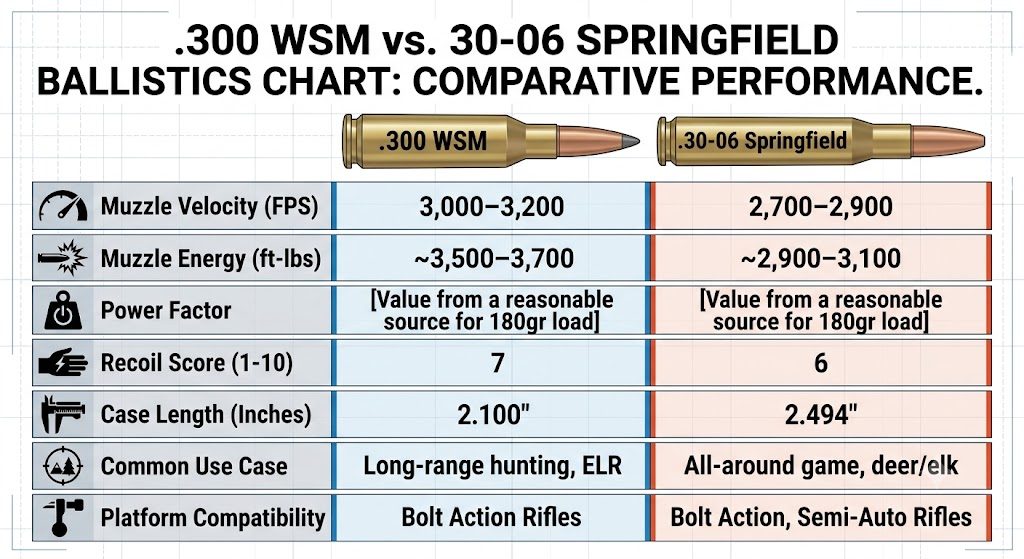
| Muzzle Velocity (Typical) | 3,000–3,200 fps | 2,700–2,900 fps |
| Muzzle Energy (Typical) | ~3,500–3,700 ft-lbs | ~2,900–3,100 ft-lbs |
| SAAMI Max Pressure | 65,000 psi | 60,000 psi |
| Typical Twist Rate | 1:10″ | 1:10″ |
| Recoil Energy | ~22–27 ft-lbs | ~18–20 ft-lbs |
| Effective Hunting Range | 600+ yards | 400–500 yards |
| Best Application | Long-range hunting, ELR | All-around game, deer/elk |
Muzzle Velocity Comparison
The .300 WSM consistently produces higher muzzle velocities compared with the .30-06 Springfield. By utilizing a short, fat powder column that burns more efficiently, the .300 WSM typically outpaces the .30-06 by 200 to 300 fps with similar bullet weights. While the .30-06 remains highly effective at standard hunting distances, the .300 WSM provides a velocity edge that helps maintain flatter flight paths at extended ranges.
Muzzle Energy Comparison
There is a noticeable difference in power output, with the .300 WSM generating significantly higher muzzle energy—often exceeding 3,500 ft-lbs—compared with the roughly 3,000 ft-lbs of the .30-06. On the other hand, the .30-06 is more than adequate for almost any big game in North America. However, for hunters targeting larger or tougher animals at longer distances, the .300 WSM delivers more kinetic energy and deeper terminal penetration compared to the .30-06.
Downrange Energy Comparison
As distance increases, the higher velocity of the .300 WSM ensures it retains energy better than the .30-06. At 500 yards, the .300 WSM often maintains performance levels that the .30-06 struggles to match without significant bullet drop compensation. The .300 WSM is designed specifically to bridge the gap between standard cartridges and full-length magnum performance, whereas the .30-06 is intended for efficiency within traditional hunting ranges.
Bullet Drop and Trajectory
The .300 WSM features a flatter trajectory due to its increased velocity, requiring less holdover for long-range shots compared with the .30-06. While the .30-06 is easy to shoot at moderate distances, the .300 WSM is superior for open-country hunting where gauging drop is critical. If your hunt involves shots routinely beyond 400 yards, the .300 WSM provides a distinct advantage compared to the more arched trajectory of the .30-06.
Recoil Comparison
Recoil is the most significant trade-off when choosing the .300 WSM. Because it achieves magnum-level performance in a lighter, short-action rifle, it kicks harder than the .30-06. Most hunters find the .30-06 recoil to be well within comfortable limits, whereas the .300 WSM can be punishing, particularly in very lightweight rifles, making the .30-06 a better choice for shooters sensitive to recoil.
Ammunition Availability
The .30-06 Springfield is arguably the most widely available big-game cartridge in the world, with countless factory loads found in almost any gun shop. In contrast, while the .300 WSM is popular, it is not as ubiquitous as the .30-06. If ammunition availability and cost-effectiveness are your main concerns, the .30-06 is the superior choice compared to the more specialized .300 WSM.
Which Is Better?
The .30-06 Springfield is better for the average hunter who wants a versatile, time-tested “do-it-all” rifle. It is widely available, easy to shoot, and perfectly capable of taking any North American big game at reasonable distances. It remains a gold standard for those who value tradition, lower recoil, and accessible ammunition.
The .300 WSM is better for the backcountry or western hunter who needs the power and flat-shooting capability of a magnum but wants to maintain a lighter, faster-handling, short-action rifle. If you specialize in long-range precision or hunting in wide-open terrain, the performance gains of the .300 WSM make it the superior choice compared to the standard .30-06.
FAQ
Is .300 WSM a true magnum?
Yes, the .300 WSM provides ballistic performance that essentially rivals the classic .300 Winchester Magnum but does so using a shorter, more efficient case design.
Which is better for elk?
Both are excellent for elk, but the .300 WSM is often preferred by those hunting at longer distances because it carries more downrange energy and is flatter shooting.
Is .30-06 enough for 500-yard shots?
Yes, the .30-06 can be effective at 500 yards with proper bullet selection and practice, though it will require more precise range estimation and holdover compared to a magnum like the .300 WSM.
Why would I choose a short action?
A short-action rifle, like those chambered for the .300 WSM, is typically lighter, stiffer, and cycles faster, making it an ideal platform for hunters who carry their rifle over long distances in the mountains.
300 WSM vs 30-06 Ballistics Comparison
This video provides an excellent visual and practical head-to-head comparison of how the .300 WSM outperforms the .30-06 Springfield in terms of raw velocity and effective range.