The main difference between the 204 Ruger and .223 Remington is that the 204 Ruger pushes lighter bullets at significantly higher velocities to create a remarkably flat trajectory with less recoil, while the .223 Remington fires heavier bullets that deliver greater kinetic energy and unmatched ammunition versatility. Built specifically as a high speed varmint hunting round, the 204 Ruger excels at long distances across open fields where minimizing bullet drop is the absolute priority. Because the 204 Ruger travels over 4,000 feet per second at the muzzle, it eliminates much of the guesswork associated with elevation holdovers. The .223 Remington, on the other hand, is the quintessential utility cartridge. It provides shooters with heavier projectile options, longer barrel life, and widespread availability, making it the practical choice for everything from target shooting and home defense to medium game hunting within appropriate distances.
204 Ruger vs 223 Ballistics Chart
| Specification / Metric | 204 Ruger (32 gr V-Max) | .223 Remington (55 gr V-Max) |
| Cartridge | .204 Ruger | .223 Remington |
| Parent Case | .222 Remington Magnum | .222 Remington |
| Bullet Diameter | .204 inches | .224 inches |
| Typical Bullet Weight | 24 to 45 grains | 55 to 77 grains |
| Muzzle Velocity | 4,225 fps | 3,240 fps |
| Velocity at 100 Yards | 3,645 fps | 2,865 fps |
| Velocity at 200 Yards | 3,137 fps | 2,518 fps |
| Velocity at 300 Yards | 2,683 fps | 2,198 fps |
| Velocity at 500 Yards | 1,899 fps | 1,634 fps |
| Muzzle Energy | 1,268 ft-lbs | 1,282 ft-lbs |
| Energy at 100 Yards | 944 ft-lbs | 1,002 ft-lbs |
| Energy at 200 Yards | 699 ft-lbs | 774 ft-lbs |
| Energy at 300 Yards | 512 ft-lbs | 589 ft-lbs |
| Energy at 500 Yards | 256 ft-lbs | 326 ft-lbs |
| Bullet Drop (500 Yds, 200 Yd Zero) | -29.0 inches | -43.5 inches |
| Wind Drift (500 Yds, 10 mph Wind) | 31.6 inches | 35.0 inches |
| Ballistic Coefficient (G1) | 0.170 to 0.275 | 0.250 to 0.350 (varmint loads) |
| Sectional Density | 0.110 to 0.137 | 0.157 to 0.219 |
| Effective Hunting Range | 400+ yards (varmints) | 300 yards (medium game) |
| Maximum Effective Range | 600 yards | 600 yards |
| Typical Twist Rate | 1:12 | 1:7 to 1:12 |
| Recoil (Free Recoil Energy) | ~3.8 ft-lbs | ~4.5 ft-lbs |
| Trajectory | Incredibly flat | Arcs moderately past 300 yds |
| Barrel Life | 3,000 to 4,000 rounds | 8,000 to 10,000+ rounds |
| Accuracy Potential | Excellent | Excellent |
| Hunting Performance | Varmints and small game | Varmints to small deer |
| Target Shooting | Extremely precise | Excellent general purpose |
| Long-Range Performance | Supersonic past 600 yards | Supersonic past 600 yards |
| Ammunition Availability | Moderate | Exceptionally high |
| Ammunition Cost | Moderate to high | Low to moderate |
| Rifle Availability | Limited but steady | Universal |
| Magazine Compatibility | Standard AR-15 magazines | Standard AR-15 magazines |
| Suppressor Compatibility | Excellent | Excellent |
| Best Use Cases | Prairie dogs, coyotes | Plinking, defense, hunting |
| Main Advantages | Extreme velocity, flat shooting | Ammo cost, heavier bullets |
| Main Disadvantages | Poor energy retention | More drop at distance |
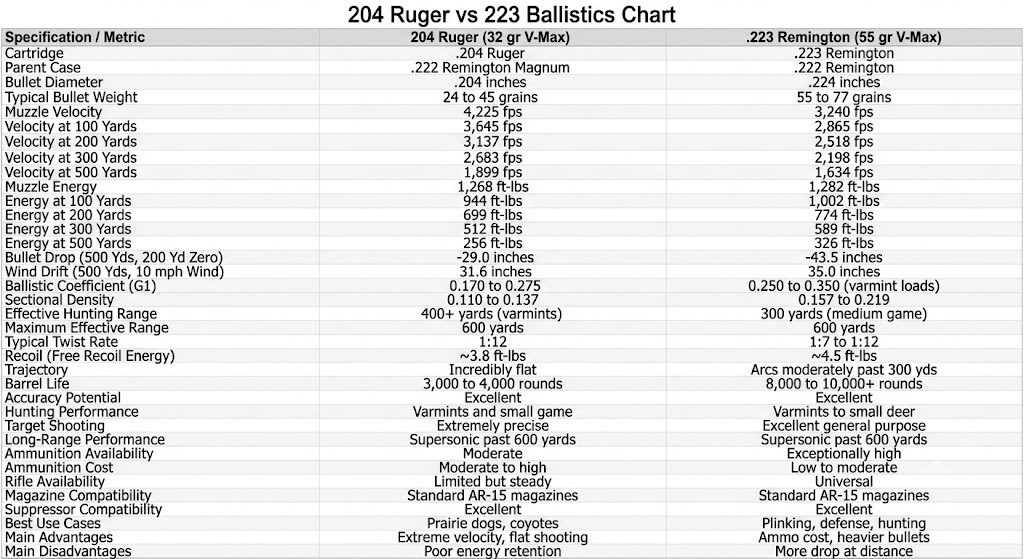
The comparison table above clearly illustrates how raw velocity shapes the performance of the 204 Ruger against the heavier bullets of the .223 Remington. Right out of the barrel, the 204 Ruger holds a massive speed advantage, clearing 4,200 feet per second. This blistering speed is the direct cause of the cartridge’s remarkably flat trajectory. The 204 Ruger simply drops less than the .223 Remington over identical distances.
However, speed alone does not guarantee power. Because the .223 Remington uses significantly heavier projectiles, it actually retains kinetic energy slightly better than the 204 Ruger at extended ranges. While the 204 Ruger arrives at the target faster and flatter, the .223 Remington hits with a bit more authority.
For the dedicated varmint hunter targeting small pests out to 400 yards, the flatter trajectory of the 204 Ruger makes it much easier to connect with tiny targets. For shooters looking for a highly versatile rifle capable of everything from range training to home defense, the .223 Remington offers more economical ammunition and a broader range of practical applications. Both cartridges offer negligible recoil, making them excellent choices for high volume shooting or introducing beginners to centerfire rifles.
Detailed Comparison Sections
Understanding the Comparison Chart
To fully grasp the differences between these two cartridges, you must look at how bullet weight and velocity interact. The 204 Ruger relies entirely on velocity to achieve its performance. The .223 Remington takes a more balanced approach, pairing moderate velocity with more substantial bullet mass.
How to Read the Ballistics Chart
When analyzing the ballistics chart, pay close attention to velocity at distance, kinetic energy, and bullet drop. Velocity determines how quickly a bullet reaches the target. Kinetic energy is the hitting power transferred upon impact. Bullet drop shows the arc of the projectile, which directly dictates how difficult it will be to aim at distant targets.
Velocity Comparison
The 204 Ruger is one of the fastest factory loaded cartridges in the world. With a 32 grain bullet, it easily surpasses 4,200 fps at the muzzle. A standard 55 grain .223 Remington leaves the barrel around 3,240 fps. That nearly 1,000 fps difference means the 204 Ruger reaches the target considerably faster, giving small game less time to move before impact. At 500 yards, the 204 Ruger is still traveling at 1,899 fps, outpacing the 1,634 fps of the .223 Remington.
Energy Comparison
While the 204 Ruger is significantly faster, the .223 Remington is heavier. At the muzzle, both cartridges generate roughly the same kinetic energy, hovering around 1,270 foot pounds. However, as the light 32 grain bullet of the 204 Ruger encounters air resistance, it sheds energy quickly. By 500 yards, the heavier 55 grain bullet of the .223 Remington retains 326 ft-lbs of energy compared to the 256 ft-lbs of the 204 Ruger.
Trajectory Comparison
Trajectory is where the 204 Ruger absolutely dominates. Because the bullet is traveling incredibly fast, gravity has less time to pull it downward over a given distance.
Bullet Drop Comparison
If both rifles are zeroed at 200 yards, the difference in drop becomes obvious at extreme ranges. At 500 yards, the 204 Ruger drops only 29 inches. The .223 Remington drops roughly 43.5 inches. This 14 inch difference means a shooter using the 204 Ruger has a much wider margin of error when estimating distance in the field.
Wind Drift Comparison
Lightweight bullets are traditionally vulnerable to wind, but the high velocity of the 204 Ruger helps compensate for its lack of mass. In a 10 mph crosswind at 500 yards, the 204 Ruger will drift about 31.6 inches. The .223 Remington will drift about 35 inches. The faster flight time of the 204 means the wind has less time to push the bullet off course.
Ballistic Coefficient Comparison
Ballistic Coefficient measures how efficiently a bullet slices through the air. The short, light bullets of the 204 Ruger typically have low BC numbers ranging from 0.170 to 0.275. The .223 Remington generally utilizes slightly longer, heavier bullets with BC numbers between 0.250 and 0.350 for standard varmint loads. The higher BC of the .223 Remington is the reason it retains its kinetic energy better at extended distances.
Accuracy Comparison
Both cartridges are incredibly accurate. In a high quality bolt action or AR-15 platform, both are capable of shooting sub-MOA groups. The functional accuracy advantage goes to the 204 Ruger in the field, simply because its flat trajectory requires fewer elevation adjustments when engaging small targets at unknown distances.
Effective Range Comparison
Both cartridges are highly effective out to 500 yards for target shooting. For practical hunting applications, the 204 Ruger is devastating on small pests out to 400 yards. The .223 Remington has a similar effective range on varmints but brings enough energy to take medium game like coyotes and small deer within 200 to 300 yards.
Hunting Performance Comparison
If you are clearing a field of prairie dogs, the 204 Ruger is the superior tool. The extreme velocity causes explosive fragmentation upon impact, and the flat trajectory ensures high hit probabilities. If you are hunting larger predators or taking ethical shots on small whitetail deer where legally permitted, the heavier bullets and deeper penetration of the .223 Remington make it the better choice.
Target Shooting Comparison
For casual range use, the .223 Remington is the undisputed champion due to the availability of cheap practice ammunition. If your goal is precision benchrest shooting or punching paper at 300 yards with minimal recoil, the 204 Ruger offers a laser flat path that makes target shooting incredibly satisfying.
Long-Range Performance Comparison
Neither cartridge is designed for true 1,000 yard precision shooting. They both perform best inside 600 yards. Within that window, the 204 Ruger provides the flatter arc, while the .223 Remington provides slightly better energy retention.
Recoil Comparison
Both of these cartridges are famous for their mild recoil. The .223 Remington produces about 4.5 ft-lbs of free recoil energy in a standard rifle. The 204 Ruger produces even less, coming in around 3.8 ft-lbs. This essentially non-existent recoil allows shooters to keep their eyes in the scope, watch their own bullet impacts, and take rapid follow up shots.
Barrel Life Comparison
Shooting a bullet at 4,200 feet per second creates intense heat and pressure inside the barrel. Because of this, the 204 Ruger is considered a barrel burner. Accuracy will typically degrade after 3,000 to 4,000 rounds. The .223 Remington is incredibly gentle on barrels, often maintaining excellent precision well past 8,000 to 10,000 rounds.
Ammunition Cost Comparison
The .223 Remington is one of the most affordable centerfire rifle cartridges available today. You can buy bulk ammunition for a fraction of the cost of premium hunting rounds. The 204 Ruger is a niche cartridge. Ammunition is almost exclusively manufactured with premium varmint bullets, making it significantly more expensive per round than standard .223 ammunition.
Ammunition Availability
You can walk into any hardware store or sporting goods shop in the country and find boxes of .223 Remington. The 204 Ruger is much harder to find on store shelves. While you can easily order it online, you cannot rely on local stores to always have 204 Ruger in stock.
Rifle Compatibility
The .223 Remington is the standard chambering for the incredibly popular AR-15 platform, as well as nearly every bolt action rifle line on the market. The 204 Ruger was designed to utilize the same bolt face and magazines as the .223 Remington. You can convert an AR-15 to shoot 204 Ruger simply by swapping the barrel, making it an easy upgrade for varmint hunters.
Pros and Cons of 204 Ruger
Pros:
- Laser flat trajectory out to 400 yards.
- Practically zero recoil.
- Extreme muzzle velocities.
- Perfect for high volume varmint hunting.
Cons:
- Expensive premium ammunition.
- Shorter barrel life.
- Low energy retention for larger game.
Pros and Cons of .223 Remington
Pros:
- Exceptionally cheap and abundant ammunition.
- Excellent barrel life.
- Can fire heavier bullets for larger game.
- Universal rifle and parts compatibility.
Cons:
- More bullet drop than high speed varmint rounds.
- Slower flight time to target.
Which Cartridge Is Better for Beginners?
The .223 Remington is the best possible choice for beginners. The recoil is negligible, the rifles are easy to find, and most importantly, the ammunition is cheap enough to allow for regular, high volume practice.
Which Cartridge Is Better for Hunting?
For strictly hunting prairie dogs, groundhogs, and small pests, the 204 Ruger is the clear winner due to its flat trajectory and explosive terminal performance. For coyotes, feral hogs, or deer, the heavier bullets of the .223 Remington offer the necessary penetration and energy required for an ethical harvest.
Which Cartridge Is Better for Long-Range Shooting?
If long range means shooting varmints at 500 yards, the 204 Ruger takes the crown. Its minimal bullet drop takes the math out of the equation. If long range means target shooting past 600 yards, shooters will eventually favor the .223 Remington simply because they can load heavier 77 grain match bullets that buck the wind much better.
Which Cartridge Should You Choose?
Choose the 204 Ruger if you are a dedicated varmint hunter who wants a specialized tool for shooting small targets across windy, open plains. Choose the .223 Remington if you want a reliable, versatile, and affordable rifle that can serve multiple roles from training to home defense.
Verdict
The 204 Ruger and the .223 Remington are both exceptional cartridges, but they serve different masters. The 204 Ruger is a highly specialized scalpel. It is engineered specifically to send lightweight projectiles at blistering speeds, providing varmint hunters with an incredibly flat trajectory and zero recoil. The .223 Remington is a versatile workhorse. It sacrifices some of that extreme velocity in exchange for heavier bullets, cheaper ammunition, and longer barrel life. If your sole purpose is eradicating small pests at distance, the 204 Ruger will perform flawlessly. For almost any other application, the affordability and utility of the .223 Remington make it the smarter investment.
FAQs
Can you shoot 204 Ruger out of an AR-15?
Yes. The 204 Ruger utilizes the same bolt face and magazines as a standard 5.56 or .223 AR-15. To safely fire 204 Ruger, you only need to install a dedicated 204 Ruger barrel.
Is 204 Ruger good for coyotes?
The 204 Ruger is highly effective on coyotes out to roughly 300 yards. The high velocity creates massive internal damage, and the bullet rarely exits the animal, which is highly preferred by hunters looking to save the pelt.
Why is 204 Ruger ammo so expensive?
Unlike the .223 Remington, which is produced by the millions for military and training applications, the 204 Ruger is a niche hunting cartridge. Manufacturers load it almost exclusively with premium polymer tipped hunting bullets, which drives up the cost per round.
What is the effective range of a .223 for hunting?
For small varmints, the .223 Remington is highly effective out to 400 yards. For medium game like coyotes or small deer, hunters should limit their shots to 200 or 300 yards to ensure the bullet retains enough energy for a clean kill.
Does a 204 Ruger have less recoil than a 223?
Yes. Because the 204 Ruger fires significantly lighter bullets, it generates slightly less free recoil energy than the .223 Remington. Both cartridges, however, recoil so softly that the difference is difficult to feel.