The main difference between the cartridges is that the .480 Ruger utilizes a wider, much heavier bullet traveling at moderate velocities to deliver massive momentum and deep penetration with manageable recoil, whereas the .454 Casull utilizes slightly narrower bullets driven at extreme hyper-velocities to generate blistering kinetic energy and devastating hydrostatic shock at the cost of severely punishing recoil.
480 Ruger vs 454 Casull Comparison
| Feature | .480 Ruger | .454 Casull |
| Bullet Diameter | 0.475 inches (12.1 mm) | 0.452 inches (11.5 mm) |
| Typical Bullet Weight | 275 gr to 410 gr (typically 325 gr or 400 gr) | 240 gr to 360 gr (typically 240 gr or 300 gr) |
| Muzzle Velocity | 1,100 to 1,350 fps (7.5-inch barrel) | 1,400 to 1,900 fps (7.5-inch barrel) |
| Muzzle Energy | 1,000 to 1,300 ft-lbs | 1,500 to 1,900+ ft-lbs |
| Momentum | ~55 to ~68 lb-fps | ~55 to ~65 lb-fps |
| Maximum Pressure | 48,000 psi (SAAMI) | 65,000 psi (SAAMI) |
| Ballistic Coefficient | Low (~0.160 to 0.220) | Low (~0.150 to 0.200) |
| Penetration | Extreme (Straight-line crushing depth) | Extreme (High-velocity bone shattering) |
| Expansion | 0.70 to 0.85 inches | 0.65 to 0.80 inches |
| Trajectory | Arcing past 75 yards | Very flat out to 100 yards |
| Recoil | Heavy “Shove” (~22 to 26 ft-lbs) | Violent, sharp “Snap” (~35 to 40+ ft-lbs) |
| Effective Range | 50 to 100 yards (Handgun Hunting) | 100 to 150 yards (Handgun Hunting) |
| Ammo Availability | Low (Specialty production runs) | Moderate (Standard big-bore offering) |
| Ammo Cost | Expensive ($2.00 to $3.00 per round) | Expensive ($1.50 to $3.00 per round) |
| Best Use | Dangerous game defense, heavy brush hunting | Long-range handgun hunting, grizzly defense |
The table above illustrates the mechanical divide between high mass and high pressure. The .454 Casull operates at rifle-like pressures to turn heavy handgun bullets into hyper-velocity projectiles. The .480 Ruger relies on a massive 0.475-inch diameter bullet to crush through tissue, eliminating the need for extreme speeds.
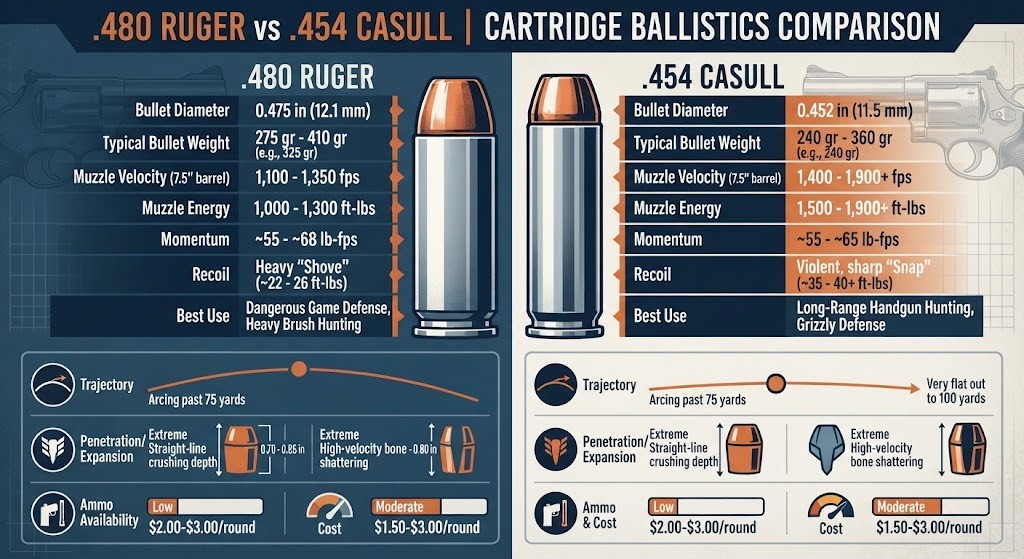
480 Ruger vs 454 Casull Ballistics
To objectively evaluate these two behemoths, we must examine full-power factory hunting ammunition fired from standard long-barreled hunting revolvers (typically 7.5 to 8 inches in length).
- Load A (.480 Ruger Standard Hunting): Hornady 325-grain XTP Jacketed Hollow Point. Muzzle velocity is 1,350 feet per second. Muzzle energy is 1,315 foot-pounds.
- Load B (.480 Ruger Heavy Bear Defense): Buffalo Bore 410-grain Hard Cast Lead Flat Nose. Muzzle velocity is 1,200 feet per second. Muzzle energy is 1,311 foot-pounds.
- Load C (.454 Casull Standard Hunting): Hornady 240-grain XTP Jacketed Hollow Point. Muzzle velocity is 1,900 feet per second. Muzzle energy is 1,923 foot-pounds.
- Load D (.454 Casull Heavy Bear Defense): Buffalo Bore 360-grain Hard Cast Lead Flat Nose. Muzzle velocity is 1,425 feet per second. Muzzle energy is 1,623 foot-pounds.
480 Ruger vs 454 Casull Velocity
Velocity is the absolute domain of the .454 Casull. Because it operates at a staggering 65,000 psi, it can push a 240-grain hollow point to nearly 1,900 feet per second from a revolver barrel, and even faster from a lever-action rifle. This borders on rifle velocity, resulting in incredibly violent expansion and devastating hydrostatic shock when the bullet strikes soft tissue.
The .480 Ruger deliberately sacrifices velocity to maintain controllable recoil. Pushing a 325-grain bullet at 1,350 feet per second is no small feat, but it cannot match the laser-like speed of the Casull. When hunters step up to the massive 400-grain or 410-grain hard-cast bullets, the velocity drops to roughly 1,150 to 1,200 feet per second. The .480 Ruger is a subsonic or trans-sonic steamroller, whereas the .454 Casull is a supersonic missile.
480 Ruger vs 454 Casull Muzzle Energy
Muzzle energy represents the kinetic work capacity of a projectile. Because kinetic energy calculations heavily favor velocity, the high-pressure .454 Casull easily dominates this category.
The .454 Casull routinely generates between 1,600 and 1,950 foot-pounds of muzzle energy. This makes it one of the most powerful production handgun cartridges on the planet, delivering energy levels that rival the .30-30 Winchester rifle cartridge but from a belt holster.
The .480 Ruger generally maxes out around 1,300 foot-pounds of kinetic energy. While this is roughly 300 to 600 foot-pounds less than the Casull, it is still approximately double the energy of a standard .45 ACP and significantly more powerful than the legendary .44 Magnum. It is more than enough energy to ethically drop a moose or a grizzly bear.
480 Ruger vs 454 Casull Momentum
Momentum is a linear measurement calculating mass in motion. In terminal ballistics involving dangerous game, high momentum correlates closely with the ability of a bullet to crush through massive bone structures (like a bear’s skull or an elk’s shoulder) without deflecting.
Because momentum is directly tied to bullet mass, the .480 Ruger closes the performance gap significantly in this category.
A 325-grain .480 Ruger bullet traveling at 1,350 feet per second yields roughly 62.6 pound-feet per second of linear momentum. A massive 410-grain bullet traveling at 1,200 feet per second yields an incredible 70.2 pound-feet per second.
A 240-grain .454 Casull bullet traveling at 1,900 feet per second yields approximately 65.1 pound-feet per second. A heavy 360-grain bullet at 1,425 feet per second yields roughly 73.2 pound-feet per second.
Both cartridges provide absolutely devastating, bone-crushing momentum. The .480 Ruger achieves this momentum entirely through sheer bullet weight, whereas the Casull requires extreme velocity to match it.
480 Ruger vs 454 Casull Trajectory
For handgun hunters attempting shots past 75 yards, trajectory is a critical factor. The calculations below assume a 100-yard zero using iron sights.
| Distance | .480 Ruger (325 gr at 1,350 fps) Drop | .454 Casull (240 gr at 1,900 fps) Drop |
| Muzzle | -0.75 inches | -0.75 inches |
| 50 Yards | +2.2 inches | +0.8 inches |
| 100 Yards | 0.0 inches (Zero) | 0.0 inches (Zero) |
| 150 Yards | -8.5 inches | -3.8 inches |
The .454 Casull is a remarkably flat-shooting revolver cartridge. Because it launches lighter bullets at near-rifle velocities, a hunter can confidently hold the crosshairs steady on the vitals of a deer at 150 yards with minimal elevation adjustment. The slower, heavier .480 Ruger bullet drops more aggressively, requiring a significant 8.5-inch holdover at 150 yards.
480 Ruger vs 454 Casull Recoil
Recoil is the single most defining difference between these two calibers, and it was the primary reason Ruger invented the .480.
The .454 Casull generates violently severe recoil. Fired from a heavy 50-ounce hunting revolver, a full-power load can easily exceed 35 to 40 foot-pounds of free recoil energy. Because of the astronomical 65,000 psi pressure, the recoil is a sharp, vicious, wrist-snapping torque accompanied by a deafening muzzle blast. It is known for inducing severe flinching and has literally drawn blood from inexperienced shooters who fail to lock their wrists.
The .480 Ruger was engineered to fix this exact problem. Fired from a similarly heavy revolver, a 325-grain load generates roughly 22 to 26 foot-pounds of free recoil energy. While this is certainly heavier than a .44 Magnum, the lower 48,000 psi pressure limit changes the nature of the recoil. Instead of a violent snap, the .480 Ruger delivers a heavy, rolling “shove” back into the palm. It is drastically more comfortable to shoot than the Casull, allowing hunters to practice more often and place their shots with greater precision.
480 Ruger vs 454 Casull Penetration
Both cartridges are apex penetration tools when loaded with hard-cast lead flat-nose bullets.
The .454 Casull relies on speed. A 300-grain or 360-grain hard-cast bullet will effortlessly shatter the heavy shoulder joints of a moose and continue driving deep into the vital cavity, frequently providing a complete pass-through.
The .480 Ruger relies entirely on massive bullet weight and a wider frontal area. A 400-grain hard-cast bullet moving at 1,200 feet per second will not deform, deflect, or stop. It acts like a flying anvil, crushing a massive, straight-line channel through any animal on the North American continent.
480 Ruger vs 454 Casull Expansion
Striking a target at 1,900 feet per second generates immense hydraulic pressure. When a .454 Casull hollow point hits fluid-filled tissue, the expansion is catastrophic and immediate. The temporary stretch cavity is massive, leading to incredibly fast incapacitation on medium game like deer.
The .480 Ruger starts at a massive 0.475-inch diameter before it even begins to expand. When a 325-grain XTP bullet strikes an animal at 1,300 feet per second, it mushrooms beautifully, often exceeding 0.80 inches in expanded diameter. It creates a massive permanent crush cavity simply because the projectile itself is so physically large.
480 Ruger vs 454 Casull Self Defense & Concealed Carry
Neither cartridge is practical or safe for urban self-defense, home defense, or concealed carry. Firing either cartridge indoors will cause immediate, permanent hearing damage. The massive bullets will effortlessly pass completely through human attackers, multiple residential walls, and into neighboring homes. These revolvers are massive, heavy, and impossible to conceal. They are dedicated hunting and wilderness survival tools.
Which Has More Stopping Power: 480 Ruger or 454 Casull?
On heavily muscled, dangerous game like grizzly bears, their practical stopping power is functionally identical. Both will crush the skull or shatter the shoulders of an apex predator.
On medium game like deer or hogs, the .454 Casull provides slightly faster instantaneous stopping power due to its hyper-velocity impact, which generates massive hydrostatic shock that the slower .480 Ruger cannot match.
Which Is More Powerful: 480 Ruger or 454 Casull?
Based strictly on kinetic energy and raw physics, the .454 Casull is the more powerful cartridge. It operates at a significantly higher pressure limit (65,000 psi vs 48,000 psi) and consistently generates between 300 and 600 more foot-pounds of muzzle energy than the .480 Ruger.
480 Ruger Pros and Cons
Pros
- Massive 0.475-inch bullet diameter punches enormous permanent wound channels
- Delivers bone-crushing momentum through heavy bullet weights up to 410 grains
- Significantly milder, more comfortable “push” recoil impulse compared to the violent .454 Casull
- Allows hunters to harness near .475 Linebaugh performance without the punishing recoil penalty
Cons
- Ammunition is highly specialized, expensive, and difficult to find on local retail shelves
- Heavier, slower bullets result in an arcing trajectory that makes long-range shots (past 100 yards) challenging
- Revolvers chambered in this caliber are primarily limited to Ruger Super Blackhawks and Alaskans
454 Casull Pros and Cons
Pros
- Generates mind-boggling kinetic energy approaching 2,000 ft-lbs from a handgun
- Extremely flat trajectory makes 150-yard handgun hunting highly practical
- Revolvers chambered in .454 Casull can safely fire cheaper, lower-recoil .45 Colt ammunition for practice
- The undisputed gold standard for grizzly bear protection in Alaska
Cons
- Generates severely punishing, sharp recoil that induces severe flinching in many shooters
- Deafening muzzle blast and concussive shockwave can be highly disorienting
- Extreme pressures cause faster wear and tear on both the shooter’s wrists and the firearm’s forcing cone
Final Comparison
| Category | Winner | Reason |
| Velocity | .454 Casull | Extreme 65,000 psi pressure effortlessly drives bullets 500+ fps faster |
| Muzzle Energy | .454 Casull | Generates roughly 400 to 600 more ft-lbs of kinetic energy |
| Momentum | Tie | .480 uses massive weight; .454 uses massive speed to achieve similar momentum |
| Penetration | Tie | Both effortlessly crush through heavy bone and dense muscle on apex predators |
| Expansion | .454 Casull | Hyper-velocity impacts force hollow points to open far more violently |
| Trajectory | .454 Casull | Superior velocity produces a significantly flatter curve out to 150 yards |
| Recoil Control | .480 Ruger | Lower operating pressure replaces the violent snap with a rolling, manageable push |
| Effective Range | .454 Casull | Flatter trajectory confidently extends ethical hunting shots to 150 yards |
| Self Defense | Neither | Both are severe over-penetration hazards in any residential setting |
| Concealed Carry | Neither | Both are massive, heavy revolver cartridges completely unsuitable for concealment |
| Ammo Cost | Tie | Both are specialty big-bore cartridges carrying premium price tags |
| Ammo Availability | .454 Casull | Wider commercial adoption by multiple firearm manufacturers |
| Overall Performance | Depends on Priority | .454 Casull for raw energy and range; .480 Ruger for giant holes and manageable recoil |
480 Ruger vs 454 Casull: Which Should You Choose?
Selecting between the .480 Ruger and the .454 Casull requires an honest assessment of your physical recoil tolerance and your intended hunting distances.
Choose the .480 Ruger if you want massive, bone-crushing terminal performance but refuse to subject your wrists to the torture of ultra-high-pressure magnums. The .480 is a masterpiece of ballistic efficiency. It provides a vastly wider frontal area than a .44 Magnum and easily crushes through heavy brush and tough game, all while remaining highly enjoyable to shoot. It is the ultimate heavy timber hunting cartridge where shots are taken inside 75 yards.
Choose the .454 Casull if you want the absolute pinnacle of commercial handgun kinetic energy and require a flat trajectory for longer shots. If you are hunting deer or hogs across open fields out to 150 yards, or if you need the ultimate grizzly bear defense gun, the .454 Casull is the undisputed king. Furthermore, the ability to practice with cheap, low-recoiling .45 Colt ammunition makes the .454 Casull platform vastly more versatile for everyday range sessions.
FAQs
Is 480 Ruger more powerful than 454 Casull?
No, the .454 Casull is significantly more powerful. It generates approximately 400 to 600 more foot-pounds of muzzle energy than the .480 Ruger due to its astronomically higher operating pressures and blistering velocities.
Which has more muzzle energy?
The .454 Casull routinely generates between 1,600 and 1,950 foot-pounds of muzzle energy. The .480 Ruger maxes out around 1,300 foot-pounds of muzzle energy.
Which has more stopping power?
Both offer immediate, devastating stopping power on dangerous game. The .454 Casull provides slightly faster incapacitation on thin-skinned game due to massive hydrostatic shock, while the .480 Ruger provides unstoppable blunt-force trauma via a much wider 0.475-inch bullet.
Which has more recoil?
The .454 Casull produces violently severe recoil. It is a sharp, vicious snap that is significantly more punishing to the shooter’s wrists than the heavy, rolling push of the .480 Ruger.
Which has better penetration?
Both cartridges offer absolute maximum penetration when utilizing heavy hard-cast lead bullets. They will both pass completely through the shoulder structure of a grizzly bear.
Which expands more?
While the .454 Casull expands more violently due to its extreme velocity, the .480 Ruger starts at a much wider diameter (0.475″ vs 0.452″), meaning its final expanded profile is often just as wide, if not wider.
Which has a flatter trajectory?
The .454 Casull has a drastically flatter trajectory. Its near-rifle velocities allow it to shoot perfectly flat out to 100 yards, whereas the slower .480 Ruger bullet begins dropping aggressively past 75 yards.
Which is better for self defense?
Neither cartridge is suitable for civilian home defense against human threats due to extreme over-penetration risks. However, both are exceptional for wilderness defense against apex predators.
Which is better for concealed carry?
Neither. Both are exclusively chambered in massive, heavy steel revolvers that cannot be practically concealed on the human body.
Is 454 Casull faster than 480 Ruger?
Yes, the .454 Casull is dramatically faster. A standard 240-grain .454 Casull bullet exits the barrel at roughly 1,900 fps, whereas a standard 325-grain .480 Ruger bullet exits at roughly 1,350 fps.
Is 454 Casull stronger than 480 Ruger?
Yes, the .454 Casull operates at 65,000 psi (compared to the 48,000 psi of the .480) and delivers substantially more kinetic energy.
Which is cheaper to shoot?
Both are very expensive. However, a revolver chambered in .454 Casull can safely fire .45 Colt ammunition, which is significantly cheaper and widely available for practice.
Can a 480 Ruger shoot 454 Casull?
No. They are completely different calibers with different bullet diameters and case dimensions.
Which is easier to shoot?
The .480 Ruger is drastically easier to shoot due to its lower operating pressure, which mitigates the sharp, painful muzzle whip associated with the .454 Casull.