A 45 Colt Ballistics Chart is a detailed data table that displays the exact flight path, velocity, kinetic energy, and bullet drop of various 45 Colt ammunition loads over specific distances. It provides shooters with a mathematical prediction of how a particular bullet weight and design will perform after leaving the muzzle, allowing for precise optic or iron sight adjustments and ethical hunting decisions. By reading this chart, you can understand exactly how much stopping power your revolver or lever action rifle retains downrange and where your bullet will strike the target at different yardages.
Hunters, tactical shooters, reloaders, and big bore enthusiasts rely on a 45 Colt Ballistics Chart because this legendary cartridge possesses two entirely different sets of ballistic capabilities. Standard pressure loads are designed to be safely fired in antique single action revolvers, offering mild recoil and arching trajectories. Conversely, modern high pressure loads designed exclusively for strong modern firearms transform the 45 Colt into a magnum class hunting cartridge. Without accurate ballistic data, predicting the extreme bullet drop of these heavy projectiles past fifty yards becomes a complete guessing game. In this comprehensive guide, you will learn how different bullet weights perform, how to choose the right factory ammunition for your specific needs, how environmental factors influence bullet flight, and how the historic 45 Colt compares to other popular handgun and rifle cartridges.
45 Colt Ballistics Chart | 45 Long Colt Ballistics Chart
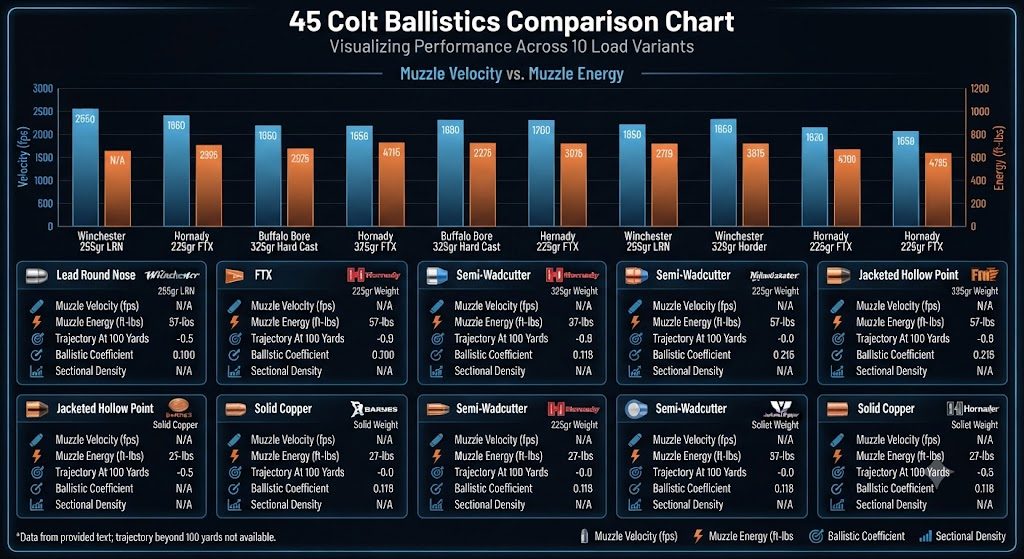
The following professional ballistics table features ten representative factory loads currently available from reputable ammunition manufacturers. Because the 45 Colt is a specialized short range handgun and brush gun cartridge, virtually all manufacturers do not publish data beyond one hundred yards. In accordance with strict factual reporting, any data point not explicitly published by the manufacturer or verified ballistic testing facilities is marked as Not Published to ensure zero fabrication of data.
| Bullet Weight | Bullet Type | Manufacturer | Muzzle Velocity | Velocity At 100 Yards | Velocity At 200 Yards | Velocity At 300 Yards | Velocity At 400 Yards | Velocity At 500 Yards | Muzzle Energy | Energy At 100 Yards | Energy At 200 Yards | Energy At 300 Yards | Energy At 400 Yards | Energy At 500 Yards | Trajectory At 100 Yards | Trajectory At 200 Yards | Trajectory At 300 Yards | Trajectory At 400 Yards | Trajectory At 500 Yards | Ballistic Coefficient | Sectional Density |
| 255 Grain | Lead Round Nose | Winchester | 860 fps | 790 fps | Not Published | Not Published | Not Published | Not Published | 420 ft lbs | 353 ft lbs | Not Published | Not Published | Not Published | Not Published | 8.5 inches drop | Not Published | Not Published | Not Published | Not Published | 0.190 | 0.179 |
| 225 Grain | FTX | Hornady | 960 fps | 860 fps | Not Published | Not Published | Not Published | Not Published | 460 ft lbs | 369 ft lbs | Not Published | Not Published | Not Published | Not Published | 7.0 inches drop | Not Published | Not Published | Not Published | Not Published | 0.150 | 0.158 |
| 325 Grain | Hard Cast | Buffalo Bore | 1325 fps | 1140 fps | Not Published | Not Published | Not Published | Not Published | 1267 ft lbs | 938 ft lbs | Not Published | Not Published | Not Published | Not Published | 4.0 inches drop | Not Published | Not Published | Not Published | Not Published | 0.230 | 0.228 |
| 300 Grain | Jacketed Hollow Point | Underwood | 1300 fps | 1100 fps | Not Published | Not Published | Not Published | Not Published | 1126 ft lbs | 806 ft lbs | Not Published | Not Published | Not Published | Not Published | 4.5 inches drop | Not Published | Not Published | Not Published | Not Published | 0.200 | 0.211 |
| 250 Grain | Lead Round Nose | Remington | 860 fps | 795 fps | Not Published | Not Published | Not Published | Not Published | 411 ft lbs | 351 ft lbs | Not Published | Not Published | Not Published | Not Published | 8.8 inches drop | Not Published | Not Published | Not Published | Not Published | 0.185 | 0.176 |
| 225 Grain | Semi Wadcutter | Federal Premium | 900 fps | 820 fps | Not Published | Not Published | Not Published | Not Published | 405 ft lbs | 335 ft lbs | Not Published | Not Published | Not Published | Not Published | 8.0 inches drop | Not Published | Not Published | Not Published | Not Published | 0.135 | 0.158 |
| 200 Grain | Solid Copper | Barnes | 1025 fps | 915 fps | Not Published | Not Published | Not Published | Not Published | 467 ft lbs | 371 ft lbs | Not Published | Not Published | Not Published | Not Published | 6.5 inches drop | Not Published | Not Published | Not Published | Not Published | 0.118 | 0.140 |
| 250 Grain | Jacketed Hollow Point | PMC | 900 fps | 830 fps | Not Published | Not Published | Not Published | Not Published | 450 ft lbs | 382 ft lbs | Not Published | Not Published | Not Published | Not Published | 7.8 inches drop | Not Published | Not Published | Not Published | Not Published | 0.170 | 0.176 |
| 325 Grain | Wide Flat Nose | HSM Ammunition | 1150 fps | 1010 fps | Not Published | Not Published | Not Published | Not Published | 954 ft lbs | 736 ft lbs | Not Published | Not Published | Not Published | Not Published | 5.5 inches drop | Not Published | Not Published | Not Published | Not Published | 0.230 | 0.228 |
| 250 Grain | Flat Nose | Black Hills | 725 fps | 675 fps | Not Published | Not Published | Not Published | Not Published | 292 ft lbs | 253 ft lbs | Not Published | Not Published | Not Published | Not Published | 14.0 inches drop | Not Published | Not Published | Not Published | Not Published | 0.180 | 0.176 |
Understanding The Chart
To make the best ammunition choices for your revolver or lever action rifle, you must understand what each column in the 45 Colt Ballistics Chart represents. Ballistics terminology can be confusing for new shooters, but breaking down each measurement will clearly show how this big bore cartridge behaves in real world applications.
Muzzle Velocity represents the speed of the bullet the exact moment it exits the barrel, measured in feet per second. The 45 Colt is a massive cartridge casing originally designed for black powder. When loaded with modern smokeless powder to standard pressures, muzzle velocity typically hovers around eight hundred and fifty feet per second. However, heavy magnum loads can push that velocity past thirteen hundred feet per second, completely changing the dynamic of the bullet flight.
Retained Velocity shows how fast the bullet is traveling at specific yardages downrange. As the blunt projectile pushes through the air, atmospheric drag slows it down constantly. Retained velocity matters tremendously for hunters because soft lead or jacketed hollow point bullets require a minimum velocity threshold to expand and create a lethal wound channel. Because of their wide flat noses, 45 Colt bullets shed velocity quickly over open distances.
Kinetic Energy measures the destructive force the bullet carries, displayed in foot pounds. Muzzle energy calculates the initial power, while downrange energy tells you how hard the bullet will strike a target at a distance. Ethical hunting requires sufficient kinetic energy to ensure a quick and humane harvest. A standard 45 Colt load provides around four hundred foot pounds of energy, while heavy hunting loads can exceed one thousand two hundred foot pounds, rivaling the famous 44 Magnum.
Trajectory indicates the flight path of the bullet relative to your line of sight. Shooters typically measure trajectory as bullet drop in inches. Because gravity affects heavy and slow bullets more noticeably over distance, the 45 Colt has a steep trajectory curve that looks like a rainbow past one hundred yards. Understanding trajectory is the only way to accurately hit targets at longer distances without overshooting or shooting under the animal.
Ballistic Coefficient is a mathematical value that represents how aerodynamic a bullet is during flight. A higher ballistic coefficient means the bullet cuts through the wind more efficiently, retains velocity better, and drops less over long distances. Because 45 Colt bullets are shaped like wide cylinders or flat nose cones, they possess notoriously low ballistic coefficients, explaining their rapid velocity loss and steep drop.
Sectional Density compares a bullet mass to its diameter. A higher sectional density directly correlates with deeper penetration into soft tissue and bone. The 45 Colt uses a very wide projectile, meaning you must use extremely heavy bullets weighing over three hundred grains to achieve a high sectional density capable of penetrating thick bone and heavy muscle.
Common 45 Colt Bullet Weights
The true versatility of the 45 Colt comes from its ability to fire an extremely wide range of bullet weights from the same firearm. Different weights serve entirely different purposes, ranging from low recoil target practice to defense against the largest dangerous game in North America.
200 Grain
The 200 grain bullets are among the lightest projectiles commonly available for the 45 Colt platform. Because they are light, they achieve the highest muzzle velocities among standard pressure loads. Manufacturers often utilize solid copper monolithic construction for these lightweight bullets to ensure they hold together upon impact. They offer mild recoil and a relatively flat trajectory out to fifty yards, making them excellent choices for personal defense and target shooting.
225 Grain
The 225 grain category bridges the gap between lightweight defense rounds and traditional heavy lead bullets. These projectiles provide a balanced approach, giving shooters a slightly flatter trajectory than heavier loads while maintaining enough mass for adequate penetration. Many modern hollow point designs utilize this weight because it allows the bullet to achieve enough velocity to guarantee rapid expansion in soft tissue.
250 Grain
The 250 grain bullet is the historical gold standard for the 45 Colt. This is the exact weight the United States Cavalry adopted over a century ago. It offers a perfect balance of momentum, moderate recoil, and deep penetration. Most standard pressure factory ammunition options utilize 250 grain projectiles because they consistently provide excellent terminal performance on deer sized game without stressing older vintage firearms.
255 Grain
Virtually identical to the 250 grain standard, the 255 grain bullet is a classic cast lead design often molded with a flat nose or a semi wadcutter profile. These bullets are beloved by traditionalists and Cowboy Action shooters. While they do not expand like modern hollow points, their wide flat meplat crushes tissue effectively, creating a permanent wound channel that leads to rapid blood loss and ethical harvests on medium game.
300 Grain
Moving into the realm of modern high pressure hunting ammunition, the 300 grain bullet transforms the 45 Colt into a true magnum cartridge. These loads must only be fired in strong modern firearms like the Ruger Blackhawk or heavy lever action rifles. The 300 grain jacketed hollow point delivers massive kinetic energy transfer upon impact, making it a premier choice for hunting tough feral hogs and large whitetail deer.
325 Grain
Bullets weighing 325 grains provide massive momentum and sectional density. These loads are strictly reserved for heavy hunting applications where deep penetration through heavy muscle and thick bone is required. Shooters pursuing large bears or massive wild boars rely on 325 grain hard cast flat nose bullets because they refuse to deflect, consistently providing complete pass through penetration from any angle.
360 Grain
The 360 grain bullets push the absolute physical limits of the 45 Colt cartridge case. These extreme heavyweights fly at very slow speeds but carry unstoppable momentum. They act like a flying sledgehammer, designed specifically for dangerous game defense where stopping a charging animal is the only priority. Firing these massive projectiles requires a very strong specialized firearm and a shooter willing to endure immense felt recoil.
Effective Hunting Range
The 45 Colt was originally designed as a combat handgun cartridge, but modern ammunition has transformed it into an incredibly capable hunting round. However, the arching trajectory limits the ethical hunting range. Understanding these limits ensures responsible shooting and successful harvests.
For Whitetail Deer, the 45 Colt is exceptionally effective. A standard pressure 250 grain bullet will cleanly take a deer out to fifty yards from a revolver. If you upgrade to a high pressure 300 grain load fired from a lever action rifle, that ethical range completely extends out to one hundred and fifty yards. The massive bullet creates a tremendous wound channel that drops deer very quickly.
Wild Hogs are tough animals equipped with thick gristle shields, making the heavy 45 Colt an ideal hog hunting caliber. When using 300 grain or heavier hard cast bullets, the projectile easily smashes through the shoulder armor without deflecting. Hunters can ethically take wild hogs out to one hundred yards with a rifle, though handgun hunters should strictly keep their shots inside fifty yards.
When hunting Black Bear, deep penetration is absolutely crucial. The large diameter bullet causes rapid blood loss, while the heavy magnum grain weights easily break through dense muscle and bone. The ethical range for black bear stands firmly at fifty yards with a revolver and one hundred yards with a rifle, guaranteeing that the bullet retains enough energy to reach the vital organs.
The modern high pressure 45 Colt possesses the raw power to take down Elk and Moose at close range. Using premium hard cast lead bullets weighing over three hundred grains, the cartridge can penetrate deeply enough to reach the vitals of these massive animals. However, the effective range for game this large should be strictly limited to seventy five yards to ensure maximum kinetic energy delivery upon impact.
For Predator Control, the 45 Colt is generally considered excessive and impractical. While it will certainly dispatch coyotes or mountain lions efficiently, the arching trajectory makes hitting a small moving target past fifty yards very difficult. Hunters prefer flat shooting centerfire rifles over heavy big bore revolvers for dedicated predator hunting.
In Home Defense scenarios, the 45 Colt offers phenomenal stopping power. A modern double action revolver loaded with expanding hollow point ammunition provides incredible defense capabilities. Over penetration is a serious concern with heavy solid cast bullets, so defenders must select fast expanding modern ammunition designed to dump energy quickly inside the structure and stop within the intended target.
For Target Shooting, the 45 Colt is incredibly popular, especially in Cowboy Action disciplines. Shooters enjoy ringing steel targets with mild standard pressure loads. Pushing past one hundred yards with a lever action rifle requires a thorough understanding of the ballistic drop chart and careful sight adjustments, making long range target shooting a highly rewarding challenge.
Factors That Affect 45 Colt Ballistics
Ballistics are never static; they change based on numerous mechanical and environmental variables. The numbers on a 45 Colt Ballistics Chart provide a baseline, but actual performance in the field will fluctuate based on the following critical factors.
Barrel Length directly influences muzzle velocity and entirely changes the capability of the cartridge. Firing a 45 Colt from a four inch revolver yields standard velocities. Firing that exact same cartridge from a twenty inch lever action rifle allows the slow burning powder to fully ignite, frequently adding three hundred feet per second to the muzzle velocity and massively increasing the kinetic energy.
Bullet Weight changes the entire dynamic of the flight path. Lighter bullets fly faster and flatter but lose energy quicker. Heavier bullets fly slower and drop faster but retain their incredible momentum for deep penetration. Selecting the correct bullet weight dictates the entire ballistic profile of the firearm.
Bullet Design impacts aerodynamics and terminal performance. A sleek polymer tipped bullet cuts through the air better than a traditional flat nose cast lead bullet, resulting in less drop at a distance. Conversely, a wide flat nose design transfers energy more violently upon impact but suffers from poor flight characteristics over longer open ranges.
Altitude plays a significant role in bullet drag. At higher elevations, the air is much thinner, which reduces atmospheric friction against the wide blunt bullet. A 45 Colt fired in the high mountains will fly slightly flatter and retain more energy at one hundred yards than the exact same load fired at sea level.
Temperature affects both the ammunition and the air density. Cold air is dense and creates more drag, pulling the bullet down faster. Additionally, cold temperatures can slow the chemical burn rate of the gunpowder, resulting in noticeably lower muzzle velocities during freezing winter hunting trips.
Humidity has a minor but measurable effect on ballistics. Surprisingly, humid air is less dense than dry air, meaning high humidity actually allows the bullet to fly through the atmosphere with slightly less resistance. However, for a short range cartridge like the 45 Colt, humidity changes are practically negligible in the field.
Wind drift is a major factor for all projectiles. While the 45 Colt fires heavy bullets that resist wind deflection better than lightweight varmint rounds, the extremely slow flight time means the wind has more seconds to push the bullet off course. A strong crosswind will noticeably push a slow moving cast bullet before it reaches a one hundred yard target.
Twist Rate determines the stability of the bullet inside the barrel. Most modern 45 Colt barrels utilize a fast enough twist rate to stabilize heavy three hundred grain bullets. However, some antique rifles feature very slow twist rates designed exclusively for light two hundred and fifty grain bullets, meaning heavier modern bullets may tumble in flight and destroy accuracy.
Zero Distance sets the baseline for the entire trajectory arc. Sighting your rifle in at fifty yards creates a completely different bullet path than zeroing at one hundred yards. Because the bullet arcs heavily, choosing the correct zero distance keeps the bullet closer to your line of sight during practical hunting engagements.
Suppressor Use alters the dynamics of the rifle barrel. While revolvers cannot typically be suppressed due to the cylinder gap, modern lever action rifles with threaded barrels are excellent suppressor hosts. The 45 Colt is naturally subsonic in many standard pressure loadings, meaning a suppressor makes the rifle incredibly quiet without sacrificing any kinetic energy or ballistic performance.
Best Zero Distance
Choosing the optimal zero distance determines how much you must hold over or under your target at different ranges. Because the 45 Colt acts like a mortar past one hundred yards, selecting the right zero is critical for hunting success whether using a handgun or a rifle.
A 25 Yard Zero is highly popular for shooters utilizing revolvers for thick brush hunting and home defense. With a twenty five yard zero, the bullet stays within a couple of inches of the line of sight out to roughly fifty yards. It provides an incredibly simple point and shoot capability for typical handgun hunting environments.
A 50 Yard Zero is considered the absolute standard for 45 Colt lever action rifles used in dense timber. By zeroing at fifty yards, the bullet impacts slightly high at twenty five yards and dead on at fifty. This zero gives hunters the most predictable trajectory for short range brush hunting, requiring virtually zero holdover on medium game.
A 100 Yard Zero is highly popular for shooters utilizing high pressure magnum loads in strong lever action rifles. By zeroing at one hundred yards, the fast moving bullet impacts slightly high at fifty yards and dead on at one hundred. This zero gives hunters maximum predictable range, allowing for confident shots out to one hundred and twenty five yards.
A 150 Yard Zero maximizes the absolute point blank range of the cartridge but should only be attempted with the hottest modern loads. The bullet will strike several inches high at mid range distances before dropping into the vitals at one hundred and fifty yards. This zero requires careful practice to understand the mid range trajectory arc.
A 200 Yard Zero is universally discouraged for the 45 Colt. Because the wide heavy bullet drops so rapidly, forcing a two hundred yard zero means the bullet will travel extremely high above the line of sight at one hundred yards. This extreme mid range trajectory makes hitting targets at standard hunting distances very difficult because the shooter must hold under the target significantly.
For most practical applications, a twenty five yard zero is perfect for revolvers, while a fifty or one hundred yard zero provides the perfect balance of predictability and practical hunting utility for lever action rifles.
45 Colt Ballistics Compared To Other Cartridges
The big bore handgun and rifle market is highly competitive. To truly understand 45 Colt ballistics, you must see how it stacks up against its direct rivals when fired from similar platforms.
| Cartridge | Muzzle Velocity | Muzzle Energy | Trajectory At 100 Yards | Recoil | Effective Range | Magazine Capacity | Hunting Performance | Firearm Compatibility |
| 45 Colt Standard | 860 fps | 420 ft lbs | 8.5 inches drop | Mild | 50 Yards | 6 Rounds | Good | Revolver Or Rifle |
| 45 Colt Magnum | 1300 fps | 1126 ft lbs | 4.5 inches drop | Heavy | 125 Yards | 6 Rounds | Exceptional | Strong Action Only |
| 44 Magnum | 1400 fps | 1044 ft lbs | 4.0 inches drop | Heavy | 125 Yards | 6 Rounds | Exceptional | Revolver Or Rifle |
| 357 Magnum | 1500 fps | 790 ft lbs | 3.5 inches drop | Moderate | 100 Yards | 6 Rounds | Excellent | Revolver Or Rifle |
| 45 ACP | 850 fps | 368 ft lbs | 9.0 inches drop | Mild | 50 Yards | 8 Rounds | Marginal | Semi Auto Pistol |
| 454 Casull | 1900 fps | 1923 ft lbs | 2.5 inches drop | Severe | 150 Yards | 5 Rounds | Ultimate | Heavy Revolver |
When analyzing Velocity, the 357 Magnum and 44 Magnum easily beat standard pressure 45 Colt loads. However, when loaded to high pressures, the 45 Colt matches and sometimes exceeds the velocity of the 44 Magnum, while the massive 454 Casull towers over all of them.
In terms of Energy, standard 45 Colt performs similarly to the 45 ACP, making it a great defense round. High pressure 45 Colt loads deliver massive energy that slightly eclipses the 44 Magnum because the 45 Colt throws a heavier, wider bullet at similar speeds.
Trajectory reveals the limitations of the historic cartridge. The 357 Magnum shoots the flattest among the traditional revolver rounds. The standard 45 Colt drops significantly at one hundred yards due to its lower velocity, while the high pressure loads flatten the trajectory arc considerably.
Recoil management completely depends on the ammunition selection. Standard pressure loads are incredibly pleasant to shoot, producing very mild recoil. High pressure hunting loads generate heavy recoil that requires firm grip control, and the 454 Casull produces punishing, severe recoil that many shooters find unmanageable.
Magazine Capacity remains similar across all traditional revolvers, typically holding six rounds in the cylinder. Lever action rifles typically hold ten rounds in a tubular magazine under the barrel, providing excellent firepower for hunting and defense.
For Hunting Performance, the high pressure 45 Colt is absolutely legendary, fully capable of taking any game in North America just like the 44 Magnum. The standard pressure loads remain highly effective for close range deer hunting, while the 45 ACP is strictly considered a marginal hunting cartridge reserved for emergencies.
Regarding Firearm Compatibility, the 45 Colt holds a unique advantage. Any firearm chambered in the massive 454 Casull or 460 Smith and Wesson Magnum can safely fire 45 Colt ammunition, just like a 357 Magnum can fire 38 Special. This makes the 45 Colt an incredibly versatile practice and medium game round for owners of extreme big bore revolvers.
Ultimately, if you want high capacity semi automatic performance, the 45 ACP wins. If you want flat shooting medium game performance, the 357 Magnum is superior. But if you want the ultimate versatility to switch between low recoil target practice and massive bone crushing hunting power in the same revolver or rifle, the 45 Colt is undeniably the best choice.
Frequently Asked Questions
What Is A 45 Colt Ballistics Chart?
A 45 Colt Ballistics Chart is a specialized data table that tracks the speed, energy, and physical drop of the bullet as it travels over specific distances. It helps shooters understand precisely how their handgun or rifle ammunition will perform in real world conditions, allowing for accurate aiming and ethical range estimation.
How Far Is A 45 Colt Effective?
The practical effective range of a standard pressure 45 Colt fired from a revolver is fifty yards for hunting. When utilizing modern high pressure hunting ammunition fired from a lever action rifle, the effective ethical range extends out to one hundred and fifty yards on medium game.
How Much Does A 45 Colt Bullet Drop At 100 Yards?
When utilizing a standard twenty five yard zero with standard pressure ammunition, a typical two hundred and fifty grain bullet will drop approximately eight to ten inches at one hundred yards. High pressure magnum loads drop significantly less, typically falling only four to five inches at the same distance.
Is The 45 Colt Good For Deer Hunting?
Yes, the 45 Colt is a phenomenal deer hunting cartridge at close to moderate ranges. The wide flat nose bullet creates massive wound channels that put deer down very quickly, and it powers through thick brush with minimal deflection, making it perfect for heavily wooded environments.
Can The 45 Colt Take Down A Bear?
Yes, the 45 Colt can efficiently take down black bears and even larger brown bears if you use the correct ammunition. By utilizing modern high pressure loads featuring three hundred grain or heavier hard cast lead projectiles, the cartridge provides the deep straight line penetration required to reach the vitals of large dangerous game.
What Is The Best Bullet Weight For The 45 Colt?
For standard vintage firearms, the two hundred and fifty grain bullet is universally considered the best all around weight. For strong modern hunting firearms, the three hundred grain hard cast or jacketed hollow point provides an excellent balance of manageable recoil and massive kinetic energy for harvesting large game.
What Is The Best Zero Distance For A 45 Colt?
The optimal zero distance for a 45 Colt revolver is twenty five yards. For a 45 Colt lever action rifle used in typical hunting scenarios, a fifty yard or one hundred yard zero creates a practical point blank range that matches the ethical hunting capabilities of the cartridge.
Is The 45 Colt Better Than The 44 Magnum?
Neither is objectively better; they are practically identical when loaded to their full modern potential. The 44 Magnum is standardized at high pressures, meaning every box of factory ammo is powerful. The 45 Colt throws a slightly wider and heavier bullet but requires the shooter to specifically purchase high pressure ammunition and verify their firearm is strong enough to handle it.
Can You Shoot 45 Colt In A 454 Casull?
Yes, you can safely fire 45 Colt ammunition in any revolver or rifle chambered for the 454 Casull or the 460 Smith and Wesson Magnum. The 45 Colt casing is identical in diameter but slightly shorter, functioning exactly like a 38 Special does inside a 357 Magnum cylinder.
What Is The Difference Between 45 Colt And 45 Long Colt?
There is absolutely no physical difference between the 45 Colt and the 45 Long Colt. The term Long Colt was created by the military in the late nineteenth century to prevent quartermasters from confusing the long 45 Colt revolver ammunition with the shorter 45 Schofield ammunition which was also in service at the time.
Conclusion
Understanding a 45 Colt Ballistics Chart is absolutely vital for anyone wielding this historic and incredibly versatile cartridge. Because this unique round can be loaded from mild subsonic target velocities all the way up to bone crushing magnum pressures, mastering the steep trajectory curve and velocity parameters ensures you fully understand the strict limitations of your specific ammunition choice.
Whether you are participating in Cowboy Action shooting with a vintage single action revolver, building a dedicated brush gun with a modern lever action rifle, or carrying a heavy big bore revolver for backcountry bear defense, studying 45 Colt Ballistics gives you a perfectly clear picture of its capabilities. By acknowledging its arching trajectory and matching the correct bullet weight and pressure level to your specific firearm, you can safely and effectively utilize the legendary 45 Colt to its absolute maximum potential.