The .222 Remington is a highly accurate centerfire rifle cartridge introduced in 1950. A ballistics chart for this cartridge tracks its velocity, energy, and trajectory, showcasing the extremely flat-shooting characteristics that made it a dominant force in early benchrest shooting and varmint hunting.
.222 Remington Ballistics Chart
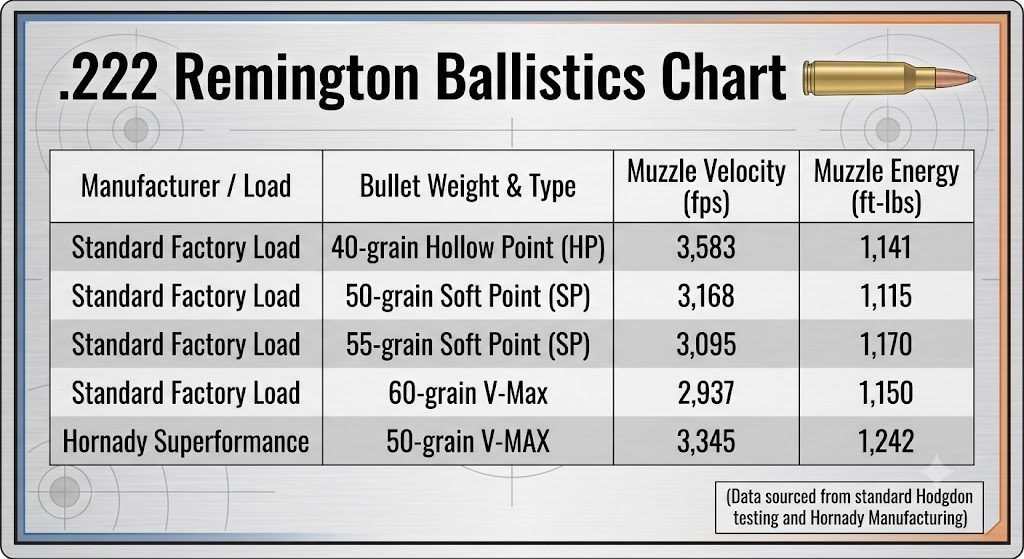
This chart details the standard ballistic performance across various bullet weights and factory loads for the .222 Remington.
| Manufacturer / Load | Bullet Weight & Type | Muzzle Velocity (fps) | Muzzle Energy (ft-lbs) |
| Standard Factory Load | 40-grain Hollow Point (HP) | 3,583 | 1,141 |
| Standard Factory Load | 50-grain Soft Point (SP) | 3,168 | 1,115 |
| Standard Factory Load | 55-grain Soft Point (SP) | 3,095 | 1,170 |
| Standard Factory Load | 60-grain V-Max | 2,937 | 1,150 |
| Hornady Superformance | 50-grain V-MAX | 3,345 | 1,242 |
Understanding the Table
The data highlights the .222 Remington’s primary design goal: pushing lightweight bullets at blistering speeds with minimal recoil.
- High Velocity: When loaded with a light 40-grain bullet, the cartridge achieves a muzzle velocity approaching 3,600 fps, making it devastatingly effective on small varmints.
- Consistent Energy: Across the 40-grain to 60-grain weight range, the muzzle energy remains remarkably consistent, hovering between 1,100 and 1,170 ft-lbs.
- Modern Upgrades: Modern propellants, like those used in the Hornady Superformance line, can push a 50-grain polymer-tipped bullet over 3,300 fps, significantly increasing its effective range and energy output.
The History and Legacy of the “Triple Deuce”
Often affectionately referred to as the “triple deuce,” “triple two,” or “treble two,” the .222 Remington was designed by Remington engineer Mike Walker. It was launched commercially alongside the Remington Model 722 bolt-action rifle. Unlike many cartridges of the era, the .222 was an entirely original design and did not rely on a pre-existing parent case.
For decades, it was a wildly popular cartridge for target shooters and hunters pursuing foxes, prairie dogs, woodchucks, and coyotes. Because it produced very low recoil and less muzzle blast than larger rounds like the .220 Swift or .22-250 Remington, it was incredibly pleasant to shoot while still offering a very flat trajectory.
Why It Faded in Popularity
Despite its massive success, the .222 Remington was eventually overshadowed by its own descendants. In the late 1950s and early 1960s, the U.S. military was looking for a new smallbore rifle cartridge. Remington stretched the .222 case to increase its powder capacity, leading to experimental designs that ultimately birthed the .223 Remington (adopted by the military as the 5.56×45mm NATO).
Because the .223 fit in the same rifle actions but offered slightly more speed and military surplus brass was cheap and abundant, it eventually replaced the .222 as America’s favorite varmint round.
A Lasting Influence
While less common on standard sporting goods shelves today, the .222 Remington’s legacy is firmly cemented in firearms history. It served as the parent case for an entire family of cartridges, including the .222 Remington Magnum and the .221 Fireball, and its basic architecture ultimately laid the groundwork for modern favorites like the .300 Blackout. Furthermore, it remains popular in parts of Europe where civilian ownership of “military calibers” like the .223 is restricted.