A 45 70 Government Ballistics Chart is a comprehensive reference table that details the velocity, kinetic energy, and trajectory curve of the historic 45 70 Government cartridge over various distances. By reviewing this chart, you can visualize exactly how your heavy, large caliber bullet behaves from the moment it leaves the barrel until it strikes a target downrange. This critical data allows you to accurately predict bullet drop, compensate for wind drift, and verify that your projectile retains enough energy for an ethical harvest on large, tough game animals in heavy timber.
Shooters, hunters, reloaders, and lever-action rifle enthusiasts use a 45 70 Ballistics Chart to unlock the true potential of this classic cartridge. Introduced in 1873 as a black powder military round for the Springfield Model 1873 “Trapdoor” rifle, the 45 70 has evolved into a premier dangerous game hunting cartridge when loaded with modern smokeless powder. By studying ballistics data, a big-game hunter can confidently take shots on elk, moose, or grizzly bear knowing their bullet will penetrate deeply and deliver massive kinetic energy. In this comprehensive guide, you will learn how to analyze ballistics data, choose the right bullet weight, select the optimal zero distance, and understand how the 45 70 performs across different firearm pressure tiers.
45 70 Government Ballistics Chart
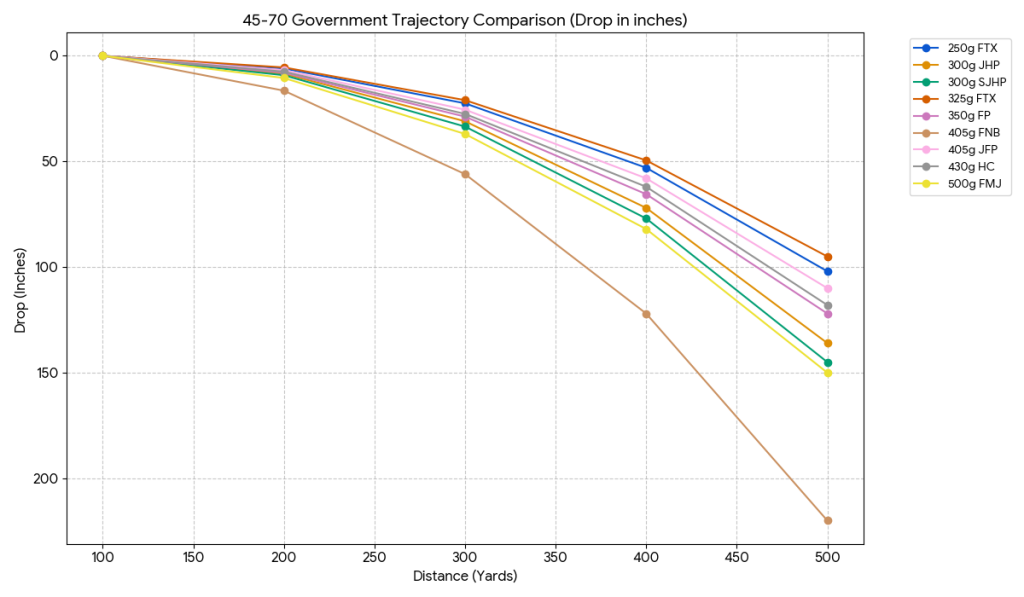
Below is a detailed ballistics table featuring popular factory-loaded ammunition across representative bullet weights and pressure levels. The data represents a standard 24-inch test barrel and assumes a 100-yard zero under standard sea-level atmospheric conditions. Because this cartridge traditionally fires blunt, heavy bullets, its aerodynamic efficiency drops off significantly past 200 yards.
| Bullet Weight | Bullet Type | Manufacturer | Muzzle Velocity | Velocity At 100 Yards | Velocity At 200 Yards | Velocity At 300 Yards | Velocity At 400 Yards | Velocity At 500 Yards | Muzzle Energy | Energy At 100 Yards | Energy At 200 Yards | Energy At 300 Yards | Energy At 400 Yards | Energy At 500 Yards | Trajectory At 100 Yards | Trajectory At 200 Yards | Trajectory At 300 Yards | Trajectory At 400 Yards | Trajectory At 500 Yards | Ballistic Coefficient | Sectional Density |
| 250 Grain | FTX LEVERevolution | Hornady | 2025 fps | 1708 fps | 1432 fps | 1210 fps | 1060 fps | 960 fps | 2276 ft lbs | 1619 ft lbs | 1138 ft lbs | 813 ft lbs | 623 ft lbs | 511 ft lbs | 0 inches | 6.0 inches drop | 22.5 inches drop | 53.0 inches drop | 102.0 inches drop | 0.185 | 0.170 |
| 300 Grain | JHP | Winchester | 1880 fps | 1500 fps | 1220 fps | 1040 fps | 920 fps | 830 fps | 2354 ft lbs | 1499 ft lbs | 991 ft lbs | 720 ft lbs | 563 ft lbs | 459 ft lbs | 0 inches | 8.5 inches drop | 31.0 inches drop | 72.0 inches drop | 136.0 inches drop | 0.140 | 0.204 |
| 300 Grain | SJHP | Remington | 1810 fps | 1440 fps | 1180 fps | 1010 fps | 900 fps | 815 fps | 2182 ft lbs | 1381 ft lbs | 927 ft lbs | 679 ft lbs | 539 ft lbs | 442 ft lbs | 0 inches | 9.2 inches drop | 33.5 inches drop | 77.0 inches drop | 145.0 inches drop | 0.130 | 0.204 |
| 325 Grain | FTX LEVERevolution | Hornady | 2050 fps | 1728 fps | 1449 fps | 1225 fps | 1070 fps | 968 fps | 3032 ft lbs | 2154 ft lbs | 1515 ft lbs | 1083 ft lbs | 827 ft lbs | 677 ft lbs | 0 inches | 5.5 inches drop | 21.0 inches drop | 49.5 inches drop | 95.0 inches drop | 0.230 | 0.221 |
| 350 Grain | InterLock FP | Hornady | 1900 fps | 1572 fps | 1302 fps | 1102 fps | 973 fps | 877 fps | 2805 ft lbs | 1922 ft lbs | 1316 ft lbs | 943 ft lbs | 735 ft lbs | 597 ft lbs | 0 inches | 8.0 inches drop | 28.8 inches drop | 65.5 inches drop | 122.0 inches drop | 0.195 | 0.238 |
| 405 Grain | FNB | Rem/Win Standard | 1330 fps | 1145 fps | 1020 fps | 930 fps | 855 fps | 790 fps | 1590 ft lbs | 1178 ft lbs | 935 ft lbs | 777 ft lbs | 656 ft lbs | 561 ft lbs | 0 inches | 16.5 inches drop | 56.0 inches drop | 122.0 inches drop | 220.0 inches drop | 0.214 | 0.276 |
| 405 Grain | JFP Heavy (Marlin/Ruger) | Buffalo Bore | 2000 fps | 1675 fps | 1395 fps | 1180 fps | 1035 fps | 940 fps | 3597 ft lbs | 2523 ft lbs | 1750 ft lbs | 1252 ft lbs | 961 ft lbs | 793 ft lbs | 0 inches | 6.8 inches drop | 25.5 inches drop | 58.0 inches drop | 110.0 inches drop | 0.214 | 0.276 |
| 430 Grain | Hard Cast Heavy | Buffalo Bore | 1925 fps | 1625 fps | 1360 fps | 1155 fps | 1020 fps | 930 fps | 3537 ft lbs | 2520 ft lbs | 1765 ft lbs | 1272 ft lbs | 993 ft lbs | 825 ft lbs | 0 inches | 7.5 inches drop | 27.5 inches drop | 62.0 inches drop | 118.0 inches drop | 0.225 | 0.293 |
| 500 Grain | FMJ Heavy | Underwood | 1650 fps | 1430 fps | 1240 fps | 1080 fps | 970 fps | 890 fps | 3022 ft lbs | 2270 ft lbs | 1707 ft lbs | 1295 ft lbs | 1045 ft lbs | 880 ft lbs | 0 inches | 10.5 inches drop | 37.0 inches drop | 82.0 inches drop | 150.0 inches drop | 0.280 | 0.341 |
Understanding The Chart
A ballistics chart displays several technical variables that dictate how a round performs downrange. Breaking down these metrics helps clarify the flight characteristics of the massive 45 70 Government.
Muzzle Velocity
Muzzle velocity is the speed at which the bullet exits the barrel, measured in feet per second. In the 45 70, muzzle velocity varies significantly depending on the pressure class of the ammunition. Traditional trapdoor-safe loads launch heavy bullets at 1100 to 1330 fps, whereas high-pressure modern loads for lever actions like the Marlin 1895 push bullets at 1900 to 2050 fps.
Retained Velocity
Retained velocity measures the speed of the projectile at designated points downrange. Because 45 70 bullets feature wide flat noses or blunt profiles, they experience significant aerodynamic drag. As a result, retained velocity drops steadily, causing projectiles to lose speed much faster than streamlined bottleneck rifle cartridges.
Kinetic Energy
Kinetic energy represents the striking force of the projectile, expressed in foot pounds. Energy is calculated using both the bullet’s mass and its velocity. Standard 45 70 trapdoor loads produce roughly 1500 to 1600 foot pounds of energy at the muzzle, while high-pressure “+P” loads generate well over 3500 foot pounds, providing devastating stopping power for large and dangerous game at short to medium ranges.
Trajectory
Trajectory details the flight path of the bullet relative to the sight line, tracking drop or elevation in inches. The 45 70 exhibits a curved, arcing trajectory. Standard 405-grain loads drop rapidly past 150 yards, requiring accurate distance estimation or scope turret adjustments for longer shots.
Key insight: Adjusting the muzzle velocity from traditional black powder speeds (1300 fps) to modern lever-action speeds (2000 fps) visually flattens the trajectory arc entirely inside 150 yards, highlighting the massive difference in modern ammunition capabilities.
Ballistic Coefficient
The Ballistic Coefficient measures a bullet’s aerodynamic efficiency. Higher numbers indicate better air-cutting capability and less velocity degradation. Traditional 45 70 flat-nose lead bullets have relatively low Ballistic Coefficients ranging between 0.130 and 0.230. Modern rubber-tipped spitzer bullets, like Hornady’s FTX, offer improved ratings near 0.230, which extends their practical range across open clearings.
Sectional Density
Sectional density compares a bullet’s mass directly to its diameter. A higher sectional density corresponds to greater penetration potential in target tissues. Heavy 45 70 bullets weighing 405 to 500 grains feature exceptionally high sectional densities (0.276 to 0.341), allowing them to penetrate deeply through thick muscle and heavy shoulder bone.
45 70 Pressure Tiers and Action Types
The 45 70 cartridge is unique because commercial ammunition and handloading data are strictly categorized into three distinct pressure tiers based on the strength of the firearm’s action. Using high-pressure ammunition in an older or weaker action can result in catastrophic firearm failure.
Tier 1: Trapdoor Actions (SAAMI Limit: 28,000 PSI)
This tier includes original and replica Springfield Model 1873 Trapdoor rifles, original Sharps rifles, and original Remington Rolling Blocks. Ammunition in this class stays within the SAAMI pressure ceiling of 28,000 PSI. These loads typically launch 405-grain lead bullets at 1100 to 1330 fps. Standard factory ammunition from Remington, Winchester, and Federal is loaded to Tier 1 levels to remain completely safe in all functional firearms.
Tier 2: Lever Actions (Pressure Ceiling: 40,000 to 42,000 CUP / PSI)
This tier is explicitly designed for modern, strong lever-action rifles such as the Marlin 1895, Henry Lever Action 45-70, and Winchester Model 1886 production models. Ammunition manufacturers like Buffalo Bore, Underwood, and Hornady produce specialized heavy loads or “+P” ammunition for this category, safely launching heavy 300 to 430-grain bullets at 1900 to 2050 fps.
Tier 3: Ruger No. 1 and Modern Single Shots (Pressure Ceiling: 50,000+ PSI)
This tier encompasses single-shot rifles with massively strong actions, primarily the Ruger No. 1 and Browning 1885 High Wall. Reloaders can safely push the 45 70 to its absolute physical limits in these specific firearms, achieving performance levels that closely mimic the massive 458 Winchester Magnum at short ranges.
Common 45 70 Bullet Weights
The 45 70 fires heavy projectiles ranging from 250 to 500 grains. Selecting the appropriate bullet weight depends on target size, range requirements, and felt recoil tolerance.
250 Grain
The 250-grain weight class features light, fast-moving projectiles often designed with polymer tips or solid copper construction. These loads offer the highest muzzle velocities and flattest trajectories out to 200 yards, along with significantly reduced felt recoil, making them excellent for deer hunting.
300 Grain
The 300-grain weight is one of the most versatile choices for general big-game hunting. Available in jacketed hollow point, soft point, and polymer-tipped options, it strikes a brilliant balance between velocity, trajectory, and reliable expansion on deer, black bear, and wild hogs inside 200 yards.
325 Grain
Popularized by Hornady’s LEVERevolution line, the 325-grain FTX bullet incorporates a flexible elastomer tip. This specialized design allows pointed spitzer-style bullets to be loaded safely end-to-end in tubular lever-action magazines without the risk of chain detonation, greatly improving aerodynamic efficiency, velocity retention, and trajectory flatness.
350 Grain
The 350-grain bullet is heavily favored by many traditional hunters for elk, moose, and bear. It provides higher sectional density than 300-grain offerings, ensuring deeper penetration through thick muscle and heavy shoulder bones while maintaining highly practical velocities.
405 Grain
The 405-grain weight is the historical gold standard for the 45 70. In standard pressure loadings, it delivers mild recoil and dependable performance. In high-pressure “+P” lever-action loadings, hard-cast or jacketed 405-grain bullets deliver massive, deep penetration, making them incredibly popular for protection against brown bear and grizzly bear in dense brush.
430 to 500 Grain
Heavyweight projectiles from 430 to 500 grains are designed explicitly for maximum structural penetration. Hard-cast lead bullets in this category feature non-expanding flat meplats that crush tissue and punch clean through heavy bone on massive game like bison, cape buffalo, and dangerous game species without breaking apart.
Effective Hunting Range
Due to its bullet geometry and arcing trajectory, the effective range of the 45 70 is determined by trajectory drop and energy retention limits.
Whitetail Deer
The 45 70 is an incredibly effective cartridge for whitetail deer inside 200 yards. It creates large wound channels and, paradoxically, often causes minimal meat damage due to moderate impact velocities that do not produce explosive, blood-shot fragmentation like high-velocity magnums.
Elk and Moose
For elk and moose, the 45 70 loaded with 325 to 405-grain premium bullets is incredibly effective within 200 yards. It delivers deep penetration and heavy bone-breaking performance in timber and dense cover, anchoring massive animals quickly.
Black Bear and Grizzly Bear
The 45 70 is widely used and highly respected for bear protection and hunting in dense brush. Heavy hard-cast loads weighing 405 to 430 grains carry sufficient kinetic energy and sectional density to penetrate tough hide and heavy skull or shoulder bones. Effective stopping range for defensive encounters is typically well under 100 yards.
Wild Hogs
Feral hogs feature a dense gristle shield over their shoulders. Heavy 300 to 405-grain 45 70 loads break completely through the shoulder shield effortlessly, anchoring large boars immediately at close to medium ranges.
Target and Long-Range Shooting
In vintage black powder target competitions (such as Quigley-style matches), highly skilled shooters engage steel targets out to 800 to 1000 yards using specialized tang sights. Mastering this extreme distance with a 45 70 requires precise mathematical calculation of severe bullet drop, heavy wind drift, and long time-of-flight.
Factors That Affect 45 70 Ballistics
Several physical and mechanical variables influence downrange performance.
Barrel Length
Standard factory test data is based on 24-inch barrels. Modern guide guns and brush carbines often feature much shorter 18.5 or 16.5-inch barrels. Shortening the barrel typically results in a velocity drop of approximately 20 to 30 feet per second per inch removed, along with increased muzzle flash and blast.
Bullet Design (Flat Meplat vs. Flex Tip)
Flat-nosed meplat bullets displace tissue effectively on impact but create high air resistance, slowing down quickly. Flexible polymer-tipped bullets cut through the air much more efficiently, resulting in flatter trajectories and noticeably higher retained energy downrange.
Altitude and Air Density
Because 45 70 bullets have low aerodynamic ratings, high elevation significantly reduces atmospheric drag. Shooting in mountain environments yields flatter trajectories and less velocity loss compared to sea-level shooting.
Wind Drift
Due to low Ballistic Coefficients and relatively slow flight speeds, 45 70 bullets spend a massive amount of time in the air and are highly susceptible to crosswind displacement. Reading wind velocity and direction is absolutely critical for any shots past 150 yards.
Best Zero Distance
Choosing a zero distance depends heavily on optic selection, bullet type, and shooting terrain.
50-Yard Zero
A 50-yard zero works exceptionally well for thick brush hunting and iron-sight lever guns. The bullet remains very close to the line of sight out to 100 yards and drops predictably beyond that distance, making it perfect for rapid target acquisition in dense cover.
100-Yard Zero
A 100-yard zero is the standard configuration for rifles equipped with low-power scopes or red dot sights. It provides a clean, easily understood baseline for tracking the steep bullet holdovers required at 150 and 200 yards.
150-Yard MPBR Zero
Using a Maximum Point-Blank Range zero (typically zeroed around 130 to 150 yards depending on your specific muzzle velocity) keeps the bullet trajectory within a 3-inch rise above or fall below the line of sight from the muzzle out to roughly 175 yards. This allows a hunter to hold dead-center on a deer’s chest without adjusting optics.
45 70 Ballistics Compared To Other Cartridges
The following table compares the 45 70 Government against other popular big-bore and hunting cartridges at 200 yards using standard hunting factory loads.
| Cartridge | Muzzle Velocity | Muzzle Energy | Trajectory At 200 Yards | Recoil | Effective Hunting Range | Rifle Action Compatibility |
| 45 70 Govt (Marlin Load) | 2000 fps | 3597 ft lbs | 6.8 inches drop | Heavy | 200 Yards | Lever / Single-Shot |
| 450 Bushmaster | 2200 fps | 2686 ft lbs | 4.5 inches drop | Moderate-Heavy | 250 Yards | Bolt / AR-15 / Lever |
| 454 Casull (Rifle) | 1900 fps | 2400 ft lbs | 8.0 inches drop | Moderate | 150 Yards | Lever / Revolver |
| 458 Winchester Magnum | 2500 fps | 5000 ft lbs | 3.5 inches drop | Extremely Heavy | 300 Yards | Bolt / Single-Shot |
| 30 30 Winchester | 2390 fps | 1902 ft lbs | 7.5 inches drop | Light-Moderate | 200 Yards | Lever / Bolt |
The 45 70 offers heavier bullet mass and deeper penetration than straight-wall options like the 450 Bushmaster, while delivering highly manageable recoil compared to full-length safari magnums like the 458 Winchester Magnum.
Frequently Asked Questions
What is a 45 70 Government Ballistics Chart?
A 45 70 Ballistics Chart is a reference table detailing muzzle velocity, downrange speed, kinetic energy, and bullet drop across specific distances to assist with target holdover calculations and cartridge evaluation.
How far can a 45 70 accurately shoot?
With specialized target sights and known distances, 45 70 rifles can engage targets past 800 yards. However, for big-game hunting, its practical ethical effective range is generally inside 200 yards due to severe trajectory drop and rapid velocity loss.
How much does a 45 70 drop at 200 yards?
With a standard 100-yard zero, high-velocity 325 to 405-grain lever-action loads drop approximately 5.5 to 7.5 inches at 200 yards, while low-pressure 405-grain trapdoor loads drop a massive 16.5 inches.
Is the 45 70 suitable for grizzly bear defense?
Yes, it is widely considered one of the best. Loaded with heavy hard-cast lead bullets weighing 405 to 430 grains at high-pressure lever-action levels, the 45 70 provides massive kinetic energy and deep penetration through thick muscle and bone.
What is the best bullet weight for deer hunting with a 45 70?
Bullet weights between 250 and 325 grains are exceptionally well-suited for deer, providing flatter trajectories, moderate recoil, and rapid expansion without excessive over-penetration.
What pressure limits apply to 45 70 rifles?
SAAMI sets the standard safe limit at 28,000 PSI for vintage trapdoor actions. Modern lever actions (like the Marlin 1895) handle up to 40,000–42,000 CUP/PSI, while massively strong single-shot actions like the Ruger No. 1 can handle 50,000+ PSI.
Conclusion
A 45 70 Government Ballistics Chart highlights the brilliant capabilities of one of America’s oldest active rifle cartridges. From standard pressure trapdoor loads to high-pressure modern lever-action and single-shot offerings, the 45 70 delivers massive projectile mass, reliable deep penetration, and bone-crushing stopping power inside 200 yards. Understanding its unique trajectory curvature, retained energy, and strict pressure limits enables shooters and hunters to select the absolute perfect setup for their heavy timber field requirements.